
Topic
Institutional Legitimacy
Within the Topic facet, Institutional Legitimacy topic intelligence connects articles that share a specific subject, signal focus, or monitoring theme. The page gives readers a richer path through related reporting, source evidence, market actors, and infrastructure implications, with enough context to understand why the topic matters across company movements, governance decisions, regional exposure, and operational risk. Readers can compare recurring signals, affected organisations, public evidence, market context, service continuity, procurement, competition, compliance, and strategic planning questions behind the subject instead of stopping at a thin list of matching articles. It explains what the topic covers, which infrastructure actors or policies are involved, what evidence supports the coverage, and why the subject may matter for operators, customers, investors, and policy readers.

Story
APNIC Renamed an Election as an Appointment. The Selector Did Not Change.
APNIC's 2026 By-law amendment replaced one verb: the Executive Council would no longer “elect” the Director General but “appoint” that officer. Read alone, the change sounds like a transfer of power. APNIC's own supporting paper says the opposite. The selector was already the…

CASE FILE
Internet Society Put Board Email on a Retention Clock It Does Not Publish
Internet Society has now written archive retention into the procedure governing every Board mailing list. That is a useful continuity rule. Yet the public procedure points to another policy for the actual period, leaving readers unable to tell which clock, custodian and…

CASE FILE
At PP-26, a Debt Balance Is Not a Voting Status
The ITU Constitution does not say that any unpaid invoice cancels a State's vote. It sets a comparison: countable arrears must be measured against the contribution due for the two preceding years. A compliant repayment schedule can change what is counted without making the debt…

ICANN
ICANN's Second Reviews Draft Needs a Public Change Ledger
ICANN's attempt to redesign its accountability reviews is entering a second consultation. That is a sign of movement, not yet a record of how the design moved. The first draft drew 23 submissions; the group then kept refining its architecture, and a timeline subgroup has now…

Leaders
What Mohamed Awang-Lah controlled at MY.NeuTrans—and what he did not
Dr Mohamed Awang-Lah made a consequential structural choice after JARING: he founded a company designed to supply passive network infrastructure to operators without also competing for their retail customers. The public record supports that decision, its implementation and the…
CASE FILE
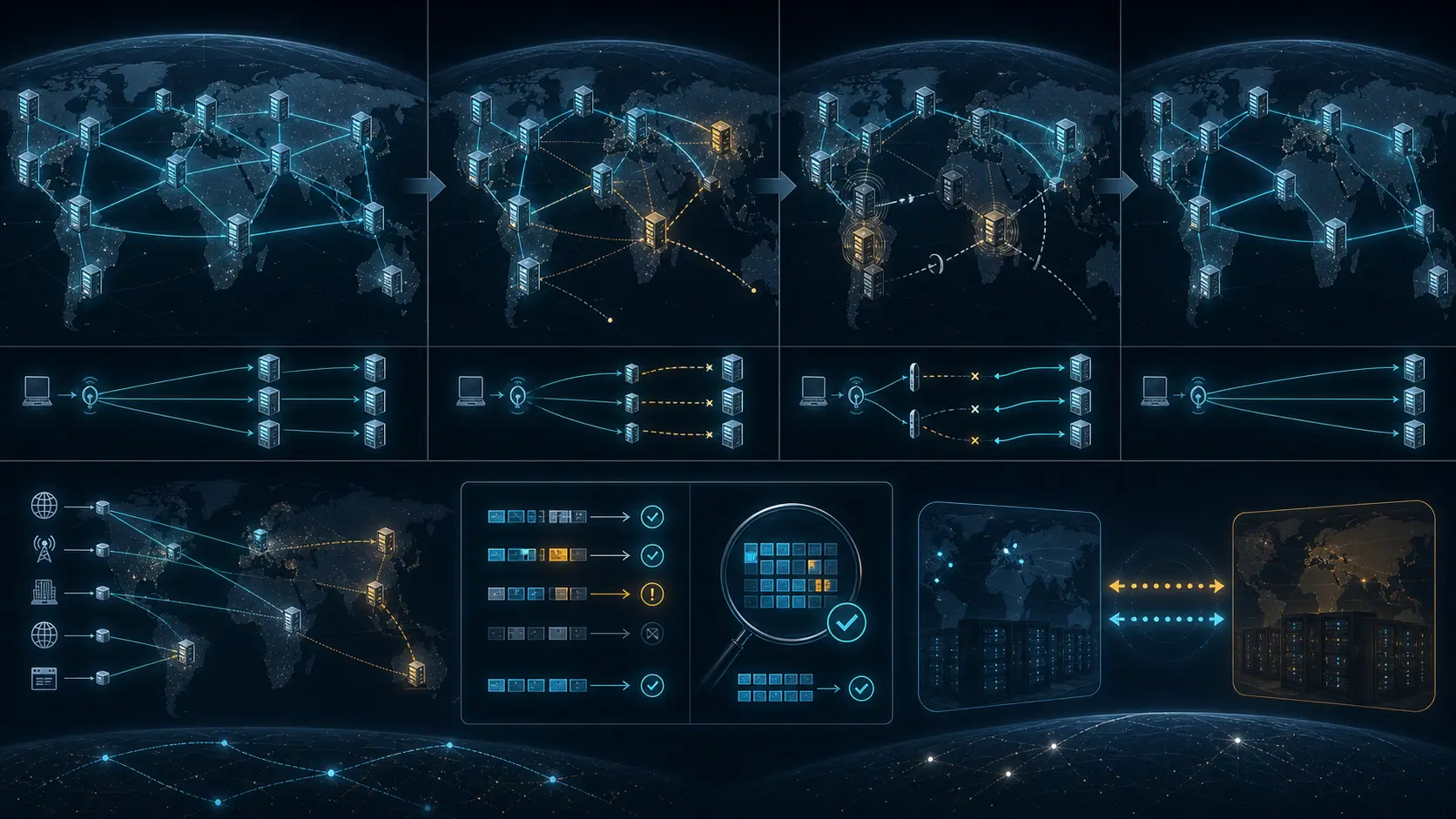
The F-Root outage that showed why redundancy is not the same as readiness
A January 2020 DNS incident exposed a narrow but consequential weakness in distributed infrastructure: many nodes can exist, yet recovery can still depend on whether separate organisations can detect a semantic fault, agree on its cause and exercise emergency routing authority…

CASE FILE
At PP-26, Six-Language Access Depends on the Document Class
A delegate opening the PP-26 document page will not find one multilingual rule. A contribution belongs to a six-language series; an agenda is English only; an information paper cannot be discussed and is also English only; a temporary draft normally stays in its original…

Story
ARIN Published a 15-Seat Fellowship Ceiling. Its Roster Has 19
ARIN’s Fellowship timeline and its selected-Fellows announcement describe the same ARIN 58 cohort with different capacities. The planning page stops at 10 in-person and five virtual places. The announcement keeps the 10 in-person places and raises the virtual count to nine. A…

ICANN
ICANN's Two IANA Oversight Clocks Now Start at the Final Report
ICANN has changed two constitutional clocks around the IANA naming function. The Customer Standing Committee's effectiveness review now runs on a five-year cycle measured from the prior final report, while the periodic IANA Naming Function Review keeps five years but starts…

CASE FILE
At PP-26, a Sole Candidate Still Needs a Majority
The live PP-26 page currently shows one candidate for Secretary-General and one for Director of the Telecommunication Standardization Bureau. That is not an election result, or even a final single-candidate slate: nominations remain open until 12 October. If either field still…

Story
APNIC’s NRO Ballot Has Two Electorates. Its Result Needs the Mix
At 14:00 in Brisbane on 27 August, APNIC opened one electronic ballot for one regional seat on the NRO Number Council. It did not open that ballot to one electorate. Member organizations and qualified conference regulars enter through different doors, vote on different clocks and…

Story
RIPE NCC's One-Tier Board Needs an Authority Migration Table
RIPE NCC wants its legal structure to catch up with the way it says the organisation already works. The proposed one-tier Board would put the Managing Director on the Board as an executive director and recast the elected Executive Board members as non-executive directors. That…

Story
APNIC's Leadership Consultation Needs a Participation Receipt
APNIC has designed a careful consultation on barriers to community leadership: three online listening sessions, a mailing list, a hybrid conference session and de-identified reporting. That protects candour, but it also removes the visible trail by which readers could judge…

Story
RIPE's Appointed NRO Seat Needs a Decision Receipt
RIPE NCC has opened a public door into one of its three NRO Number Council seats: nominations, eligibility checks and support statements are visible. The final passage is different. The Executive Board will appoint the member without a community vote, while the published election…

Story
AFRINIC Has Named Its Next CEO. It Has Not Yet Named the Owner of Every Decision Before January
Mike Silber is due to become AFRINIC's chief executive on 1 January 2027. The 130 days between announcement and assumption of office need a public responsibility map, not an assumption that a future title already carries today's authority.

Story
APNIC's First EC Preview Needs a Decision Crosswalk
APNIC's Executive Council Chair has opened a useful new window before the Council meets. The first preview names what the EC expects to examine in September and promises a companion account afterwards. That is better than learning every priority from minutes a month later. But…

IETF
Vint Cerf and the Nine Exceptions Hidden Inside “Everyone”
Vint Cerf’s 2002 declaration that the Internet is for everyone is often remembered as a promise. Its more useful architecture lies in the next words: “but it won’t be.” Repeated nine times, that qualification turns universality from applause into unfinished work.

IETF
The IAB Can Set Architectural Conditions. It Cannot Set Child-Safety Law
Technical advice acquires borrowed authority one citation at a time. A regulator cites an architecture statement, a supplier cites the regulator, and a service describes the resulting product as though the design were required by law. By the time an age gate reaches a user, the…

CASE FILE
WTPF-26 May Adopt Five Opinions. None Is an ITU Mandate
Five draft Opinions will arrive in Nassau carrying nearly two years of expert preparation. If WTPF-26 adopts them by consensus, they may shape later policy arguments across governments, companies and international institutions. They will still not be regulations, treaty rules or…

IETF
The IETF NOC Is Volunteer-Managed Again. Its Authority Handoff Is Still Shared
Joe Clarke’s appointment as IETF NOC Lead restores volunteer management to the network that makes an IETF meeting function. It does not turn that network into a volunteer-only service. Community engineers, Linespeed, Meetecho, the IETF LLC and the IESG occupy different parts of…