
Topic
Institutional Legitimacy
Within the Topic facet, Institutional Legitimacy topic intelligence connects articles that share a specific subject, signal focus, or monitoring theme. The page gives readers a richer path through related reporting, source evidence, market actors, and infrastructure implications, with enough context to understand why the topic matters across company movements, governance decisions, regional exposure, and operational risk. Readers can compare recurring signals, affected organisations, public evidence, market context, service continuity, procurement, competition, compliance, and strategic planning questions behind the subject instead of stopping at a thin list of matching articles. It explains what the topic covers, which infrastructure actors or policies are involved, what evidence supports the coverage, and why the subject may matter for operators, customers, investors, and policy readers.

CASE FILE
WTPF-26’s Space Opinion Keeps Technology Choice Open. Outcomes Need One Scorecard
A village reached by fibre and an island reached by satellite can both be marked “connected”. The label is useful only if it preserves what the connection actually delivers. WTPF-26’s new space-connectivity Opinion encourages technology-inclusive targets and local choice. That…

CASE FILE
A Working Group Can Say a Wider IETF Principle Does Not Apply. The Environment Assumption Must Expire
The architecture review ends with a narrow sentence: this principle does not apply because the protocol can only operate inside a controlled environment. Five years later, the protocol sits behind a gateway, ships in a product and crosses an administrative boundary. The sentence…

IETF
Agent Audit Draft Adds Self-Hosted Stores. Independence Is a Separate Layer
An audit trail does not become independent merely because it travels beside an agent’s request or lands in a product called an Audit Store. A new revision of an individual Internet-Draft now permits agents to carry records between self-operated stores. The useful flexibility also…

History
The Future Protocol That Hid Inside an IPv4 Option
EIP's version field looked backward while its address space looked forward. RFC 1385 kept the familiar IPv4 header so an old machine would see an ordinary packet with an option it did not understand—and, ideally, keep forwarding it.

CASE FILE
An Operational Considerations Section Cannot Accept the Risk It Names
The change board has read the new protocol’s operational section. It names scale limits, monitoring gaps and a migration hazard. Everyone agrees that the document is unusually candid. Then the chair asks who is authorised to accept those limits for the production network, and the…

IETF
CFRG’s Curve Rewrite Leaves Three Acceptance Decisions to Calling Protocols
A byte string can pass every mathematical check and still be unacceptable to the protocol that received it. Revision 14 of CFRG’s pairing-friendly-curves draft makes that boundary unusually visible: the common document says how to recover valid points and scalars, while the…

History
The Number That Changed Meaning at the Domain Boundary
One security domain could encode “Unclassified” as 5 while another encoded the same human label as 1. CIPSO did not solve that disagreement by choosing a universal number. It put a Domain of Interpretation identifier beside the number and made interoperability depend on the…

Story
APNIC Adopted a Foundation Liaison. The Public Record Stops Before the Protocol
APNIC has done the difficult part that institutions often avoid: it identified an old role with no settled scope, named the governance risks around it, and formally adopted a replacement. The next part was deliberately separated. Observer attendance, confidentiality and…

CASE FILE
A Data Manifest Cannot Account for the Datapoints That Never Arrived
A network chart contains a clean sixty-second blank. The points before it have a platform, subscription and collection context; so do the points after it. The empty interval has none. A manifest can make received telemetry intelligible, but it cannot, from inside the same…

IETF
Deletion Is the Hard Test as DNSOP’s Integration Draft Reaches Its Last Call Deadline
A DNS name can be easy to attach to an application and surprisingly hard to detach. As DNSOP’s integration draft reaches its scheduled Working Group Last Call deadline, its most consequential test is not whether a user can prove control once. It is whether the application can…

CASE FILE
SCONE Can Carry a Rate, Not the Policy That Chose It
SCONE makes a network's throughput advice visible to a QUIC application. What crosses the path is a number. The subscriber plan, traffic classification, load decision, responsible operator and correction route that produced it do not travel with the signal. That is a sound…

IETF
CSR Attestation Reaches Last Call, but the Certificate Is Not the Evidence Record
A certificate can be perfectly valid and still say nothing about the private evidence that persuaded its issuer. The CSR-attestation draft now in IETF Last Call makes that boundary unusually clear: a CA may appraise extra device evidence or discard it, while publishing the…

Story
The New RIR Draft Has Two Review Limits—and No Public Counter
Three requests can cite the same duty, concern the same registry and arrive in the same audit cycle. Under the recommended RIR Governance Document, whether the third may proceed depends on two clocks and on who counts as the same initiator. The draft supplies the limits. It does…

CASE FILE
A Key Transparency Tombstone Does Not Retire the Old Log
The migration model in the KEYTRANS architecture gives an old log a precise job: point each label toward its newer home without letting an outage revive stale data. That marker solves lookup order. It does not prove that offline clients have finished monitoring the old history…

CASE FILE
RMRP Can Sign Its AI Audit Log. It Still Cannot Count the Calls It Never Saw
A new model-routing draft turns silent omission into a signed assertion that can be challenged. That is a serious control improvement—but completeness still begins with a witness outside the router.

CASE FILE
Two Institutions Share the Systems. Their Review Routes Remain Different
IRTF conduct rules and the IESG's access-restriction statement expose a governance problem hidden inside shared infrastructure: the reach of a technical intervention can exceed the forum that prompted it. The decision, its implementation and its review must remain separately…
History
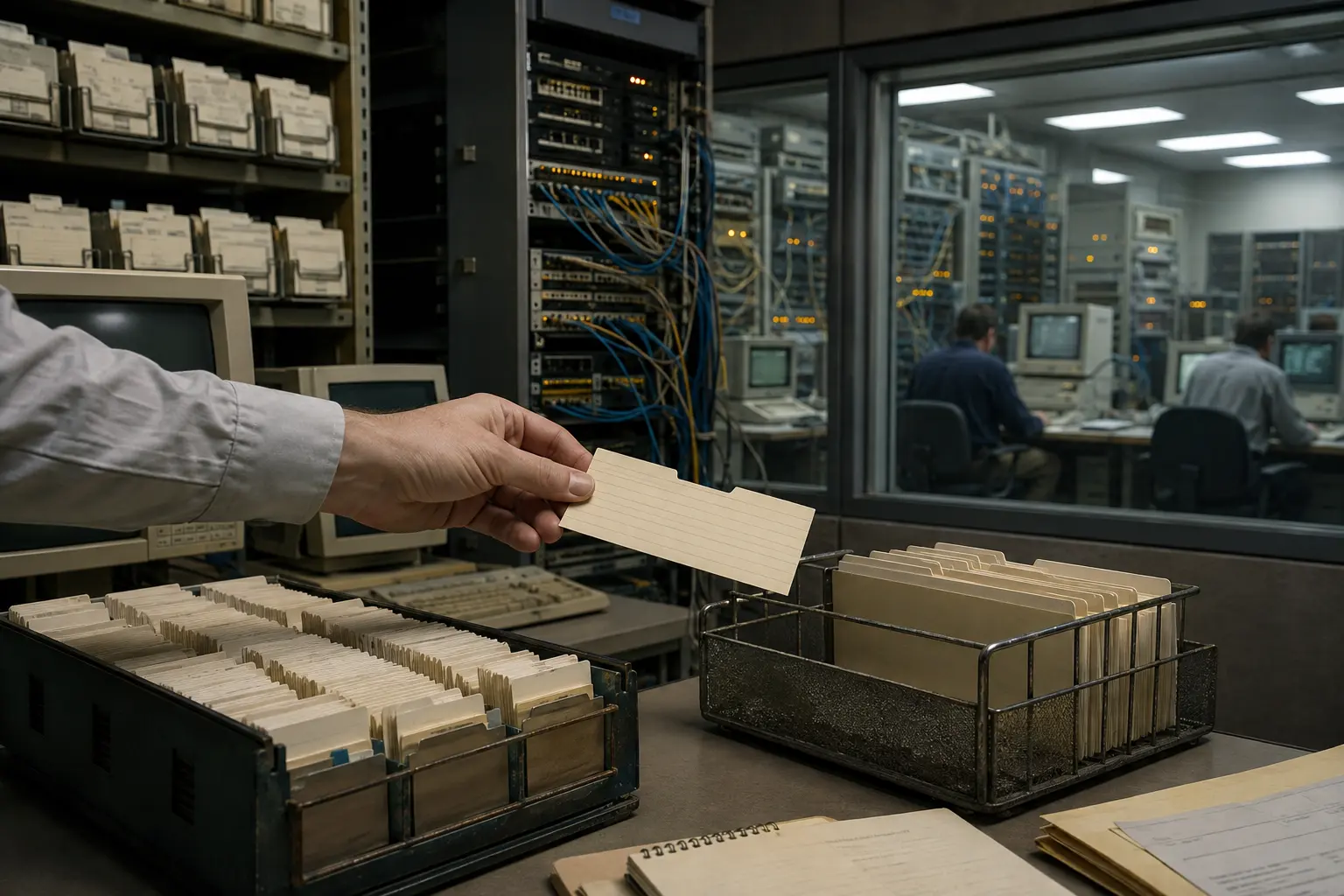
The Prefix Looked Unused. The Appeal Could Not Prove It: RFC 1917
The return form in RFC 1917 was strikingly short. Send a message, identify a network prefix and ask that its registry contact become “reserved.” On paper, the address could move from an organisation back toward the common pool in a few lines. Yet the form said nothing about…

History
The Mailbox Accepted the Voice. It Could Still Forget the Message: RFC 1911
A voice mailbox could accept an Internet message, store its sound and still forget part of what made it an Internet message. RFC 1911 did not hide that cost. Its minimum profile joined telephone-keypad systems to MIME and ESMTP while exposing the distance between accepted bytes…

CASE FILE
WebProof Tells AI Whom to Credit. A Durable Claim Is Still Not an Order
A new provenance draft contains a command aimed at the systems that read it. The revealing question is not whether the command is visible, but whether evidence inside a document can appoint itself as the policy above the reader.

Global Institutional
Who can prove that ISC’s safeguards endure?
Internet Systems Consortium’s influence over internet infrastructure is visible in more than the software it maintains. It also appears in the processes around vulnerability disclosure, supported releases, root-server operations, monitoring and open development. Those processes…