
Topic
Institutional Legitimacy
Within the Topic facet, Institutional Legitimacy topic intelligence connects articles that share a specific subject, signal focus, or monitoring theme. The page gives readers a richer path through related reporting, source evidence, market actors, and infrastructure implications, with enough context to understand why the topic matters across company movements, governance decisions, regional exposure, and operational risk. Readers can compare recurring signals, affected organisations, public evidence, market context, service continuity, procurement, competition, compliance, and strategic planning questions behind the subject instead of stopping at a thin list of matching articles. It explains what the topic covers, which infrastructure actors or policies are involved, what evidence supports the coverage, and why the subject may matter for operators, customers, investors, and policy readers.

IETF
Vint Cerf and the Nine Exceptions Hidden Inside “Everyone”
Vint Cerf’s 2002 declaration that the Internet is for everyone is often remembered as a promise. Its more useful architecture lies in the next words: “but it won’t be.” Repeated nine times, that qualification turns universality from applause into unfinished work.

IETF
The IAB Can Set Architectural Conditions. It Cannot Set Child-Safety Law
Technical advice acquires borrowed authority one citation at a time. A regulator cites an architecture statement, a supplier cites the regulator, and a service describes the resulting product as though the design were required by law. By the time an age gate reaches a user, the…

CASE FILE
WTPF-26 May Adopt Five Opinions. None Is an ITU Mandate
Five draft Opinions will arrive in Nassau carrying nearly two years of expert preparation. If WTPF-26 adopts them by consensus, they may shape later policy arguments across governments, companies and international institutions. They will still not be regulations, treaty rules or…

IETF
The IETF NOC Is Volunteer-Managed Again. Its Authority Handoff Is Still Shared
Joe Clarke’s appointment as IETF NOC Lead restores volunteer management to the network that makes an IETF meeting function. It does not turn that network into a volunteer-only service. Community engineers, Linespeed, Meetecho, the IETF LLC and the IESG occupy different parts of…

Story
AFRINIC Extended Its Bylaws Consultation. Its Only Named Form Went Down Four Days Before the Deadline
A deadline is a promise about access, not merely a date printed on a page. AFRINIC gave contributors until 17 May to use a designated constitutional-comment form; on 13 May it announced that the form host was unavailable, leaving the public record without the timestamps and…

CASE FILE
PP-26 Registration Does Not Accredit a State to Vote
A person can be admitted to an international conference while the authority to cast a State’s vote is still unresolved. PP-26 makes that separation unusually explicit: online registration opens an access process, an original diplomatic instrument opens an accreditation process…

CASE FILE
IEEE 802's WRC-27 Comment Expires in Five Years. Its Public Record Should Not
IEEE 802 LMSC sent European spectrum policymakers a position on WRC-27 on 21 August. Its own rules put an unusually clear limit on that act: public statements to government bodies expire five years after issue. The limit is valuable only if two records stay separate—the…

Story
The 27 August Redline: Reading APNIC’s prop-165 Through Its Assessment Delta
APNIC’s canonical `prop-165` record now points to `prop-165-v004`, published on 27 August 2026, while the Secretariat analysis displayed on that record is expressly introduced as applying to version 3. With the APNIC 62 Open Policy Meeting scheduled for 10 September 2026, the…

Story
RIPE-861 Recommends Off-List Nominations. The Candidate List Needs a Receipt
RIPE's new guide gives a quiet volunteer a private way to approach a continuing working-group chair. That can widen participation. It also moves the first step outside the public archive, making the later conversion from interest to a complete candidate list the part that needs…

ICANN
ICANN’s Prioritization Draw Sets the Queue. What Can a Low Number Actually Guarantee?
A physical ticket costing USD 100 will help determine when a 2026 new gTLD application is processed. The mechanism sounds almost ceremonial beside an application system built around technical evaluations, objections and contracts. Its effect is not ceremonial.

CASE FILE
An IETF-Appointed ISOC Trustee Is Not an IETF Delegate
Four routes lead into the Internet Society Board: Chapters, Organization Members, the IETF and the Board itself. The routes are meant to vary who can open the door. They do not divide the table into four instructed caucuses. That distinction became unusually visible in 2026, when…

CASE FILE
IEEE Put Its 2026 Election Behind a ‘Professional Member’ Gate. Its Voting Guide Still Lists Graduate Students
IEEE's annual ballot opened on 17 August with a new public rule: only “professional members” may vote or sign related petitions. Yet a current IEEE voting guide still lists Graduate Student Members, while a separate 2026 notice assigns different rights to graduate students…

Story
A Date Is Not a Review Window: AFRINIC’s Missing Assessment-to-Agenda Record
AFRINIC’s staff impact assessment for `AFPUB-2026-GEN-002-DRAFT01` is dated 23 June 2026. AFRINIC-37 met on 24 June, with the Policy Compliance Dashboard scheduled for 15:15–16:05 local meeting time. The minutes preserve the PDWG Chair’s concern that providing an assessment only…

IETF
IETF's Stand-In Draft Names the Successor, Not the Trigger
Picture a transfer panel with two circuits. One is marked for the IETF Chair; the other is wired to a named stand-in. The second circuit is ready, but the sensor between them is missing. The panel says power will switch “automatically and immediately” when the first circuit…

CASE FILE
ITU Council Backed Doha for PP-26. The Controlling Decision Still Needs a Public Update
The ITU Council's 25 August extraordinary session did not choose a conference venue from scratch. Decision 636 and majority Member State concurrence had already fixed PP-26 in Doha for 9-27 November 2026. A public update says Councillors supported Qatar as planned; the…
Story
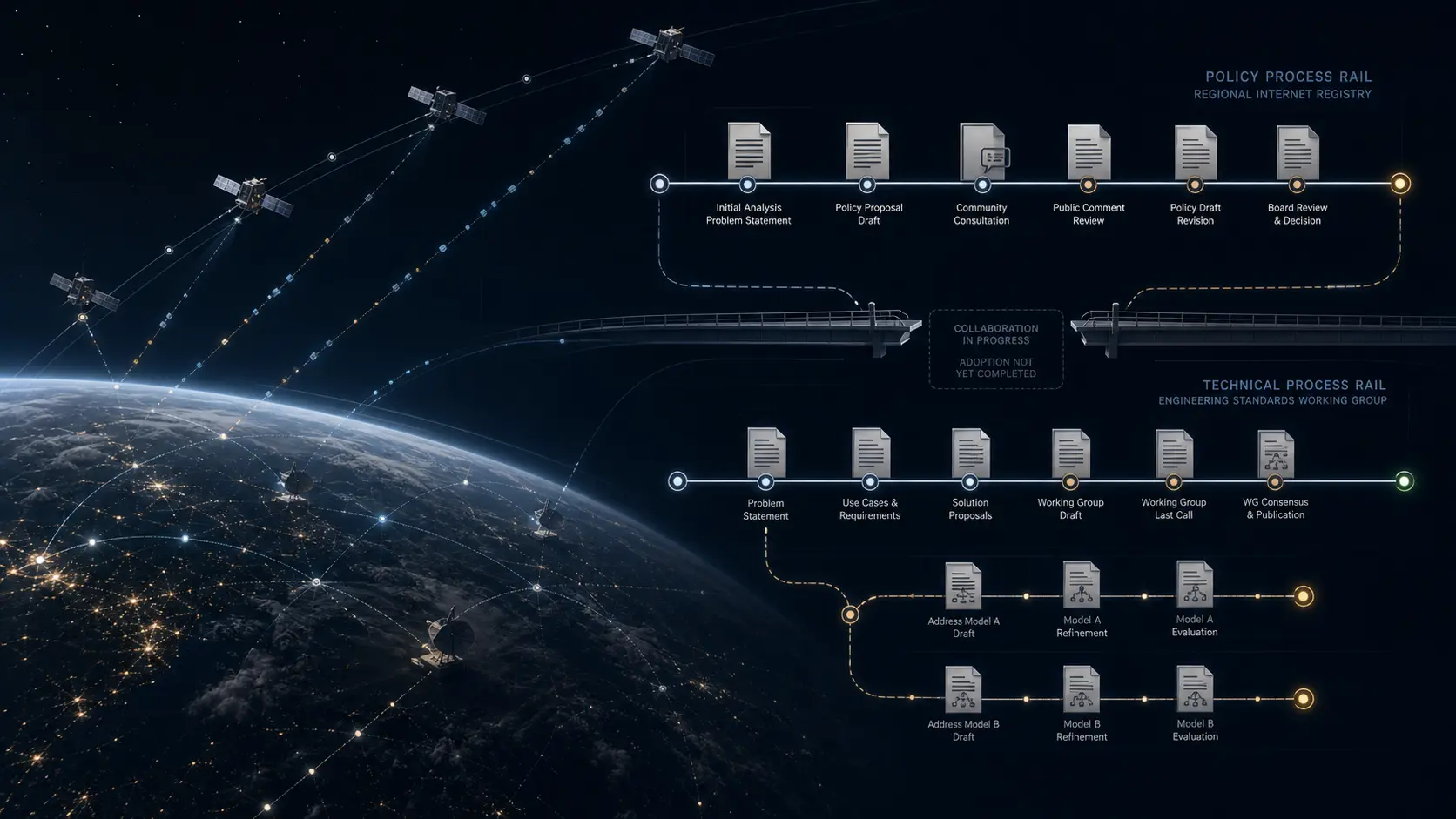
ARIN Calls Its Space Policy Joint. IETF Has Not Adopted the Address Model
ARIN-2026-1 says the proposal is joint with an IETF working group. The linked IETF record says the address model has no formal standing, and the working-group chairs found no clear consensus to adopt it as-is. Both statements can be faithfully recorded only if institutional…

IETF
IETF's Chair-Delegation Draft Reaches the IAB Seat
A notice on a public page can say who will chair a meeting, for how long, and on whose authority. That may be enough to move work without moving office. It is less obviously enough when the same notice says another Area Director now holds the IETF Chair's full membership on the…

Story
Where Member Notice Stops: RIPE-865 and the Burden of a Public Record
RIPE-865 preserves the general position that RIPE NCC members are informed when authorities seek their data or registry action, unless notice is expressly prohibited. Its eEvidence section creates a different notification state: confidentiality applies, and the RIPE NCC cannot…

Story
APNIC’s Service-Term Delegation Has No Public Classification Receipt
APNIC’s Executive Council gave the Secretariat room to change service terms without turning routine administration into policy making. The delegation is sensible and expressly bounded. What the public record lacks is the small entity that would let a later reader test the…

CASE FILE
Internet Society Has a $329,000 Board Budget. Payment Disclosures Stay Internal
Internet Society's 2026 plan gives the public one Board number: $329,000. Its newly revised policies create real controls over trustee travel and other funding, but the disclosure chain ends with the Chair and the Board. The missing record is not a receipt folder on the open web.…