
Topic
Cross-border Connectivity
Within the Topic facet, Cross-border Connectivity topic intelligence connects articles that share a specific subject, signal focus, or monitoring theme. The page gives readers a richer path through related reporting, source evidence, market actors, and infrastructure implications, with enough context to understand why the topic matters across company movements, governance decisions, regional exposure, and operational risk. Readers can compare recurring signals, affected organisations, public evidence, market context, service continuity, procurement, competition, compliance, and strategic planning questions behind the subject instead of stopping at a thin list of matching articles. It explains what the topic covers, which infrastructure actors or policies are involved, what evidence supports the coverage, and why the subject may matter for operators, customers, investors, and policy readers.

History
The Portland Home Behind South Africa’s First Internet Link
Before a leased line joined Rhodes University to the wider Internet, email between South Africa and Portland moved through a store-and-forward relay. In 1991, a low-speed circuit ending at Randy Bush’s home office became the far end of Rhodes’s first full IP connection. The…

History
China’s 1986 Email Was Not Yet a CSNET Mail Node
An email from Beijing reached CERN in 1986, but that exchange was not the same thing as a local host joined to CSNET. The distinction lies in the route, the relay and what could keep running after one message.

Europe and Middle East National Telecom Trends
Europe’s 2029 Call-Price Rule Runs on Two Clocks
The price rule due in 2029 will be shaped by two earlier deadlines: a wider BEREC usage benchmark in 2026 and the European Commission’s statutory review in 2027. The gap between those dates is where evidence has to become a decision.

Europe and Middle East Institutional Trends
Europe’s Emergency Network Has Three Cost Lines—and No Single Payer
Europe could spend €3.57 billion to connect emergency communications across borders while national governments continue to own the networks that must reach the border. That estimate is only one ledger: the Commission’s impact assessment places broadband upgrades for national…

Europe and Middle East Cloud Services Trends
The AWS Disconnect Test Needs a Record Buyers Can Audit
AWS plans a 24 October exercise that will disconnect the European Sovereign Cloud from the AWS Global Network backbone and disable a separate operational-data transfer system. Its promised evidence will matter to buyers only if it shows what the exercise established and who can…
History
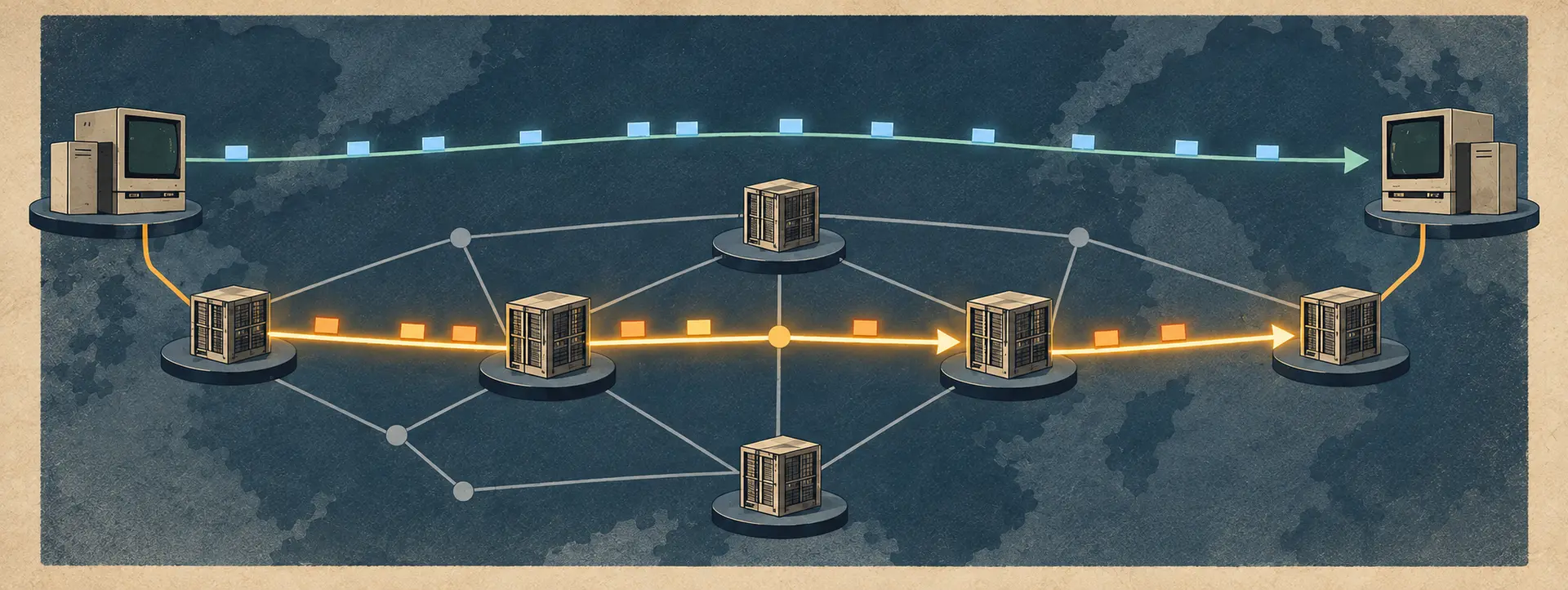
The X.25 Call Was Not the TCP Conversation: RFC 877
A public X.25 circuit could carry IP datagrams without becoming the TCP conversation above them. RFC 877 made that separation explicit, and let the network’s own cost and capacity shape how long a circuit stayed open.

History
NORSAR Kept 2.4 kbit/s for Seismic Data as ARPANET Arrived
When NORSAR’s voice-grade line was upgraded for ARPANET, the seismic stream did not disappear into a larger network. The year-end 1973 operating report says 2.4 kbit/s remained assigned to seismic data; NORSAR and the University of London Institute of Computer Science shared the…

Europe and Middle East National Telecom Trends
EG-IX’s 1.22 Exabytes: Growth Is Clear; Local Value Still Needs Proof
EG-IX reported 1.22 exabytes of traffic in nine months, but the total cannot tell a buyer which routes stayed in Egypt, which users benefited or whether service costs fell. The investment case turns on that missing denominator—and on the service terms that shape participation.

History
Three Networks, One Transmission: The 1977 Internetting Demonstration
The famous van was only one endpoint. The real test was whether a message could cross packet radio, the ARPANET and a satellite packet network without turning them into one enlarged network. The surviving record supports a successful route—and a much narrower claim than “the…

Europe and Middle East Institutional Trends
The EU’s government network must prove it can change providers
Orange Business has been selected to provide the TESTA-EIRIS backbone. The European Commission’s own design assigns DG DIGIT control of the wider system and calls for alternatives at critical functions. The test of sovereignty will come when administrations migrate, handle…

Global National Telecom Trends
Colt sells managed SCION reach; the buyer still needs a path inventory
Colt has turned SCION into a managed enterprise offer spanning three broad regions. The announcement does not show which customer destinations have independent routes, who controls failover or what the service contract guarantees.

Europe and Middle East National Telecom Trends
Two cables can still fail as one: the UAE’s 20-year telecom resilience test
The United Arab Emirates has renewed the public telecommunications licences of e& and du through 2046. The headline is a two-decade investment horizon; the harder question is whether the routes behind that promise remain independent when a real failure reaches land.

Europe and Middle East National Telecom Trends
OFN’s Iraq dark-fibre agreement extends FIG inland; the service chain is still unproven
A new fibre purchase puts a named terrestrial supplier behind Ooredoo’s planned Iraq landing for FIG. It advances the route on paper; the public record still stops short of showing who will operate, repair and sell the complete service.

CASE FILE
Philippines’ cable outage: three clocks behind one “restored” notice
On 2 October, public probes saw a sharp rise in latency between the Philippines and Singapore, but could not identify a cable. InfiniVAN later reported its C2C segment restored; carriers then described their own rerouting and service recovery. These are connected events, not…

History
The Plug Had Four Pins: NORDUnet and Europe’s Protocol Choice
In May 1988, a Nordic research network asked the United States for a route into NSFNET while promising to carry several rival network services at home. Its four-pin plug became a practical answer to a harder question: could researchers share a backbone before they agreed on one…

Europe and Middle East National Telecom Trends
e&’s 500-Tbps promise is a route test, not a throughput forecast
e& says international capacity will rise from 20 Tbps to more than 500 by 2030. Its existing cable and wholesale platform gives the target an operating base; project funding, sellable capacity and independently testable routes remain undisclosed.

History
A Billion Users Still Left Most People Out: RFC 3271
In 2002, Vint Cerf projected more than a billion Internet users by the end of 2005—and immediately noted that this would still mean only about 16% of the world's population. That contrast turns “the Internet is for everyone” from a victory slogan into a test with many separate…

Global Regional ISP
Shijiazhuang XuDing Technology Company Ltd: a Chinese-registered company inside RIPE NCC's registry, operating the CoreLink routing brand
Shijiazhuang XuDing Technology Company Ltd: a Chinese-registered company inside RIPE NCC's registry, operating the CoreLink routing brand intelligence summary explains the development, the public evidence available to readers, the organisations involved, the regional context…

Global Datacenter
Registered, authorised, and still unproven: what DATAMATIX's live posture says about operating a network
Registered, authorised, and still unproven: what DATAMATIX's live posture says about operating a network intelligence summary explains the development, the public evidence available to readers, the organisations involved, the regional context, market exposure, and the…

North America Regional ISP
Hughes After the Spectrum Sales: Chapter 11 and the Starlink Feeder
Hughes Network Systems, LLC, the satellite broadband unit of EchoStar, filed for Chapter 11 on August 3, 2026 — a reorganization that arrives only after EchoStar ceded roughly 115 MHz of spectrum to SpaceX and AT&T under FCC-approved sales, and after a referral arrangement began…