
Topic
Consensus Capture
Within the Topic facet, Consensus Capture topic intelligence connects articles that share a specific subject, signal focus, or monitoring theme. The page gives readers a richer path through related reporting, source evidence, market actors, and infrastructure implications, with enough context to understand why the topic matters across company movements, governance decisions, regional exposure, and operational risk. Readers can compare recurring signals, affected organisations, public evidence, market context, service continuity, procurement, competition, compliance, and strategic planning questions behind the subject instead of stopping at a thin list of matching articles. It explains what the topic covers, which infrastructure actors or policies are involved, what evidence supports the coverage, and why the subject may matter for operators, customers, investors, and policy readers.

Story
When AFRINIC’s Rule Stops but Its Earlier Acts Survive
AFRINIC’s proposed constitution carries forward a deceptively simple rule: an emergency policy that fails endorsement at the next Public Policy Meeting stops for the future, yet actions already taken under it remain valid. That split can protect address uniqueness and people who…

North America Datacenter Trends
Hillsboro has closed the data-centre intake, not the project pipeline
Hillsboro’s 120-day land-use moratorium stops new data-centre and battery-storage applications from entering the city system. It does not cancel projects already being built or assessed. A separate 180-day pause applies to Strategic Investment Program agreements with stand-alone…

Story
Eleven Days Is Not Thirty: How AFRINIC-2 Kept Three Late Proposals Out of Consensus
AFRINIC's first policy meeting after recognition faced an institutional test disguised as calendar arithmetic. Three proposals arrived on the public list only ten or eleven days before the 27 April 2005 policy session. The meeting discussed them, but it did not convert that…

Story
Three Seats, Three Lines of Authority: AFRINIC's 2005 NRO Number Council Entitlement
On 25 April 2005, AFRINIC acquired an equal three-person place in the NRO Number Council, whose members also served as the ICANN ASO Address Council. That institutional equality was real, but it was never a blank cheque: the AFRINIC Board appointed and could replace only one…

Story
AFRINIC-1: The Meeting Where One Room Held Six Different Kinds of Authority
AFRINIC's first public policy-and-member meeting was an effective act of institutional assembly, but not a moment when everyone in Dakar became one constitutional body. The durable lesson of 23–24 May 2004 is that attendance, policy participation, corporate membership, election…

Story
A /24, a Consensus, and the Decision AFRINIC-3 Did Not Finish
At AFRINIC-3, entities accepted the case for direct IPv4 assignments to qualifying end-user organisations, but the consequential word in the record is not “implemented”—it is “consensus,” the first of four states in a chain whose missing links still matter.

Story
Cairo After Recognition: What AFRINIC-3 Could Decide—and What It Could Not
AFRINIC-3 brought policy discussion, IPv6 advocacy, registry reporting, training, partnership-making and Internet-governance debate into the same Cairo venue. That concentration made the meeting useful, but it did not create a single electorate or a continental mandate. The…

Story
The five-minute appointment that left AFRINIC’s “consensus” unexplained
AFRINIC’s appointment of Haitham El-Nakhal as a PDWG Co-Chair produced a clear officeholder but an unclear public account of the process: one eligible candidate, two advertised seats, a rule prescribing acclamation, and a result announced as consensus.
Story
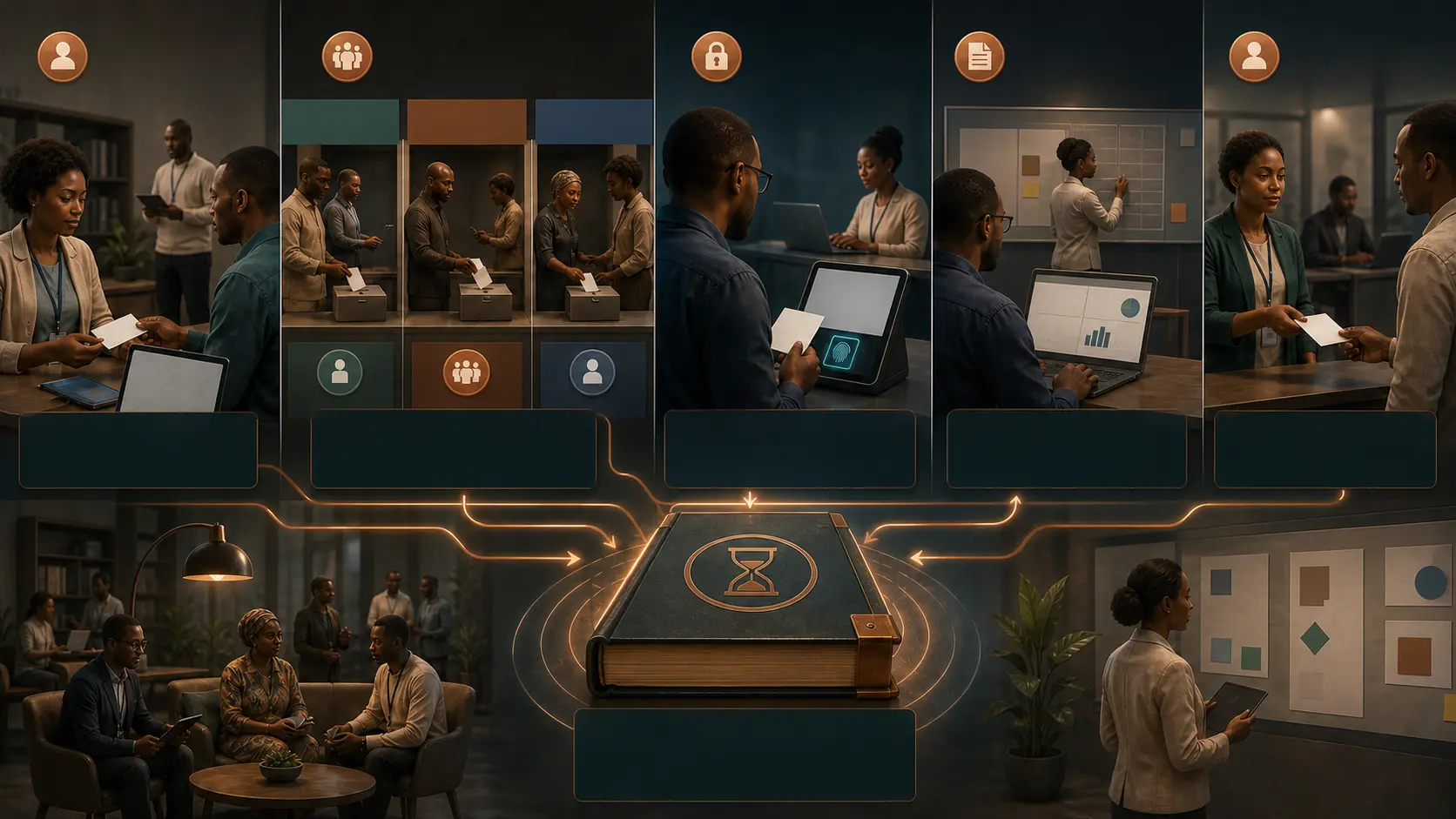
When the ballot decides years, not seats: AFRINIC's 2026 election bridge
AFRINIC's election rules for 2026 did more than tell people how to choose officeholders. They placed three different constituencies beneath one temporary instrument and converted electoral preference into unequal periods of institutional influence. That design offers a credible…

Story
Three Seats, No Mandate: What AFRINIC’s 2026 Governance Committee Election Actually Created
AFRINIC’s members elected Daniel K. Nanghaka, Afaf El Maayati and Maud Adjeley Ashong Elliot to a committee designed to advise, not govern. Their staggered expiries make the order of victory visible, but unpublished aggregate voting statistics and an unfinished public record of…

Story
The Four People Before the Ballot: Auditing AFRINIC’s 2026 NomCom Appointment
On 1 April 2026, AFRINIC’s Board named four people to the committee that would decide which candidates could advance toward seven governance and policy positions. The written rules contain genuine safeguards. The public evidence showing how the screeners themselves were selected…

Story
The Rulebook That Cannot Become AFRINIC’s Constitution
AFRINIC’s proposed overhaul of its Policy Development Working Group contains a serious answer to paralysis and a dangerous shortcut around constitutional authority. The distinction will decide whether continuity rests on lawfully delegated procedure or on a policy manual…

Story
AFRINIC’s Compliance Dashboard Must Remain a Bookkeeper’s Tool
AFRINIC’s proposed compliance dashboard can help members find inaccurate records, understand which adopted rule is being checked, receive notice and correct evidence. That is useful registry administration. It must end there. AFRINIC is a record-keeper, not a sovereign, and it…

CASE FILE
How Consensus Advice Held .AMAZON for Five Years
In the .AMAZON dispute, governments did not own the root-zone switch and an independent review panel did not acquire it. The decisive power moved through presumptions, reasons, application status, contract terms and finally delegation—showing how consensus can stop a namespace…

NANOG
A Sponsor Line Is Not an Agenda Firewall: What NANOG’s Public Programme File Can Show
Sponsorship and programme selection answer different practical questions at a technical meeting, yet their public traces often appear on the same event surface. That proximity can create either complacency or suspicion. Neither response is adequate. NANOG’s public material makes…

NANOG
A Call for Content Is Not a Selection Record: What NANOG’s Public Programme File Can Show
NANOG’s public materials reveal more of the route into a meeting programme than a bare agenda would: a call, review language, shepherding, dated milestones and several historical descriptions of committee responsibility. But visibility at the entrance is not the same as a…

NANOG
The $1.58 Million Boundary: What a NANOG Sponsor Buys—and What Still Has to Pass Review
In 2024, meeting sponsorship supplied NANOG with $1,576,133 in cash—more than meeting fees and roughly half of all revenue and support. Yet the public sponsorship offer does not promise a technical talk, and the published proposal process assigns selection to the Program…

NANOG
The Talk Was Accepted. The Evidence Wasn't Settled: NANOG's Vendor Test After the Stage
A number can travel farther than the qualification printed beside it. The dispute that followed NANOG 96's presentation on IP geofeeds shows why vendor research should be judged neither by the employer on the title slide nor by the applause in the room. Its proper test is whether…

NANOG
The First Packet Is Not the Mandate
An operations archive can show when a crisis first became visible, how competing explanations fared and which repairs appeared to work. What it cannot do, simply by accumulating messages, is turn observation into origin, repetition into consensus or useful advice into…

NANOG
NANOG’s Members Can Govern NANOG—Not North America
In 2020, 125 ballots produced 96 percent approval for a NANOG bylaw amendment; 583 people were eligible to vote. Those figures describe a valid decision inside NANOG, Inc., not a plebiscite of North American network operators. The distinction is not a technicality. It is the line…