
Region
Europe
Europe regional intelligence explains how companies, people, policy moves, network operations, investment signals, data centre demand, telecom execution, and market constraints shape infrastructure delivery in the same geographic market or governance area. The page connects published coverage with evidence, regional actors, operating dependencies, market context, and customer or regulatory exposure that may otherwise sit across separate topic or company pages. Readers can compare who is active, which signals are backed by public evidence, how local execution risk connects to broader internet infrastructure strategy, and what changes may affect customers, partners, regulators, or capital planning. Readers can understand the geography, the relevant infrastructure sectors, the public evidence base, and the practical questions that make the regional page more useful than a short listing of articles.

History
TCP/IP Shared FUNET’s Backbone with DECnet, 1992–94
For Finnish universities, the Internet did not arrive by erasing every network already in use. FUNET’s 1992 move to Frame Relay belonged to a longer engineering transition; a 1994 account still lists both TCP/IP and DECnet on the research backbone. The record shows a…

CASE FILE
UK legal-aid breach update puts the earliest known record in 1978
An October update adds 250,000 Legal Aid Agency records dating before 2007 and limited probation data to the 2025 incident’s known scope. Its own caveat matters as much as the date: a record range is not a list of people whose information was taken.

Europe and Middle East Datacenter Trends
2CRSi’s €1bn Strasbourg case still turns on a sale promise
2CRSi says the first Aether AI Factory rollout could generate more than €1 billion in Group revenue. The site transaction, available power, permits, component supply and purchase terms still sit between that estimate and delivered, invoiced servers.

Europe and Middle East National Telecom
Freenet pays €76m for waipu.tv’s last quarter; a €50m tail tests the price
The buyout gives freenet the last claim on Exaring AG’s earnings and ends the minority shareholders’ IPO route. Since freenet already controlled and consolidated the business, the test is what the new ownership makes attributable to shareholders after the cash leaves the group.

Europe and Middle East National Telecom Trends
The Northern Ireland Mast Proposal Turns on Who Gets Told
Northern Ireland’s proposed route for new mobile masts would narrow the council’s formal review to siting and appearance. A question added to the consultation asks whether councils should also notify neighbours. The distinction matters: the draft already gives some people notice…

Europe and Middle East Cloud Services
VINCI’s 87.33% stake puts All for One’s customer continuity to the test
VINCI Energies has completed its offer for All for One with approximately 87.33% of the shares. That gives Axians a route into more than 4,500 midmarket customer relationships; it does not make cross-selling, renewals or service quality automatic. With recurring revenue at 53%…
CASE FILE
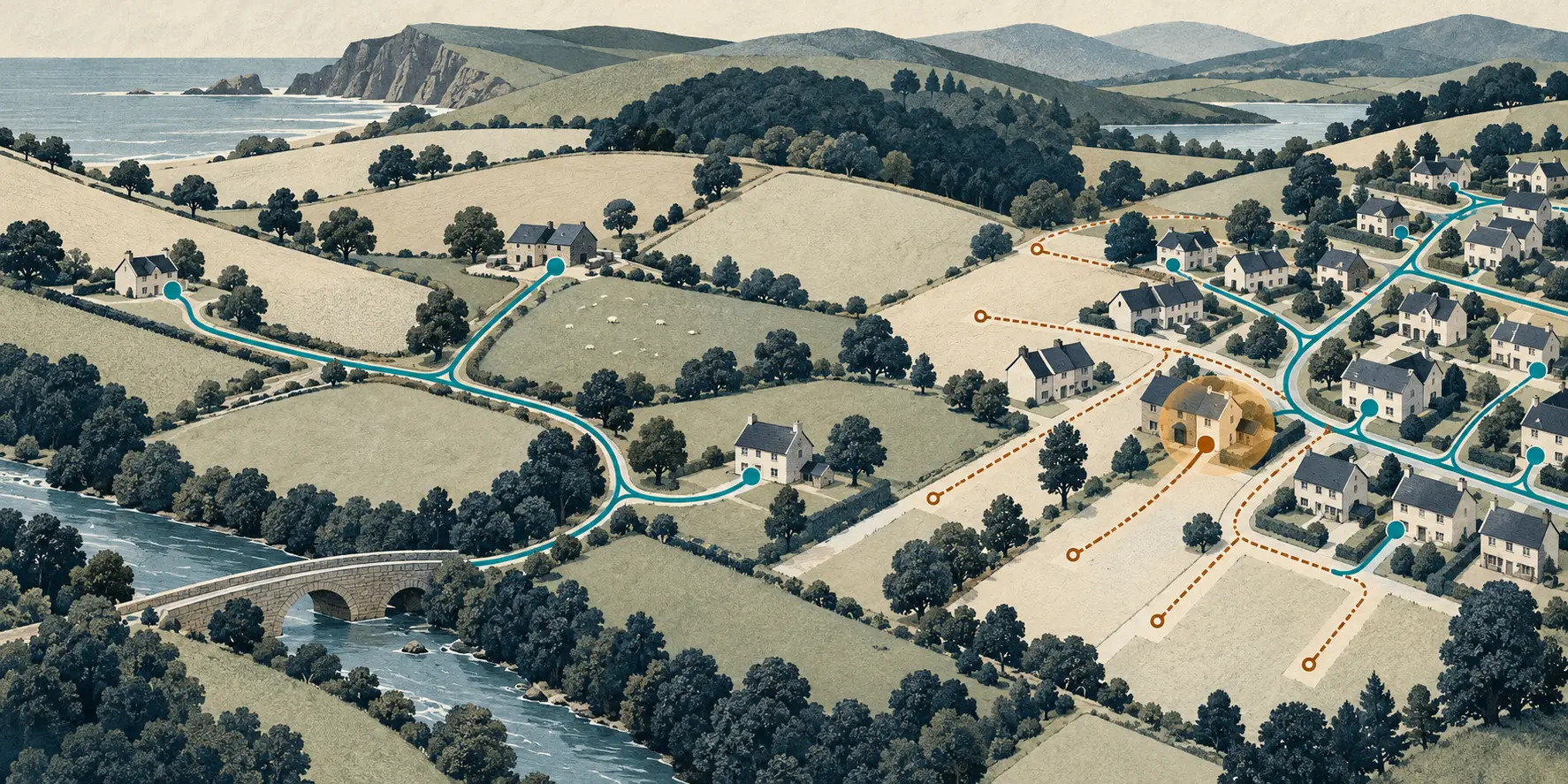
Under Review Is Not a Broadband Connection
The September 2026 National Rolling Open Market Review maps providers’ current and planned broadband coverage at individual UK addresses. Its classifications help decide where public subsidy may go, but a supplier claim, a credible build plan, a funded intervention and a usable…

Europe and Middle East Institutional Trends
Ofgem’s new self-build route stops at the shared grid
Ofgem paired a new statutory consultation with the rejection of an older code proposal. Customers may gain control of the connection they build, while shared reinforcement that can set the energisation date remains with the wider system.

Europe and Middle East Datacenter Trends
Iver’s 222.98 MWth backup fleet is not 223 MW of data-centre power
A permit application puts a precise number on emergency fuel-burning equipment at Amazon’s proposed Iver site. The number describes heat entering engines under standby conditions; it does not measure electricity for servers or what the grid can deliver.

Europe and Middle East Institutional Trends
Europe’s fibre target meets a 2026 funding cliff
Europe can report near-universal 5G signal coverage while fibre still reaches only three quarters of homes. The harder question is whether national plans connect that remaining build to money, places and accountable delivery after a large share of planned public funding is due to…

Europe and Middle East National Telecom Trends
The UK’s CNI telecom charter sets an escalation route; tested connections will decide its value
A new UK charter tells telecom providers how to identify critical infrastructure customers, test equipment and escalate silence before legacy lines are withdrawn. Its value will depend on whether each owner can show that a specific service still works after the change.

Europe and Middle East Datacenter
InterLAN-IX: one exchange, two sets of numbers
Romania's domestic peering fabric is operated by InterLAN Internet Exchange SRL, a Bucharest-headquartered company whose own published figures and the Romanian Network Operators Group's description of the same platform do not reconcile on members, locations or traffic. For an…

History
The International Link Came First; TCP/IP Came Later: Lithuania’s LITNET, 1991–94
Lithuania’s first route abroad was already useful before its research network had become an ordinary IP network. The early story runs through a satellite channel, X.25 packet switching and X.400 mail, then through a domestic link and a gradual TCP/IP transition.

Leaders
Sander Steffann and the Procurement Test for IPv6
An IPv6 checkbox can appear in a tender long before a packet crosses an IPv6 network. Sander Steffann’s work on RIPE’s equipment guidance asks what a buyer can demand, what a vendor should be able to show, and what still has to be tested after purchase.

Europe and Middle East National Telecom Trends
Europe’s backbone map is being drawn before the next funding rules
The Commission wants a map of Europe’s terrestrial and submarine networks, then a view of where money may be missing. The study can clarify those choices; it cannot make a network, a grant or a market failure appear by itself.

Europe and Middle East National Telecom Trends
Pisces has a joint venture. Its access rules remain the real test
The 14 October announcement gives the Ireland–continental Europe cable a named delivery company and chief executive. It does not yet show who will receive capacity, on what terms, or when the route will carry traffic.

Story
RIPE NCC’s board proposal gives the CEO a vote—and a separate signature route
RIPE NCC’s October proposal would replace its current Executive Board with one body of executive and non-executive members. The CEO would join its votes, while the draft gives each executive member a separate route to represent the association. Those are related changes, but they…

Europe and Middle East Datacenter Trends
Eurofiber sells a German WDM service over NGN fibre
Eurofiber’s six-city data-centre offer will primarily use NGN Fiber Network infrastructure, in which Eurofiber is a shareholder. The launch identifies the customer-facing brand and markets; it does not yet show who controls provisioning, routes, fault response or contractual…

History
Ariadne Built Greece’s Research Network Before IP Became Its Default
Ariadne linked Greek universities and research institutes through a multiprotocol service before its successor network made TCP/IP the common direction. The 1993 record shows how access, international gateways, protocol conversion and user support fit together—and where the IP…

Europe and Middle East National Telecom Trends
TalkTalk’s service continuity now sits inside a CMA ring fence
The takeover stopped an immediate collapse, but it did not establish that service will remain dependable. The CMA’s separation order now makes continuity an operating obligation that can be monitored while the deal is reviewed.