
Profile
Briefing
Briefing profile intelligence connects person, company, institution, and other entity coverage for readers comparing the subjects behind BTW.MEDIA reporting. The page helps compare public profiles, related events, evidence packs, role changes, operating footprints, governance exposure, organisational links, and market relevance while keeping organisation and people records distinct from ordinary news chronology. Readers can understand the subject behind the headline, the evidence supporting that profile, and the infrastructure or market relationships that make the profile relevant. They can see who or what the profile represents, which public sources support it, how it connects to companies, markets, governance bodies, or events, and what changes may deserve continued attention as the subject evolves.

CASE FILE
The Filing Layer: Intrado, 911 Routing, and the Segment the Rule Actually Names
An emergency call fails in segments, and only some of them are obliged to say so afterwards. Intrado describes itself as delivering emergency calls to the answering point with location information; federal outage rules write their 911 trigger at the same layer. Whether the party…

Europe and Middle East National Telecom Trends
The Caspian cable is launched; the corridor still has to perform
The 380-kilometre link between Azerbaijan and Kazakhstan has crossed a real commissioning milestone. Its design capacity and inauguration establish the segment; they do not yet show how much end-to-end traffic the wider Asia–Europe route carries.

Latin America and Caribbean Datacenter
Ascenty: The Megawatt That Travels Without Its Basis
Brazil's data-centre buildout is routinely described in megawatts, but the documents gathered for this report on 18 October 2026 contain no megawatt figure for Ascenty Data Centers e Telecomunicações S/A at all — and that gap is the story, because the unit itself is doing work…

Europe and Middle East National Telecom
e&’s 500 Tbps target needs a definition before it can be audited
The operator’s 2030 ambition is easy to repeat and difficult to verify. A dated baseline, a stable perimeter and a clear account of what “capacity” counts would turn the headline into a monitorable commitment.

Europe and Middle East Institutional Trends
Europol’s Report Finds EU Forensic Tool Testing Still Fragmented
A new Commission–Europol analysis points to incompatible formats and national validation practices. It recommends shared tools and testing, but does not establish an EU-wide test authority.

ICANN
The .org refusal: a consent gate without a published test
In November 2019 the Internet Society agreed to sell Public Interest Registry, the operator of the .org top-level domain, to the private equity firm Ethos Capital. On 30 April 2020 the ICANN Board declined its consent to the change of control of the .org registry agreement, and…

Europe and Middle East National Telecom Trends
France’s 1800 MHz sharing pools capacity but keeps licence duties separate
France’s four mobile operators can now pool 1800 MHz radio capacity at selected shared sites. Arcep’s decision leaves each licensee answerable for its own deployment duties.

Asia-Pacific National Telecom
The Solomon Islands end of the Coral Sea Cable System belongs to a company registered in Australia
A single landing at Honiara carries the country's international traffic, but the instruments that decide what a buyer there can contract sit one layer up: in an Australian ownership vehicle and a rights-of-use grant. This briefing reads what the operator publishes about both, and…

Asia-Pacific Institutional Trends
ACMA counts 18 telco website fixes, but not the follow-through
ACMA says 18 telcos improved complaint information after a website sweep; its report does not map each change to a provider or a published verification result.

North America National Telecom Trends
The CRTC’s reporting review asks what oversight can safely stop collecting
The CRTC has put seven reporting duties on a fast track for review. The harder question is what evidence would remain when a form disappears.
CASE FILE
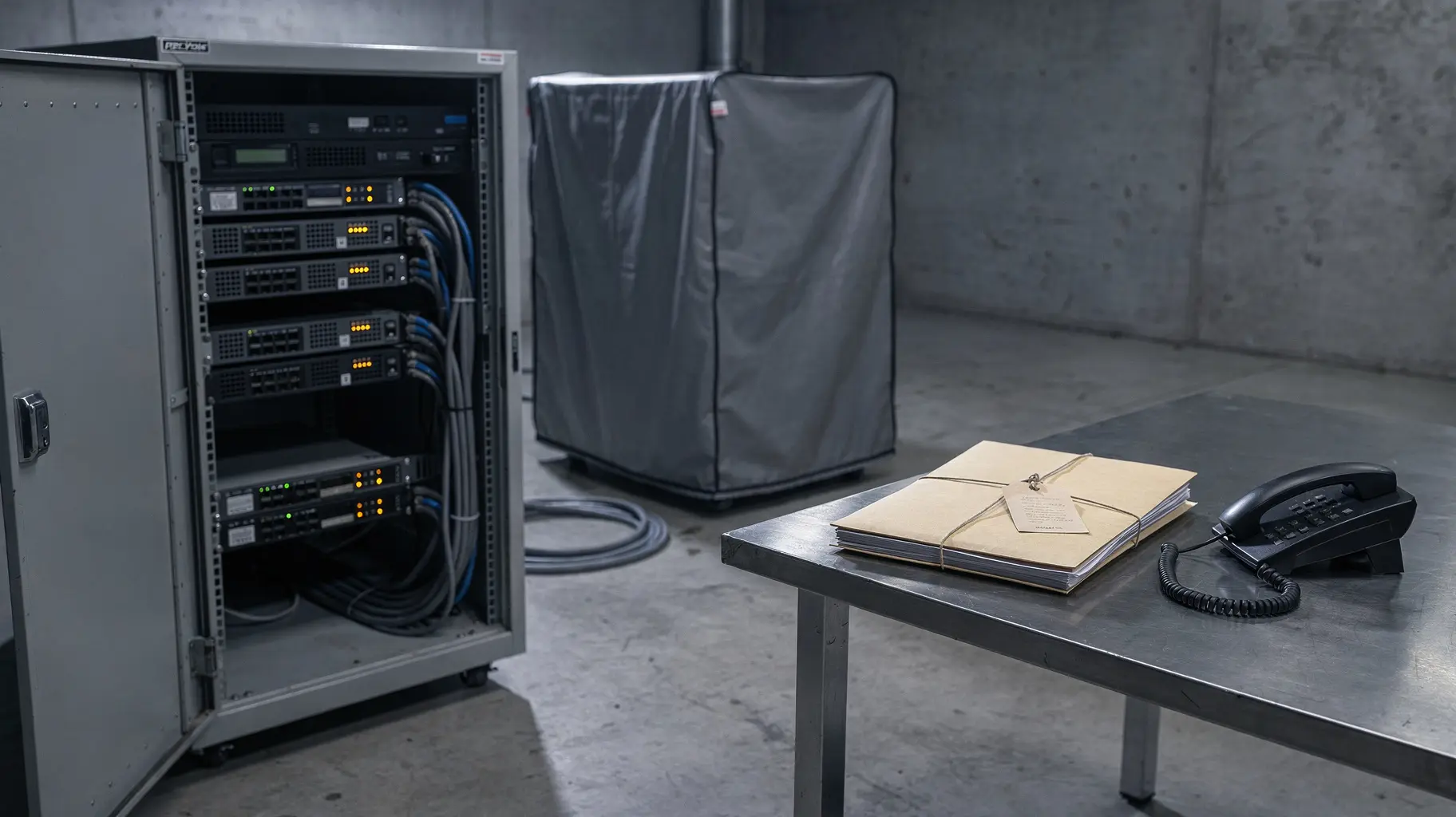
Documented, Not Established: ICANN's Emergency Registry Backstop and the Terms Nobody Has Read
A failed registry should be a bad day for one company, not for every registrant in a top-level domain. The emergency back-end arrangement that carries that promise is documented. What makes it callable — a live designation, a binding trigger, funded readiness, a tested handoff…

North America National Telecom Trends
Ottawa’s 2008 access agreement kept relocation costs with Videotron
A 2008 municipal access agreement continued to govern Ottawa transmission equipment after a chain of corporate transfers brought it under Videotron. The CRTC’s decision shows why ownership records and right-of-way contracts need to travel together through an acquisition.

North America Datacenter Trends
Texas’s data-center permit pause now runs on two clocks
Texas’s data-center permit pause has two reporting checkpoints, neither stated as an automatic expiry. TCEQ’s update is due 19 October and ERCOT’s report is planned by 10 December; the signed instruction keeps TCEQ’s pause in place until ERCOT completes its review.
CASE FILE
Netnod's Three Service Lines and the Number That Cannot Be Split
Netnod publishes a peering fabric, a root-server role and a time service. The root system's operators publish one number that can be checked — 2,047 instances — and it cannot be attributed to any of them. Everything else here comes from the operator's own front page, captured on…

CASE FILE
Nominet's member revolt proved a remedy, not a mandate
Nominet's own documents record a member-requisitioned meeting, a certified vote and directors leaving afterwards. They do not, on the record I could reach, establish what members were entitled to do — and that gap is the governance story.

North America National Telecom Trends
Alberta’s 568 overlay sets an eight-month buffer against a moving forecast
Alberta’s next area code is scheduled to go live on 10 June 2028, eight months before the Canadian Numbering Administrator’s current forecast says the existing code complex will need more numbers. The date is a readiness buffer built around a forecast, not a prediction of the day…

North America National Telecom Trends
Canada opens wireless number-porting systems to full MVNOs
The CRTC has let registered full mobile virtual network operators port numbers through the shared system directly. Its ruling separates that right from ownership of the radio network and leaves the consortium responsible for the rule changes that make access workable.

Europe and Middle East National Telecom Trends
Oman’s private-network rules and spectrum study run on separate clocks
Oman closed a spectrum study for private broadband in October after consulting separately on a personal-use private-network regulation in June. The public record does not join the two processes or show an allocation decision. For an enterprise, that means network permission and…

Europe and Middle East Institutional
SwissIX publishes the fabric, not the load across it
SwissIX states that it is present in eight datacenters across Switzerland and that it offers 400G ports at three named core sites. Nothing in its public record says how much of its capacity sits in each of those eight places — and that division, not the count, is what a…

Africa National Telecom Trends
Morocco’s first non-licensee FTTH offer sets terms, not coverage
Morocco’s regulator has approved a passive fibre access offer from Uni Fiber, a joint venture outside the licensed operators themselves. The decision makes the reach of access rules more important than the label on the network owner: it governs infrastructure Uni Fiber…