
Impact
HIGH
Within the Impact facet, HIGH impact intelligence highlights articles where the expected effect level, operational exposure, or decision relevance is comparable. Readers can use the page to separate routine market updates from higher-consequence governance, infrastructure, security, and investment signals that may affect planning, procurement, policy, or customer exposure. The page connects the consequence band to public evidence, related organisations, regional context, operating dependencies, service continuity, competition, investment timing, compliance, and customer risk. It helps readers decide which developments deserve deeper monitoring, which actors are most exposed, and how a signal may affect operations or market planning.

Global Cloud Services Trends
Nebius puts GPUs and customer cash flows behind a $775m facility
Nebius's first senior secured facility shows how long-term AI capacity contracts can turn fast-depreciating hardware into financeable infrastructure, while leaving the operator with execution and covenant risk.

Europe and Middle East National Telecom Trends
e& receives $5.84bn as Vodafone stake exit completes
The transfer closes e&’s strategic shareholding in Vodafone and puts $5.84 billion of gross cash on its balance sheet, with a $110 million dividend payment still due on 30 July.

Europe and Middle East Institutional
Netel secures up to SEK202m of equity financing before Infrea merger
Netel is asking shareholders to accept a sharp expansion in its share count—maximum dilution for a non-entity is about 54%—to refinance debt ahead of its planned Infrea merger.

Europe and Middle East National Telecom Trends
France and Germany put wholesale access at the heart of the 2GHz spectrum bargain
Paris and Berlin want scarce satellite spectrum to serve two purposes at once: reserve room for Europe’s IRIS² connectivity programme while preventing the selection process from becoming a closed route to market.

Europe and Middle East Cloud Services Trends
UK opens host-site EOI for £750m sovereign AI supercomputer
The 17 July request asks eligible UK research hosts to prove that sovereign compute can be placed, powered and governed as a national service; it is a site-selection step, not a new funding award or tender.
Europe and Middle East Datacenter Trends
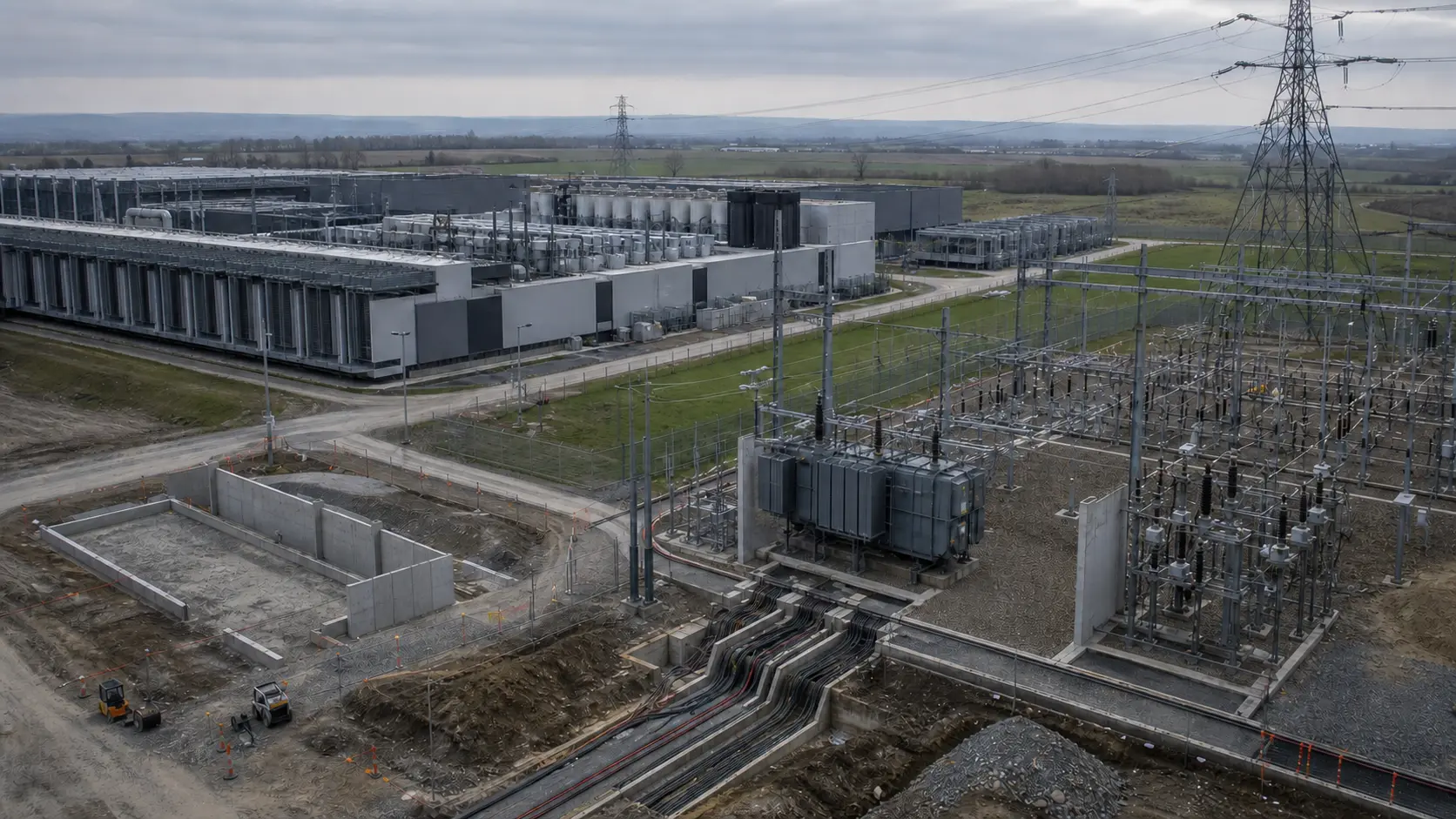
EU grid plan would make data-centre queues an economic contest
Brussels is proposing to replace simple place-in-line logic with a test of who imposes grid costs, who can ease congestion and whose project delivers the strongest public benefit.

Asia-Pacific Datacenter Trends
HeungKong's 27MW data-centre bet starts with an empty order book
A five-year RMB795.6 million capacity plan in Ningxia puts recurring costs ahead of customer demand at a company already contending with falling revenue and continuing losses.

North America Datacenter Trends
Justin Hotard and HPE's Exascale-to-AI Translation Problem
Frontier became a record-setting supercomputer before it became accepted infrastructure, and accepted infrastructure before it could serve as evidence for a repeatable enterprise AI business. Justin Hotard's HPE years expose the difficult managerial distance between those…

Global Institutional Trends
Cristiano Amon and Qualcomm's 5G Optionality Under Pressure
On 12 March 2018, a United States presidential order stopped Broadcom's proposed takeover of Qualcomm, turning a dispute over corporate control into a public test of research cadence, licensing economics and national security. The order was an act of government following CFIUS…
Global Institutional Trends
Gaurab Raj Upadhaya and the Bounded Custody of the Root Key
A small metal key helps explain a large institutional achievement: how the root of DNSSEC can depend on a volunteer's presence while denying that volunteer the power to act alone.
Global Institutional Trends
Jeff Bezos and Blue Origin's long test of patient capital
NASA’s 2021 choice of SpaceX for its first Human Landing System award, followed by the GAO’s denial of the Blue Origin Federation protest and Blue Origin’s loss in the Court of Federal Claims, made exclusion unmistakable; NASA’s 2023 decision to add Blue Origin as the second…
Europe and Middle East Institutional Trends
Christel Heydemann and the operating compact behind France's copper shutdown
Announcing a fibre build is a promise to create a network; switching off copper is a commitment to move every remaining dependency away from an old one. France's closure therefore turns on more than cable and coverage: it reaches homes, business systems, alarms, emergency…

Number Resource Society
How to Ratify a Number-Resource Continuity Charter
A continuity charter for Internet number resources will not become legitimate because its principles sound prudent or because a well-attended meeting applauds them. Ratification is a chain of attributed decisions: a bounded drafting mandate, a public evidence record, declared…

Number Resource Society
The Registry-Choice Pilot That Must Be Allowed to Fail
A registry-choice pilot will produce useful evidence only if its sponsors commit in advance to the possibility that the idea is wrong. From 2026 to 2036, a bounded trial should preregister its cohorts, controls, benefit thresholds, safety floors, stopping rules and rollback path…

Number Resource Society
A Ten-Year Stress Test for Number Resource Institutions
Number-resource institutions are built around continuity. Allocations, registrations, transfers, directory data and route-security credentials must remain dependable while boards change, laws conflict, markets move and systems age. Their public language therefore emphasizes…
North America Institutional Trends
David Ulevitch and the Public-Safety Capital Test
David Ulevitch’s post-Cisco record poses a harder question than whether a software investor can spot promising technology: what must capital become when the buyer is a public institution, the operating environment is an emergency, and legitimacy is part of the product rather than…

Leaders
Shaquille O'Neal and the Business Risk of Borrowed Trust
Shaquille O'Neal's commercial importance is not that his name appears beside many businesses. It is that companies have repeatedly turned public recognition into formal infrastructure: a licence for personality rights, a board and franchise relationship, a bounded brand-category…
Leaders
Randy Bush and the Operational Case for Routing Security
The internet's shared routing and naming systems work only when thousands of independent operators can place limited, testable trust in one another. Randy Bush's career offers a way to examine how that trust is built: not by assuming protocols or institutions are infallible, but…

Leaders
Abhisak Chulya and the Hard Economics of Building a Thai Cloud
Abhisak Chulya's consequential decision was not simply to start a technology company, but to keep changing what that company was prepared to own: first a Thai-language route into the internet, then advertising services, and eventually the software, servers, networks and support…

Leaders
Mike Lynch and the Problem of Founder Attribution
Autonomy made Mike Lynch one of Britain's most significant software founders, but its sale to Hewlett-Packard turned a celebrated exit into a prolonged test of where credit, control, risk and responsibility really lie: with the founder, the company around him, the buyer who…