
Impact
HIGH
Within the Impact facet, HIGH impact intelligence highlights articles where the expected effect level, operational exposure, or decision relevance is comparable. Readers can use the page to separate routine market updates from higher-consequence governance, infrastructure, security, and investment signals that may affect planning, procurement, policy, or customer exposure. The page connects the consequence band to public evidence, related organisations, regional context, operating dependencies, service continuity, competition, investment timing, compliance, and customer risk. It helps readers decide which developments deserve deeper monitoring, which actors are most exposed, and how a signal may affect operations or market planning.

History
The UUID Crossed the Connection. Authority Stayed Put: RFC 927 and the Double-Login Bargain
A TAC could check a name and password once, then send a four-octet user number to the next host. RFC 927's useful restraint lay in what did not travel with that number: the target still decided whether the first host's authentication was good enough for its own service.

Global Datacenter Trends
Marvell Added US$5.76bn of Supplier Commitments. Customer Orders Stay Cancellable
Marvell has made one side of its AI-capacity wager much harder than the other. In thirteen weeks, unconditional purchase commitments to foundries and test-and-assembly partners rose from US$2.7568 billion to US$8.5189 billion. The new schedule reaches deep into fiscal 2030. Yet…

History
The Keystroke Cost Four Octets: How RFC 916 Let State Replace Repetition
One typed character once faced a seven-octet packet around it. RFC 916 cut that packet to four octets by moving the character into the header position that would otherwise say how long the data was. The saving worked only because the connection had already made the missing facts…

History
The Name That Did Not Report a Reading: RFC 1065 and the Shape of Manageable Things
In 1988, Internet management needed a way to describe what could be observed without pretending that a description was already an observation. RFC 1065 supplied that restraint: a managed entity type could have a stable name, syntax, encoding and access category, while the live…

Global Datacenter Trends
NVIDIA’s US$36bn AI-Cloud Backstop Yields to Better Bids
NVIDIA has committed US$36 billion to cloud service from selected AI-cloud partners that first procure its data-centre hardware. The unusual term is not the six-year horizon. It is the switch: a partner can replace NVIDIA with a third-party customer offering a more advantageous…

CASE FILE
A Cookie Matched the Request. It Did Not Prove the Decision: RFC 10025 and Ambient Authority
A browser can attach the right-looking cookie to the right-looking request at the exact moment a consequential button is pressed. That still leaves four questions open: who caused the request, whether the server still accepts the session, whether this action is allowed now, and…

History
The Byte That Meant “Start Over”: SLIP, RFC 1055, and the Cost of Recovering a Serial Frame
On a quiet serial line, the difference between a valid packet and yesterday’s noise could be one byte. RFC 1055’s SLIP convention used `END` to finish an IP datagram, but it also recommended an `END` before the next datagram. That extra byte did not repair the wire or certify the…

History
The Cutover Was Not One Cutover: How RFC 897 Separated Renaming from DNS Resolution
On 14 March 1984 a host could acquire an official name ending in `.ARPA` while the program using that name still consulted a local copy of a centrally maintained table. The new namespace could arrive through the old lookup machinery. RFC 897 made that apparent contradiction a…

CASE FILE
A Ciphertext Reached the Key. It Did Not Name Its Sender: RFC 9180 and the Authority Missing from HPKE Base Mode
A team can receive an HPKE ciphertext, open it with the intended private key and still be unable to say who sent it, what outer request it belonged to, whether it is fresh, or whether anyone was entitled to act on its plaintext. RFC 9180 makes the cryptographic transition…

Global Cloud Services Trends
Semtech's US$62m Module Sale Opens a 560-Basis-Point Margin Gap
Semtech is selling its cellular-module business to Compal Electronics for US$62 million. The cheque is almost identical to the disposal group's disclosed net carrying assets, but the more consequential disclosure is a pair of margins: management's fiscal-Q3 midpoint is 58.3% with…

CASE FILE
The Packet Declared a Haptic Effect. The Device Still Had to Decide Whether to Render It: RFC 9993
A remote session marks one haptic unit as high priority. The packet is valid, the stream is negotiated and the receiver can decode it. None of that tells an actuator where on a body it may act, whether the requested amplitude is within the device’s envelope, whether a temperature…

History
The LANs the Host Was Not Meant to See: RFC 925 and the Cost of Hiding a Topology
An early Internet site could either expose every cable to the wider network or arrange its cables so that a host believed it lived on one large local network. RFC 925 chose the second illusion. It kept the host's ARP unchanged and made an intermediary discover, remember and…

CASE FILE
A Key Could Cross the Fabric. It Could Not Decide the Route: RFC 9992 and RIFT Authority
Two Top-of-Fabric nodes lose contact, each advertises the same RIFT key with a different value, and a leaf sees both. It must select one. A deterministic result is useful; it is not a declaration that the winning value is the current truth, that any receiver may act on it, or…

History
The Carrier Was Not the Connection: How RFC 892 Separated Transport State from the Network Path
One network connection could carry several transport conversations. One transport conversation could, in the most capable class, ride several network connections. RFC 892 treated those as inverse mappings rather than a contradiction: the carrier moved protocol units, while peer…

CASE FILE
The Private Key Never Left. Its Authority Did: RFC 9987 and the Transitive Trust of SSH Agent Forwarding
An engineer forwards a workstation’s SSH agent to a bastion. A process on that bastion cannot copy the private key, yet it may still ask the distant agent to sign a new authentication request. “No key exfiltration” is therefore an incomplete incident verdict: material custody and…

CASE FILE
The Domain Requested the Failure Report. The Receiver Still Had to Authorize Disclosure: RFC 9991 and DMARC Forensics
A mail receiver detects a genuine authentication failure in a forwarded calendar invitation. The author's domain has requested a forensic report at an external address. Sending the report could expose the invitation, its recipients and the forwarding path to a party that never…

Global Cloud Services Trends
TD Synnex's Share of Autodesk Revenue Fell to 8%—but the Channel Did Not Vanish
Autodesk added US$283 million of quarterly revenue while the portion attributed to TD Synnex, calculated from rounded disclosures, fell by roughly US$118 million. That is not evidence that customers stopped using partners. It is evidence that the identity on the invoice changed…
History
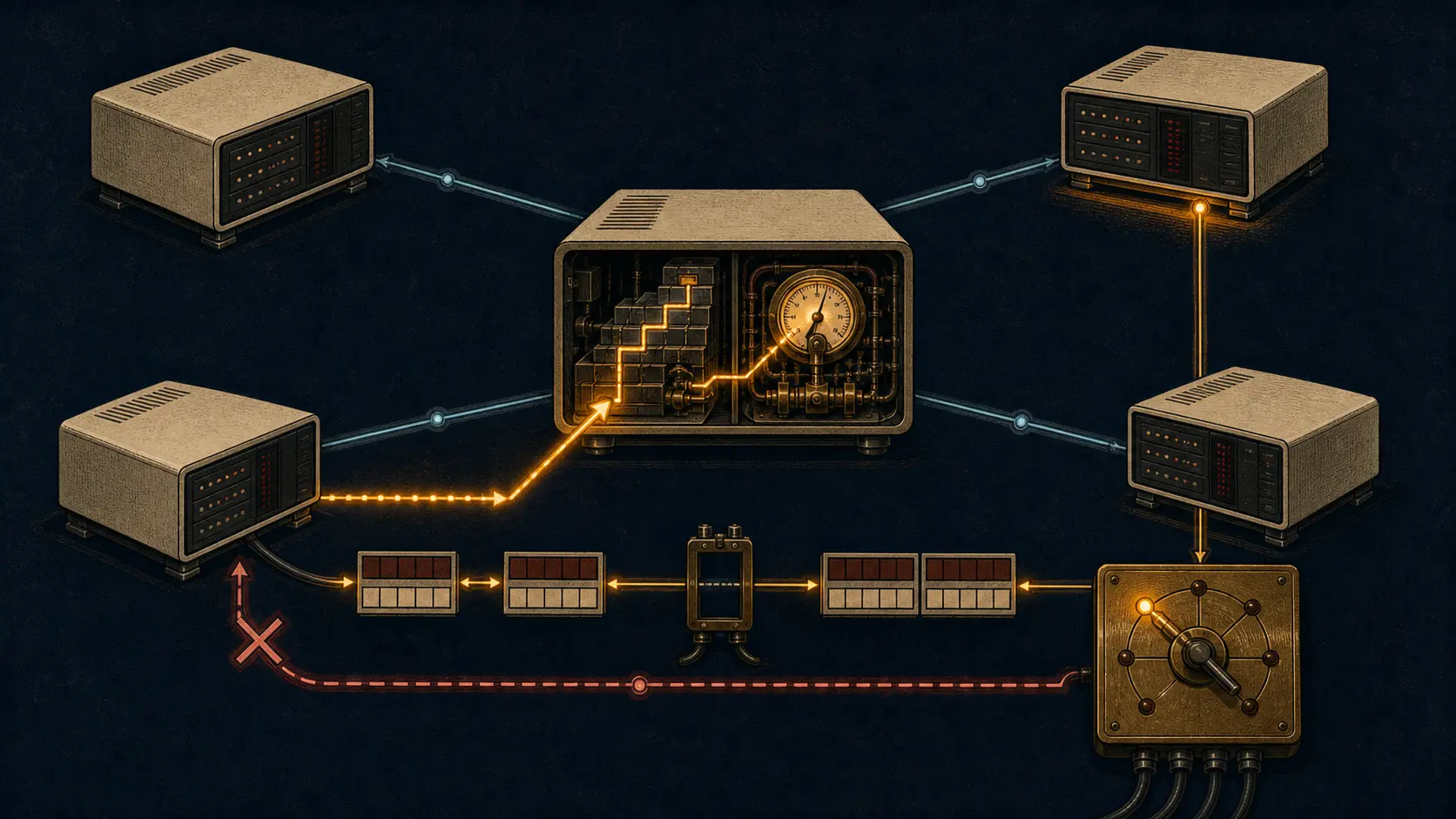
The Fastest Path Carried the Clock. It Did Not Choose the Master: How RFC 891 Bound Routing and Time to One HELLO
In the Fuzzball network, one HELLO could change both the route to a host and the clock offset associated with that route. The economy was deliberate, but authority remained divided: measured delay selected a path, configuration named the master, and the local clock decided…

History
The Frame Was Longer Than the Datagram: How RFC 894 Kept Ethernet Padding Out of IP
An Ethernet interface could deliver 46 data octets even when the IPv4 datagram inside it ended sooner. RFC 894 did not resolve the mismatch by stretching IP. It assigned two rulers to two layers: Ethernet supplied enough zeroes to satisfy its physical minimum, while the IP Total…

CASE FILE
The Label Named the Encoding. It Did Not Name the Schema: RFC 9996 and Authority Behind a Protobuf Payload
A gateway accepts `application/protobuf`, the decoder returns a message value, and the request enters the business system. None of those successes establishes that the receiver used the producer's intended message definition. RFC 9996 gives Protocol Buffers a proper outer label.…