
Primary Domain
Internet Infrastructure
Within the Primary Domain facet, Internet Infrastructure intelligence groups reporting by primary domain so readers can follow a focused area of internet infrastructure, governance, connectivity markets, or digital capital. The page brings together related articles, public evidence, institutions, companies, people, regional exposure, operating dependencies, and market context that may otherwise sit across separate category pages. It explains the domain, the likely actor class, the market or governance context, and the source material readers should use when comparing signals. Operators, analysts, and governance readers can see how the same domain appears across events, profiles, market shifts, public-source evidence, regional dependencies, and longer-cycle infrastructure decisions over time.

History
One Empty Query Could Show Who Was Online: Name/Finger’s Presence Boundary
A 1977 empty CRLF asked one host to enumerate every user on that machine. The request could travel; the answer stayed a site-produced report whose fields and disclosure boundary were local.

History
The Three-Year Plan for Internet White Pages: RFC 1107
In July 1989, a plan for finding people across research networks arrived with an unusually clear qualification: a service might be possible in three years, but the memo did not represent a committed Internet-community research activity. That gap between timetable and commitment…

Academics
Kurtis Heimerl’s Community Cellular Model Drew a Line Between Local Service and Carrier Control
Community cellular networks promise something larger than a cheaper signal: a place can shape how communications work where a national carrier sees too little commercial return. Kurtis Heimerl’s deployments show the opportunity—and the boundary. Local operators can tailor…
History
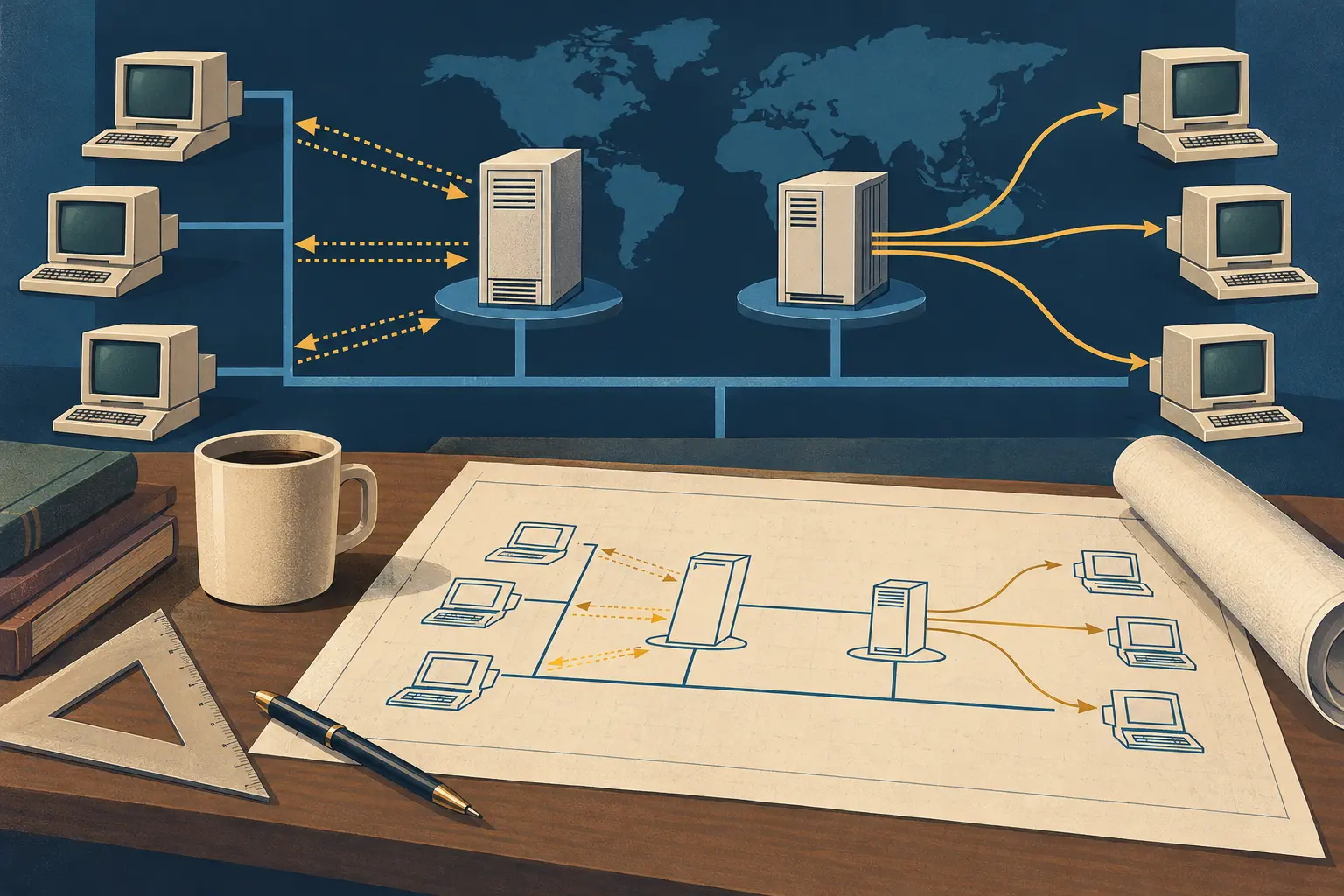
A Name Server Could Not Deliver a Datagram to the Group: RFC 1001 and RFC 1002
A name directory can tell a sender where a name is registered. In the March 1987 NetBIOS-over-TCP proposal, that answer still did not distribute a group datagram. RFC 1001 and RFC 1002 gave that second job to a distinct logical service, then left its forwarding result largely…

Europe and Middle East National Telecom Trends
OFN’s Iraq dark-fibre agreement extends FIG inland; the service chain is still unproven
A new fibre purchase puts a named terrestrial supplier behind Ooredoo’s planned Iraq landing for FIG. It advances the route on paper; the public record still stops short of showing who will operate, repair and sell the complete service.
History
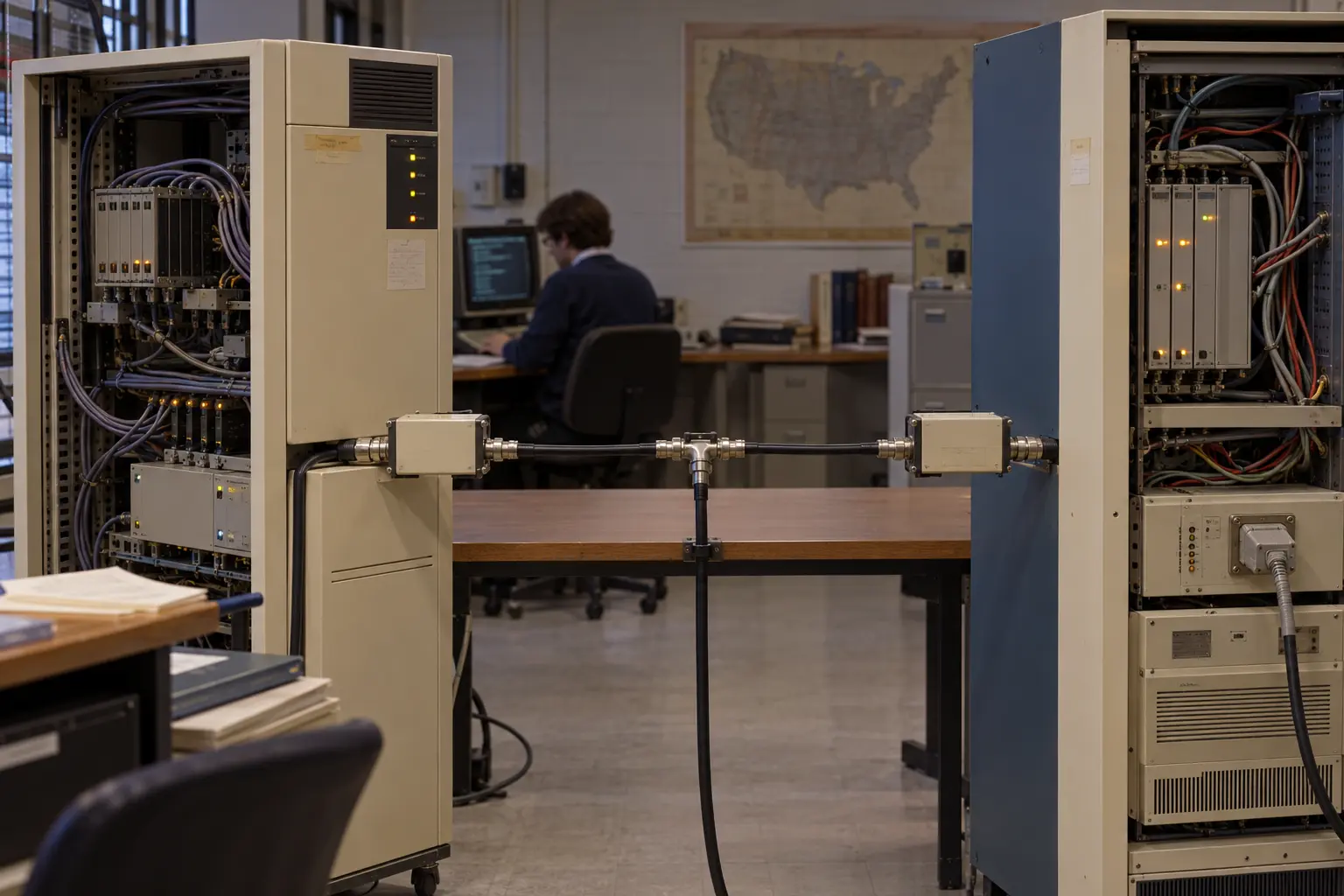
The Ethernet Handoff Was Common. An Open IGP Was Not: RFC 1009
In 1987, the National Science Foundation required gateways from different vendors to meet at a familiar boundary: Ethernet, with serial links as a minimum companion. The same specification admitted that the vendors still had no open interior gateway protocol in common. One layer…

History
Archie’s Search Was Only as Fresh as Its Last FTP Listing
Archie made a scattered set of anonymous FTP archives searchable by collecting their directory listings. That small distinction shaped the service: its answer could point to a filename and a place, but the file still lived on someone else’s machine—and the index could only…

Europe and Middle East National Telecom
Deutsche Telekom’s AI savings need a cash-flow bridge
Deutsche Telekom has put a larger number on AI’s expected contribution, but the €2.5 billion headline is a gross cost target. Investors and operating leaders still need a bridge from that accounting measure to the cash spent, the work changed and the benefits retained.

History
When a Usenet Cancel Failed Locally, RFC 1036 Said to Stop
A cancel message could travel through the same distribution machinery as ordinary Usenet news, yet its authority remained tied to what each host could find and verify for itself. RFC 1036 drew a sharp boundary: if a system could not cancel the named article locally, it should not…

History
The License Covered the Code, Not the Protocol: Gopher’s 1993 Line
On 11 March 1993, the Minnesota Gopher Team opened a newsgroup post by saying it had heard enough “hysteria” and rumor to set out an official position. The phrase that later stuck was simple: commercial users would need a licence. The policy that followed was not. It divided…

North America National Telecom
AT&T’s Fiber JV: Open Access Depends on the Anchor Tenant
AT&T plans to combine Forged Fiber 37 and Gigapower with GIP and CPP Investments. The ownership split is public; the wholesale rules that will turn “open access” into an orderable service are not. AT&T remains central to the customer relationship and was named as the planned…

IETF
RFC 10065 makes the group ID a control input, not proof of enforcement
RFC 10065 gives operators a way to carry group identity into network access rules. The harder question begins after the identifier arrives: who owns its mapping, where is the rule installed, and what evidence shows that the right traffic was actually controlled?

History
A Port Was Not Enough: RFC 675 Put the Network in the Socket Name
A process could choose a port that made sense on its own machine. It could not assume that the same number named the same endpoint across a network of independently run systems. RFC 675 answered that scope problem by joining a port to the address of the TCP that owned it, then…

CASE FILE
Philippines’ cable outage: three clocks behind one “restored” notice
On 2 October, public probes saw a sharp rise in latency between the Philippines and Singapore, but could not identify a cable. InfiniVAN later reported its C2C segment restored; carriers then described their own rerouting and service recovery. These are connected events, not…

History
The Plug Had Four Pins: NORDUnet and Europe’s Protocol Choice
In May 1988, a Nordic research network asked the United States for a route into NSFNET while promising to carry several rival network services at home. Its four-pin plug became a practical answer to a harder question: could researchers share a backbone before they agreed on one…

Story
The Legacy Host Went Quiet. Its IPv4 Lease Did Not.
A /32 DHCPv4 mask can quiet an old client that cannot use IPv6-Only Preferred. The address it receives, the inbound packets it can still accept and the pool that supplies its lease remain operational questions.

History
A Language Tag Was One Token, Not a Navigation Map: RFC 1766
RFC 1766 split a language tag into a primary value and hyphenated subtags, then told applications to treat the complete string as one token. Its consequential boundary was administrative: the parts helped organize a shared namespace, but did not become a universal route through…

IETF
Syslog Could Report Clock Quality. Operators Still Had to Set Its Bounds: RFC 5424
A timestamp can travel farther than the conditions that made it credible. RFC 5424 gave a syslog originator a compact way to describe those conditions, but the description was only as sound as the clock configuration and monitoring behind it.

History
WAIS Let a Document Become Its Own Query: RFC 1625’s Relevance Loop
A reader could type a few seed words, add a document or even one passage, and ask WAIS to find similar material. What came back was a ranked citation, not a durable result set or the document itself. RFC 1625’s small but consequential design was to make a selected text entity…

IETF
Inside EAP-FAST, Type 6 Meant Something Else: RFC 5421
RFC 5421 placed a familiar EAP method code inside a new frame: Type 6 still looked like Generic Token Card, but inside an EAP-FAST tunnel it selected a differently formatted inner exchange. The specification drew a strict boundary between those meanings; its IESG note warned that…