
Primary Domain
Internet Infrastructure
Within the Primary Domain facet, Internet Infrastructure intelligence groups reporting by primary domain so readers can follow a focused area of internet infrastructure, governance, connectivity markets, or digital capital. The page brings together related articles, public evidence, institutions, companies, people, regional exposure, operating dependencies, and market context that may otherwise sit across separate category pages. It explains the domain, the likely actor class, the market or governance context, and the source material readers should use when comparing signals. Operators, analysts, and governance readers can see how the same domain appears across events, profiles, market shifts, public-source evidence, regional dependencies, and longer-cycle infrastructure decisions over time.

History
A Plain File Put Each Site’s Crawler Rules at the Root: robots.txt, 1994
In 1994, Web robot authors agreed on a modest convention: a server could publish crawler preferences at one predictable address, /robots.txt. The choice made the rule cheap to find and easy to serve, but it also concentrated editing in the site administrator and depended on…

History
When Class C Was Too Large: RFC 1375’s Small-Network Address Proposal, 1992
In 1992, one proposal tried to make an Internet address say more about the size of the network using it. RFC 1375 offered new IPv4 classes for sites that could not use a full Class C block, then sketched regional and device-oriented meanings for some of the same bits. Its…

History
The LAN Bridge Chose a Root Before a Route: DEC’s Spanning Tree, 1985–86
A bridge could make two Ethernet segments look like one larger LAN, but a second physical path could send a broadcast around a loop forever. DEC’s answer joined a distributed algorithm to a shipping bridge in 1986. IEEE later standardized the same tree outcome through a different…

History
Mongolia’s UUCP Mail Ran Ahead of Its Permanent Internet, 1994–96
Mongolia’s early international email used scheduled exchanges between Datacom’s domestic bulletin-board system and an outside mail host. The records distinguish that service from the permanent satellite Internet connection that followed.

History
Before JAMNet, UWI’s Internet Mail Arrived on Someone Else’s Clock
In 1992, the University of the West Indies at Mona reached the outside world by calling a CUNet computer in Puerto Rico once or twice a day. Messages came back in batches; a person then carried them to other people on campus. JAMNet’s 1994 satellite link changed the network…

History
CenpacNet’s Satellite Link Was Not the Whole Internet: Nauru, 1998–2010
Nauru’s first Internet service rested on several systems that did not share one owner or one failure mode: a national telephone network, an international satellite gateway, a small dial-up market, CenpacNet’s mail and domain operations, and the people who knew how to keep them…

History
Twenty Computers, Two Mail Runs: Namibia’s University Internet, 1993–94
At the University of Namibia, one server sent and collected email over a South African dial-up link at 6 a.m. and 6 p.m. The first year shows why a national connection could matter intensely to some users, remain inaccessible to others, and fail to answer the same needs…

History
PFnet Carried Village Email across the Solomon Islands by HF Radio
In the Solomon Islands, getting an email beyond a remote village did not require every household to own an Internet connection. It required a local operator, a shared station and a radio session to Honiara. PFnet made that chain into a community service from 2001 onward.

History
Uruguay’s .uy Identified Email Before the Internet Link Arrived, 1988–94
In Uruguay, messages could cross borders before the country had a permanent Internet connection. The email route, the national domain and the later academic link marked three different capabilities.

History
DENIC Was Founded in 1996. Karlsruhe Ran .de Until 1999.
The creation of a cooperative did not move a live domain system. DENIC eG had a Frankfurt office in 1997, while technical operation of the German country-code namespace remained with the University of Karlsruhe until a separate handover in 1999.

History
Kiribati’s 128 kbps Backbone Had Only 32 Dial-up Ports, 1999–2001
Kiribati’s first reported commercial Internet service paired a narrow international link with a small dial-up modem bank. A 2001 account suggests that the connection people could actually obtain mattered more than the headline capacity.

Story
RIPE NCC’s 2027 Capex Needs a Service-Level Resilience Ledger
The 2027 draft funds two data centres, migration and a period of parallel operation. The resilience case will become testable only when each critical service has a named failure domain, a migration record and a recovery result.

History
NUNet Routed Nigerian University Mail Through Abuja and Trieste
Nigeria’s university network was designed as a route to full Internet connectivity, but its early operating path was much narrower: campus mail servers called Abuja by modem, and Abuja relayed their messages to ICTP in Trieste.

Global Regional ISP Trends
A 1,500-Byte Majority Hid a Directional PMTU Gap
A study of 76,700 RIPE Atlas path measurements found 1,500 bytes on most observed paths. Its bidirectional subset and MSS comparisons show why that majority is a baseline for investigation, not a universal operating receipt.

History
When Bulgaria’s Research Network Lost Its External Link, 1997
A research network can have international circuits on a chart and still lack a usable path to the Internet. Bulgaria’s academic network makes that distinction visible across a decade of changing names, technologies and funding.

History
SezamPro Needed More Than a Dial Tone to Become an ISP
SezamPro began as a dial-up online service. Connecting its users to the Internet took a separate chain: a BBS, an academic-network handoff, an email gateway, a public café, more telephone lines and, eventually, a provider circuit.

North America Cloud Services Trends
Azure’s gateway outage began when paused updates resumed in a burst
A temporary pause ended; a large group of gateway updates restarted within a short period. At the same time, a separate change had made configuration requests slower. Microsoft’s incident review shows how the two conditions met in a shared regional control plane—and why a gateway…

History
Squid Began as a Fork to Keep Harvest’s Cache Running, 1996
When the Harvest research project was winding down, its cache code still had work to do. Duane Wessels took the last pre-commercial version, continued it as a separate open project, and called the fork Squid.

ICANN
ICANN’s Monthly Board Reports Make Work Visible. Outcomes Need Proof
ICANN has begun publishing monthly reports to its Board and community. The August edition makes more of the policy-to-implementation chain visible; its percentages and status labels still need to be read as management reporting, not as independent proof of public outcomes.
History
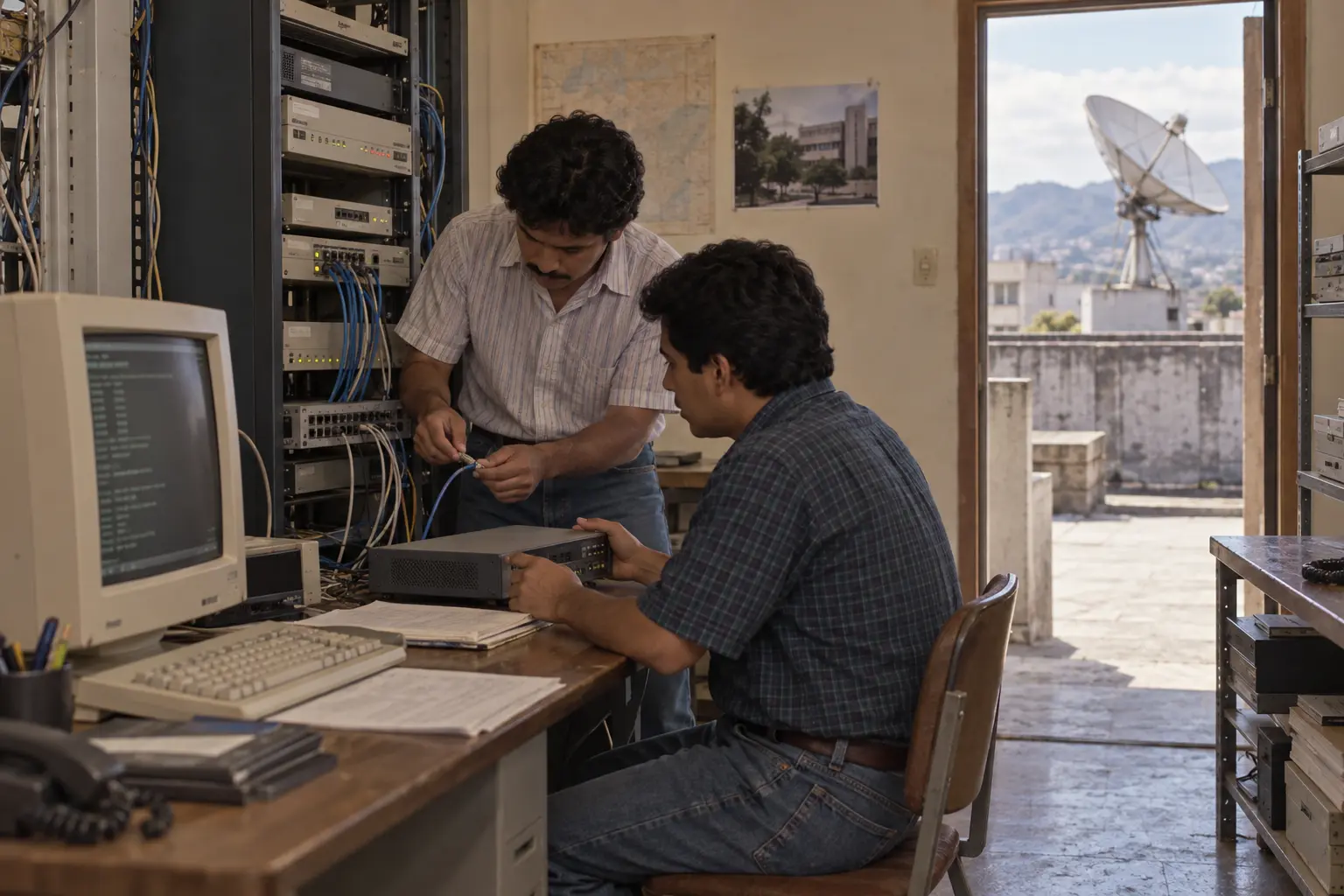
Honduras Reached the Internet by Satellite. A .hn Dispute Split HONDUNet
A June 1995 announcement said a satellite link had connected Honduras to the Internet. A later history dates the link five days later. Between the project plan and that route sat a dispute over who should administer `.hn`—one that paused HONDUNet and sent its organizers to a…