
Primary Domain
Infrastructure
Within the Primary Domain facet, Infrastructure intelligence groups reporting by primary domain so readers can follow a focused area of internet infrastructure, governance, connectivity markets, or digital capital. The page brings together related articles, public evidence, institutions, companies, people, regional exposure, operating dependencies, and market context that may otherwise sit across separate category pages. It explains the domain, the likely actor class, the market or governance context, and the source material readers should use when comparing signals. Operators, analysts, and governance readers can see how the same domain appears across events, profiles, market shifts, public-source evidence, regional dependencies, and longer-cycle infrastructure decisions over time.

History
The Master Key Never Encrypted a Packet: RFC 3079
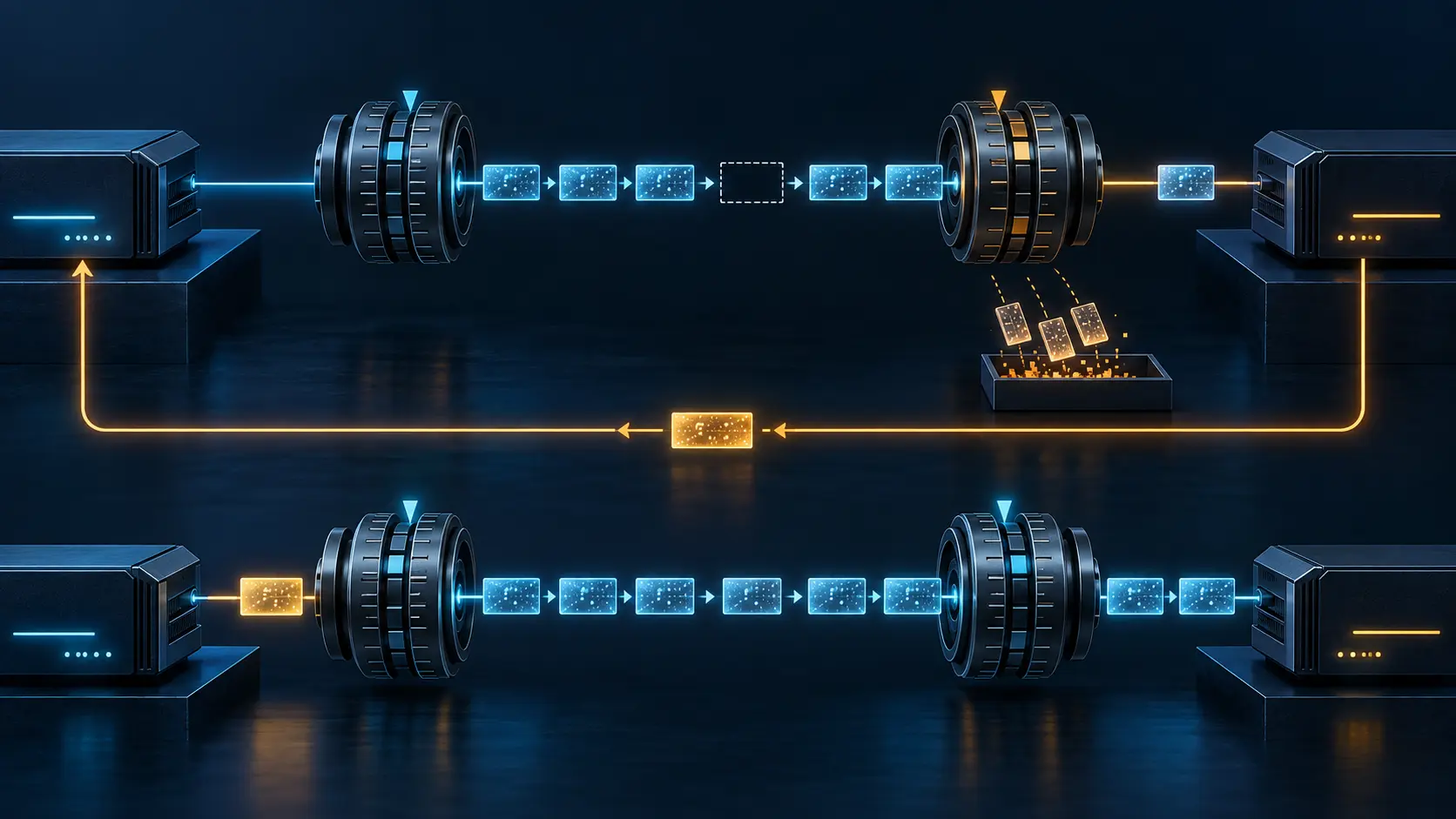
RFC 3079 called one value a master key, then forbade it from touching traffic. Its job was to feed two role-aware branches, which in turn produced transient send and receive keys for separate cipher contexts. That hierarchy made a quiet point about interoperability: deriving…
History
The Counter Detected the Lost Packet. It Could Not Decrypt the Next One: RFC 3078
RFC 3078 placed a twelve-bit counter beside encrypted PPP traffic so a receiver could notice when the stream had jumped. In stateful mode, that knowledge arrived with an uncomfortable consequence: the packet that exposed the gap still had to be thrown away. Recovery needed a…

History
The Satellite Was One-Way. The Link-Layer Model Was Not: RFC 3077
In a satellite network, a receiver could hear a feed without being able to answer it on the same medium. RFC 3077 did not make that asymmetry disappear. It joined the broadcast path to a separate Internet backchannel, then tried to let ordinary link-layer protocols behave as…

History
The Bytes Became Canonical Only After the Parser Had Already Changed the Document: RFC 3076
Canonical XML promised a stable byte stream, not a time machine. Before RFC 3076 could sort a single attribute, an XML processor had already normalized line endings, expanded entities, replaced CDATA and built an XPath node-set. The resulting octets could be repeated exactly.…

History
The Signature Verified the Transform. It Did Not Verify the Document You Saw: RFC 3075
In XML Signature, a green cryptographic result belonged to a deliberately constructed entity: referenced data after its declared transforms, represented by digests inside canonicalized `SignedInfo`. RFC 3075 made that receipt precise. It also warned that the source document, the…

History
The Hash Chose Which DHCP Server Could Answer. It Could Not Promise Service
RFC 3074 turned a configured share into 256 buckets and a repeatable answer to one narrow question: which server was eligible to respond? The map did not measure work or prove a lease arrived.

History
The Hash Assigned the Server. It Did Not Prove the Server Was Ready: RFC 3074
RFC 3074 let cooperating DHCP servers compute who should answer without negotiating each request. The same calculation could not say whether the chosen server was reachable, had an address to offer or completed the client's configuration.

CASE FILE
The Mailbox Was Never the Remedy: Where Accountability Actually Fired in the Svea Abuse-Contact Chain
Every abuse report has to land somewhere. For Svea's legacy routed network block 193.105.138.0/24, the landing place shown by independent mirrors of the RIPE Database is a shared mailbox on the Verizon Business domain — a carrier-era contact inherited from a lineage Svea never…

History
The MIME Name Was Public. The Font Specification Still Lived at the Vendor: RFC 3073
RFC 3073 gave Portable Font Resource files a public MIME name. It did not make that name a substitute for the complete specification, a compatible decoder or evidence that a recipient rendered the intended glyphs.

History
The Parser Could Skip the Chunk. It Could Not Know What It Meant: RFC 3072
RFC 3072 made an unfamiliar SDXF chunk traversable by giving it a boundary a reader could locate. But reaching the next chunk is not the same as understanding what was skipped—or knowing whether an application can safely ignore it.

History
The Label Was a Country Code. The Registry Could Still Be Generic: RFC 3071
In 2001, John Klensin argued that two characters could identify a country-code namespace without telling readers how its registry actually behaved. RFC 3071’s proposed categories followed operating practice—not the shape of the label—and stopped short of asking DNS administrators…

History
The Mask Promised a Neighbor. The VLAN Required a Router: RFC 3069
RFC 3069 saved IPv4 addresses by giving separated customer networks one shared prefix. But a host’s idea of “on-link” did not create a shared link: an upstream router had to answer, bind and forward.

History
The Tunnel Was Media-Independent. Its Circuit Was Not: RFC 3070
RFC 3070 made L2TP portable across a Frame Relay network, but portability did not make the bearer disappear. The tunnel still depended on a virtual circuit with its own endpoints, framing identifier, setup rules, packet-size limit and unresolved questions of service quality and…

History
A Common Incident Object Was Not a Common Verdict: RFC 3067
RFC 3067 imagined a security-incident report that could cross organisational and national boundaries without losing the distinctions needed to act. Its strongest insight was not that every response team should reach the same conclusion. It was that they needed a common entity…

History
The Tag Named the Content. It Could Not Certify Understanding: RFC 3066
In January 2001, RFC 3066 gave Internet protocols a compact way to say which human language an information entity used. It also drew a line that systems still cross too casually: a valid label can guide selection and processing, but it cannot testify that a person will understand…

History
The Gateway Owned the Milliseconds. The Call Agent Still Owned the Call: RFC 3064
When circuit telephony met packet control, distance became a design constraint. RFC 3064 put reactions measured in tens of milliseconds beside the wire, inside the media gateway. It did not surrender the larger decision: the Call Agent still decided what the call meant, and a…

History
Labels Waited for the Thread to Rewind: RFC 3063
In a changing MPLS network, a route could point around a loop before a label-switched path was ready. RFC 3063 proposed a way to make the label wait: send a short-lived, colored control thread downstream, and do not advertise the mapping until that thread has returned through a…

North America Regional ISP
Gafachi's Fragmented Registry Identity: An ASN That Now Points Elsewhere, and a New Routing Footprint With No RPKI Shield
Gafachi's Fragmented Registry Identity: An ASN That Now Points Elsewhere, and a New Routing Footprint With No RPKI Shield intelligence summary explains the development, the public evidence available to readers, the organisations involved, the regional context, market exposure…

History
The Missing Extension Was Not an Empty Answer: RFC 3059
RFC 3059 tried to save a round trip in service discovery: return each service URL with its attributes in the same reply. Its most durable lesson lies in the path where that optimization disappeared. No extension did not mean “no attributes.” It meant the client still owed the…

History
The OID Made IDEA Encodable. It Did Not Make the Cipher Available: RFC 3058
RFC 3058 gave IDEA two precise names inside CMS and a reproducible way to wrap a content key. It solved the problem of how conforming software should represent the cipher. It did not install IDEA at either end, grant permission to use it, select it for a message, or prove that…