
Primary Domain
Infrastructure
Within the Primary Domain facet, Infrastructure intelligence groups reporting by primary domain so readers can follow a focused area of internet infrastructure, governance, connectivity markets, or digital capital. The page brings together related articles, public evidence, institutions, companies, people, regional exposure, operating dependencies, and market context that may otherwise sit across separate category pages. It explains the domain, the likely actor class, the market or governance context, and the source material readers should use when comparing signals. Operators, analysts, and governance readers can see how the same domain appears across events, profiles, market shifts, public-source evidence, regional dependencies, and longer-cycle infrastructure decisions over time.

CASE FILE
The Charter Opened a Work Queue. It Did Not Migrate a Certificate.
The LAMPS charter now contemplates an unsigned X.509 certificate as a slimmer way to carry trust-anchor subject information. Removing a self-signature can save expensive bytes. It does not make the container trusted, choose a post-quantum algorithm or move one relying party.…

CASE FILE
The Policy Named a Partition. It Did Not Reserve the Resources.
Two candidate paths can point to the same endpoint while carrying different Network Resource Partition identifiers. One 32-bit value changes which underlay resources the headend is meant to invoke. The BGP field can state that association; it cannot create the resources, install…

CASE FILE
Fourteen ACKs Did Not Prove a Window of Twenty-Four
An application sends ten segments, pauses, then supplies four more. Every segment is acknowledged. A naive slow-start counter can call the resulting congestion window twenty-four, although the path has never carried more than ten in one round trip. The IESG has now approved a…

CASE FILE
The Proxy Opened a Port. It Did Not Authorize the Internet.
The IESG has approved an HTTP extension that lets one proxy-bound UDP socket serve many remote peers. Its operational lesson is sharper than the feature: advertising a reachable address allocates a path, while Context IDs, tuple policy and observed forwarding decide who may use…

CASE FILE
The Signature Was Valid. The Token Was Wrong.
The IESG has approved a replacement for the JWT security playbook. Its hardest rule is also its most practical: a receiver must prove not only that a token is authentic, but that this exact kind of token is entitled to cross this exact application boundary.

Europe and Middle East Regional ISP Trends
Seech-Infocom's public footprint must separate routing evidence from resilience claims
Seech-Infocom's public footprint must separate routing evidence from resilience claims intelligence summary explains the development, the public evidence available to readers, the organisations involved, the regional context, market exposure, and the infrastructure consequences…
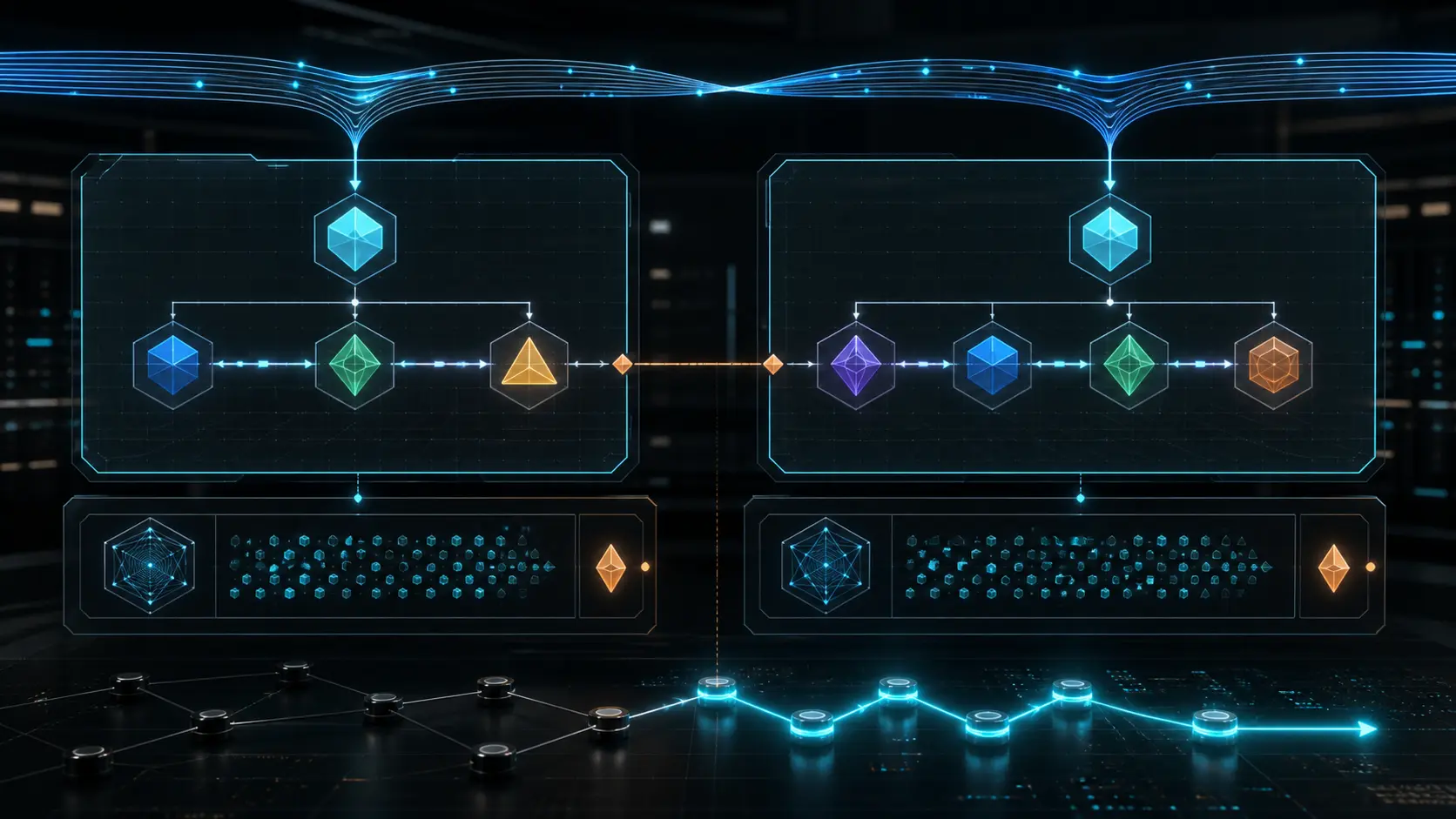
CASE FILE
The Path Kept Its ID. Its Instructions Changed.
The IESG has approved a compact identifier for segment lists carried in BGP SR Policy. The number can simplify telemetry and cross-system configuration, but it stays meaningful only inside its Candidate Path—and it can remain unchanged while the actual SID sequence changes.

Number Resource Society
A Country Field Is Not an RIR Mandate
A required country value identifies an administrative input, not authority to speak for a jurisdiction, an RIR service region or every operator associated with it.

CASE FILE
The Gateway Said “Post-Quantum Ready.” The Tunnel Still Used ECDSA.
The IESG approved a mechanism for post-quantum signature authentication in IKEv2 on 24 August 2026. The decision advances the standards path for ML-DSA and SLH-DSA, but a supported algorithm, an advertised method and an authenticated tunnel remain three different facts.

CASE FILE
IANA Registered a DELEG Capability Key. Deployment Still Needs Proof.
IANA added a temporary `deleg` key to the DNS Resolver Information registry on 24 August 2026. The entry gives operators a common way to declare support for the emerging DELEG protocol; it does not turn an Internet-Draft into a standard or a declaration into running behavior.

CASE FILE
The serial matched. The zone did not
The transfer finished, the file parsed and the SOA serial was exactly the number operations expected. One glue record was nevertheless missing. DNS had long possessed ways to say that a copy was newer and that a transaction came from an approved peer; ZONEMD added a different…

CASE FILE
The First Endpoint Was Preferred. It Was Never Eligible.
An HTTPS record can put one endpoint first and still require a client to ignore it. SVCB makes DNS a publisher of bounded connection plans, not a substitute for compatibility, endpoint authentication or running evidence.

CASE FILE
The Network Named a Provisioning Domain. It Did Not Choose the Path.
A Provisioning Domain can keep one network's addresses, resolvers and routes from contaminating another. It names a coherent context; it does not convert a Router Advertisement into a command that chooses a connection.

CASE FILE
The bridge was gone. The topology still crossed it
Two BGP-LS producers can each retain one stale half of a failed link. A consumer that merges their disclosures may reconstruct a plausible connection that no longer exists, and a controller may compute straight across it. The failure is not simply “bad telemetry.” It exposes who…

CASE FILE
The route existed. The subscription did not
A VPN route can be valid, selected and available at its source while a remote PE correctly receives nothing. RFC 4684 lets Route Target interest travel toward the route and matching reachability travel back. That inverse graph saves state, but it also makes an absent or stale…

CASE FILE
The Child Has Spoken. Who Makes the DS Record Real?
A child zone can publish a perfectly signed request for its next DNSSEC trust state and still be rightfully refused. CDS/CDNSKEY automation works only when signal, acceptance, parent publication and validator observation remain separate facts.

History
Philip F. Smith and the Routing Report That Could Observe, Not Command
A daily BGP report begun in 1999 made routing behaviour public at a moment when registry records and operator claims could not show what the network was actually announcing. Philip F. Smith’s long-running instrument matters because it also exposes its own limits: a selected path…

CASE FILE
Zero is not a diagnosis
An alert that says only “BGP saw zero” has thrown away the fact that decides the response. Zero is a valid ORIGIN code, a prohibited autonomous-system identity, and an RPKI disavowal value in three different protocol entities. RFC 7607 makes the distinction operational: refuse…

CASE FILE
Who Owns the Renewal Clock? ACME ARI and the Last Mile of Certificate Replacement
A certification authority can spread renewal work across a day, yet a fleet can still compress that day into one frantic minute. ACME Renewal Information supplies a window; the client, deployment system and live service decide whether that window becomes a safe replacement.

CASE FILE
The Reply Said Success. No Client Had Changed: DHCPv6 Reconfigure and the Authority of a Trigger
A relay can report that configuration changed, a server can answer `Success`, and an authenticated packet can reach a client without any of those events proving that the client now runs different addresses, prefixes or service parameters. DHCPv6 Reconfigure is useful precisely…