
Content Type
Research
Within the Content Type facet, Research intelligence gathers BTW.MEDIA articles that share the same editorial format, helping readers compare briefings, profiles, risk notes, market analysis, and event coverage without mixing different kinds of evidence. The page explains how this content type frames internet infrastructure events, company movements, governance decisions, operational signals, and public evidence across the site. Readers can compare which actors or infrastructure systems appear most often, how source quality changes interpretation, and whether the material is a durable profile, a time-sensitive event, a strategic market signal, or a governance development. The result is a useful search page for operators, investors, customers, analysts, and policy stakeholders who need to understand the consequence, timing, and evidence behind similar article formats.

IETF
The network passed the speed test. Who accepted the waiting?
A managed connection can deliver the expected volume of data while leaving an unresolved choice between delay, retransmission and individual transfer performance. That choice belongs in the service handover, not in an unexplained headline rate.

History
Who pays while a network upgrade waits for everyone else?
A protocol can coexist with old equipment long before it delivers a return to its first users. The history of Quick-Start exposes the cost of that interval—and why a smaller deployment can sometimes be the more ambitious business.

IETF
A Deprecation Date Retires an RDAP Label, Not Its Clients
An IANA registry can mark an RDAP extension obsolete. An operator can publish an end date. Yet somewhere beyond both records, a client may still ask for yesterday’s interface. That is not a contradiction. It is a map of divided authority—and a warning against treating one date as…

Story
The RIR Draft Calls the System Bottom-Up. Status-Change Consultations Stay Optional
The recommended RIR Governance Document describes the Internet Numbers Registry System as open and bottom-up. A few pages later, its new Article 2.7 says neither the RIRs nor ICANN are obliged to consult their communities when assessing a proposal to recognise or derecognise a…

IETF
A CDN must carry a loop warning it cannot authenticate
A cooperative defence can depend on preserving information that remains untrusted. CDN-Loop exposes the division between a customer's configuration freedom, a provider's protective decision and the evidence needed to explain a failed request.

IETF
DNSSEC Recovery Runs on Clocks No Signer Controls Alone
The private key is unusable. The zone is still answering, and yesterday’s signatures still validate. That is not recovery; it is borrowed time. A new DNSOP draft explains how to use that interval without destroying the trust that remains. Its harder lesson is institutional: the…

CASE FILE
A DNS Failure Drew 51 Queries. The Cause Was Still Unresolved
APNIC Labs sent several kinds of “no” from an experimental authoritative DNS service. Definitive negatives drew roughly four queries per test. `SERVFAIL` drew 51.73 and silence 83.46. Those are measurements of received traffic—not a verdict on which resolver layer multiplied it.

IETF
A captive portal needs an expiry date for its idea of a device
An address can legitimately pass from one terminal to another. The access system has to retire the old association, not merely recognize the address again. That small distinction connects network admission, accounting and privacy.

IETF
A Self-Signed Delegation Update Proves a Key, Not Its Authority
A DNS message can prove that its sender holds a private key and still leave the decisive question unanswered: who entitled that key to alter a child’s delegation? A DNSOP proposal for rapid child-to-parent updates makes that distinction explicit. Its lasting value will depend on…

CASE FILE
The Purge Was Accepted. The Downstream CDN Still Said No
Revision 20 of an IETF working-group draft follows a cache-control request past the reassuring `201 Created` response. In a CDN cascade, a later rejection has to return as data inside another provider’s status resource—and the provider that refused may remain unnamed.

IETF
A firewall’s speed belongs to a particular configuration
Two reports can describe the same appliance without showing that its protection and performance were achieved together. The missing connection is often the configuration between the tests.

CASE FILE
A Registry-Lock Quorum Counts Approvals, Not Independent Authority
Two approval messages can look like two-person control while both are recoverable through the same compromised mailbox. A proposed EPP registry-lock extension can count authorising contacts; the harder task is proving that the authorities behind those contacts were genuinely…

CASE FILE
The ICMP Error Named a Node. It Did Not Prove Which One
Revision 05 of an IETF draft makes node context harder to omit when an ICMP source address cannot do the diagnostic job alone. It also exposes a less comfortable truth: a more informative error can carry less of the packet that triggered it, and neither piece is authenticated.

IETF
Why a routing delay metric leaves the queue out
A network can need a stable signal for choosing paths and a sensitive signal for judging service. Trouble begins when a low-latency promise quietly treats them as the same measurement.

CASE FILE
An EPP Balance Can Gate Transactions Without Exposing the Ledger
A registrar can be told exactly how much spending room it has and still be unable to explain why the next domain command was refused. The emerging EPP balance mapping makes funding state operational; it does not turn that state into an accounting record.

CASE FILE
A Holder-Designated RDAP Referral Extends Discovery, Not Registry Authority
A Holder-Designated RDAP Referral Extends Discovery, Not Registry Authority intelligence summary explains the development, the public evidence available to readers, the organisations involved, the regional context, market exposure, and the infrastructure consequences that may…

Leaders
Mohamed Awang Lah and the Problem of Making Internet Capability Survive Institutional Change
The most revealing question about Mohamed Awang Lah is not whether he was important to Malaysia’s early internet development. The public record makes his importance difficult to dispute. The harder question is what, precisely, survived his successive roles: a person’s authority…

CASE FILE
A Successful EPP Server Validation Is a Dated Policy Verdict, Not a Health Certificate
The word “success” can survive on a dashboard long after the observation that produced it has expired. A new EPP proposal would make the result portable; governance begins by refusing to make it timeless.

CASE FILE
The EPP Same-Entity Set Turns an External Policy Into an Atomic Boundary
A registrar can submit a command naming one domain while the repository must decide whether that command reaches a set too large to list. The protocol message is visible; the rule that draws its boundary may sit somewhere else.
History
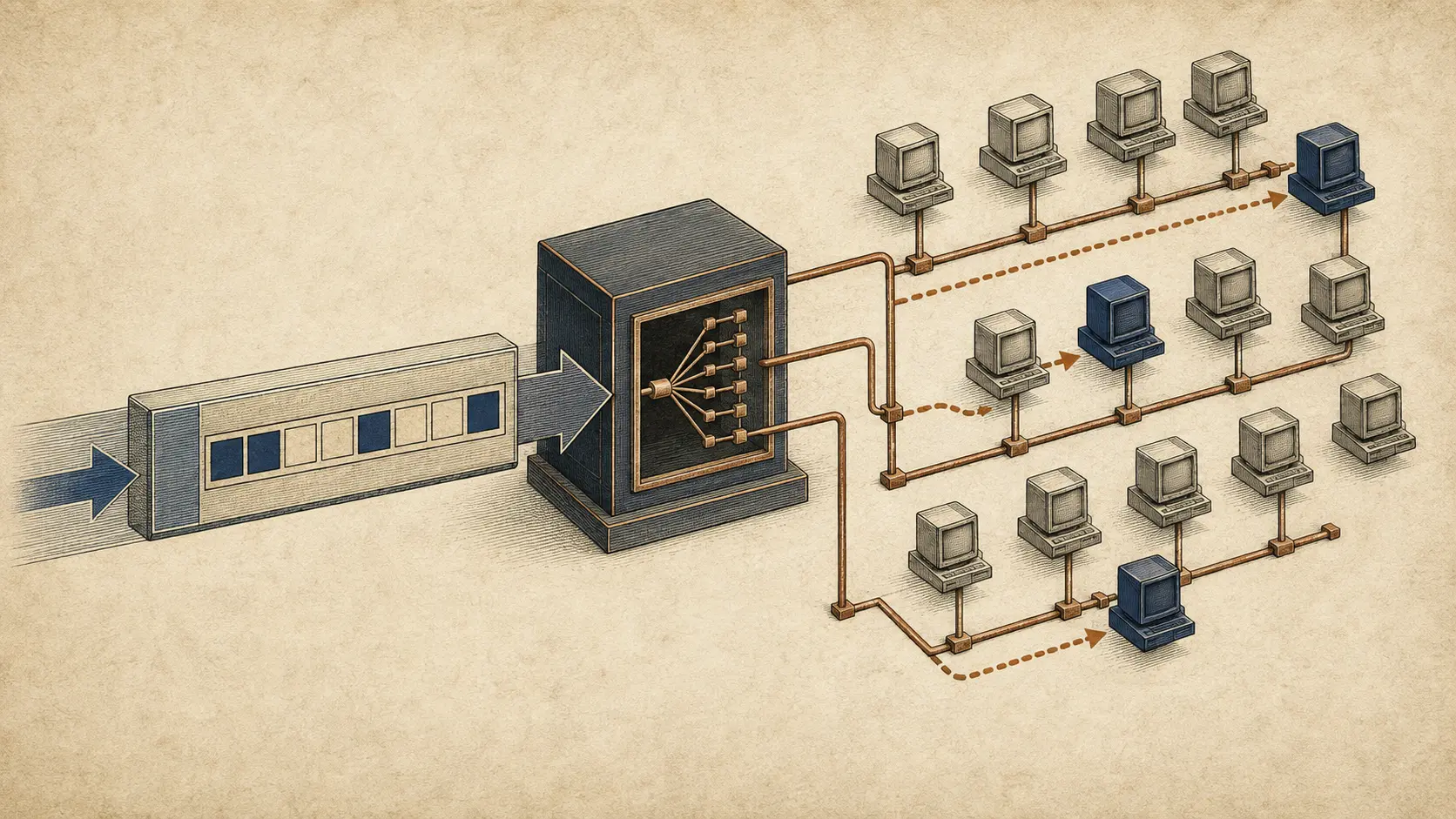
The Broadcast Packet That Carried Its Own Guest List
One UDP datagram approached a remote subnet as a broadcast, yet it carried a private instruction inside its IPv4 header: these hosts may listen; the others must stop. Selective Directed Broadcast Mode tried to make the packet itself serve as a temporary membership list.