
Content Type
Research
Within the Content Type facet, Research intelligence gathers BTW.MEDIA articles that share the same editorial format, helping readers compare briefings, profiles, risk notes, market analysis, and event coverage without mixing different kinds of evidence. The page explains how this content type frames internet infrastructure events, company movements, governance decisions, operational signals, and public evidence across the site. Readers can compare which actors or infrastructure systems appear most often, how source quality changes interpretation, and whether the material is a durable profile, a time-sensitive event, a strategic market signal, or a governance development. The result is a useful search page for operators, investors, customers, analysts, and policy stakeholders who need to understand the consequence, timing, and evidence behind similar article formats.

IETF
The Registry Closed. The Number Did Not Die
Standards institutions rarely get a clean shutdown switch. Their harder task is to stop allocating new meaning without pretending that old meaning vanished. A six-page Internet-Draft about legacy IANA registries exposes that problem with unusual precision: it proposes four…

History
Equal Cost Did Not Make the Paths Interchangeable: RFC 2991 and the Price of Stable Multipath
Two routes can tie in the routing table and still disagree about packet size, delay and what a probe can see. In 2000, RFC 2991 made the router’s choice among those paths a question of how much disruption a network was willing to accept.

IETF
The Stack Got Smaller. The Configuration Became the Protocol
A proposed modular form of SCHC can turn a four-byte IPv6 prefix into a one-byte RuleID. The bargain only works because both endpoints already possess the meaning that no longer travels on the wire.

Europe and Middle East Institutional
The 2027 Question: What Allianz's AI Numbers Actually Measure
Allianz's public AI story is usually told as a deadline. The group's Capital Markets Day set 2024–2027 targets, and coverage since has often folded its internal AI platforms into that countdown. The documents Allianz publishes tell a more precise story: 2027 is a productivity…

History
The Header Said 33 Seconds. The Message Had Not Yet Been Played: RFC 2424
An unopened message could already announce how long its voice clip should last. RFC 2424 made that preview portable, while stating why the number was not the same thing as a measurement of the media behind it.

History
The Network Could Decline Without Saying No: RFC 2990 and the Missing QoS Feedback Loop
In November 2000, RFC 2990 described an awkward bargain at the centre of Internet quality of service. A network could remember each application's reservation and return a precise answer, but carrying that state through a high-speed core was expensive. Or it could aggregate…
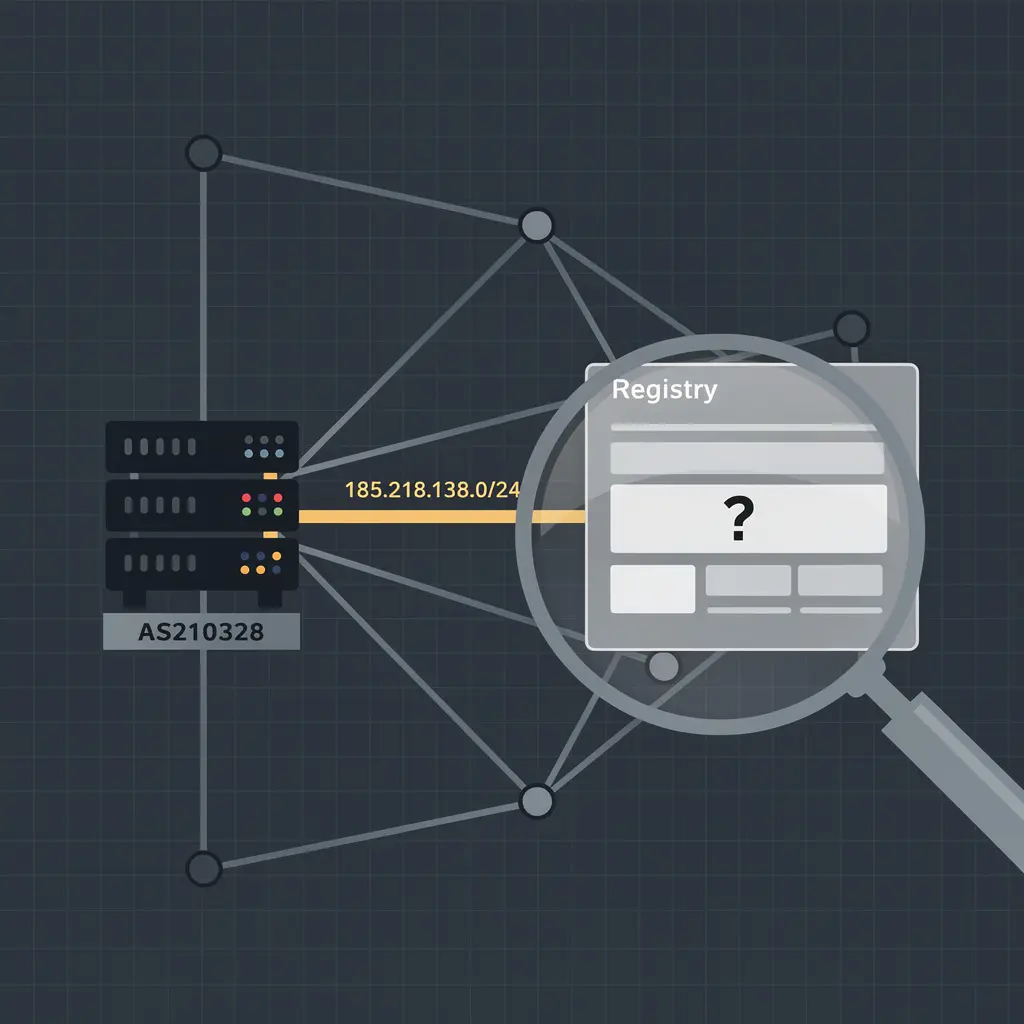
Europe and Middle East Cloud Services
The Registry Says One Company, the Records Say Another: Inside AS210328's Identity Gap
The Registry Says One Company, the Records Say Another: Inside AS210328's Identity Gap intelligence summary explains the development, the public evidence available to readers, the organisations involved, the regional context, market exposure, and the infrastructure consequences…

CASE FILE
RFC 9643: The Service Beyond the Configured Proxy
Treating an accepted TCP egress configuration as evidence of service reachability confuses instructions with results. Operators need to establish which proxy admitted the connection, which remote identity answered and whether the intended application operation actually completed.

History
The Checklist Graded Capabilities, Not Packets: RFC 2989
In November 2000, RFC 2989 assembled a formidable checklist for network-access AAA protocols. It asked whether a candidate could scale, fail over, protect entities, carry EAP, authorize, reconcile state and deliver accounting records. Then it inserted the sentence that kept the…

History
The codec agreed. The nibble did not: RFC 2422
G.726 could define the sound-coding algorithm and still leave two systems to disagree about a byte. RFC 2422 made the missing choice explicit: which four-bit codeword goes into which half of an octet, and what to do when the last pair is incomplete.

IETF
The Contact Converged. Its Merge Decision Had No Receipt
Two devices can finish with the same compact vCard after a synchronization engine decides that independently created telephone properties are really one value. The record may be valid, useful and fully interoperable. It still cannot say why the heuristic fired, whose edit…

History
The Tags Looked the Same. One Was a Limit, the Other a Preference: RFC 2987
In November 2000, RFC 2987 placed `charset` and `language` inside the same media-feature grammar. Both used registered tokens, equality comparison and optional quality weights. Yet the document refused the most convenient inference: identical syntax did not make the two claims…

History
The MIB Moved Branches; MARS Did Not: RFC 2417
In 1998, the Multicast Address Resolution Service acquired a new place in the management-information tree. RFC 2417 corrected the root assigned to its MIB—but a corrected address for management data is not evidence that multicast traffic, ATM circuits, or deployed agents moved…

IETF
The Schema Compiled. No Optical Slot Had Moved
A YANG validator can accept every identity, choice and range in `ietf-layer1-types` without causing one cross-connect to close. Revision 20 gives controllers and devices a common optical vocabulary. It does not create the datastore, authorize the change, reserve a tributary slot…

Europe and Middle East Cloud Services
Mistral Compute Sells the Future: Regional Endpoints, Priority Tiers and a Gigawatt on Paper
Between March and August 2026, Mistral AI added a second layer to its Mistral Compute project. The first layer was physical and financial: $830 million of debt, 13,800 NVIDIA GB300 accelerators and 44 MW of powered capacity at Eclairion's Bruyères-le-Châtel site south of Paris.…

CASE FILE
The Named Custodian: Who Actually Holds a RIPE Abuse Contact, and What the Record Shows About Placeholder Accountability
Every network abuse complaint in the RIPE service region is directed at a mailbox named in the RIPE Database. Prior reporting has established that the registry validates only that this mailbox can receive mail, and that the escalation machinery above it has never fired for a…

Story
DFINFRA and AS210860: the cost of verifying a silent registry record
A German retail group's registry entry still names a contact for a network that has not announced a single prefix since March 2026, while a peering profile derived from the same network still promises ten address blocks and an open door. Every counterparty who consults these…

IETF
Unknown Entered the Same Queue as Valid
ASPA can distinguish a published contradiction from missing relationship evidence. Revision 28 then recommends giving an Unknown route the same preference level as a Valid one. That choice protects reachability while deployment is incomplete; it does not make the two evidence…

Global Institutional
What Allianz Technology Actually Ships: The Software Execution Record Behind the AI Ambition
Allianz Technology SE is the captive IT and software arm of the Allianz insurance group, and its public identity has been shaped by two very different kinds of records: the infrastructure programme — data centres, wide-area networking, cloud regions — and the software estate that…

Leaders
Brian Behlendorf and the Test a Public Release Could Not Perform
Apache’s first release was built from fixes that webmasters had already made for themselves. Brian Behlendorf helped give those separate patches a place to meet; the servers that adopted the result still had to make their own decision.