
Content Type
Research
Within the Content Type facet, Research intelligence gathers BTW.MEDIA articles that share the same editorial format, helping readers compare briefings, profiles, risk notes, market analysis, and event coverage without mixing different kinds of evidence. The page explains how this content type frames internet infrastructure events, company movements, governance decisions, operational signals, and public evidence across the site. Readers can compare which actors or infrastructure systems appear most often, how source quality changes interpretation, and whether the material is a durable profile, a time-sensitive event, a strategic market signal, or a governance development. The result is a useful search page for operators, investors, customers, analysts, and policy stakeholders who need to understand the consequence, timing, and evidence behind similar article formats.

History
The Prefix That Could Not Return Traffic: RFC 5220
An IPv6 host could hold two valid addresses, send a packet through the wrong provider, and leave the reply aimed at a prefix with no public return route. RFC 5220 named this a host-selection problem; it did not report a measured outage or prove how often it occurred.

History
The Password Matched. The User Was Not Yet Authenticated: RFC 3112
RFC 3112 gave LDAP a way to test a password against a derived value in the directory. It also drew a hard line around the answer: a match could be true while no directory association had authenticated the client.
Story
The frozen stack: what DFINFRA's address footprint can and cannot prove
The frozen stack: what DFINFRA's address footprint can and cannot prove intelligence summary explains the development, the public evidence available to readers, the organisations involved, the regional context, market exposure, and the infrastructure consequences that may follow.…

IETF
The String Was Exact. The Authority Was Still Local
A service can now hand a customer a precise DNS change instead of a paragraph of instructions. That removes one class of ambiguity. It does not tell the DNS operator who authored the request, whether the customer may alter the named zone, whether local policy should accept the…

History
Both Layers Said Forward. They Meant Opposite Directions: RFC 3108
RFC 3108 exposed a problem more dangerous than a missing field: two legitimate control systems used the word “forward” from different origins. A media gateway could receive a perfectly valid traffic descriptor and still have to reverse its direction before using it.

History
The New RFC Fixed the Session Label, Not the Payload Design: RFC 5219
In 2008, RFC 5219 replaced an MP3-over-RTP specification whose example already named the right format while its prose told session descriptions to use the wrong one. The revision corrected that split and clarified implementation pseudocode; its own change note did not claim a new…

IETF
The AS2 Names Matched. The Signer Was Still a Local Decision
A certificate rollover can leave every visible signal green—TLS connected, names reflected, signature valid, MIC matched—while one decisive fact remains outside the protocol transcript: who authorized this key to speak for this partner, in this direction, now?

History
The Gateway Lent the Address. Locality Became a Protocol: RFC 3102
Realm Specific IP offered a striking alternative to invisible address translation: let the private host borrow public addressing parameters and place them in its own packets. The address moved into the host, but allocation, lease, policy and return-path control remained at the…

History
DHCP Authentication Stayed Inside the Trust Domain: RFC 3118
RFC 3118 added authentication to DHCP, but not a network-wide identity service. Its delayed exchange assumed that a client and server could receive a shared secret out of band inside one administrative domain—and left the decision to accept an unauthenticated offer to local…

History
Before Consent Became a Checkbox: RFC 3098
RFC 3098 did more than ask Internet advertisers to behave. It turned responsibility into an operating design: do not preselect the audience, tell people how their data will be used, confirm the request with provenance, make removal possible, and keep the cost of maintaining a…
Story
The company behind the dormant network: what the Hamburg register can prove that AS210860's registry layer cannot
The company behind the dormant network: what the Hamburg register can prove that AS210860's registry layer cannot intelligence summary explains the development, the public evidence available to readers, the organisations involved, the regional context, market exposure, and the…

IETF
One Packet per Second Is Not Idle
PowerBench revision 03 turns a tiny traffic trace into a large warning for buyers of network equipment: a watt figure cannot be compared until the useful work, device state, configuration, meter and time window have been made part of the same result.
History
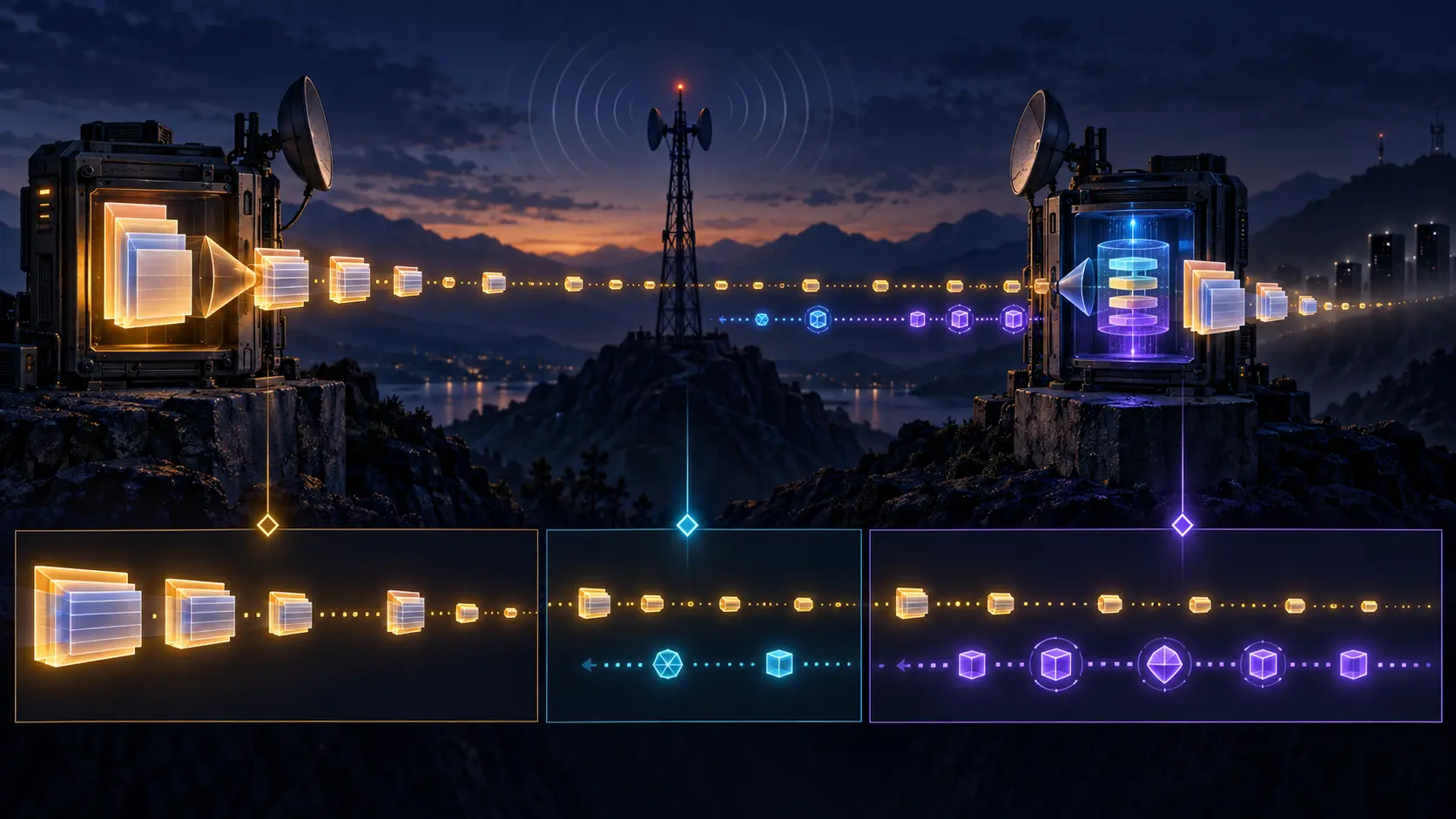
ROHC Began Without a Return Channel: RFC 3095
Before ROHC could trust an acknowledgment, it had to work where no acknowledgment could come back. RFC 3095 therefore made every compression context begin in unidirectional mode, then let the decompressor—not the compressor's optimism alone—request the move to feedback-driven…

History
TALI Could Not Assume Its Peer Was Version 2: RFC 3094
Before a TALI 2.0 gateway could send new management operations, it had to learn what the far end understood. RFC 3094 makes that negotiation a protocol rule—and publishes it with an unusually explicit warning that the vendor proposal had not been technically reviewed by the IETF.

Europe and Middle East Cloud Services
The Routing-Policy Swap Behind AS210328: What the August 2026 Registry Edit Changed — and What It Did Not
The Routing-Policy Swap Behind AS210328: What the August 2026 Registry Edit Changed — and What It Did Not intelligence summary explains the development, the public evidence available to readers, the organisations involved, the regional context, market exposure, and the…

Story
The contractual tail: how African LIRs stayed RIPE NCC members while AFRINIC served them
The handover of Africa's internet number registry is usually told as a single act of recognition. The dated instruments tell a more layered story: for over ten months after AFRINIC began operating, African members were legally RIPE NCC members under the RIPE NCC Standard Service…

CASE FILE
The Draft Had Eight Numbers. The Registry Still Had None
On 1 October 2026, an OpenPGP implementer could place two official-looking documents side by side and receive two different answers. Revision 05 of a working-group draft called eight composite algorithms 37 through 44. The live IANA registry still called the entire range from 37…

History
Foo Entered the RFCs Before the RFCs Explained It: RFC 3092
In December 1971, RFC 269 told a user to rename `FOO` as `BAR` and assumed the example needed no cultural translation. Three decades later, RFC 3092 counted roughly seven per cent of the RFC Series carrying the same private vocabulary. The explanation arrived after the convention…

Global Datacenter
Kingston's 62%: How a Private Memory Assembler Turned a Price Cycle Into Durable Dominance
Kingston Technology has held the number-one position in third-party DRAM modules for more than two decades. Its latest lead — an estimated 62% share of a $21.2 billion market that grew 59% in a single year — is less a story about memory prices than about what a private assembler…

History
The Pi Multicast Group Was Not an IPv4 Address: RFC 3091
RFC 3091 imagined clients assembling π from a stream, a numbered UDP reply or multicast. Its multicast instructions began with a destination no IPv4 host could join, while the TCP and UDP ports elsewhere in the same document exceeded the fields that carry them.