
Content Type
Research
Within the Content Type facet, Research intelligence gathers BTW.MEDIA articles that share the same editorial format, helping readers compare briefings, profiles, risk notes, market analysis, and event coverage without mixing different kinds of evidence. The page explains how this content type frames internet infrastructure events, company movements, governance decisions, operational signals, and public evidence across the site. Readers can compare which actors or infrastructure systems appear most often, how source quality changes interpretation, and whether the material is a durable profile, a time-sensitive event, a strategic market signal, or a governance development. The result is a useful search page for operators, investors, customers, analysts, and policy stakeholders who need to understand the consequence, timing, and evidence behind similar article formats.

History
A One-Day Workshop Could Not Test an Expiring Signature: RFC 3130
By the time DNSSEC specialists met around IETF 49, the short workshop had become a misleading unit of proof. A signer could run, a validator could answer and a demonstration could end successfully before the clocks, organisations and independent implementations that determined…

History
Syntax Stopped Being Copied: RFC 2234 and ABNF
When every protocol note had to carry its own explanation of the grammar notation, a reader needed to learn the rulebook again before reading the rules. RFC 2234 made that rulebook separately citeable. Its small institutional move was to give Internet specifications a common…
Story
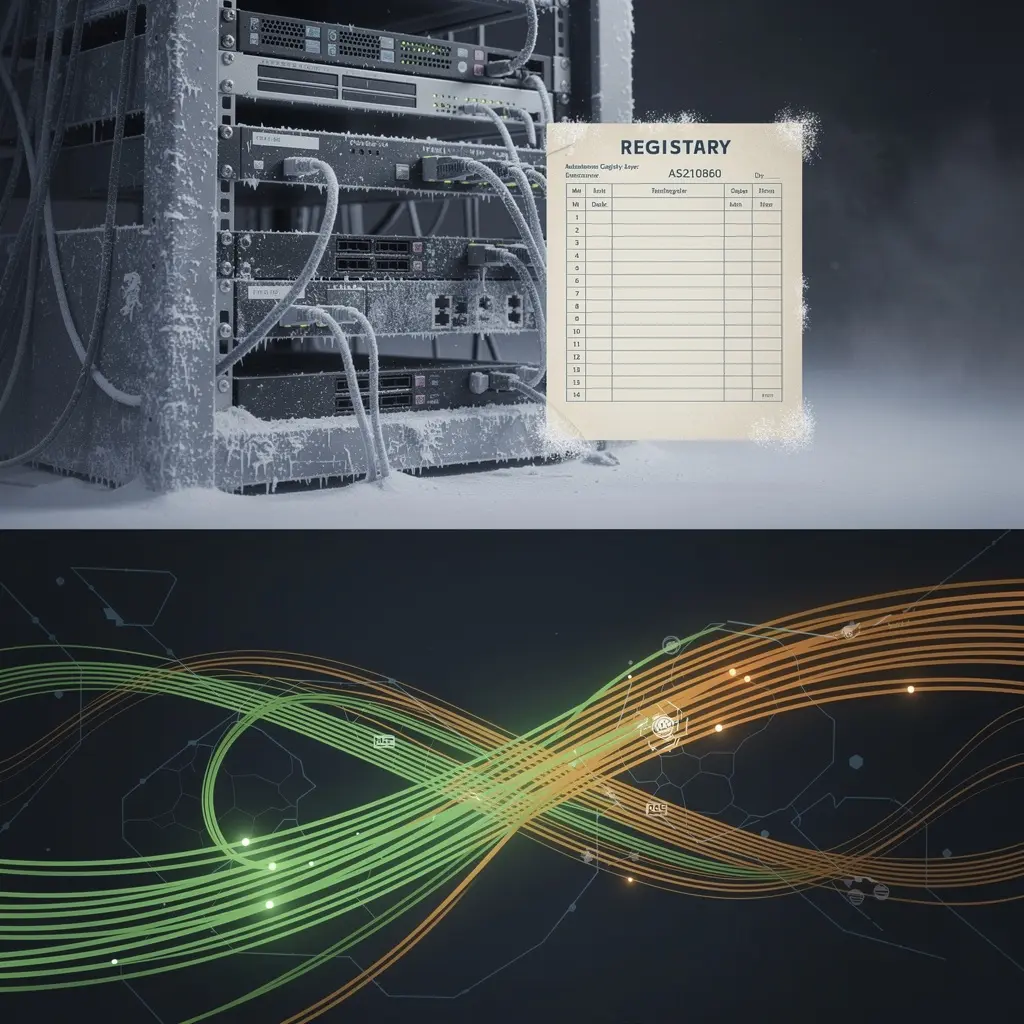
Two tiers of EDEKA: where the frozen registry ends and live routing begins
Two tiers of EDEKA: where the frozen registry ends and live routing begins intelligence summary explains the development, the public evidence available to readers, the organisations involved, the regional context, market exposure, and the infrastructure consequences that may…

History
The KDC Carried the Trust That Every IPsec Peer Could Not: RFC 3129
In June 2001, RFC 3129 treated Internet key exchange less as a contest between cryptographic algorithms than as a problem of institutional placement. Its question was blunt: if every IPsec peer had to carry policy, certificates, computation and pairwise secrets, could a Kerberos…

IETF
The Backup Lost Sight of the Primary. The Multicast Path Was Still Alive.
A BIER backup ingress can lose its monitoring path to the selected ingress while every protected receiver path still works. If that narrow observation is allowed to command a takeover, resilience creates the very duplicate traffic it was meant to contain.

History
A Plus Sign Was Only One Local Dialect: RFC 5233
An address can carry a delivery hint inside its local part, but the hint is not a universal language. RFC 5233 let Sieve inspect a “user” part and a “detail” part without claiming every mail system split them the same way—or even used a plus sign.

History
The First Fragment Passed. The Overlap Changed the Port: RFC 3128
In 2001, a short security note exposed a difficult truth about packet filtering: a firewall could approve one set of bytes while the receiving host later assembled another. RFC 3128 did not discover fragmentation, or even overlapping fragments. Its contribution was to show how…

History
Long-Term Proof Had to Outlive the Key: RFC 3126
RFC 3126 treated an old signature as an evidence-preservation problem. A valid calculation made in 2001 would not explain itself decades later if certificates, revocation records, exact signed bytes or trustworthy algorithms had disappeared. Its answer was a ladder of timestamps…

IETF
It Opened the Handshake. It Still Needed the Group's Memory.
An MLS external receiver can open the same commit or proposal seen by group members and still lack the state needed to authenticate who sent it. The missing receipt is not more ciphertext. It is the current GroupContext that joins an epoch, a sender leaf, a credential and an…

History
The Filter Could Flag Delivery, Not Rewrite the Mailbox: RFC 5232
An email rule could mark the copy it was delivering, but RFC 5232 did not give it a wand for changing any message already in storage. The difference between requested flags and durable mailbox state sits at the boundary between filtering and delivery.

Europe and Middle East Datacenter
Mistral Compute's Operational Claim, Audited: What the Fleet Numbers Actually Record
Mistral Compute's French infrastructure program has accumulated a layer of claims that outpace its dated evidence: a vendor blog calling an 18,000-GPU fleet "already operational," a registry that both energizes and does not energize the same site, and a product suite sold on the…

IETF
The Protocol Admitted the Number. The 32-Bit Field Did Not.
A LAKE extension value can be valid in the proposed registry range and perfectly formed on the wire, yet still fall outside the integer type chosen by an implementation. That is not a parsing footnote. It is the point where two peers can authenticate the same exchange while…

History
A Valid Signature Still Needed a Policy: RFC 3125
RFC 3125 tried to make the rules around an electronic signature addressable as data. A correct cryptographic calculation remained only the first gate: validity under a transaction still depended on which policy bytes were referenced, which commitments and trust conditions…

Europe and Middle East Cloud Services
MainStreaming and the AI Edge Delivery Claim: What the Orchestration Automates
MainStreaming sells an edge video delivery network that lives inside ISP infrastructure rather than at traditional CDN points of presence, bound together by an "AI Orchestrator" it says matches each viewer to the best edge server. The deployment record with DAZN, ITV and BT shows…

History
One Message, Three Different Counts: RFC 5231
A mail filter can count mailbox addresses, envelope destinations or header-field instances. RFC 5231 made those different measurements comparable—but left the test surface to decide what the number means.

History
A Send Grant Was Not a Packet Queue: RFC 3124
The Congestion Manager proposed one place where a host could decide when competing applications should transmit. Its sharpest boundary was equally important: the manager granted an opportunity, while the application still chose the bytes and the network still determined their…

IETF
The Active Key Signed Its Successor. That Was the Problem.
A signature can show that the key accepted by yesterday’s policy approved a change. It cannot answer the harder question: should that key, acting alone, have been allowed to decide every key that will control the identifier tomorrow?

History
A Prefix List Was Not Yet an Access Policy: RFC 3123
DNS could publish a compact list of network prefixes. RFC 3123's more important choice was to refuse to say what that list commanded: the record preserved representation, while applications still had to supply meaning, authority and action.

History
The Away Message Was a Policy, Not a Template: RFC 5230
An automatic reply is a message sent in someone’s name while they are absent. RFC 5230 made that simple sentence an operational policy: decide whether the incoming note was meant for this recipient, identify which response it would trigger, remember who has already received it…

History
A Delay Number Was Also a Clock Claim: RFC 3116
In an ATM laboratory, subtracting one timestamp from another looked like the easy part. RFC 3116 made the harder truth visible: before the switch could be judged, the clocks, counters, traffic and measurement boundary had to testify too.