Summary
- The Cryptographic Module Validation Program publishes validated modules certificate by certificate, and separately publishes an in-process list carrying each submission's status and the date it entered that status.
- Independent laboratories accredited by NVLAP verify a module against testable requirements; the programme reviews and validates the submission, as a joint effort of NIST and the Canadian Centre for Cyber Security.
- Across the three pages read on 17 November 2026, no field explains why a submission sits in a given state, how many submissions have been returned to a laboratory, or why a module was withdrawn.
- The module description printed alongside a certificate is the vendor's own: "Module descriptions were provided by the vendors, and their contents have not been verified for accuracy by NIST or CSE."
A cryptographic module that cannot hold a validation does not reach the market the certificate serves. That is the whole point of a gate, and the gate here is unusually talkative about its own output: the programme publishes the finished population and the live queue side by side, both searchable, both open. What it does not publish, anywhere in the three pages read for this briefing, is a reason.
Start with who is deciding. The Cryptographic Module Validation Program describes itself without hedging: it "is a joint effort between the National Institute of Standards and Technology under the Department of Commerce and the Canadian Centre for Cyber Security, a branch of the Communications Security Establishment." A validation decision about a cryptographic module is therefore co-owned by a United States standards agency and a Canadian signals-intelligence agency, and the page says so in its first line rather than in a footnote. The National Institute of Standards and Technology is the visible half of that arrangement; the Canadian half is not decorative.
The same page splits the work. "Cryptographic and Security Testing Laboratories (CSTLs) verify each module meets a set of testable cryptographic and security requirements. Each CSTL submission reviewed and validated by CMVP. Each CSTL is an independent laboratory accredited by NVLAP." Read the division literally: a laboratory does the verification, the programme does the validation, and the laboratories themselves are accredited by a third body. Nobody in that chain is the vendor, which is the point.
The sentence about the laboratory verifying is the strongest sentence on the page, and it is the one that makes the certificate mean something to a stranger.
Now the pass side. The validated modules search "provides access to the official validation information of all cryptographic modules that have been tested and validated under the Cryptographic Module Validation Program", and each certificate record carries a serious amount of supporting material: algorithm implementation references to the CAVP algorithm validation, security policies, original certificate images or references to the consolidated validation lists, and vendor product links where the vendor supplied them. Statuses carry stated consequences. A revoked certificate means the validation "is no longer valid and may not be referenced to demonstrate compliance to the 140 standards"; a historical one means federal agencies "should not include these in new systems but can be procured for legacy systems." Those are two different instruments in one field: revocation withdraws a claim, and the historical label writes a procurement rule. Neither is a footnote to the certificate. Both are the certificate's practical content.
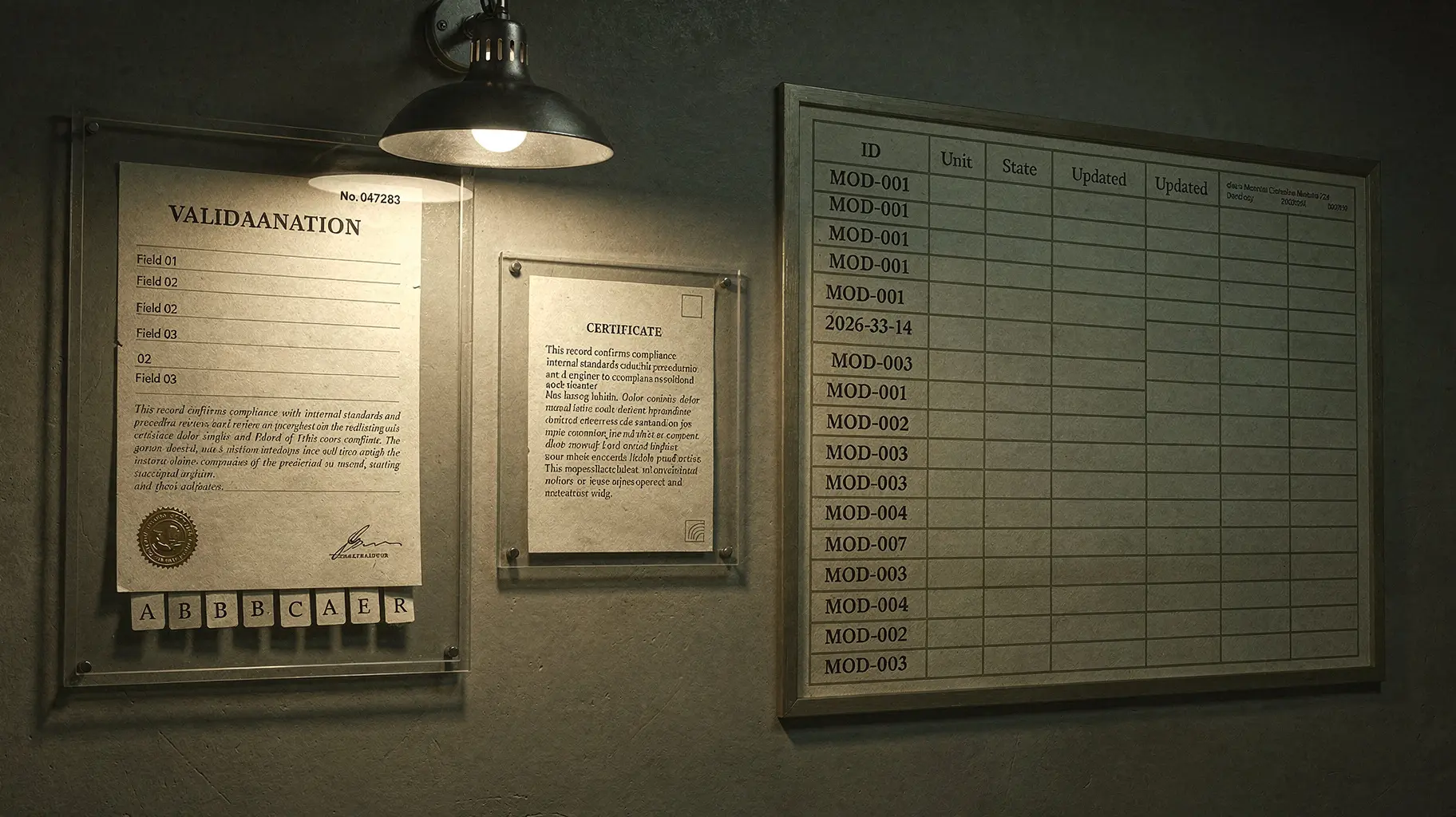
The interim side is where the programme is more candid than most regulators. The Modules In Process list "contains cryptographic modules on which the CMVP is actively working", and it is built to answer a narrow question: "This list provides some granularity into which entity has the action." Then the sentence that carries the whole briefing: "For each submission, the status and the date it went into that state is listed."
That sentence corrects the lazy version of this story. The fail is not invisible. A submission that has gone back to a laboratory for more work sits on a public board as a position, with a date attached, while the vendor's competitors and customers can both see it. Anyone can count how long a file has held one position. Very few public processes in this sector volunteer that much. If the objection were that an industry gate hides its rejects, this gate does not: it publishes the waiting room, the desk each file is on, and how long it has been there.
What it does not publish is the reason. Across the three pages reviewed — the programme page, the validated modules page and the in-process list — no field states why a submission came back, no count of returned submissions appears, and no ground is given for a withdrawal. A status tells you which desk holds the file. It does not tell you what was found there: whether the implementation failed, whether the evidence was thin, whether the laboratory and the programme disagreed about a requirement, or whether the vendor simply took a year to answer. Those possibilities are indistinguishable from outside, and they are not equivalents.
One is a security fact about a product; another is a scheduling fact about a company.
Then there is the sentence a buyer actually reads. On the same page that promises official validation information, the programme adds: "Module descriptions were provided by the vendors, and their contents have not been verified for accuracy by NIST or CSE." Put the two halves together and the record becomes lopsided in a precise way. The verdict is independent, laboratory-verified, programme-validated, co-owned by two agencies. The description of what was verified is a vendor paragraph, published with an explicit disclaimer that neither NIST nor CSE checked it.
A reader who trusts the certificate and skims the prose is trusting two different authors without being told to notice the seam.
One more boundary before this is useful. This briefing reads the programme's pages, not the standard behind them, and not any individual entry on either list. No FIPS 140-3 text was read, so nothing here describes what a module must do to pass, how a security level is assigned, or what an implementation-guidance document settles. No certificate record, no in-process entry and no laboratory file was opened. The claims above are about what three pages say they publish, and the negative is scoped to those three pages as retrieved on 17 November 2026 — not to what the programme holds or publishes elsewhere.
The delta from this archive is checkable. A search of BTW's published and draft coverage for "NIST" on 17 November 2026, limit 30, returned rows on agent identity under DevSecOps, two O-RAN items, IR 8613 on multi-cloud, IR 8587 on token revocation, operational-technology security, the NIST time-service history and the CSF's five elements, among unrelated rows. None of the rows returned by that search reads FIPS 140-3 validation or the Cryptographic Module Validation Program. The directory card counts ten prior articles, and nothing is claimed here about the rest.
So what kind of instrument is this? It is a gate that publishes its verdicts exhaustively, publishes its queue honestly, and stops one field short of publishing the reasoning — while the one descriptive paragraph attached to a verdict belongs to the party with an interest in how it reads. That is not a hidden gate. It is a documented gate with an unaudited narrative layer, and the difference between those two things is exactly the difference between a certificate and a sentence.
Member Briefing
Read the full trend briefing
Members read the full briefing with the source notes behind every finding.
Strategic Circle
A daily briefing in your language, built from changes we have verified.
Join for USD 20/monthCancel anytime.
Members also get the full research library, a daily briefing on the networks they follow and the private forum.