
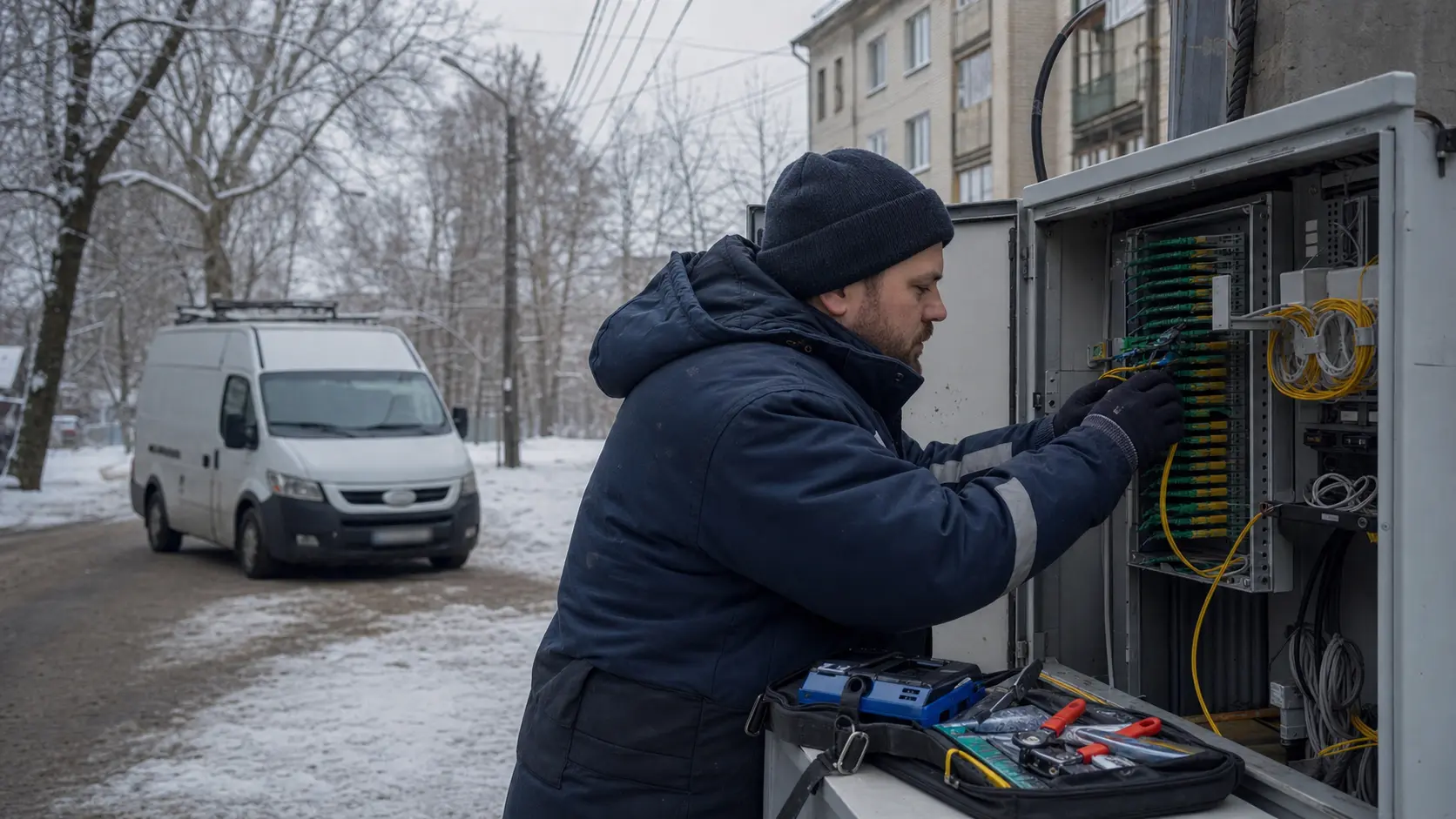
Summary
- Eurocontact Veliky Novgorod, operating publicly under the Novline designation, has enough public evidence to be treated as a real licensed regional communications operator: official service pages, six licence references, city-specific tariffs, subscriber technical conditions, RIPE LIR identity, AS52193 and visible announced address space all point to an operating access and network business rather than a dormant shell.
- The hard question is economic rather than existential. Novline's published household tariffs sit in a low monthly-revenue envelope, while the company is trying to support field repair, local offices, cable and fibre expansion, IPTV representation, business connectivity, upstream reachability, customer equipment and regulatory duties across Veliky Novgorod and smaller regional towns.
- The most defensible judgment is conditional viability. Eurocontact VN can be a valuable local operator if it keeps network density, paid repair boundaries and upsell discipline ahead of labour, capex and churn. Public evidence does not prove national-scale resilience, deep supplier bargaining power or a margin immune from national providers and Russia-specific procurement pressure.
The payer is buying transferred repair risk
The payer in this business is not an abstract broadband subscriber. It is a person in an apartment who wants video calls to work, a shop that cannot lose card payments, a small office that needs a stable line before Monday morning, a local institution that wants television or IP connectivity without becoming its own maintenance department, or a household in a private-sector street waiting for fibre construction to reach the gate.
That payer may compare megabits and monthly prices, but the reason to choose a local operator is usually less glamorous: when something breaks, there should be a local counterparty that knows the building, the cabinet, the drop line, the modem and the neighbourhood.
That is the proper starting point for Eurocontact Veliky Novgorod LLC. The company, using Novline as its commercial designation, offers internet, digital cable television, IPTV, IP telephony, L2VPN and VLAN channels, intercoms and video surveillance. Its own materials describe services for both individuals and legal entities. Its pages show city surfaces for Veliky Novgorod, Staraya Russa, Chudovo, Borovichi, Valday and Malaya Vishera. The commercial premise is that regional proximity can have a price.
A national carrier may have brand scale, procurement scale and mobile bundling power, but the local provider can try to win with installation knowledge, reachable support and willingness to extend or repair the local last mile.
The difficulty is that the customer rarely pays separately for every bit of that responsibility. A residential tariff turns a messy service obligation into a simple monthly number. The household sees 50, 100, 500 or 1,000 Mbit/s and a monthly bill. Behind it sit upstream capacity, city fibre, coax distribution, subscriber drops, cabinets, routers, modems, set-top equipment, support phones, service offices, payment systems, fault visits, legal notices and licence compliance. The operator earns only if enough customers pay steadily and if failures do not consume more labour than the tariff can bear.
This is why Eurocontact VN should not be analysed as a generic profile of a Russian telecom company. The relevant economic question is sharper. Can a regional operator in Novgorod Oblast price local uptime and repair highly enough to cover the cost of being local? It is not enough to have a licence, an ASN, a website and tariff cards. Those facts prove the operating surface. They do not prove that every town branch, expansion street, customer modem and supplier bill is being carried by a thick margin.
The payer also faces substitutes. In Veliky Novgorod, public comparison pages show national and larger operators competing for address-level broadband demand, including Rostelecom, MTS, MegaFon, t2 and other brands visible to consumers. That creates a ceiling on how much Novline can charge for ordinary connectivity. If the customer sees internet as a commodity, Novline must match or nearly match the market. If the customer sees the operator as the party that will actually answer during a fault, Novline may hold the account even without national scale. The investment case lives in that difference.
The boundary is a regional Novline access business
The operating boundary is reasonably clear. Novline's about page identifies LLC Eurocontact VN as a licensed communications operator and gives the full company details: legal identity, registration numbers, address in Veliky Novgorod, sales-office surface, manager and contact channels. RIPE records reinforce the same identity under ORG-EVNL1-RIPE, with EUROCONTACT VELIKY NOVGOROD LLC as a Russian LIR and the same Veliky Novgorod address. Public business databases align around a July 2020 registration, a wired-communications main activity, the same INN, KPP and OGRN, and active status.
The service boundary is broader than a plain internet-access offer. On the residential side, Novline sells internet, internet plus digital TV, television packages and IPTV packages. On the business side, the site invites office internet and TV enquiries and the company describes communication channels such as L2VPN and VLAN. The support and technical documents show customer-premises equipment, subscriber wiring, fault-reporting obligations and technical rules. The regional pages show branch contact points and local tariff cards. Malaya Vishera news shows active fibre construction in private-sector streets, not merely a static coverage claim.
The company is therefore best read as a regional access and local communications operator with its own network-resource identity and a mixed service catalogue. It is not publicly evidenced as a national backbone operator. It is not evidenced as a fully vertically integrated television-content owner. It is not evidenced as a hyperscale hosting or cloud provider. It may provide business channels and network services, but the public evidence does not reveal how much revenue comes from businesses versus households, nor whether business services carry premium margins.
That distinction matters because too much importance can be placed on a registry entry. AS52193 is real and visible. Eurocontact VN has RIPE LIR identity and address resources. But an ASN does not sell a subscription by itself. A prefix is a tool, a control surface and an operating obligation. The paid service still depends on customers, contracts, service reliability, pricing and repair discipline. Likewise, licence evidence is necessary for a telecom operator, but a licence is not a moat. It permits operation and imposes duties; it does not ensure attractive unit economics.
The most revealing boundary evidence is actually mundane. Novline's technical conditions for subscriber coax data lines say the data signal between the cable modem and central router uses Eurocontact VN cable structures and equipped distribution infrastructure. They restrict unauthorised changes by the customer, require immediate reporting of faults and unauthorised connection attempts, and say customer-caused restoration is performed by Eurocontact VN specialists under current tariffs. That is where the business becomes tangible.
The company is not merely billing for access to the internet; it is responsible for the condition of a local physical path.
Published tariffs define a narrow revenue envelope
The published Veliky Novgorod tariffs show the shape of the revenue problem. Internet-only residential offers run from a 50 Mbit/s tier at 370 RUB per month to a 1 Gbit/s tier at 1,000 RUB per month. Internet-plus-TV bundles include tiers such as 500 Mbit/s with 155 digital channels at 900 RUB and 1 Gbit/s with 155 channels at 1,150 RUB. Promotional offers can be lower still, including a 100 Mbit/s plus TV plan advertised at 250 RUB per month under a named promotion. These figures are useful not because every customer pays exactly those rates, but because they set the retail envelope inside which fixed and variable costs must be recovered.
At those prices, the operator needs density. A 1,000 RUB monthly payment sounds meaningful only until it is divided across upstream capacity, access-network depreciation, billing, support, office staff, taxes, payment friction, equipment loss, bad debt, installation time and future repair. A 370 RUB entry plan leaves even less room. The economic logic of cable and fibre networks has always depended on shared infrastructure: one trunk, one building entry or one street build must support many paying accounts. The more customers attached to each network segment, the more the fixed cost can be spread.
The thinner the street or town, the more every truck visit and every modem swap damages the economics.
The tariff spread also shows what Novline is trying to monetise. The difference between low-speed internet and high-speed bundled service is not just speed. It is a way to increase account revenue from households already on the network. Television packages, IPTV options and office enquiries are tools for turning an access line into a broader monthly relationship. The risk is that each add-on brings its own support burden. IPTV raises content and supplier dependence. Television involves signal-quality and subscriber-equipment issues. Office service raises uptime expectations and can require more personalised response.
A tariff card can show upsell; it cannot show whether the upsell is profitable.
The market benchmark is uncomfortable. Public provider comparisons for Veliky Novgorod show competing internet offers with minimum prices in the same general low hundreds of RUB and speed claims up to 1 Gbit/s. National operators can subsidise acquisition, cross-sell mobile, absorb marketing cost across larger customer bases and use centralised systems. A local operator may know the building better, but it cannot expect the ordinary customer to pay a large local premium if the advertised speed and price look worse. That caps Novline's pricing power in the mass residential segment.
This turns the payer's incentive into a discipline test. If the household or office genuinely values local response, Novline can retain the account and possibly sell a higher bundle. If the household treats service as a commodity, the provider is exposed to churn whenever a larger operator offers a discount, bundled SIM, free installation or faster advertised tier. Price therefore does not just indicate revenue. It indicates how little room there may be for operational sloppiness.
The tariff evidence does not disclose ARPU, discounts, payment behaviour or churn. It does, however, show that Eurocontact VN is not operating in a premium enterprise-only segment. A meaningful part of the public offer is low-ticket recurring access. That makes the business more stable than one-off project work, but only if subscriber maintenance remains under control. In a low-ticket access model, repeated repair visits can turn a customer from profitable to loss-making long before the customer cancels.
Regional reach creates a density problem
Novline's regional footprint is strategically attractive and operationally awkward. The company presents activity in six cities or towns: Veliky Novgorod, Staraya Russa, Chudovo, Borovichi, Valday and Malaya Vishera. Regional spread can diversify revenue, increase brand presence and let a local operator serve places where national providers may be less attentive. It can also fragment density. Each town needs some combination of sales presence, support knowledge, access facilities, spares, contractors, local permissions, building relationships and customer communication.
A network that looks small on a map can become labour-intensive when the operator must respond locally.
Malaya Vishera is the clearest public example. The local Novline news page describes fibre construction in private-sector streets, completed work on named streets, work in progress on others, a plan to build to additional streets and Pustaya Visherka by the end of 2026, and a 2027 focus on several more streets. It says the project will create a distribution network for household connections and states a total build of 4 kilometres of trunk fibre and 20 kilometres of distribution fibre. That is the right kind of evidence for an operating regional ISP: street-level construction, household connection logic and time-phased coverage expansion.
It is also the right kind of evidence for economic caution. Private-sector fibre is not the same as adding another apartment block already passed by plant. Lower density raises the cost per address. Drops may be longer. Weather, poles, ducts, permissions and customer schedules matter more. Construction may require local trust and collective demand. The same notice encourages residents not yet in the plan to submit collective applications. That wording is economically revealing. Collective demand reduces build risk. It helps the operator decide whether a street has enough likely take-up to justify capital and field time.
The office-closure notices are equally revealing, though in a different way. A Malaya Vishera news item says the local office is temporarily closed because an employee is on leave, while information remains available by phone and payment can proceed through personal account and bank channels. Another holiday notice keeps technical support available by phone and SMS fault messages, asking customers to include the connection address and describe the fault. None of this is scandalous. Small regional branches naturally depend on a small number of people.
But it shows the cost of being local: the operator must maintain a visible service surface in each town even when the human base is thin.
That creates a trade-off. A local branch builds trust and may improve retention. It can help collect payments, explain tariffs, schedule installations and reduce customer anxiety. But a branch also costs money and can create customer expectations that exceed the revenue of a low-priced line. The company needs enough subscriber density in each locality to justify the presence. If density is too low, central support becomes cheaper but local differentiation fades. If local differentiation fades, the company competes more directly on price against national operators.
The regional strategy therefore works only if construction is disciplined. Fibre should follow demand clusters, not civic ambition alone. Offices and support channels should be sized to the revenue base. Repair rules must keep customer-caused faults billable. Product complexity should not multiply field visits. In small towns, the operator's worst enemy is not one dramatic failure; it is the steady accumulation of low-value obligations spread too thinly across geography.
Number resources strengthen credibility but do not prove monetisation
Eurocontact VN's number-resource evidence is unusually important because it separates the company from a pure retail reseller. RIPE records show ORG-EVNL1-RIPE as EUROCONTACT VELIKY NOVGOROD LLC, with LIR status and a Veliky Novgorod address. RDAP for AS52193 identifies Evrokontakt-as, with registration in 2019 and a last-changed event in July 2026. RIPEstat showed the AS announced at the 2026-07-19 query time. Announced-prefix data showed 19 rows, including aggregates and more-specifics across several IPv4 ranges and two IPv6 aggregates.
RIPEstat's routing-status data is more useful than a static whois fact because it shows a live route footprint. At the query time, AS52193 had 17 IPv4 prefixes, 3,328 IPv4 addresses, two IPv6 prefixes and full or near-full RIS visibility. Public BGP mirrors showed three upstreams and many peers. IPinfo showed the same 3,328 IPv4 footprint and listed important routers in Veliky Novgorod and Saint Petersburg contexts. BGP.tools identified upstreams including MegaFon, Global Network Management and RASCOM in its public view.
This is meaningful. It indicates that Eurocontact VN is not merely an access brand sitting invisibly behind someone else's network. It has its own autonomous-system identity, address space and routing presence. That can improve control over addressing, traffic engineering, customer services, business connectivity, redundancy design and network reputation. It also helps explain why the company belongs in a telecom-economics discussion. A local access operator with live routing resources has more operating surface than a sales agency.
But number-resource evidence must not be inflated. An AS number is not a customer count. A visible prefix is not a paid service. A peer count is not an SLA. An upstream label on a BGP mirror is not a contract price. Public route data can show reachability and some network relationships; it cannot show capacity commitments, traffic volume by customer, redundancy under failure, whether traffic is balanced, how much transit costs, whether backup paths have enough headroom, or whether business customers pay for guaranteed service.
That difference is central to the article's judgment. The registry evidence is strong enough to say Eurocontact VN controls real network resources. It is not strong enough to say those resources are monetised at attractive margins. A small operator can hold addresses and still struggle if residential ARPU is low, if customers churn, if equipment replacement is expensive, or if field repair consumes too much labour. Conversely, a small but disciplined operator can turn a modest routing footprint into a valuable local network if it keeps churn low and uses business services to lift account revenue.
The IPv6 evidence is also a mixed signal. Two large IPv6 allocations in public views show capability and future-readiness, but they do not prove consumer adoption, CPE readiness or revenue. IPv6 is good hygiene and can reduce long-term pressure on IPv4 resources, yet it rarely allows a regional ISP to charge a premium by itself. It matters because sophisticated network control supports resilience and operational credibility; it is not a product that most households knowingly buy.
Suppliers sit under the monthly bill
Eurocontact VN's customers see Novline; the operator sees a stack of suppliers and obligations. Upstream networks carry traffic beyond the local footprint. Equipment suppliers provide routers, switches, optical gear, coax components, cable modems, customer routers and TV equipment. IPTV introduces a content and operator relationship. Payment, banking, office services and software sit underneath ordinary billing. Regulatory compliance sits above all of it. The customer bill has to carry the entire chain.
The IPTV public offer is particularly important. It names LifeStream LLC as the operator for the IPTV cable-broadcasting service and Eurocontact VN as an authorised representative under an agency contract and power of attorney. The document describes monthly subscriber fees, personal accounts, line support, tariff-change notices and delivery through the authorised representative. This does not make Novline's IPTV offer weak. It makes the boundary clearer. Eurocontact VN can package and support the customer relationship, but part of the content/service stack sits with another operator.
That supplier structure is rational. A regional access operator should not necessarily own every content right or every upstream layer. Partnering can reduce capital burden and shorten time to market. The problem is bargaining power. If the supplier cost rises, if content terms change, if technology changes, or if regulatory conditions shift, the local operator must decide whether to raise prices, absorb cost or change the bundle. In a market where customers compare monthly tariffs tightly, passing through cost can be difficult.
Upstream dependence has the same logic. BGP views showing multiple upstreams are better than a single visible route, but they are not the same as owning a national backbone. MegaFon, RASCOM and Global Network Management appearing in public views tell us that Eurocontact VN has external routing relationships visible to the internet. They do not tell us the price per Mbps, committed capacity, protection terms, outage credits or upgrade constraints. A regional ISP can be operationally sound with such suppliers, but the customer's uptime promise still rests partly on counterparties outside its full control.
Supplier dependence matters more in Russia's current geopolitical and procurement context. Even without evidence that Eurocontact VN is individually restricted by sanctions, the Russian telecom equipment environment is not frictionless. Foreign-vendor support, replacement modules, software updates, payment channels, insurance and financing can all be affected by supplier risk appetite and wider restrictions. Domestic substitutes and parallel channels may solve some problems, but they can raise cost, reduce choice or lengthen lead times. A small regional operator has less room to absorb that than a national carrier.
Field labour is the hidden margin line
The most important cost line may not appear directly in public accounts. It is field labour. Broadband customers do not experience a network as a balance sheet. They experience it as installation appointment, line quality, modem behaviour, Wi-Fi complaints, TV signal problems, payment confusion and response time after a fault. Every one of those events can require human attention. In a low-ticket monthly model, the operator has to make support work repeatable and bounded.
Novline's support evidence shows a structured but finite support surface: technical support hours through the day, branch phone numbers and SMS fault reporting in regional notices. The technical documents sharpen the boundary. Customers may not independently change the coax line composition or path, attach unauthorised devices, damage connectors or ignore faults. The company reserves the ability to suspend service until the subscriber line matches requirements, and customer-caused restoration is done by company specialists under current tariffs. Those are not just legal niceties. They are attempts to protect margin.
Without such rules, local repair becomes a free option for the customer. A subscriber could alter wiring, add splitters, move a modem, damage connectors, blame the operator and demand restoration. The company would then pay a technician to fix a problem not priced into the monthly tariff. The technical conditions move part of that risk back to the customer. They also help preserve network quality for neighbours, because poor in-premises coax or unauthorised connections can degrade signal levels and create diagnostic noise.
That does not eliminate the labour problem. It only makes it manageable. Technicians still need to install lines, test signal levels, replace equipment, respond to outages, handle weather damage, support elderly or non-technical customers, coordinate with building managers and maintain records of what has been done. In smaller towns, travel and scheduling consume time. If the company expands into private streets, the labour mix becomes more construction-heavy before it becomes maintenance-heavy.
Headcount evidence from public profiles suggests a modest organisation, not a tiny one-person service. RBC reports an average headcount of 75; Vsem Podryad reports 62 for 2025. The discrepancy is not unusual across public profiles, but the rough range is informative. A 60-75 person company with about 132.8 million RUB of reported 2025 revenue is substantial for a local provider, yet not large enough to bury mistakes under scale. Labour productivity matters. Dispatch discipline matters. The number of accounts per technician matters. The ratio of proactive maintenance to emergency calls matters.
This is where local operators can either beat national competitors or lose quietly. A national provider may have a centralised call centre and slower local empathy. A local operator can diagnose quickly and keep local goodwill. But if that goodwill means every customer expects bespoke support, margin disappears. The winning model is local enough to retain trust, standardised enough to keep labour under control, and strict enough to bill customer-caused work.
Capital renewal is harder than the revenue line suggests
Reported revenue of roughly 132.8 million RUB for 2025 makes Eurocontact VN look more serious than a micro-provider. Public profiles also show meaningful profit figures, though they differ in how they label profit and net profit. RBC reports 2025 revenue of 132.833 million RUB, cost of sales of 96.427 million RUB and profit of 63.003 million RUB. Saby and Vsem Podryad show net-profit figures around 34.8 million RUB. Those numbers suggest an active company with positive public financial indicators.
The problem is that telecom capital renewal can be lumpy and only partly visible from annual headline figures. Fibre construction requires upfront spend before every address becomes a paying account. Customer equipment may sit with subscribers in temporary use. Coax networks need maintenance, amplifiers, splitters, connectors and quality control. Routers and switches need replacement cycles. IPv6 readiness, security posture and routing hygiene require skilled engineering. Business connectivity may require higher reliability and better equipment than residential access.
High domestic interest rates make the timing more important. The Bank of Russia's June 2026 key-rate decision left the key rate at 14.25 percent after a small cut. That is a macro indicator, not Eurocontact VN's exact borrowing rate. Still, it tells us the environment for financing equipment and construction is tight. A regional operator that funds network expansion from retained earnings avoids some financing risk, but then expansion competes with maintenance, wages and dividends for cash. If it borrows, interest cost raises the hurdle rate for every new street and town.
The Malaya Vishera fibre plan illustrates this. Four kilometres of trunk fibre and 20 kilometres of distribution fibre could create valuable future cash flows if take-up is strong and repair costs are controlled. It can also consume capital before revenue arrives. Private-sector builds often rely on resident demand signals because density is lower than in apartment blocks. The invitation for collective applications is therefore not just community outreach; it is risk management. The company needs to know which streets will convert from planned coverage into paying customers.
Equipment renewal also interacts with supplier pressure. If import channels are more complicated, if replacement hardware costs rise, or if lead times lengthen, the operator may keep older equipment in service longer. That can be rational, but it raises outage and maintenance risk. The more a network depends on old coax segments, customer modems or specialised gear, the more the operator needs disciplined spares and preventive maintenance. Otherwise the monthly subscription becomes a promise funded by yesterday's capital.
The public evidence is not enough to judge whether Eurocontact VN's capex plan is adequate. We do not have cash-flow statements, depreciation, network age, capex by city or equipment inventory. What can be said is that the company operates in a business where replacement cannot be deferred forever. The fact that revenue is positive does not automatically mean the network is being renewed at the right rate.
Public contracts validate capability, not the whole business
Public procurement profiles add a useful but limited signal. Saby reports tender participation and wins, while Vsem Podryad identifies several procurement wins with an aggregate value around a few million RUB and work descriptions linked to telecommunications wiring or local line activity. Those records matter because they show that the company can interact with institutional buyers and perform formal telecom-related works. They also support the view that field capability is real rather than merely advertised.
But the amounts visible in the opened profiles are too small to carry the business. Against reported revenue above 130 million RUB, a few million RUB of identified procurement wins is supporting evidence, not the core economic engine. It would be wrong to read procurement as proof that Eurocontact VN depends on government contracts. It would also be wrong to ignore it. A local operator that can win municipal or institutional jobs may gain reputation, building access and recurring relationships. Those can feed the access business even if the tender itself is modest.
The procurement evidence also reveals the value of practical competence. A regional ISP's differentiation may be less about abstract technology and more about knowing how to get lines built, repaired and accepted in real local environments. Municipal offices, emergency-management bodies, schools, clinics, small businesses and housing stock need connectivity that fits local constraints. A provider that can execute small formal projects may earn trust disproportionate to the contract amount.
The open question is whether such trust converts into higher recurring revenue. A wiring job that leads to a multi-year service account is more valuable than the tender value suggests. A one-off job with thin margin and warranty headaches is less valuable. Public profiles do not disclose the follow-on service relationship. The article's judgment therefore treats procurement as a capability signal and a possible customer-access channel, not as proof of a durable institutional moat.
Competition caps the value of being local
Regional access providers often describe themselves through service quality and local presence. Customers, however, encounter comparison tables. In Veliky Novgorod, public provider pages list several alternatives and tariffs at broadly comparable monthly levels. National names can advertise 100 Mbit/s, 500 Mbit/s or 1 Gbit/s service, sometimes bundled with mobile service, television or promotional discounts. That limits Novline's ability to raise prices simply because it is local.
The competitive question is not whether a national operator can serve every address better. It is whether enough customers believe the local operator is worth staying with when another offer arrives. In apartment blocks, provider switching can be easy if multiple operators have infrastructure. In private streets, switching may depend on actual coverage and installation wait times. In business accounts, switching can involve static addressing, internal network changes, contract timing and risk tolerance. The stickiness varies by customer segment.
Novline's strongest competitive asset is likely local execution. The company can advertise its own regional offices, phone numbers, branches and construction notices. It can speak directly to residents about street plans. It can ask for collective applications. It can use technical rules to keep premises wiring within known standards. It can support intercoms and video surveillance alongside internet. Those are not national-scale advantages; they are local trust advantages.
The weakness is that local execution must be paid for. A national provider can sometimes absorb unprofitable acquisition because the household also buys mobile service or because group-level scale reduces per-account overhead. A regional operator has fewer adjacent revenue pools. It needs higher retention, lower service cost or higher product penetration to justify the same customer. If a customer takes only the cheapest internet plan and calls support frequently, the account may be unattractive. If the customer takes internet, TV, equipment, business connectivity or paid repair, the account becomes more defensible.
Customer concentration is another unknown. Public tariffs make the residential offer visible, but business services may be economically important even if less advertised. L2VPN, VLAN channels and office internet can carry better margins if priced correctly. They can also impose higher expectations. A small business may tolerate a home internet hiccup poorly if it loses payment acceptance or booking systems. The operator must decide when a customer needs a business-grade service and must pay for it, rather than quietly enjoying business use on residential economics.
Competition therefore pushes Eurocontact VN toward segmentation. Residential mass service must be efficient and standardised. Higher-end residential bundles must lift account value without multiplying faults. Business services must be priced for response and service boundary. Regional expansion must follow demand. Local trust is valuable, but only if it lets the operator hold or raise account revenue, not if it merely attracts more underpriced obligations.
Regulation and geopolitics turn uptime into cost
Telecom is not a normal local-service business. Eurocontact VN's official pages and licence materials show a regulated communications operator surface: data transmission, telematic services, cable broadcasting, telephone-related permissions, communication channels and subscriber conditions. Regulation is essential to the legitimacy of the offer. It also creates fixed obligations that do not shrink neatly when a town has fewer customers.
The public documents show legal and operational discipline around subscriber accounts, notices, technical breaks, service rules and claims. Customer-facing telecom rules can protect the operator, but they also impose standards. A tariff change requires communication. An outage can create a claim. Equipment handed to a customer must be tracked and returned. Subscriber lines have to meet technical parameters. Personal accounts and payment channels need to work even when service is suspended. These are ordinary duties for a licensed operator, and ordinary duties are exactly why scale matters.
Geopolitics adds a second layer. The article does not need to claim that Eurocontact VN is named on any sanctions list; the public evidence reviewed here does not show that. The relevant point is broader procurement and counterparty pressure. Russian telecom operators operate in an environment where foreign equipment, software support, payment routes, vendor warranties and financing relationships can be affected by international restrictions and supplier risk decisions. Even legally available goods can become more expensive or slower to procure.
A regional operator may have to hold more spares, extend the life of older equipment, source through narrower channels or accept less favourable payment terms.
That pressure interacts with the low tariff envelope. If a router, optical module, cable modem or network appliance becomes more expensive in RUB terms, the operator cannot automatically pass the cost to every residential customer. Competition and household budgets limit price increases. If the company delays replacement, repair costs may rise. If it raises prices, churn may rise. If it absorbs cost, margins compress. This is the basic trap for small network operators in constrained procurement environments.
Regulatory and geopolitical risk also makes documentation more valuable. A local operator with clean licence evidence, known legal identity, registry contact discipline and clear subscriber terms has a better chance of dealing with suppliers, banks, public customers and regulators. But documentation is not the same as resilience. It lowers some friction; it does not remove equipment, financing or labour constraints.
The right conclusion is measured. Russia-specific pressure raises Eurocontact VN's cost of staying current, but it does not by itself prove distress. Public financial profiles show positive revenue and profits in 2025. The network is visible. Tariffs and construction notices are active. The risk is not imminent failure visible in public evidence. The risk is that equipment renewal and supplier constraints gradually reduce the economics of local repair unless pricing and density keep up.
Unofficial signals should be read with restraint
Unofficial public signals help, but only when they are kept in their proper lane. 2IP's Novline profile and public measurement/review surfaces show that Novline is visible as an internet provider to ordinary users. That is useful corroboration of market presence. It is not reliable proof of subscriber count, customer satisfaction, uptime or quality. Review pages are self-selecting and can overrepresent unhappy or unusually engaged users. Speed tests depend on customer devices, Wi-Fi, time of day, tariff and measurement path.
Provider comparison pages are similarly useful but bounded. They show that customers can compare Novgorod broadband prices and national alternatives. They show the consumer mental model: provider, speed, monthly fee, connection charge, coverage addresses and promotion. They do not prove which provider is available in every building, which offers are actually accepted by customers, or which operator performs best after installation. They are price and substitute evidence, not a full market-share model.
Public business profiles need the same caution. RBC, Saby and Vsem Podryad align around identity, revenue order of magnitude and active operating status, but they differ in some headcount and procurement details. That does not make them useless. It means the article should use them as third-party profile evidence, not as audited truth. The key economic reading survives the uncertainty: Eurocontact VN appears to be a real, active, profitable regional operator of meaningful but limited scale.
BGP mirrors also require restraint. BGP.tools, IPinfo and RIPEstat provide valuable external views of AS52193. They can show active announcements, prefix counts, visible upstreams and observed neighbours. They cannot show purchased capacity, SLA, congestion, packet loss, customer distribution, revenue by service or outage history. In an economic essay, that distinction is not pedantry. It prevents the network evidence from becoming an unsupported quality claim.
The strongest unofficial signal may be the combination of all these weaker signals. A company-controlled site, active city pages, technical documents, regulator licence context, RIPE records, BGP visibility, public financial profiles and competitive listings all point in the same direction: Novline is not a paper operator. But none of them alone answers the investment question. The public picture supports existence and operating seriousness. It does not settle durability.
What would reverse the judgment
The article's base judgment is that Eurocontact VN is conditionally viable but constrained: real local operating evidence, narrow retail pricing, meaningful regional labour burden, visible network control, and uncertain long-term renewal economics. Several facts would materially improve that judgment.
The first would be subscriber density by city and by network segment. If Novline can show high take-up on existing plant, strong renewal in private-sector fibre streets and low churn against national operators, the regional strategy looks much stronger. Dense local plant turns field labour into a controllable cost. Sparse plant turns each repair into a margin event.
The second would be ARPU and product mix. A business supported mostly by 370-550 RUB residential internet lines is fragile. A business with high penetration of TV bundles, business channels, managed services, intercoms, video surveillance and paid repair has a better revenue base. The public tariff pages show the products exist; they do not show mix.
The third would be repair economics. Number of tickets per thousand subscribers, repeat fault rate, average truck roll cost, customer-caused repair recovery, modem loss rate and first-time fix rate would change the conclusion. A local ISP can tolerate low monthly tariffs if support is efficient. It cannot tolerate chronic unpriced repair.
The fourth would be capital discipline. Evidence of planned network renewal, spare-parts availability, equipment age, supplier diversification and funding would reduce the risk that today's positive revenue is consuming yesterday's network. Public construction notices are encouraging, but they show build activity, not asset health across the footprint.
The fifth would be upstream and resilience detail. Multiple visible upstreams are positive, but contract-level evidence of capacity, failover, diverse paths and actual outage performance would be stronger. If Eurocontact VN can show resilient upstream design and business-grade service performance, the local operator thesis strengthens.
The sixth would be customer concentration. A few large accounts can make a regional operator look healthy until one account leaves. Conversely, a broad base of households and small businesses can create resilience if churn is low. Public profiles do not disclose concentration.
Facts could also weaken the judgment. High churn in Veliky Novgorod, weak take-up in new private-sector builds, inability to pass equipment cost through tariffs, rising customer complaints, loss of key upstreams, content-supplier disruption, or repeated office closures without adequate support would all damage the thesis. So would evidence that reported profits do not convert into cash, or that network renewal is being deferred.
The reversibility of the thesis is important. Eurocontact VN is not a simple buy-or-dismiss story. The public evidence supports a real operator with real assets and real customers. The unanswered questions are about the quality of monetisation. A small regional ISP can look stable for years if existing plant produces cash, then suddenly face a renewal cycle that exposes underpricing. It can also look modest in public data while quietly owning a defensible local franchise.
Conclusion: local trust has to become paid density
Eurocontact Veliky Novgorod's economic story begins with a customer transferring risk. The customer pays Novline because connectivity failure is inconvenient, costly or embarrassing, and because a local operator may be easier to reach than a national system. The company has the public ingredients needed to make that proposition credible: a licensed operator identity, visible regional service pages, current tariffs, city branches, technical subscriber rules, active construction evidence, RIPE LIR identity, AS52193 and public route visibility.
Those same ingredients create the cost base. Locality means offices, technicians and branch communications. Network control means upstream relationships, routing hygiene and address administration. Television and IPTV add supplier dependence. Fibre expansion adds upfront capital. Coax and subscriber equipment add premises-level repair. Regulation adds fixed discipline. Geopolitical and financing conditions raise the cost of renewal. None of those costs cares whether the customer is on a cheap plan.
The defensible conclusion is that Eurocontact VN can work as a regional ISP only if it keeps turning local trust into paid density. That means building streets where demand is real, keeping branch service thin but credible, enforcing repair boundaries, using bundles and business services to lift account value, maintaining enough upstream diversity, and renewing equipment before deferred maintenance becomes the business model. The visible public evidence is positive enough to reject a dormant-shell reading. It is not strong enough to grant the company a protected-margin story.
For BTW's purposes, the company should be watched as a local infrastructure operator whose main vulnerability is not lack of existence but the price of accountability. If customers pay only for megabits, Novline is exposed to national competition and rising cost. If customers pay for reachable repair, reliable local installation and practical continuity across towns, Eurocontact VN has a plausible regional franchise. The facts that matter next are not another registry entry or another announced prefix.
They are take-up, churn, repair cost, capex renewal and the share of customers willing to pay for the local operator when a national discount appears.
Sources
- https://101internet.ru/novgorod/orders/tohome
- https://2ip.ru/isp/NovLine%2BPlus%2BLtd./
- https://bgp.tools/as/52193
- https://borovichi.novline.ru/
- https://chudovo.novline.ru/
- https://companies.rbc.ru/id/1205300002962-obschestvo-s-ogranichennoj-otvetstvennostyu-evrokontakt-velikij-novgorod/
- https://ipinfo.io/AS52193
- https://malaya-vishera.novline.ru/
- https://malaya-vishera.novline.ru/news/
- https://novline.ru/
- https://novline.ru/kontakty/
- https://novline.ru/news/
- https://novline.ru/novosti/index.php
- https://novline.ru/o-kompanii/
- https://novline.ru/phone/
- https://novline.ru/podderzhka/sozdanie-seti-wi-fi.php
- https://novline.ru/tariffs/vernoe-reshenie.php
- https://novline.ru/tv/
- https://novline.ru/upload/docs/randdocs/%D0%A2%D0%A3%20%D0%95%D0%B2%D1%80%D0%BE%D0%BA%D0%BE%D0%BD%D1%82%D0%B0%D0%BA%D1%821.pdf
- https://novline.ru/upload/docs/randdocs/%D0%A2%D1%80%D0%B5%D0%B1%D0%BE%D0%B2%D0%B0%D0%BD%D0%B8%D1%8F%20%D0%BA%20%D0%BF%D0%B0%D1%80%D0%B0%D0%BC%D0%B5%D1%82%D1%80%D0%B0%D0%BC%20%D0%B0%D0%B1%D0%BE%D0%BD%D0%B5%D0%BD%D1%82%D1%81%D0%BA%D0%BE%D0%B9%20%D1%80%D0%B0%D1%81%D0%BF%D1%80%D0%B5%D0%B4%D0%B5%D0%BB%D0%B8%D1%82%D0%B5%D0%BB%D1%8C%D0%BD%D0%BE%D0%B9%20%D1%81%D0%B8%D1%81%D1%82%D0%B5%D0%BC%D1%8B.pdf
- https://novline.ru/upload/docs/randdocs/Usloviya.pdf
- https://novline.ru/upload/docs/randdocs/oferta.pdf
- https://novline.ru/upload/iblock/606/606348b7b02a397918a86ed0f5358e30.pdf
- https://novline.ru/upload/iblock/74f/74f8ab5693d1b8789744166db84b4e3b.pdf
- https://novline.ru/upload/iblock/973/9733e183fdc313dc7ceba69223e80b18.pdf
- https://novline.ru/upload/iblock/c2f/c2f8dbb30353be79c45482f529a5573d.pdf
- https://rdap.db.ripe.net/autnum/52193
- https://rest.db.ripe.net/ripe/organisation/ORG-EVNL1-RIPE.json
- https://rkn.gov.ru/activity/connection/register/license/p8000/?id=%D0%9B030-00114-77%2F00078180
- https://russa.novline.ru/
- https://saby.ru/profile/5321203675-532101001
- https://stat.ripe.net/data/announced-prefixes/data.json?resource=AS52193
- https://stat.ripe.net/data/as-overview/data.json?resource=AS52193
- https://stat.ripe.net/data/asn-neighbours/data.json?resource=AS52193
- https://stat.ripe.net/data/routing-status/data.json?resource=AS52193
- https://valday.novline.ru/
- https://vsem-podryad.ru/company/c55c66a6-e7ad-4891-96f4-20cd5e746803/
- https://www.cbr.ru/eng/press/keypr/
- https://www.novline.ru/podderzhka/balans.php
- https://www.ripe.net/membership/member-support/the-ripe-ncc-and-ukraine-russia/