Summary
- Eurocable LTD has credible evidence of a real local communications operator behind the Sevencom brand in Sverdlovsk, with Russian legal identifiers, communications licences, consumer and business offers, office contacts, support channels, and RIPE number-resource records.
- The investment case is not about traffic scale. It is about whether local network reliability, repair access, customer proximity and bundled services can defend monthly revenue against bigger fixed-line, mobile and wireless substitutes while supplier, power, equipment and compliance costs rise.
- The thin AS57874 footprint, its apparent dependence on the wider Gerkon and Sevencom routing environment, and the absence of obvious downstream transit customers make Eurocable LTD a retail-access and local-service economics case rather than a wholesale infrastructure platform.
The paying account is the starting point
The useful way to read Eurocable LTD is not to start with an autonomous system number, a legal registration or a brand page. It is to start with one paying household, one small business or one municipal-style account that needs the connection to work when a router fails, a building loses power, a television service needs retuning, a payment route breaks, or an office asks why a promised speed does not show up on the customer’s device. That account is not paying for abstraction.
It is paying a monthly bill that must carry the cost of upstream connectivity, field labour, customer care, billing, equipment, regulatory obligations, number-resource administration, power, spares and the next upgrade cycle.
That is why the core question for Eurocable LTD is a cash-flow question. If the customer only buys the lowest advertised megabit price, a small local operator has little structural advantage. Larger carriers can spread backbone, compliance and vendor costs across more customers. Mobile operators can sell convenience even where fixed-line quality is uneven. Building-level competitors can use promotions to win apartment blocks.
The local operator has to sell something that the spreadsheet customer notices: faster repair, familiar support, installation in a specific neighbourhood, a technician who knows the building, bundled television or camera service, and a commercial willingness to survey an address that a national operator may treat as marginal.
The evidence points to Eurocable LTD operating in that local-service zone. The public Sevencom pages present services for households, business customers and budget institutions across places such as Yekaterinburg, Aramil, Verkhnyaya Pyshma, Iset, Polevskoy and Sredneuralsk. They list fixed internet, television, video surveillance, intercoms, security systems and business connectivity. They also show legal footer information for ООО “Еврокабель”, including the Russian tax identifier 6673126142, state registration number 1056604824627 and communications licence references running into 2026.
That does not by itself prove the size of the customer base, but it does show a real operating surface: contracts, offices, tariffs, payment notices, support notices and service descriptions.
The economic discipline is to avoid mistaking that operating surface for pricing power. A local operator can have a genuine footprint and still struggle to earn attractive returns if churn rises, if apartment-house access is expensive, if backhaul costs are sticky, or if every new service requires technician visits that the tariff does not cover. Eurocable LTD’s public positioning asks customers to value fibre availability, home and business bundles, support hours and local installation. The question is whether those attributes generate enough gross margin after the unavoidable cost stack.
What is proven about the company
The company identity is better grounded than many sparse regional network entries. Corporate and public-service pages identify ООО “Еврокабель” with an Ekaterinburg legal address, the same tax and state registration numbers, and a primary activity in wired telecommunications. Business-register mirrors show a registration date in May 2005, a small charter capital figure, private ownership, and 2024 financial indicators including revenue of roughly 44.7 million rubles, net profit of roughly 2.8 million rubles, and average headcount near 12 people.
These third-party registry summaries should be read as secondary, but they are directionally useful because they frame the business as small, local and operating rather than dormant.
The official Sevencom pages add commercial substance. The Yekaterinburg site offers home internet, television, video surveillance and intercom services. The Aramil site shows similar retail orientation and lists local office and support details. Contact pages name Eurocable in the banking and corporate requisites. Personal-data pages identify Eurocable as the operator collecting customer information for communications-service contracting and support. Tariff pages show consumer internet, internet-plus-television, digital television, video surveillance and business-oriented service modules.
News pages discuss tariff changes, support-phone disruption, payment disruption and network restoration work. Those are mundane details, but they are exactly the details that distinguish an operating access provider from a mere registry entry.
The RIPE evidence is narrower. Eurocable LTD appears as a RIPE NCC member and resource holder. AS57874, named EUROCABEL-AS, is assigned to Eurocable LTD. The associated IPv4 evidence centers on 91.236.80.0/23, split in some views into two /24s, with no visible IPv6 footprint in the common public routing summaries consulted. The aut-num policy shown in RIPE-derived records imports from AS42498 and exports AS57874 to AS42498. Third-party ASN pages therefore present AS57874 as small, IPv4-only and dependent on upstream transit rather than as a broad peering network. That evidence supports number-resource governance and a real routing identity.
It should not be stretched into a claim that Eurocable LTD runs a national backbone, sells IP transit, or controls a large wholesale platform.
There is also a broader Sevencom and Gerkon context. Several public pages carry a Sevencom brand while footers or AS records also reference Gerkon. AS42498, Gerkon, is much larger than AS57874 in public routing summaries and is associated with the Sevencom domain. IPinfo and Cloudflare Radar-style views describe it as an ISP network with thousands of IPv4 addresses, no visible IPv6, several upstreams and a wider peer set. That suggests the customer-facing brand and the routing estate may be organised across related legal or operational names. The defensible conclusion is not ownership control unless corporate documents establish it.
The defensible conclusion is that Eurocable LTD should be assessed within a local Sevencom operating environment, not as a standalone global network.
Operating boundary and service mix
Eurocable LTD’s apparent operating boundary is regional and address-specific. The Sevencom pages are built around local city selectors and distinct tariff pages. Home internet offers differ between apartment and private-house settings. Apartment offers in Yekaterinburg advertise fibre connection, speeds up to 1 Gbit/s on some pages, and standard tiers around 50 Mbps, 100 Mbps and building-specific variants. Private-house tariffs are higher, which is economically sensible: a detached-home access line often carries more drop cost, longer field time and weaker density than an apartment-block connection.
Aramil pages show internet-plus-television packages and private-sector tiers, again pointing to micro-market tariff design rather than one flat national price.
The bundle is broader than simple broadband. Sevencom pages advertise television, including DVB-C cable television and IPTV partner options where direct cable service is unavailable. Video surveillance pages price home camera services with seven-day and fourteen-day archive options. Intercom pages describe smart intercom functions, mobile-app control, video archive, vandal-resistant hardware and servicing of existing intercom systems. Business pages and repeated service blocks offer static IP addresses, up to 1 Gbit/s, free survey, short connection times and individual commercial terms.
Budget-institution pages are also presented in the site navigation, alongside internet, television, video surveillance and security-system language.
This mix matters because a local ISP rarely wins through raw connectivity alone. If a household buys internet, television, a camera archive and an intercom relation through the same local brand, the monthly relationship can become stickier. If a small business needs a static IP address and a technician who can inspect a site before quoting, the operator may compete on responsiveness rather than only on price. If a homeowners’ meeting approves an intercom replacement, the operator gains a building-level service relationship that may support retention.
Each adjacent service also adds complexity: hardware stock, app support, privacy obligations, building approvals, installer scheduling and after-sales service.
The boundary is therefore attractive only where density and service familiarity offset complexity. Yekaterinburg gives potential scale, but it is also competitive. Aramil and surrounding municipalities may offer local trust and fewer direct substitutes in some addresses, but lower density and higher truck-roll economics can erode returns. Private-house fibre at a higher monthly price can look better on revenue per account, yet it may consume more capital and repair time. Apartment blocks can be efficient once wired, but gaining building access and defending it against promotions is a recurring expense.
Eurocable LTD’s economic value depends on how many of these micro-markets earn back their access investment without relying on constant acquisition discounts.
Number resources are evidence, not the business model
The AS57874 evidence should be treated with care. A RIPE-registered autonomous system and a /23 of IPv4 address space provide useful evidence of network operation. They show that Eurocable LTD is not only a website name. They also create administrative obligations: maintaining registry data, abuse contact information, route objects and resource accuracy. They are necessary evidence for a network company, but they are not enough to prove a high-quality operating model.
The public routing views show a small footprint. A /23 is 512 IPv4 addresses before operational reservation and customer-assignment constraints. Third-party pages list no IPv6 addresses for AS57874. Some routing pages describe no direct peers and identify AS42498 as the visible upstream relation. Other views show the wider Gerkon network as carrying a larger footprint, more peers and several upstreams, with AS57874 appearing as downstream. If that view is current, the economic implication is dependence.
Eurocable LTD’s own AS may represent legacy, segmentation or a specific resource pool, while day-to-day customer experience may be bound to the performance and resilience of the wider Sevencom and Gerkon environment.
Dependence is not automatically bad. Small ISPs frequently buy upstream connectivity or operate under a related network. The real question is whether the arrangement gives customers enough route diversity, support clarity and cost control. A small access operator does not need to peer with everyone if its upstream is reliable and priced fairly. It does need redundancy that matches the promise it sells. If a local outage stems from a central node losing power, customers do not care whether the routing table had enough upstreams elsewhere. If a payment channel fails, customers do not care that the ASN is valid.
Reliability is experienced at the access node, the customer-premises equipment, the power feed, the support queue and the billing system.
The IPv6 absence in common summaries is also economically relevant. It does not necessarily harm most retail customers today, especially where IPv4 and NAT practices remain normal. But it signals deferred modernisation. IPv6 deployment can reduce future address pressure and improve readiness for public-sector, business and cloud-linked use cases. A local operator that has no visible IPv6 footprint may be conserving scarce engineering capacity, avoiding support risk, or simply following customer demand. The cost is that the network may look less future-ready to technical buyers and may need a later upgrade under less convenient conditions.
Revenue quality and the unit economics implied by tariffs
The available financial indicators are small enough to make the unit economics visible. A business-register summary puts 2024 revenue around 44.7 million rubles and net profit around 2.8 million rubles. Spread across twelve months, that revenue is roughly 3.7 million rubles per month before considering seasonal effects, business accounts, installation fees or service mix. With an average headcount around 12, revenue per employee is roughly 3.7 million rubles per year. The figures are approximate and secondary, but they are useful because they keep the analysis grounded: this is not a carrier with deep fixed-cost absorption.
It is a local operator where a few support-heavy clusters, a few underpriced private-house builds, or a few equipment cycles can move margins.
Published tariffs show why the margin test is tight. Consumer internet and internet-plus-television packages often sit in the hundreds to low thousands of rubles per month. Yekaterinburg apartment internet pages show standard monthly offers around the mid-hundreds to roughly one thousand rubles for common speed tiers, with promotional or building-specific prices in some cases. Private-house tariffs are materially higher, often above one thousand rubles and reaching close to two thousand rubles for higher speeds.
Aramil internet-plus-television packages list monthly prices that move from below one thousand rubles into the low twelve-hundreds for faster or premium-TV combinations. Video-camera archive services list much smaller monthly amounts.
These are not bad prices in isolation. The issue is what each ruble has to pay for. A customer’s monthly payment must cover upstream traffic, access equipment, customer-premises equipment support, technician time, help-desk labour, accounting, payment-system costs, bad debt, office costs, power, network maintenance, licence and data obligations, and eventual replacement of routers, switches, optical nodes, coaxial elements, intercom panels or cameras. It also has to cover churn: the installation cost of a customer who leaves early is an economic loss unless the tariff or connection fee recovers it.
The company’s own tariff-condition pages reveal several tools used to manage this. Prices apply only where technical availability exists. Apartment and private-sector tariffs are separated. Internet payments are structured as advance payments, while cable-television payment mechanics differ. New customers are required to fund the account before service effectively begins. Speed is described as delivered up to the customer endpoint, while actual user experience can be affected by customer equipment, software, protocols and external servers. These terms are not just legal protection; they are margin protection.
They reduce disputes, clarify that advertised speeds are not guarantees to every device, and lower the risk that the operator absorbs customer-side problems without compensation.
Cost pressure is visible in the company’s own notices
One of the clearest public signals is not in a financial statement but in customer notices about tariff changes. Sevencom notices have cited rising electricity, equipment, traffic and network-infrastructure maintenance costs when explaining price increases. That language is economically important. It identifies the cost lines that a local ISP cannot simply wish away. Power affects active equipment and offices. Traffic and upstream connectivity affect the cost of carrying video, cloud storage, games, work applications and streaming. Equipment costs affect routers, optical gear, switches, cameras, intercom panels, spares and replacement cycles.
Maintenance costs affect the technicians and contractors who keep physical access lines alive.
A local operator can pass through some cost inflation only if customers believe the alternative is worse. If the tariff increase is modest and service is stable, many customers will stay because switching is inconvenient. If support quality is poor, or if a mobile substitute works well enough, the tariff increase becomes a churn event. This is the central pricing-power test for Eurocable LTD. It can announce higher tariffs, but durable value depends on whether customers accept them because the local service is worth keeping.
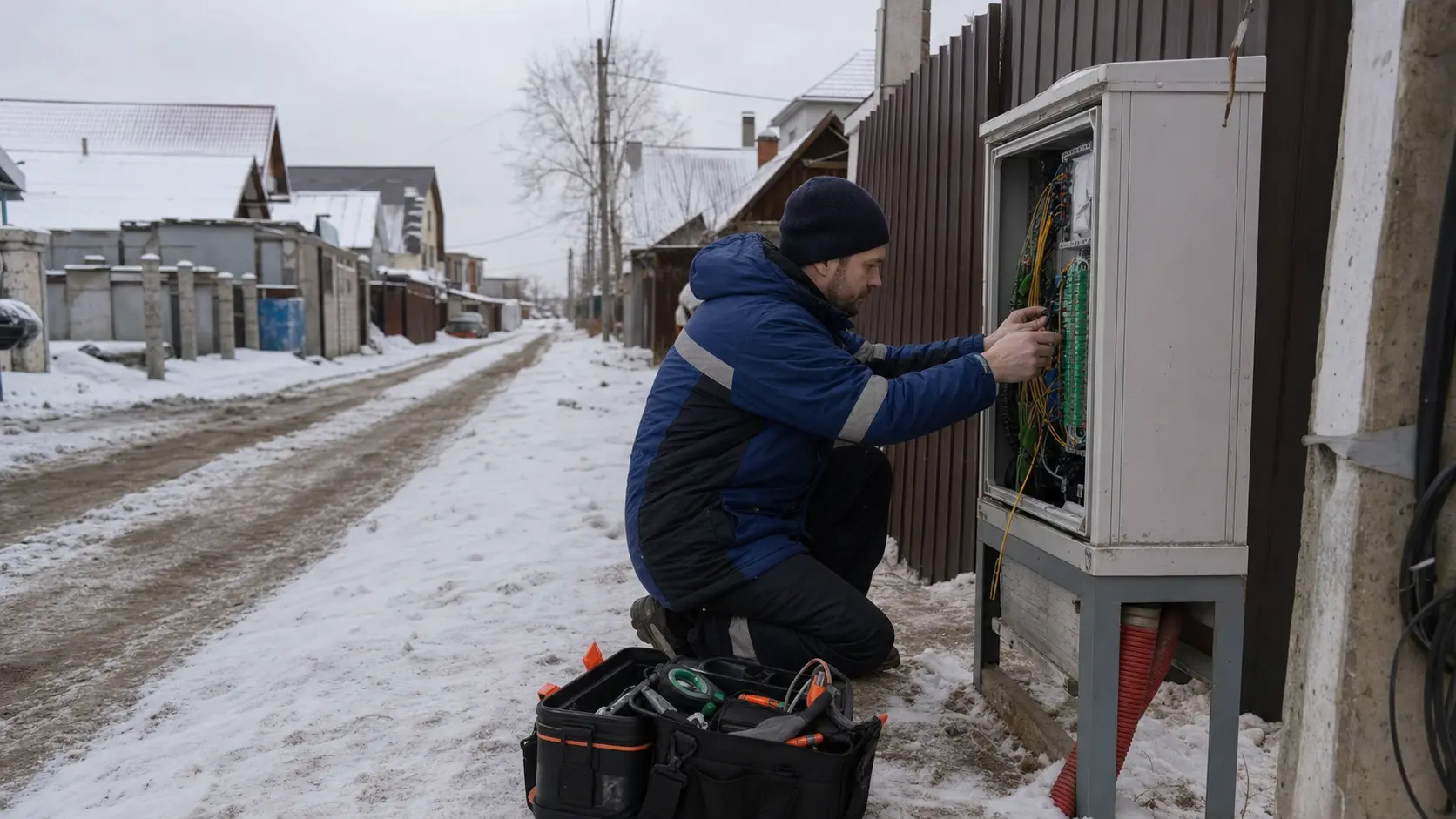
The company’s service notices also expose the operating burden. A July 2026 Yekaterinburg notice described internet trouble affecting some customers after an electrical accident and loss of power at a central communications node. A January 2026 notice described a short internet interruption caused by power loss at a node supporting data transmission. A support-phone notice in Aramil described the main support number becoming unavailable because of an issue on another communications operator’s side and the launch of a backup number. Payment notices have described disruption in mobile-app card payment and separate card-payment problems.
These are normal events for small operators, but they are not costless. Each incident consumes technician time, communication time and customer patience.
Reliability therefore is not a slogan. It is a capital and operating budget. Backup power, monitoring, spare parts, routing redundancy, payment redundancy and support redundancy all cost money before they create visible revenue. A small operator that underinvests gets outages and churn. A small operator that overinvests can destroy returns because the local tariff base is too small to amortise enterprise-grade resilience. The hard managerial task is to buy the resilience that customers actually value and will pay for, not the resilience that looks impressive in a technical plan.
The repair burden also changes the meaning of growth. A new service line can raise revenue while making the company less efficient if it adds too many one-off device issues, app questions or site visits. A camera archive, a smart intercom and a business static-IP connection may each be sensible products, but they pull on different support skills. The profitable version is a repeatable installation pattern with standard equipment, clear customer instructions and a tariff that recognises future maintenance. The unprofitable version is custom work priced like a mass-market broadband add-on.
Risk transfer and the repair bargain
The local broadband contract is also a risk-transfer instrument. The customer wants a predictable monthly payment and expects the operator to absorb uncertainty: a storm, a power interruption, a failed optical terminal, a payment-system break, a television retune, a router that cannot deliver advertised speed over old Wi-Fi, or a business customer whose static address suddenly matters because payroll, cameras or remote access depend on it.
Eurocable LTD can push some risk back through terms that limit service to technical availability, define speed at the customer endpoint, require advance payment and distinguish between operator network performance and customer-device limitations. But those clauses do not move the reputational burden. If the service feels unreliable, the customer blames the provider, not the footnote.
This is where pricing power becomes concrete. A local operator does not have pricing power because connectivity is necessary; it has pricing power only if customers believe the operator reduces their expected inconvenience. A 100 or 200 ruble monthly increase can be acceptable if it funds faster repair, local inventory, backup power or a help desk that solves the problem before a household starts comparing mobile offers. The same increase can become a churn trigger if customers see no service improvement. For private-house accounts, the hurdle is higher because each connection can carry more outside-plant exposure and travel time.
For apartment clusters, the hurdle is density: a small tariff increase across many accounts can fund building-level resilience, but only if the operator retains enough of the building to spread that cost.
Repair burden is the hidden variable in the margin. A support call is not merely a call. It can become remote diagnosis, customer education, a truck roll, equipment replacement, a second visit, billing adjustment and negative word-of-mouth. If the loaded cost of one field visit consumes several months of gross contribution from a low-tier household plan, the economics depend less on headline subscriber count and more on avoidable-visit discipline. Standard routers, clear installation rules, remote diagnostics, known building equipment and a narrow set of camera or intercom hardware can protect margin. Too much bespoke work does the opposite.
It lets revenue grow while converting the company into a low-priced field-service business.
Risk transfer also matters in business and public-service offers. A small enterprise buying a static address or a security-related connection may care less about the cheapest tariff and more about responsibility when service fails. That can support better pricing, but it also raises the downside carried by the operator. The more the customer uses the line for cameras, access control, payment terminals, office systems or public-facing functions, the more an outage becomes operational pain rather than entertainment inconvenience.
Eurocable LTD can only charge for that responsibility if it defines the service boundary, response expectation and redundancy option clearly. Otherwise it accepts enterprise-style downside at residential-style prices.
The best version of the model is therefore selective risk transfer. Basic households buy an affordable connection with clear limits. Higher-value households and buildings buy bundles that justify faster local support. Business accounts pay for survey work, static addressing, documented response expectations and optional redundancy. The company keeps the promises narrow enough to deliver and prices the wider promises accordingly.
The worst version is silent risk absorption: every service marketed as reliable, every customer expecting immediate repair, every device treated as the operator’s problem and every tariff benchmarked against commodity broadband. That model can grow revenue while hollowing out cash flow.
Supplier dependence and the Gerkon context
Supplier dependence is unusually visible because AS57874’s public routing policy points to AS42498, and many Sevencom pages sit in a broader brand environment where Gerkon appears. AS42498 public summaries show a larger regional ISP footprint than AS57874, with several upstreams, thousands of IPv4 addresses and no visible IPv6. IPinfo describes Gerkon as a consumer ISP network and shows Eurocable LTD as a downstream in its ASN relationship table. Cloudflare Radar and Ipregistry pages similarly associate AS42498 with Gerkon and the Sevencom domain.
That context can be a strength. If Eurocable LTD benefits from a larger related routing environment, it may get better upstream diversity than it would afford alone. Shared branding, billing tools, support processes and procurement could lower costs. A local customer may not care which legal name controls which AS if the service works and the contract is clear. The Sevencom customer journey seems built around a unified service brand rather than around routing distinctions.
It can also be a weakness. If Eurocable LTD lacks independent upstream diversity, its service quality may depend on decisions, contracts and capital priorities outside its own direct resource pool. If the larger Sevencom and Gerkon environment has its own congestion, payment issues, power constraints or equipment backlog, Eurocable customers feel the result. If the legal, brand and routing structure is hard for customers to understand, it may complicate trust when disputes arise. Local reliability depends on clear accountability as much as on route tables.
The sensible conclusion is conditional. Eurocable LTD may not need to build a large independent backbone to create value. In fact, doing so would probably be wasteful at its apparent scale. But it does need enforceable access to resilient upstream connectivity, predictable transfer pricing if any related-party arrangements exist, and enough engineering authority to fix customer-impacting issues quickly. A local operator earns its premium when it can say, truthfully, that the person answering the phone can get a field problem moved, not merely log a complaint.
Customer concentration and local density
No public material reviewed gives a reliable customer count or revenue split. That absence matters. With annual revenue in the tens of millions of rubles, Eurocable LTD could be materially affected by a modest number of apartment blocks, business customers, homeowners’ associations, budget institutions or municipal-style service relationships. If one building or one local institution represents a meaningful share of monthly billings, the company’s revenue quality is weaker than headline revenue growth suggests. If revenue is spread across many low-churn addresses, the business is more resilient.
The tariff pages hint at address-level segmentation. Some offers are tied to specific residential complexes or localities. Private-sector packages differ from apartment packages. Aramil has its own tariff and office context. The site’s city selector reinforces that the operator thinks in local clusters. That is how small ISPs often build economics: wire one building, one neighbourhood, one private-sector pocket, one municipal facility group, then spread maintenance and support over a dense local account base.
Density creates two kinds of value. First, it lowers the cost of service. A technician can handle multiple calls in a small geography. Spares can be stocked for the equipment actually used in that footprint. Local offices and support hours become more productive. Second, it strengthens retention. Customers in a building where neighbours also use the service may have better word-of-mouth and easier on-site support. A homeowners’ association relation or an intercom service can make the brand harder to displace.
Density also creates concentration risk. If a competitor wins building access, offers a subsidised launch tariff, or convinces a housing body to change intercom or camera providers, the operator can lose many accounts at once. If a central node powers several clusters, one incident creates broad dissatisfaction. If a local office closes or support hours shrink, the brand promise weakens quickly. Eurocable LTD’s economics therefore depend on renewal discipline in the places where it is already installed. Winning a new cluster matters less than keeping the clusters where network investment is already sunk.
Competition and realistic substitutes
The realistic substitute for Eurocable LTD is not only another small ISP. It is a mix of national fixed-line operators, cable and broadband groups, mobile broadband, building-specific promotions, satellite or wireless workarounds in marginal locations, and the decision by some customers to buy less service. In Yekaterinburg, customers are unlikely to lack alternatives everywhere. In smaller municipalities and private-house areas, alternatives may be weaker, but mobile networks and larger operators still set the reference price for acceptable connectivity.
Large operators have advantages in brand, capital, upstream purchasing and bundled mobile service. They can cross-sell mobile, fixed internet, television and cloud storage. They can absorb equipment procurement shocks better. They can run promotions that a small operator cannot match without hurting cash flow. They may also have worse local responsiveness in certain neighbourhoods, especially where a customer needs a survey, a drop line, a repair visit or a building-specific solution. That is the opening for Eurocable LTD.
The strongest competitive position for a local operator is not “cheaper internet.” It is “we are present here, we know this address, we can connect or repair faster, and we can bundle the adjacent service that the larger operator treats as secondary.” The Sevencom pages lean in that direction: same-day or fast connection language, free surveys for business customers, smart intercom functions, camera archives, local support hours and local offices. The proposition is tangible.
The weakest position is a tariff that promises more speed than the customer can experience, depends on one fragile upstream, and leaves support to explain every outage. In that case the local operator bears the downside while larger competitors set the price umbrella. Because Eurocable LTD appears to be small, it cannot afford a brand reputation built on repeated frustration. Local memory is powerful. A national operator can lose a few customers in one city and hide the problem in a large base. A local operator can have a support incident become a neighbourhood retention problem.
Regulation, data and geopolitical exposure
Communications regulation is part of the cost base, not a side topic. Sevencom pages list Eurocable communications licence numbers with expiry dates in 2026. Legal pages refer to Russian communications-service rules, personal-data processing and customer contracting. The company’s privacy material describes categories of personal data related to subscribers, clients, site users, employees and representatives, and it references processing for service contracts, payments, technical maintenance, support, analytics and legal compliance. For an access provider, this is a heavy operating obligation relative to revenue size.
Regulation creates direct and indirect cost. Direct cost includes licensing, reporting, lawful operational readiness, documentation, data protection, customer-contract forms and the staff time to maintain them. Indirect cost includes caution around new services: camera archives, smart intercoms, customer apps and business internet all increase the amount of customer data, access control and support exposure. The more Eurocable LTD becomes a local digital-services provider rather than only a broadband line, the more compliance becomes embedded in product cost.
Geopolitics adds another layer. Russian regional operators face constraints around imported equipment availability, payment rails, vendor support, software updates and international interconnection economics. A notice about mobile-app card payments being affected by changes on Google’s side is a small but concrete reminder that customer-facing service quality can depend on external technology platforms. Sanctions, currency volatility and supply constraints can also affect replacement routers, optical gear, surveillance equipment and intercom components. Even if the company buys domestically, suppliers may face their own import dependencies.
The risk is not that every external shock immediately breaks the business. The risk is that small cost shocks compound. If equipment costs rise, power costs rise, upstream costs rise and payment or app support becomes less predictable, the local operator has to raise tariffs or accept lower margins. If it raises tariffs without improving perceived reliability, churn follows. The value-creation path is therefore narrow: invest enough in resilience and support to justify price increases, but avoid adding service complexity that overwhelms a small staff base.
Unofficial market signals and what they do not prove
Unofficial signals are useful when they are kept in proportion. Abuse and reputation pages show occasional reports involving Eurocable or related IP addresses, but nothing in the reviewed material supports treating abuse as a central thesis. A low number of reports for one IP address is a weak signal. It may reflect ordinary infected-device noise, customer behaviour, scanning from a compromised endpoint, or stale reputation data. The relevant business point is that even small access networks need abuse handling because unmanaged customer activity can create upstream complaints, blocking risk and support overhead.
Cloudflare Radar-style quality and routing pages show AS57874 as identifiable but small. APNIC IPv6 measurement pages historically show little or no preferred IPv6 use in the public samples for AS57874. IPinfo and Ipregistry pages show the resource footprint and upstream relation. These signals reinforce the same conclusion: Eurocable LTD is not a broad transit platform. It is a local access-service case whose value has to be found in customer proximity, not in global routing leverage.
Customer-facing pages provide better operating signals than third-party rankings. The knowledge base lists common support topics: router setup, internet not working, password retrieval, smart-TV setup, slow internet, checking resource availability, account-management tasks, payment methods, technician calls, archive tariffs, television setup, intercom app use and camera support. This is what customers actually demand. The breadth of support topics shows the operator has many small friction points to resolve. It also shows that local support can be valuable if the operator handles those issues better than remote national call centres.
The caution is that unofficial market signals can flatter or distort. A public ASN page may lag changes. A tariff page may be stale or city-specific. A business-register page may summarize official filings with delay. A customer notice may describe only part of an outage. The correct analytical stance is to triangulate: legal records show a registered operator; official pages show services and tariffs; RIPE records show number-resource administration; routing pages show a small technical footprint; financial summaries show modest scale. Together, they support a realistic view of a small regional communications provider.
None alone proves durable economic advantage.
What would change the judgment
The judgment on Eurocable LTD would improve with evidence of low churn, dense address clusters, resilient upstream design, profitable business accounts and disciplined capital renewal. A credible disclosure of customer count by service line would matter. If thousands of households are served in compact clusters with low support calls and modest churn, the business is more valuable than revenue alone suggests. If business customers buy static IP, surveillance, security systems or dedicated support at higher gross margin, the mix improves.
If intercom and camera services create building-level stickiness without excessive maintenance calls, the bundle is a real strategic asset.
Network evidence could also improve the case. Visible IPv6 deployment would signal modernisation. Stronger route diversity or clearer relation to the larger Gerkon network would reduce dependence concerns. Published service-level terms for business customers, transparent outage communication and evidence of backup power at key nodes would support the reliability proposition. Better payment-channel redundancy would protect cash collection and reduce avoidable support load. A clear brand and legal mapping between Sevencom, Eurocable and any related network operator would improve customer and partner trust.
The judgment would weaken if tariff increases simply chase cost inflation while service incidents remain visible. It would also weaken if revenue growth is mostly price-driven rather than account-driven, if headcount reduction leaves support thin, if private-house expansion consumes capital without payback, or if larger competitors overbuild the most profitable clusters. The 2024 financial summary shows revenue growth but lower net profit. That combination is not alarming by itself, but it is a reminder that higher sales do not automatically mean value creation.
If each additional ruble of revenue requires more repair work, more equipment, more payment friction and more churn prevention, scale is not the same as strength.
The decisive missing evidence is cohort economics. How much does a new apartment customer cost to acquire and connect? How long does that customer stay? How often does a technician visit? How many support contacts occur per month? What share of private-house connections require special construction? What is the gross margin on television, cameras and intercom services after hardware and support? How much of business internet is bespoke work with installation fees versus low-margin connectivity?
Without those answers, the correct stance is cautious: the company is real, the operating surface is meaningful, but the economic quality remains unproven.
The cash-flow verdict
Eurocable LTD’s strategic question is not whether the internet is essential. It is whether this local operator can capture enough of that essentiality as cash. Customers need reliable connectivity, but they do not automatically reward the company that bears the cost of making it reliable. They reward the provider that gives them a better trade-off than substitutes: acceptable price, quick repair, reachable support, convenient payment, useful bundles and confidence that the service will not fail at the worst moment.
The evidence supports a company with real local activity under the Sevencom service environment. It has official identifiers, communications licence references, local offices, tariff pages, customer support materials, network-resource records and public notices that reveal both commercial activity and operating friction. It also appears small, IPv4-limited in its own AS footprint, dependent on a wider related routing context, and exposed to cost lines that are hard to pass through without customer trust.
That makes Eurocable LTD a reliability monetisation case. If management allocates capital to the right local clusters, maintains enough support capacity, uses bundles to deepen building relationships, and raises tariffs only where the customer experience can bear it, the business can create modest but defensible local value. If it treats strategy as a list of services while underfunding power resilience, field work, payment redundancy, abuse handling and equipment renewal, the same service list becomes a burden. In local telecom economics, reliability is only an asset when someone pays enough for it before the next repair bill arrives.