Summary
- The EU’s 20 October Arctic strategy backs a direct Greenland–Europe Pan-Arctic Cable and an Arctic Cable Hub for monitoring, protecting and repairing submarine lines.
- A new route can add diversity after commissioning. A repair hub earns its name through crews, spare cable, vessels and a clock that runs from fault to restoration.
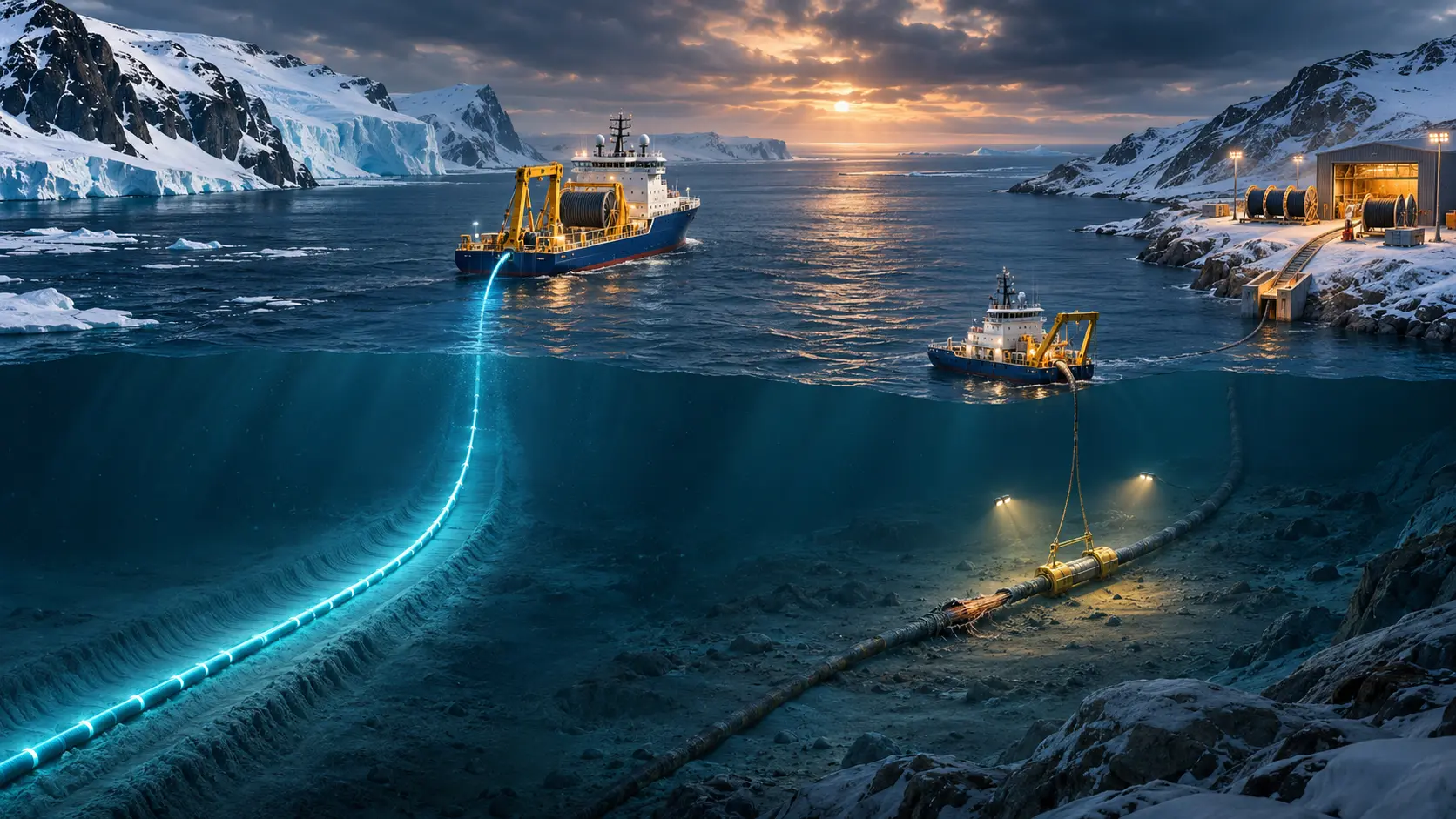
A map can make a cable look finished long before anyone has buried a metre of fibre. The European Commission’s Arctic strategy places two different promises on that map. Under its economic pillar, the Pan-Arctic Cable would link Greenland directly to Europe, with possible later extensions to Canada and Japan. Under security, an Arctic Cable Hub would help monitor, protect and repair lines already crossing the North Atlantic and Arctic. The difference matters on the first bad day at sea: an extra path can carry traffic around a cut; a repair crew can end the cut.
The Commission’s digital announcement gives the new Greenland link pride of place and adds IRIS² Arctic Connectivity for secure government satellite communications. That is a third service with a different audience. It does not pull a damaged seabed cable off the ocean floor. The strategy’s cable hub is framed as the first step toward a wider maritime security hub, with information sharing from seabed to space. The word “hub” leaves the hard work to operating agreements: who detects the fault, who can release a vessel, where spare cable is stored and who authorises a repair in difficult waters.
The route has its own handoffs. A design must become a financed system, a permitted landing, installed fibre and a service that operators actually use. The strategy says the project builds on existing EU investment and digital partnerships. At the 20 October press conference, the Commission described the pan-Arctic data cable as a long-term ambition and said it could not commit future funding at that stage while the next EU budget was being negotiated. That leaves the project’s route and funding decisions more important than the colour of the line on a policy map.
For a buyer of resilient connectivity, the two projects belong on different checklists. Ask the cable project for landing, financing, construction and service dates. Ask the hub for vessel access, spare capacity, repair permits and a tested fault-to-restoration drill. The reviewed public record gives no commissioning date for the new line or operating date and response standard for the hub. Those documents would turn two strategy names into a capacity plan.
The EU can pursue both jobs. The trouble begins when a press release counts route diversity and repair readiness as one achievement. Arctic weather will count the cable that carries traffic and the ship that can reach a break; it will not count the number of headings in a strategy.
Member Briefing
Deeper Profile Context
Sign in with the right membership level to unlock the full briefing and source notes.
Only for Strategic Circle
Strategic Circle
Open to all readers. Unlock profile briefings after joining and signing in.
Join Strategic CircleOnly for Leadership Alliance
Leadership Alliance
For qualified IP-asset owners and management; sign in to unlock alliance briefings.
Join Leadership Alliance