
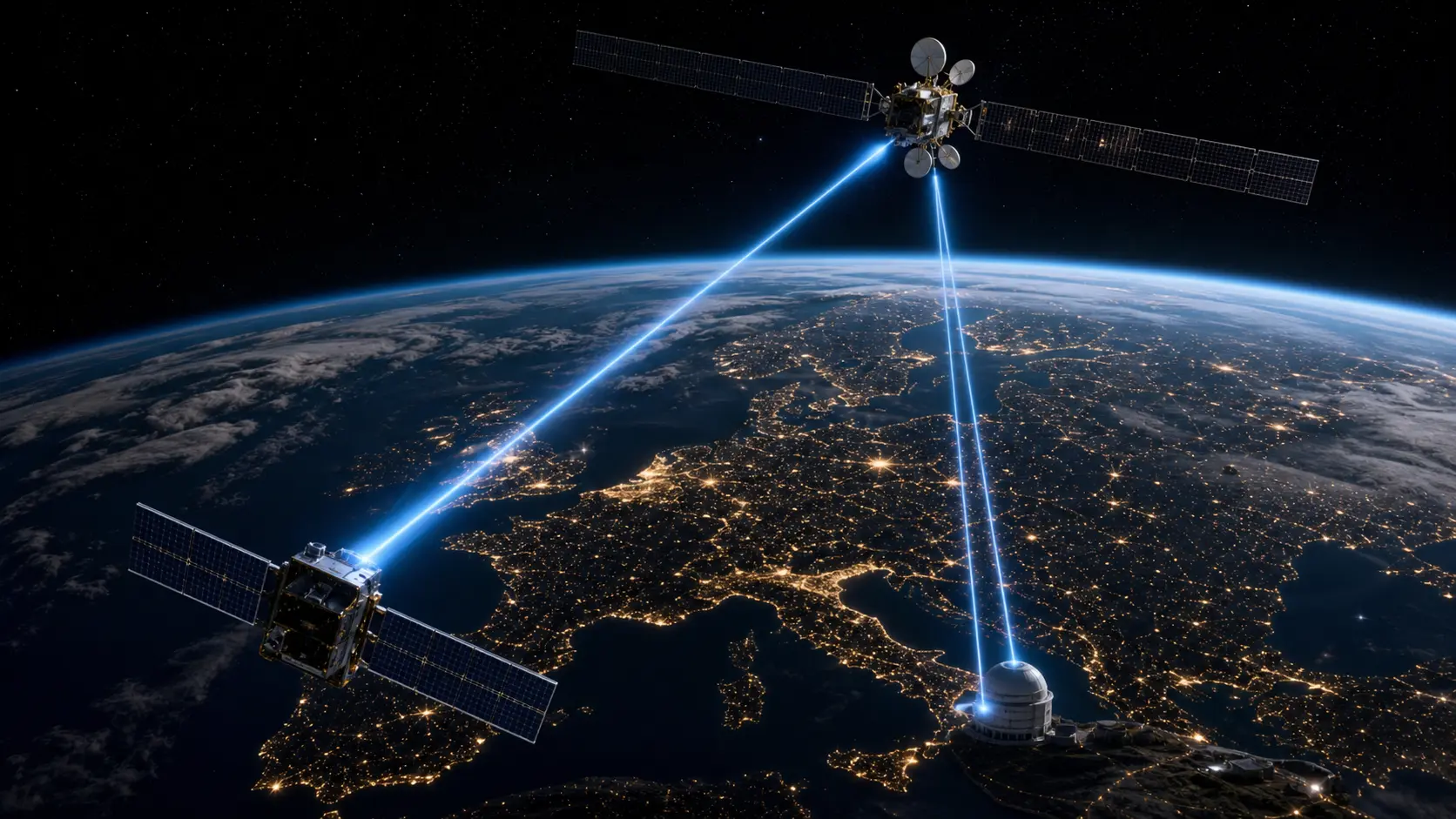
The event is the ESA-Hispasat Q-Design agreement. Hispasat says the work covers the first phase of a system that would combine quantum-key delivery from geostationary satellites, low-earth-orbit satellites and terrestrial infrastructure. That makes the agreement an architecture test: the hard question is how keys move between orbital layers, optical ground stations and the networks that governments or operators actually use.
Hispasat gives the agreement a stronger operating context because it already sits beside QKD-GEO, Spain's geostationary quantum-key-distribution prototype. The January 2025 QKD-GEO announcement describes a EUR 103.5 million programme for development, manufacturing, verification and validation, with public funding through Spain's recovery and aerospace framework and CDTI-managed contracting. ESA's Caramuel project page adds the same GEO satellite-security context from the European secure-connectivity side.
The impact mechanism is distance and trust. Fibre QKD is constrained by path loss, trusted nodes and geography; a satellite layer can change the design options for islands, cross-border government links, emergency networks and critical infrastructure. Q-Design matters because it compares the tradeoffs before Europe locks itself into one orbit or one ground-interface model.
The boundary is important. The evidence supports a design agreement, a funded GEO prototype path and official project context. It does not show a deployed encrypted service, a commercial product launch or a completed multi-orbit QKD network. The right reading is architecture readiness and future procurement pressure, not immediate operational availability.