
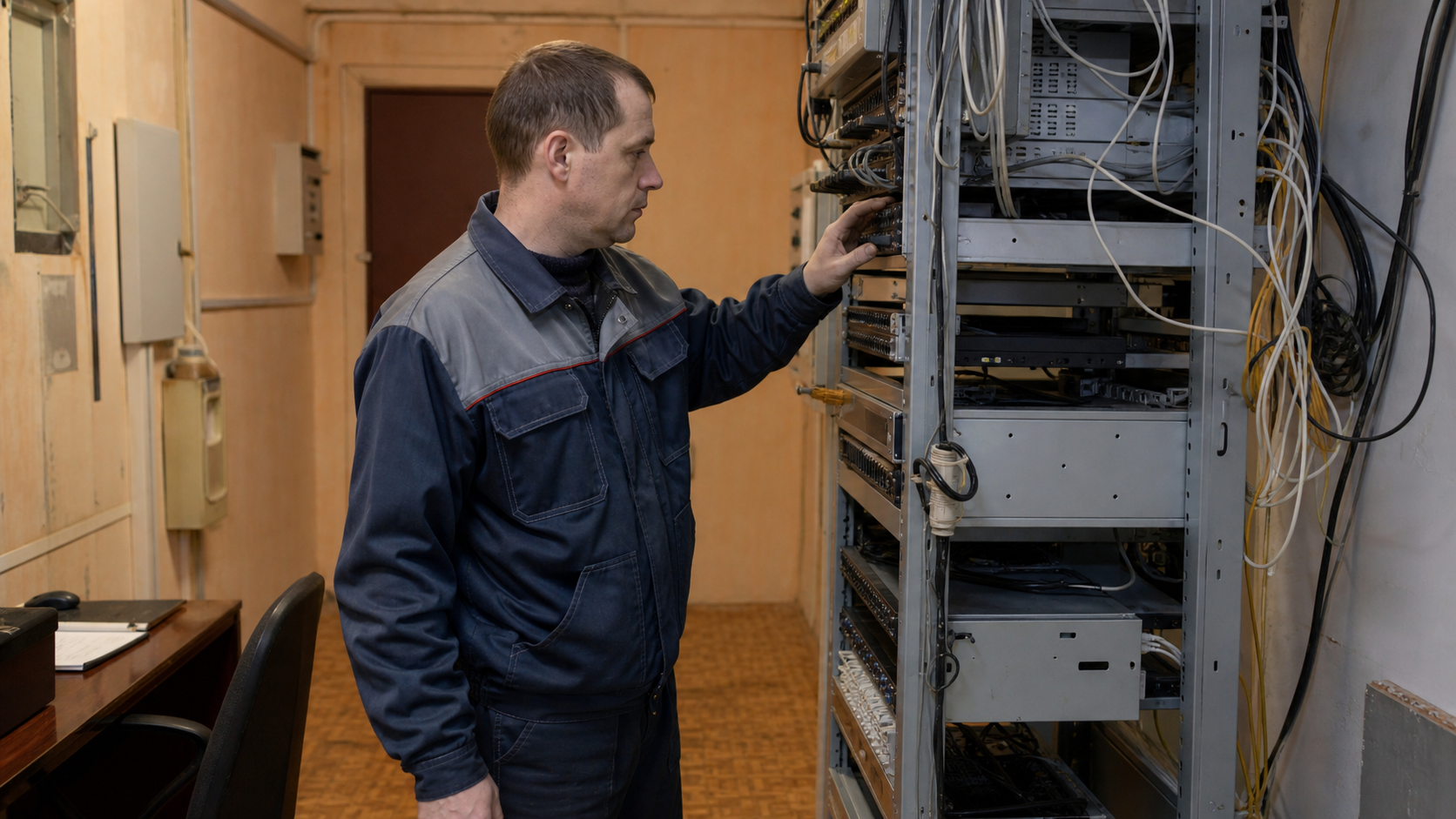
Summary
- Elektranet Ltd. has a visible local access business around the MKS brand, RIPE NCC membership, AS199933, Russian communications licenses, consumer broadband tariffs, business services and local repair promises.
- The investment question is not whether the company can advertise speed, but whether its subscription cash flow covers upstream dependence, field work, customer support, abuse handling, equipment refresh and churn without eroding service quality.
- Public financial indicators point to a small but real operator: 2025 revenue near 107.6 million rubles, net profit near 4.1 million rubles and a staff count reported in the low thirties imply positive but narrow room for mistakes.
The economic frame
The first question for Elektranet Ltd. is not how fast its top residential plan is. The first question is who pays for local reliability when that reliability depends on costs that arrive before the customer notices the service. Transit has to be bought or exchanged. Backhaul has to be provisioned. Optical lines have to be repaired in snow, heat, construction dust and apartment entrances. Support staff have to answer calls when a router, an upstream provider, a power issue or a customer balance problem is blamed on the access provider.
Licenses, registry records, personal-data obligations and abuse contacts have to be maintained even when no one is praising the company for them.
That is the cash-flow test behind a regional internet operator. A large national carrier can spread a mistake across millions of accounts, multiple product lines and a balance sheet that has access to capital markets or state-linked procurement. A small city network has a harder bargain. It must sell enough confidence to households, shops, offices and institutions to keep churn low, but it cannot spend as if it owned the full upstream chain. It has to decide where local control is worth money and where buying from a larger network is cheaper than pretending to be one.
Elektranet's public evidence points to a company that has survived for many years in that middle position. It is not merely a name in a search result. The company is visible through Russian corporate records, official service pages, communications-license references, a RIPE NCC local internet registry record, a public autonomous-system identity and local customer-facing listings. At the same time, the record does not prove a high-growth broadband platform, a national cloud provider, a proprietary content stack or a transit business with material wholesale scale.
The sensible interpretation is narrower and more useful: Elektranet appears to be a local connectivity and service operator whose economics depend on density, repair speed, pricing discipline and a defensible relationship with local customers.
The title question therefore has a practical answer. Elektranet can sell reliability only if customers see it as more valuable than the realistic substitute. For an apartment customer, the substitute may be a mobile data plan, a national carrier, another local provider or simply tolerating worse service because switching is inconvenient. For a private-home customer, the substitute may be more limited: mobile broadband, a different fibre installer, a radio link or waiting for a larger operator to reach the street.
For a small business, the substitute includes national business broadband, mobile backup, a managed IT firm or self-assembled service from several vendors. Elektranet's room to earn margin sits where its local presence lowers the customer's total risk more than its invoice raises the customer's monthly cost.
That distinction matters because revenue growth and value creation are different things. A provider can raise revenue by discounting installations, pushing higher headline speeds, bundling television or taking low-margin public contracts. None of that automatically creates value if the incremental account requires costly field work, expensive support, high churn or supplier payments that absorb the monthly fee.
Conversely, a flat or slightly declining revenue line can still create value if the company sheds poor accounts, reduces bad debt, improves repair scheduling, lifts average tenure or prices private-home service to include the cost of maintaining the line. The public numbers for Elektranet show both tension and discipline: revenue appears to have fallen in 2025 while net profit rose. That combination is not proof of operational excellence, but it says the economics should be read through cash conversion and cost control, not only through top-line growth.
Identity and operating boundary
Elektranet Ltd. is associated with the Russian legal entity commonly rendered as OOO Elektranet. Public company records identify it with registration in 2002, tax identifier 5035022283, state registration number 1025004642970 and a legal address at Sovetskaya Square 4 in Elektrogorsk, Moscow region. The same address appears across the MKS service site, RIPE-linked network records and local business listings. That consistency is useful because the English name is not self-explanatory.
Without the address, the tax identifier, the AS number and the MKS service trail, "Elektranet" could be confused with unrelated electronics or internet names.
The public-facing commercial identity is MKS Internet. The MKS site lists broadband, television, cloud video surveillance, business services, payments, connection information and company documents. Its footer names both Kompel and Elektranet, with separate tax identifiers, which matters for attribution. The service brand appears broader than one legal entity, but Elektranet is explicitly listed in documents, license references and the company footer. For this article, the relevant public entity is Elektranet Ltd., not every activity of the associated MKS brand and not Kompel unless a page or record makes the operating overlap explicit.
The operating boundary is local. The tariff pages name places including Elektrogorsk, Pavlovsky Posad, Drezna, Volginsky and Gorodishchi. The home page promotes private-home plans in Pavlovsky Posad and Bolshiye Dvory. The local listings place the office in Elektrogorsk and classify the business as an internet service provider. The company does not present itself publicly as a national network, a global cloud firm or a wholesale backbone operator. Its economic opportunity is therefore not market share across Russia.
It is route density and service trust inside a group of communities where a local crew, local office and local support number can still matter.
That boundary is a strength and a constraint. Locality can reduce customer-acquisition friction because the brand is known, the office is reachable and installers know the housing stock. It can also reduce the distance between complaint and repair: the provider can see where cable routes, apartment blocks and private streets create repeat failures. But locality reduces the addressable market. If a provider has already reached the best buildings and the easiest homes, the next ruble of growth may cost more than the last one. Private-home expansion can require trenching, aerial lines, optical terminal equipment and repeated visits.
Business services can require customised routing, static addressing, on-site work and support expectations that are higher than a household tariff.
Elektranet's legal and commercial record also suggests a company that has to balance two identities. One identity is the neighbourhood provider: office payments, local numbers, apartment and private-house installation, line maintenance, personal assistance and familiar technicians. The other identity is a regulated communications operator with number resources, routing policy, abuse contacts, licenses and public contracts. The cash-flow test is whether those identities reinforce each other. If regulated-resource control gives the local brand better uptime, lower dependence and more credibility, it supports pricing.
If it only adds compliance and upstream obligations without improving the customer promise, it becomes overhead.
What the network record proves
The strongest technical evidence is Elektranet's RIPE and public-routing footprint. The company is listed as a RIPE NCC local internet registry in Russia and is tied to ORG-EL207-RIPE. Public routing databases identify AS199933 as ELEKTRANET-AS, with the description tied to Elektrogorsk. The autonomous-system object was created in December 2013 and has continued to appear in routing data. Public tools show IPv4 and IPv6 originated resources, including the 185.41.120.0/22 allocation, 45.144.223.0/24, 91.219.117.0/24 and 2a01:4de0::/32. Several public routing views mark the visible prefixes as covered by valid route-origin authorization.
That is real evidence, but it is easy to overstate. A public AS number and an LIR record prove resource governance and routing identity. They do not prove the number of subscribers, the quality of customer support, the volume of traffic, the level of redundancy, the ownership of fibre routes, the capacity of upstream contracts or the profitability of each account. A small but careful local operator can maintain a clean routing record; a larger provider can have poor service despite more address space. The record supports the claim that Elektranet is not just a reseller name with no network identity.
It does not support a claim that Elektranet is a large carrier.
The upstream references are instructive. Public aut-num data and routing tools show import policies involving AS21453, AS48939 and AS20485, with a default route reference to AS20485. Public BGP views also show route visibility through larger networks. The commercial terms are not visible. The existence of those upstream references is enough to frame dependence: Elektranet's customers may buy local service, but the customer's experience still relies on larger networks for reachability beyond the local area.
If an upstream path suffers congestion, filtering, a distributed denial event or operational failure, the local provider absorbs the customer complaint even if it did not cause the original fault.
That exact dynamic appears in the company's own public notice from November 2024, where it told subscribers that a continuing distributed denial attack against one of its backbone providers was causing speed problems for some users. The notice is valuable because it is not a marketing claim. It shows the practical limit of local reliability. A local access provider can have technicians, lines and customer support in place, yet still face degraded service when a supplier problem travels downstream.
The customer's contract is with the local provider, so the local provider must communicate, mitigate and possibly compensate even when the attack target is upstream.
The IPv6 record also matters. The public IPv6 prefix does not prove mass IPv6 deployment to every household, but it gives Elektranet optionality. A local provider with IPv6 resources has a better long-term position than one whose customer growth depends only on scarce IPv4 addresses, carrier-grade address sharing and rented address space. Still, optionality is not adoption. Investors and customers would need evidence of actual IPv6 provisioning, customer-premises-equipment compatibility and support readiness before treating the IPv6 allocation as a service-quality advantage.
Abuse handling sits in the same category. Public records point to abuse-contact infrastructure and network-maintainer references. For customers, abuse handling is invisible until something goes wrong: spam, compromised routers, infected devices, misconfigured cameras or external complaints. For the provider, it is labour. Someone has to triage notices, identify the account, contact the customer, block or rate-limit when needed, preserve service where possible and avoid reputational damage with upstreams. In a low-margin access business, abuse work is a real cost because it does not usually produce a direct upsell.
The network record therefore supports a cautious conclusion. Elektranet has the formal resource and routing surface expected of a real local operator. The record improves confidence in identity and operating seriousness. It should not be converted into a claim about scale, resilience or pricing power without customer, traffic and capital-expenditure evidence that is not public.
The product promise
Elektranet's customer-facing offer is built around practical access rather than a complex enterprise stack. The MKS pages advertise apartment internet, private-home internet, television, cloud video surveillance, payment channels, connection scheduling and business services. For apartment customers, the tariff pages show headline tiers such as 100, 200 and 500 Mbit/s, with standalone internet prices in the hundreds of rubles per month and bundled television prices above that. For private-home customers, the prices are higher and the line-maintenance economics are more explicit.
The site states that apartment connection is free, while private-home connection costs 8,000 rubles, and a 180-ruble monthly line-maintenance amount remains relevant for private-sector blocking conditions.
That structure reveals the cost logic. Apartments can be cheaper to connect because the network can amortise building access, risers, switches and technician time across many potential customers. Private homes are a different business. Each home may need a longer drop, an optical terminal and more travel time. A free private-home connection would be a financing decision: the operator would recover the cost over future monthly bills, with churn and non-payment risk sitting on the provider. Charging 8,000 rubles upfront is a way to share that capital burden with the customer and screen for intent.
Television is a bundle, not the core network asset. The MKS pages state that the company cooperates with the 24TV service and offers packages with channel counts and monthly prices. Economically, the bundle helps only if it raises retention or gross profit after content and platform costs. If television is mainly a pass-through, it can still be useful because customers with broadband and television are less likely to churn over a small price difference. But it is not the same as owning unique content. A competing provider can partner with another television platform or the customer can substitute online video services.
Cloud video surveillance is a more interesting adjacency. The MKS pages advertise outdoor and indoor camera installation, remote access, encrypted channel language and archive periods of seven or fourteen days. Monthly per-camera pricing rose in the current public material, and the site also promotes turnkey camera work. This service can raise average revenue per account and turn connectivity into a higher-touch local service. It also adds obligations: cameras fail, storage has cost, customers may expect retention and access during incidents, and privacy or security expectations rise.
The service can create value if Elektranet's local installers and support team reduce the customer's hassle. It can destroy margin if camera support becomes a queue of small, unpaid visits.
The business-services page is positioned around internet, restrictions on access to certain resources, individual approach, allocation and routing of additional IP addresses, round-the-clock technical support, cloud and autonomous video surveillance, access-control systems and structured cabling. That is the natural extension for a local operator. Small businesses do not always need a national managed-services contract; they often need someone nearby who can make the connection work, route addresses, mount cameras, set up a local network and answer a call. The risk is customisation.
Each business account can become a small project, and small projects can consume senior technical time if the scope is loose.
The public promise is therefore coherent: fast local internet, reachable support, private-home fibre, television, cameras and practical business add-ons. The question is whether the company prices those services as products with margins or as favours attached to broadband. A regional provider's best accounts are not always the highest-speed accounts. They are the accounts whose requirements are stable, whose support needs are predictable, whose installation cost has been recovered and whose monthly payment arrives without chasing.
Pricing and revenue quality
The tariff ladder gives a window into revenue quality. Apartment internet appears in several local variants, but the key range is clear: basic access around 400 to 600 rubles per month in some towns, a 100 Mbit/s product around 450 to 600 rubles, a 200 Mbit/s product around 650 rubles and a 500 Mbit/s product around 850 rubles. Bundles with television lift the bill, with examples around 590, 790 and 990 rubles.
Private-home plans are higher in many cases, with 60, 100 and 200 Mbit/s examples around 580, 780 and 1,080 rubles, and promotional subscription tiers for new private-home areas advertised from 450 to 850 rubles depending on term and speed.
Those prices are low by Western European broadband standards but not necessarily low relative to local disposable income, housing density and substitute options. The relevant comparison is not a foreign fibre plan. It is the customer's realistic alternative in Elektrogorsk, Pavlovsky Posad, Drezna or a nearby private-home settlement. If a household has a reliable mobile signal, a national fixed-line offer and little need for low-latency service, Elektranet has limited pricing power.
If the household needs a stable wired connection, a technician who can visit and an office that understands the local address, Elektranet can compete on lower total hassle.
The reported financials give a useful scale check. Third-party company records show 2025 revenue around 107.6 million rubles and net profit around 4.1 million rubles, after 2024 revenue around 118.9 million rubles and net profit around 3.4 million rubles. Using rough arithmetic, annual revenue of 107.6 million rubles equals just under 9 million rubles per month. At an average monthly household bill of 650 rubles, that would be equivalent to roughly 13,800 average subscription-months each month. At 850 rubles, it would be roughly 10,500.
Those are not subscriber estimates, because revenue may include business service, installation, contracts, camera work, television, different legal entities and non-recurring items. The arithmetic simply shows the density requirement: a local access operator needs many modest accounts, or a smaller number of higher-value business and service accounts, to support fixed operating costs.
The profit margin is more telling than the revenue number. A 4.1 million-ruble profit on 107.6 million rubles of revenue is roughly 3.8 percent. That is a narrow cushion. It can be enough for a disciplined local operator with stable assets, but it leaves little room for repeated outages, bad debt, underpriced expansion, equipment shocks or a large legal bill. The fact that profit rose while revenue fell in 2025 may mean better pricing, lower costs, a different revenue mix, lower depreciation or one-off effects. It does not automatically mean better long-term economics.
It says the company had some cost control or mix improvement in the public numbers.
The staff count matters. Public aggregators report average headcount in the low thirties for 2025, down from higher levels in earlier years. A leaner staff can lift profit if automation, route density and better scheduling allow the same service base to be covered with fewer people. It can also weaken reliability if the company simply has fewer technicians and support workers to absorb failures. A local operator's labour force is part of the product.
Customers do not buy "headcount", but they experience it as callback speed, installation dates, repair waiting time and the quality of advice when the router is not the real problem.
Long-term subscriptions are an economic lever. The MKS site advertises six- and twelve-month subscription offers and loyalty discounts. Prepayment improves cash timing and reduces churn risk. Loyalty discounts can be rational if long-tenured customers cost less to serve and are less expensive than new acquisitions. But discounts should not hide line-maintenance cost. A customer who pays less every year but still requires old cable, repeated support and manual billing can become less profitable over time. The best version of a loyalty program rewards stable, low-friction customers.
The worst version trains the customer base to expect lower prices while the network ages.
Cost base and capital needs
Elektranet's costs fall into five practical buckets: upstream and interconnection, access network maintenance, customer support and field labour, service inputs such as television and video storage, and compliance or administrative overhead. Public records do not show the detailed cost ledger, but the service design makes the categories unavoidable.
Upstream and interconnection costs are partly visible through routing dependence, not through price. The company has its own AS identity and prefixes, but it still depends on larger networks for broader reachability. Buying or exchanging capacity is not a one-time expense. Capacity must be sized for peak usage, video growth, software updates, cloud services, gaming, remote work and security incidents. If peak demand rises faster than monthly revenue per account, the provider faces a margin squeeze. If it underbuys, customers experience congestion and blame the local brand.
Access maintenance is the defining local cost. The MKS pages emphasize optical cable to houses, twisted pair inside apartments, private-home optical terminal installation and line maintenance. Those are physical assets and work orders, not abstract bandwidth. A broken drop, a damaged fibre, a waterlogged junction, a failed switch, a bad connector or an apartment-building power issue can consume time that was never priced into the headline speed. The 8,000-ruble private-home connection fee and the separate line-maintenance language are evidence that the company recognises this cost.
Customer support is both a cost and a moat. The site repeatedly advertises round-the-clock technical support and local contact numbers. Payment pages promote office payment, bank-card top-up, online banking and electronic wallet options. A local office can reduce churn because customers know where to go. It also costs money. Office hours, staff, card processing, balance disputes and customer education do not scale like software. The support burden is higher when customers use their own routers, combine internet with television, add cameras or call the provider for problems caused by devices inside the home.
Service inputs can quietly absorb margin. Television packages have supplier economics. Camera service has storage and platform economics. Static addresses have opportunity cost because IPv4 space is scarce and operationally valuable. Business routing has engineering cost. Payment providers take fees or impose process requirements. None of these inputs is necessarily bad. They are only good if Elektranet prices the bundle with a clear understanding of usage, support and supplier terms.
Compliance and administration are not optional. The company lists communications licenses, public documents, personal-data policies and standard service terms. RIPE membership and resource records also require contact accuracy and maintenance. Russian communications regulation adds licensing, data and operational requirements. A small operator cannot treat these as background noise. If a licensing renewal, personal-data issue, abuse escalation or reporting obligation is mishandled, the downside can be larger than the monthly revenue from many customers.
The capital question is whether Elektranet can fund network refresh from operating cash. The public balance-sheet figures reported by aggregators are small relative to revenue, with assets reported below 8 million rubles in 2025. Accounting figures can understate operational reach if assets are leased, depreciated, held by related entities or expensed rather than capitalised. Still, the numbers do not suggest a capital-rich operator. That makes pricing discipline more important.
If the company expands into private homes or business camera systems without charging enough upfront or monthly, the cash strain appears before the headline revenue benefit.
Supplier dependence and service fragility
A regional provider sells local accountability while relying on a chain it does not fully control. That is not a criticism; it is the industry structure. The question is whether the provider communicates the chain honestly and designs enough redundancy to stop a supplier event from becoming a brand-damaging outage.
The November 2024 notice about a distributed denial attack on a backbone provider is a concrete example. It shows that a supplier problem can hit subscriber speeds. It also shows that Elektranet was willing to tell subscribers the cause in public. The better test is what happens next: whether the provider has alternative routes, whether it can shift traffic, whether support scripts explain the issue clearly, whether chronic customers receive credits, and whether the company invests after the event. None of that is public.
The event is still useful because it marks supplier dependence as a real operating risk, not a theoretical line in an analyst note.
Television dependence is simpler. MKS says it works with 24TV. That allows a local broadband operator to offer a television bundle without owning a content platform. It also means product quality, channel availability, application performance and commercial terms partly sit outside Elektranet. If customers value the bundle, it improves retention. If they see it as a commodity, it is mainly a pass-through service that can create support calls.
Payment and customer-account systems are another dependency. The MKS site points customers to a personal account, balance information, bank-card top-up and payment providers. A smooth account interface lowers support cost and improves cash collection. A confusing account interface pushes customers into calls and office visits. Local operators often underestimate this because billing feels administrative, but billing is part of reliability. A customer cut off because a payment did not post on time experiences that as a service failure.
Equipment supply matters as well. Private-home fibre uses optical terminals. Apartment service uses building equipment and customer routers. Video surveillance uses cameras, storage and applications. Geopolitics, sanctions, currency movement and import constraints can change equipment availability or price. A provider with low cash reserves cannot always buy ahead or standardise on the best hardware. If it supports too many device types, support time rises. If it standardises too tightly, supplier shocks can become service shocks.
Abuse and security dependence is another hidden cost. A provider with residential customers, cameras, routers and business accounts will eventually deal with compromised devices, spam, malicious traffic, password reuse, bot activity or customer complaints about blocking. Public routing hygiene and valid route-origin authorization are positive signs, but they do not eliminate endpoint risk. The company must maintain operational discipline beyond the routing table.
Competition and substitutes
Elektranet's competition should be judged locally, not abstractly. A household in its service area compares the provider against what can be installed at that address, not against the best theoretical offer in Moscow. Local listings show other nearby telecom names, while national and mobile providers create broader substitution pressure. Mobile broadband can satisfy some households, especially light users or renters. A national fixed-line provider can win customers that trust a larger brand. Another local provider can compete on personal attention, price or a specific building relationship.
The most dangerous substitute is not always cheaper internet. It is "good enough" service with lower switching friction. If a customer streams video, uses messaging and pays bills online, the provider's 500 Mbit/s headline may not matter. A reliable 100 Mbit/s connection at a lower price may be enough. Conversely, a remote worker, gamer, camera user or small business may value latency, support and quick repair more than nominal speed. Elektranet must know which customer segment it is pricing for.
The local office can be a competitive advantage where trust matters. The payment page emphasises office payment benefits: immediate crediting, no commission, card acceptance, information on tariffs and consultation on technical issues. That is old-fashioned, but not obsolete. In smaller communities, office presence can reduce anxiety and help older or less technical customers. It can also keep cash collection steady. The cost is that office service is labour-intensive. It must generate retention or upsell to justify itself.
Private homes are a distinct competitive arena. Running fibre to houses is more expensive than serving apartments, but a satisfied private-home customer can be sticky because switching may require another installation. Elektranet's private-home offers in Pavlovsky Posad and Bolshiye Dvory show an attempt to capture this segment with higher-speed plans and term subscriptions. The risk is underpriced buildout. If too many homes require expensive drops, support visits and seasonal repairs, the upfront 8,000-ruble installation fee and monthly tariff must be enough to recover capital and ongoing maintenance.
Business customers can improve margins if the scope is controlled. MKS advertises business internet, additional IP allocation and routing, cloud and autonomous video surveillance, access-control systems and structured cabling. These are services where a local provider can compete against larger firms by being responsive and practical. But a business customer can also demand priority repair, static addressing, security advice, custom network design and after-hours support. The provider needs clear service boundaries.
Strategy without resource allocation is marketing; a business-services page only creates value if the operator has enough technicians, engineers and project management to deliver without damaging residential reliability.
Public-sector and institutional work is both opportunity and risk. Third-party procurement aggregators show Elektranet participating in public contracts, with some completed and some not completed depending on the source. Contract work can absorb fixed labour and prove local capability. It can also carry payment delays, formal documentation, penalty clauses and margin pressure. A provider that uses public contracts to fill idle capacity can benefit. A provider that chases contracts below cost turns public revenue into a drain on the core network.
Unofficial market signals
Unofficial market signals should not be treated as audited truth, but they help describe the customer experience boundary. Yandex's listing for MKS shows a high rating and hundreds of ratings, with features such as leased access, backup channel, IP television, radio channel, equipment delivery, IP transit and video surveillance listed in the profile. That is a positive visibility signal. It suggests the brand is known enough locally to gather substantial public feedback.
Older review sites are more mixed. Some old reviews praise improvements and stable service after network work; others complain about outages, payment disputes and repeated technician calls. A 2023 review on one listing complains about a prolonged internet outage and daily fee deductions. Older guidebook-style reviews from 2011 and 2016 should be treated carefully because networks change, staff changes and customer expectations have changed. Still, the pattern is plausible for a local provider: when the line works, customers forget it; when it fails, the provider becomes personally accountable.
The company's own notices are more useful than anonymous reviews. The distributed denial notice, planned-work notices, tariff-change announcements, extra phone-number notice and private-sector tariff changes show an operator actively communicating operational and price changes. That does not prove service quality. It does prove that the public site is not a static shell. A local provider with active notices is easier to analyse than one whose only public record is a registry entry.
Third-party web statistics are weak evidence. Some pages claim the MKS domain was offline at a particular check or had old certificate issues; other public search results show the current site accessible and crawled recently. Such signals are useful only as reminders that the web surface is not the business. A temporary site error does not mean the access network is down, and a polished site does not mean the network is reliable. For Elektranet, the official service pages, routing record, licenses and financial records carry more weight than generic web-rank tools.
The best unofficial signal is the combination of local ratings, active public notices and a long operating history. Customers have enough interaction with the brand to leave feedback. The company has been present long enough for routing, license and corporate records to accumulate. That durability is valuable. It is not the same as a moat. In telecom, a moat appears when switching cost, local density, repair speed and brand trust allow the provider to maintain margin without falling behind on network investment.
Regulation, litigation and geopolitical risk
Elektranet operates in a regulated communications environment. The MKS documents page lists multiple licenses for Elektranet, including licenses associated with Russian communications oversight. Company aggregators also show active communications licenses and a new license in 2025 running to 2030. These records support the view that Elektranet is not merely an informal installation outfit. It is a licensed operator with the compliance burden that follows.
Licensing is a floor, not a guarantee. A license allows the company to provide certain services under the rules; it does not guarantee quality, redundancy or customer satisfaction. The public article should therefore treat licenses as operating permission and compliance evidence, not as proof of excellence. The same is true of RIPE membership. It supports resource legitimacy but does not certify commercial performance.
Legal risk appears in third-party company profiles. RBC and other aggregators report arbitration cases involving Elektranet, including a large claim in 2025 associated with a regional power-network company. Public snippets do not provide enough detail to judge liability, settlement probability or operational impact. The amount is still material relative to reported annual profit. Even if the claim is disputed or resolved favourably, it illustrates the asymmetry for a small operator: one infrastructure dispute can equal several years of net profit.
Regulatory and geopolitical risk also affects equipment, routing, payments and cross-border connectivity. Russian operators face a more complicated environment for imported network hardware, software updates, international transit relationships and content services than they did before 2022. A local provider may be insulated from some global capital-market pressures, but it is not insulated from router supply, optical equipment availability, exchange-rate moves or upstream policy. A small company with narrow profit cannot absorb every external cost shock by itself.
Data sovereignty and locality are double-edged. Local customers may value a nearby provider that keeps service relationships local and responds quickly. Businesses may also care about local camera storage, account support and Russian-language documentation. But locality does not remove dependence on wider networks and vendors. A customer who buys cloud video surveillance from a local provider is still buying a service whose storage, software and security must be funded and maintained. Local trust has to be matched by technical competence.
The regulation watchpoint is not only whether Elektranet has current licenses. It is whether the company can keep price, service obligations and compliance aligned. If regulation raises record-keeping, security, interception, data-retention or reporting costs, a small provider must either pass them through, absorb them or reduce investment elsewhere. None of those choices is painless.
Facts that would change the judgement
Several facts would materially change the view of Elektranet. The first is subscriber count by service area and product type. Revenue without subscriber count hides mix. A company with fewer high-value business and private-home accounts has different economics from one with many low-price apartment accounts. The support burden and churn risk are different in each case.
The second is gross margin by product. Broadband, television, cloud video surveillance, structured cabling, business routing and public contracts do not have the same margin. The public evidence shows the products exist, but not their profitability. If television and camera services have high support costs, they may be retention tools rather than profit centres. If business routing and structured cabling are priced well, they may be the margin engine behind a modest residential base.
The third is network ownership. The public record says Elektranet has resources and offers fibre-based access, but it does not fully reveal which ducts, poles, building networks, aggregation links and upstream circuits are owned, leased or shared. Ownership changes the downside. A provider that owns critical local assets has more control but higher capital duty. A provider that leases too much can be squeezed by suppliers or landlords.
The fourth is churn and repair time. Local reliability is not a slogan; it is measured in repeat faults, time to repair, callback quality, installation delays and complaint resolution. Public reviews give only noisy fragments. Internal repair statistics would either support or weaken the reliability thesis.
The fifth is cash conversion. Reported profit is useful, but telecom operators live on cash. Prepaid subscriptions, office payments, installation fees and business contracts can improve cash timing. Equipment purchases, line repairs, delayed public payments and legal costs can reverse it. A 3.8 percent net margin is not enough to ignore working capital.
The sixth is upstream redundancy. The public aut-num record shows upstream relationships, but not capacity, backup routes, committed information rates or failover practice. The 2024 supplier-attack notice makes this a central question. If Elektranet has improved redundancy since then, the reliability proposition strengthens. If not, the company remains exposed to external events that customers experience as local failure.
The seventh is related-party structure. The MKS brand ties Elektranet and Kompel together on public pages. That may be a normal local operating arrangement, but it complicates analysis. Which entity owns which assets, employs which staff, holds which contracts and books which revenue matters for assessing Elektranet specifically. The public customer may not care which legal entity stands behind the invoice until there is a dispute. An analyst has to care earlier.
The cash-flow judgement
Elektranet's public record supports a grounded but limited positive judgement. The company appears to be a real local communications operator with a long history, a public route identity, resource-holder status, customer-facing products, licensed operations, local office presence and recent financial revenue above 100 million rubles. It is not an empty listing.
The same record supports caution. Reported net margin is narrow. Revenue appears to have declined in 2025. Headcount has fallen from earlier levels. Service quality depends on upstream networks, field labour and equipment supply. The public balance-sheet scale is small. Review signals are mixed. Legal claims could be material. The company competes against mobile, national and local alternatives. None of that makes the business weak by definition, but it means the margin for strategic error is thin.
The best reading is that Elektranet sells continuity, not novelty. Its customers are likely paying for a local connection that works well enough, a phone number that answers, an installer who can find the address, an office where payment and tariff questions can be handled, and add-ons that make the account more convenient. That is a valuable offer in the right territory. It is also a hard offer to scale because every new street, home, camera and business account brings physical obligations.
For investors, suppliers or customers, the key test is whether Elektranet prices reliability as a funded operating commitment. A 500 Mbit/s headline at 850 rubles per month is attractive only if the provider can deliver peak-time capacity, support calls, equipment replacement and upstream resilience from that revenue. A private-home plan is attractive only if the connection fee and monthly tariff recover the higher field cost. A business account is attractive only if routing and support are not given away as unpaid custom work.
Cloud video surveillance is attractive only if storage, application support and field maintenance are priced into the account.
The company does not need to become a national carrier to be economically useful. It needs enough route density, disciplined installation economics, clean support operations, supplier redundancy and honest pricing to keep customers from switching. If it can do that, the local network can produce durable cash flow even without glamorous growth. If it cannot, higher speed tiers and more add-ons will become promises the cost base cannot finance.
The judgement should therefore stay conditional. Elektranet passes the identity and operating-reality test. It has evidence of resource control, local service and financial substance. It has not publicly proved a robust margin moat, deep capital reserves or superior resilience. The next facts that matter are not another slogan about speed. They are churn, repair time, upstream redundancy, product gross margin, private-home payback and the legal or supplier shocks that could consume a thin year's profit.