
Summary
- Electrolux Italia has enough industrial scope to matter: the company is the Italian operating company behind five appliance sites, a registered office in Porcia and a direct consumer presence that spans product sales, support, spare parts and connected-appliance services.
- The Italian investment case is not volume for its own sake. It depends on whether factories in Porcia, Susegana, Forli, Solaro and Cerreto d'Esi can run at utilisation and product mix levels that earn group capital targets while retailers and consumers resist price increases.
- The network evidence supports a narrower conclusion: Electrolux Italia is a RIPE NCC member with AS59453 and Italian IPv4 resources, which shows direct responsibility for internet-number governance but does not prove that it sells access, transit, hosting or managed network services.
The capital question starts with the factory choice
The economic incentive around Electrolux Italia is a capital allocation problem before it is a country story. A global appliance group can make refrigerators, laundry products, dishwashers, ovens and hoods inside Italy, source them from lower-cost factories elsewhere, buy selected capacity through partners, or let a rival carry the burden of price-led volume. The Italian company has to prove that its factories and product-development role produce more value than those alternatives after retailers take their margin, consumers trade down and labour and energy costs absorb part of every efficiency gain.
Electrolux Group's own financial frame makes the hurdle visible. The group targets at least 4% annual organic sales growth over a cycle, an operating margin of at least 6%, capital turnover of at least four times and return on net assets above 20%. Against that standard, 2025 was an improvement but not the destination. Net sales were SEK 131.3 billion, organic growth was 3.9% and the operating margin was 2.8%. The group produced roughly SEK 2 billion of operating cash flow after investments for the year and reported a stronger fourth quarter, but that cash discipline sits beside a margin gap that cannot be closed by ambition alone.
Italy therefore has to answer two questions at the same time. First, can the sites carry enough volume, mix and learning to lower unit cost without locking the group into uneconomic capacity? Second, can local proximity to European consumers, builders, retailers, service technicians and regulators create a pricing or risk advantage that cheaper external supply cannot match? If the answer to either question weakens, the pressure to move products, reduce headcount or use more external capacity becomes rational rather than ideological.
The current Italian dispute around planned job reductions shows that management, labour and government are debating that allocation question in different language. Reports in May and June 2026 described a plan involving roughly 1,700 to 1,719 jobs, the possible closure of Cerreto d'Esi, and cuts affecting all five Italian sites. The ministry said it was monitoring the case, then called the plan unacceptable and asked for a revised industrial plan with investment, innovation and site protection. Those facts do not settle the economics, but they show that factory flexibility carries public and regional costs.
The article's conclusion is not that every Italian job or every line should be preserved. It is that Electrolux Italia's strongest case is selective, not blanket defence. Capital should follow factories and products where Italian engineering, automation, service knowledge and European logistics can support a premium or lower lifetime cost. It should not follow low-margin volume that can be made elsewhere with similar quality, lower fixed cost and less cash tied up in underused assets.
Electrolux Italia is an appliance maker with internet-number responsibility
Electrolux Italia SpA is an Italian company, not a telecom carrier. Its own governance document describes a company incorporated in April 1952, registered in Pordenone, headquartered at Corso Lino Zanussi 24 in Porcia, and active in household appliances and electromechanical, electronic and related products. It also states that the company belongs to the Electrolux Group and operates through units or factories in Porcia, Susegana, Forli, Solaro and Cerreto d'Esi.
That operating boundary is important because it anchors the article in a real manufacturer with sites, workers, product lines and group reporting, rather than in a name found only through internet registry evidence.
The consumer-facing Italian site confirms the business model. Electrolux sells and supports appliances in cooking, dishwashing, cooling, laundry, cleaning, small appliances and air treatment. Its support pages point customers toward registration, manuals, original spare parts, repair services, fixed-price repairs, warranty tracking and direct contact channels. Its official shop sells spare parts and accessories. That gives Electrolux Italia a direct relationship with consumers after the initial sale, even when the original appliance purchase was influenced or completed through a retailer.
The internet-resource evidence is still relevant, but it must be kept in its lane. The RIPE NCC member list includes Electrolux Italia SpA among local internet registry members offering services in Italy. RIPE database outputs identify organisation ORG-EIS7-RIPE as Electrolux Italia SpA, with Italian country context and the same company registration number used in the company's governance material. RIPE RDAP lists AS59453, named ELECTROLUX-AS, with Electrolux Italia SpA as the registrant. RIPE also records an allocated Italian block, 194.246.0.0 to 194.246.31.255, under IT-ELECTROLUX-19960312.
Third-party routing views show AS59453 originating several IPv4 ranges and, in at least one view, valid RPKI coverage for key prefixes.
Those records show that Electrolux Italia carries responsibility for public internet-number resources. They do not show that it sells broadband, transit, cloud hosting, domain registry services or managed connectivity to third parties. For a manufacturer, the economic relevance is internal control and resilience. Appliances now interact with apps, service accounts, product registration tools, warranty workflows, repair bookings, e-commerce, logistics and data-protection obligations. A company that owns or manages public network resources may have more direct control over parts of its digital operating environment.
The source record cannot say whether that control is cheaper or better than outsourced connectivity, but it is enough to justify treating network-resource governance as part of Electrolux Italia's operating footprint.
That distinction matters for BTW's coverage. A route record is evidence, not a business model. The economic question is not whether Electrolux Italia is a hidden telecom company. It is whether a large appliance manufacturer with connected products, direct service channels and registered internet resources can turn digital control into lower warranty cost, better product feedback, stronger customer retention and fewer cross-border data surprises. That is a telecom-economics question because the value depends on networks, cloud service dependency and locality, but the answer still belongs to an appliance manufacturer.
The Italian boundary is big enough to matter and narrow enough to be exposed
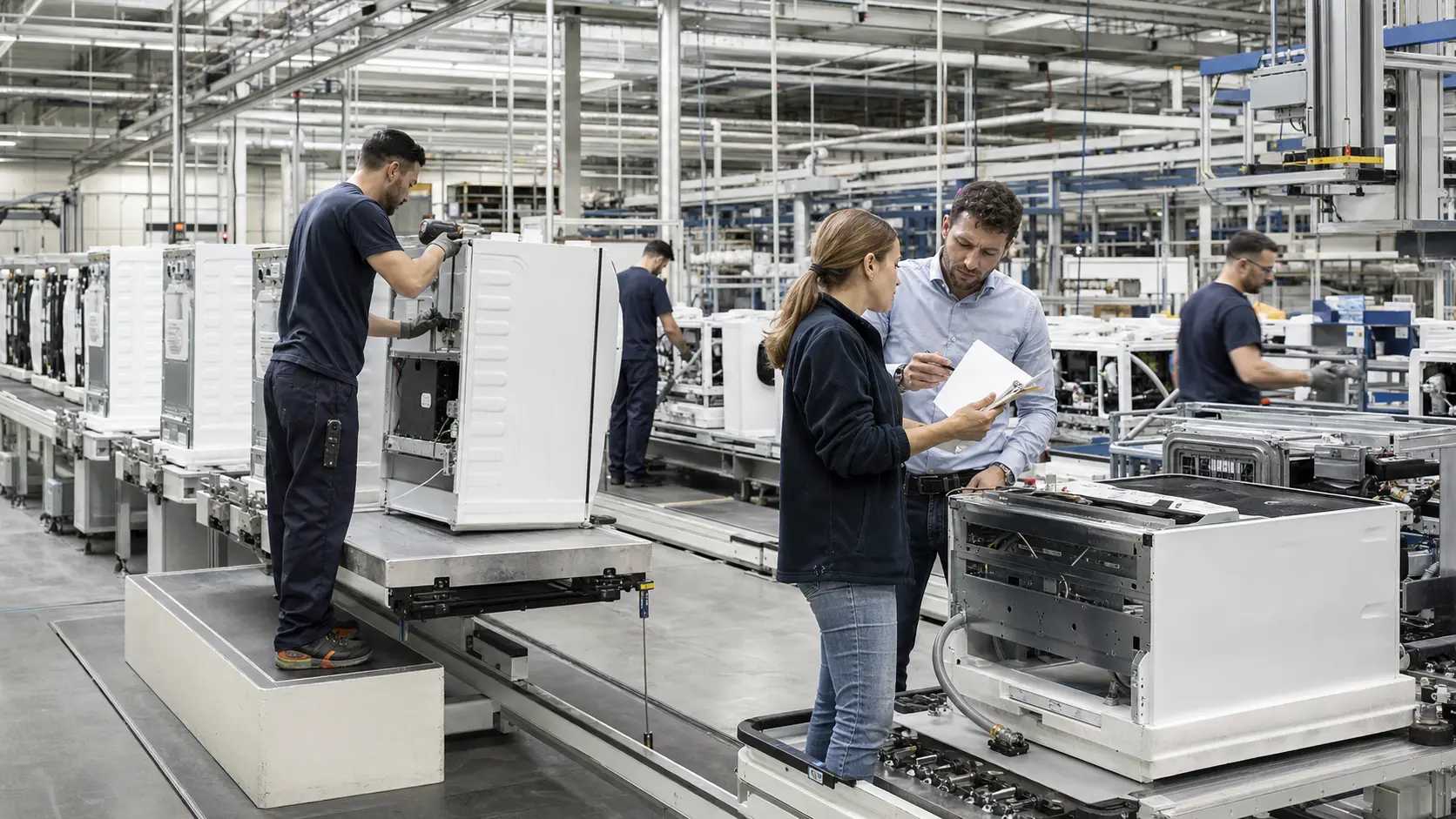
The Italian company has a clear asset boundary. The governance document lists five sites: Porcia in Friuli-Venezia Giulia, Susegana in Veneto, Forli in Emilia-Romagna, Solaro in Lombardy and Cerreto d'Esi in Marche. Reporting on the 2026 restructuring debate described site specialisations: Porcia linked to laundry, Susegana to refrigeration and freezers, Solaro to dishwashers, Forli to ovens and hobs, and Cerreto d'Esi to hoods. Public figures vary by outlet and date, but the shared picture is a distributed Italian manufacturing platform covering several major appliance categories.
That breadth is useful because it gives Electrolux Italia relevance beyond one product cycle. Refrigeration, laundry, dishwashing and cooking have different replacement rhythms, energy-label sensitivities, retail promotions and installed-base service needs. A downturn in built-in kitchens does not have to match a downturn in laundry. A strong refrigerator platform can teach lessons in insulation, compressors, control electronics and logistics that differ from dishwasher or oven economics. A multi-category Italian base also supports a broader supplier and labour ecosystem than a single assembly site.
The same breadth creates exposure. Five sites mean five fixed-cost bases, five local labour markets, five sets of supplier routines and more political attention when demand falls. If European core appliance shipments remain below pre-2020 levels, the cost of that footprint becomes harder to cover. Electrolux Group's Q4 2025 presentation estimated that the European core appliances market was down 1% year on year in the quarter and 10% below Q4 2019. The Q1 2026 report then described European consumer demand as replacement-driven, with Western Europe flat, Eastern Europe up slightly, price pressure high and built-in kitchen demand weak.
That is not the backdrop in which a full site network can be carried on hope.
The Italian boundary is therefore both valuable and vulnerable. It is valuable because it places product engineering, production, service and labour know-how inside the European market. It is vulnerable because the same market is mature, price-sensitive and exposed to imports. Electrolux Italia's capital case is strongest where its sites make products that customers or retailers cannot easily reduce to commodity price comparison. It weakens where the site is merely a European-cost wrapper around products with no distinctive economics.
Group performance says improvement is real but insufficient
Electrolux Group entered 2026 with evidence of improvement. In 2025 it lifted organic sales, improved operating income and delivered cost reductions of around SEK 4 billion. Q4 2025 showed strong working-capital performance, significant inventory reduction and an EMEA and Asia Pacific margin of 6.3% excluding non-recurring items. Q1 2026 then showed EMEA and Asia Pacific net sales of SEK 13.8 billion, organic growth of 3.6%, operating income of SEK 572 million and a 4.1% margin. Those numbers matter for Italy because they show that the region containing Italy is not structurally broken.
But the improvement is not yet enough to remove the pressure on Italy. Group Q1 2026 net sales were SEK 29.5 billion, organic sales were roughly flat and operating income excluding non-recurring items was SEK 198 million. North America pulled the group down, and the company announced a long-term partnership with Midea in North America alongside a rights issue of around SEK 9 billion. The final outcome of that issue was expected to give the group roughly SEK 9.062 billion before transaction costs.
Management's willingness to raise capital, partner with a low-cost global competitor in North America and fund further restructuring tells Italian stakeholders something important: Electrolux is not defending every manufacturing asset on old terms.
The regional performance creates a sharper test. If EMEA and Asia Pacific can generate growth and margin improvement, Italian sites should claim investment where they contribute to that progress. If they cannot, the group can move production, rely more on partners, narrow the local product range, or focus Italian spending on sales, service and brand. A profitable region does not automatically justify every plant; it raises the evidence standard for each plant.
The 6% group operating-margin target is the cleanest benchmark. A 4.1% EMEA and Asia Pacific margin in Q1 2026 is better than group average but still below the cycle target. A 6.3% Q4 2025 regional margin shows that the target is not impossible in a strong quarter, but the company cannot allocate capital using only peak-period evidence. It has to ask whether Italian factories can reach acceptable returns through a full cycle after warranty, restructuring cash, inventory, energy, supplier inflation and discounting are counted.
That is why volume alone is a misleading success measure. A site can increase units and still destroy value if those units require heavy promotions, slow inventory turns or expensive after-sales support. Conversely, a lower-volume site can justify capital if it produces high-efficiency, higher-margin, service-rich products with fewer defects and better cash conversion. Electrolux Italia's economics should be judged on contribution after capital and risk, not on national output.
Price, volume and mix decide whether better products become better margins
Electrolux's public strategy points toward premiumisation, resource-efficient products, aftermarket growth and more direct consumer journeys. The 2025 sustainability statement said the group's most resource-efficient products accounted for 26% of units sold and 36% of gross profit. That spread is economically significant: the products that save more energy or water for users also appear to carry better gross-profit weight for the group. If Italy can design or manufacture more of those products, the factory case improves.
The obstacle is consumer willingness to pay. In Q1 2026, Electrolux described European appliance demand as mainly replacement-driven. Replacement demand is reliable but price-sensitive. A consumer whose refrigerator fails may buy quickly, but may still choose the best promotion, financing offer or delivery promise rather than pay for the manufacturer's margin target. Built-in kitchen weakness is more damaging because built-in products often support better design-led differentiation. If consumers postpone kitchens, retailers and manufacturers lose a route to higher mix.
Italian retail data offer a mixed signal. Istat reported that May 2026 retail sales rose 2.2% in value year on year and 0.4% in volume, while online retail rose 11.9%. Electrical household appliances and audio-video equipment were among the stronger non-food categories, up 4.9% year on year. That supports the view that appliance demand exists. It does not prove that Electrolux can push through higher prices. The broader consumer-confidence index fell in June 2026, and value growth above volume growth often reflects price rather than strong real demand.
The product mix challenge is to make value visible at purchase and during ownership. Energy savings, lower water use, quieter operation, app control, repairability and service can support price if consumers trust the benefit. But the retailer controls much of the shelf comparison, and the cheapest credible alternative often resets expectations. Product registration, maintenance reminders, spare-part offers and service booking can make lifetime value more tangible. The risk is that app friction or service delays do the opposite: they make the brand feel expensive without feeling easier to own.
Utilisation is the make-or-break variable across five sites
Factory utilisation is the central variable because it converts all other issues into unit economics. Labour agreements, automation, energy contracts, quality programmes and supplier terms matter most when enough volume runs through the asset base. A plant with good technology and skilled workers can still lose money if fixed costs are spread over too few units. A lower-cost plant can still disappoint if poor quality or logistics failures raise warranty and working-capital needs. Italy's problem is that European demand appears too mature to assume that every line can be filled naturally.
The reported 2026 restructuring debate points to this utilisation pressure. Public reporting described large planned job reductions, including possible closure at Cerreto d'Esi, and impact across the other plants. Government and unions read that as a social and industrial-policy shock. Management likely reads it as an adjustment to expected volumes, productivity and product allocation. Both readings can be true. The economic burden of underutilisation does not disappear because the social cost is high, but the social cost increases the price of a crude reduction plan.
Susegana illustrates the two-sided case. Reporting described it as a refrigeration hub with more than EUR 130 million linked to automated Genesi assembly lines and further plans in the 2023-2026 period. That kind of site can justify capital if automation, scale and product knowledge produce competitive refrigeration economics. It becomes harder to defend if Asian and Eastern European capacity reset prices while built-in or premium demand softens.
Porcia, Solaro, Forli and Cerreto d'Esi face similar tests in their own categories. Laundry, dishwashing, cooking and hoods each have different content, labour intensity and retailer dynamics. A broad national reduction number obscures the plant-level question: which products have a defensible role in Italy, which should be consolidated, and which need a service or engineering mandate rather than a volume mandate? A credible industrial plan would map capital to those answers rather than merely state headcount numbers.
Inventory discipline is part of utilisation discipline. Electrolux highlighted significant inventory reduction and strong working capital in Q4 2025. That is positive, but it can also make weak factories feel worse in the short term because the group cannot hide underutilised capacity by building stock. If cash conversion matters, the company has to make what it can sell at acceptable margin, not what keeps every line busy. For Italian sites, that means the best defence is not simply higher output. It is output tied to orders, service economics and product roles that reduce cash drag.
Input costs keep savings from falling cleanly to profit
Electrolux's cost-efficiency programme is real, but the Italian factory case has to survive the input stack. Labour is only one part. Steel, plastics, electronics, compressors, motors, insulation materials, logistics, warranty parts and electricity all matter. APPLiA has said steel makes up 36% of appliance components, which means metal-price and carbon-policy changes flow directly into appliance cost. EUROFER's description of European steel conditions adds context: global overcapacity, weak demand, high energy prices and decarbonisation costs keep the European steel base under pressure.
Appliance makers are downstream users of that stress.
Energy is also a direct and indirect cost. Eurostat data show that EU non-household electricity prices eased in the second half of 2025 from the peaks of 2022 and 2023, but remained above the calmer pre-crisis period. The IEA described EU futures prices around USD 95 per MWh for 2026, easing toward USD 85 per MWh in 2027. Lower prices help, but energy remains a strategic variable for factories and suppliers.
Electrolux's own sustainability and circularity claims create another cost-benefit trade. The group reported progress in renewable electricity, recycled steel and plastic, and Scope 1, 2 and 3 emissions reductions. Italian sites have also been presented as strong waste performers, with all five sites certified Zero Waste to Landfill and 99.7% of 2022 waste recovered in one Electrolux Italy update. These achievements can lower risk, support tenders and strengthen brand value, especially in Europe. They can also require process discipline and supplier work that is not free.
The economic question is whether sustainability performance helps the Italian sites earn margin or merely helps them comply. If resource-efficient products carry higher gross profit and Italian factories can make them efficiently, sustainability becomes a value driver. If the same requirements add cost while low-cost imports face weaker enforcement or delayed border adjustment, Italy carries the burden without the full reward. That is why CBAM and product-scope debates matter to an appliance maker even though they sound remote from the showroom.
Supplier concentration is another missing private metric. Public sources do not disclose enough to quantify dependence on any one compressor, steel, electronics or logistics supplier. A plant with flexible suppliers, dual-sourced components and stable quality can defend a higher-cost location better than one tied to fragile inputs. Plant-level material cost, defect rates, energy contracts and supplier concentration would sharpen the judgment.
Retailers own shelf access, so direct relationships have to earn their place
Electrolux sells into a retail market where specialist chains and online channels shape demand. Unieuro describes itself as Italy's leading consumer electronics and home appliances retailer and part of the Fnac Darty Group. Fnac Darty's 2024 acquisition materials described Unieuro as the Italian leader in consumer electronics and domestic appliances, with 17% market share and EUR 2.6 billion of 2023 revenue. For Electrolux Italia, that means important routes to consumers sit in the hands of retailers that compare brands, negotiate terms and use promotions to drive footfall and online conversion.
Retailer power affects price, mix and inventory. A manufacturer can design a higher-efficiency dishwasher, but the retailer decides how prominently to display it, how to frame financing, which competing model sits beside it and how quickly to clear stock. If the retailer's priority is traffic and conversion, it may favour discounting or private-label alternatives. If the retailer wants service subscriptions, installation and repair economics, it may favour brands that support those services smoothly. Electrolux has to win both the buyer and the channel.
Direct-to-consumer activity is the counterweight, but it should not be overstated. Electrolux's Italian site, shop, product registration and support pages give it direct contact with consumers and can raise spare-part sales, reduce service friction, collect product feedback and create upgrade opportunities. Yet direct channels do not eliminate retail dependence in large appliances. The relationship is most valuable after the sale, where warranty registration, repair booking, original spare parts and connected accounts can improve lifetime margin if the experience is reliable.
This is where telecom economics meets appliance economics. Cloud service dependency is not abstract. If a connected oven, washer or air purifier needs account authentication, app messaging, firmware updates or remote diagnostics, the reliability of networks and cloud services affects customer value. Cross-border connectivity and data locality matter because the consumer may be in Italy, the group may use global platforms, and service operations may involve partners. The company does not need to be a telecom seller for connectivity choices to affect margins.
Competition makes outsourcing a real alternative
The competitive set is broad and increasingly global. Beko Europe was formed through the combination of Whirlpool's European major domestic appliance business and Arcelik's European operations, with Whirlpool saying the new company had about EUR 5.5 billion of combined 2023 revenue. Midea's own investor materials show a much larger global manufacturing and sales base, with RMB 458.5 billion of 2025 revenue, RMB 195.9 billion of overseas revenue, 29 R&D centres and 43 overseas manufacturing bases. Electrolux's North American partnership with Midea shows that a global rival can also be a practical partner.
That matters for Italian factories because the alternative to Italian production is no longer merely another Electrolux site. It can be a partner model, a joint manufacturing arrangement, a lower-cost regional facility or a competitor's product winning the shelf. When Electrolux chooses a Midea partnership in North America, it signals that the group is willing to trade full internal control for cost, speed, product coverage or capital efficiency where the economics demand it. Italy cannot assume immunity from that logic.
Imports are not automatically better. Long supply routes create working-capital, quality, tariff, lead-time and geopolitical risk. European production can respond faster to retailer demand, regulatory changes and service feedback. Italian know-how may matter for built-in products, design expectations and premium brand cues. A local site can also support repairability and parts knowledge. The question is whether those advantages are large enough and measurable enough to beat lower-cost capacity.
The strongest Italian products are those where European proximity changes the economic result. Built-in cooking, premium refrigeration, selected laundry platforms, energy-efficient designs and products tied to service or installation complexity may carry more local value than standardised low-end volume. Where the consumer mainly sees price, delivery and basic reliability, the Italian plant must automate, specialise or step away.
Competition also limits how much inflation can be passed through. Electrolux's Q1 2026 report pointed to high competitive pressure and price pressure in Europe. That means cost savings from sourcing and value engineering are partly defensive. They keep Electrolux in the market rather than necessarily expanding margin. For Italy, a cost-saving claim is not enough; the company has to show how much of the saving remains after retailer negotiations and consumer discounting.
Regulation can help only if it narrows the cost gap
Italian and European policy can influence the case for Electrolux Italia, but policy cannot replace product economics. The Ministry's involvement in the restructuring dispute can slow unilateral decisions, force more transparent industrial planning and coordinate regional responses. It can also raise the cost of adjustment. That may be socially justified, but it does not create demand for appliances or make underused lines profitable by itself.
European industrial policy has a more direct route through imports, carbon costs and standards. APPLiA has argued that more than 75% of large appliances sold in Europe are manufactured in Europe and that the sector supports a large employment base. It has also welcomed extension of the Carbon Border Adjustment Mechanism to selected finished products while warning that gaps remain for appliance categories with similar embedded carbon exposure. If CBAM scope and enforcement make imported appliances carry more comparable carbon costs, Italian and European factories gain a fairer comparison.
The limitation is timing and coverage. A partial CBAM extension helps only if it includes the right products, avoids circumvention and does not leave close substitutes outside the rules. APPLiA's own position papers argue for broader coverage including dishwashers, ovens, water heaters, certain washing machines and freezers. If refrigerators are covered but adjacent products are not, supply can shift categories or product definitions. If enforcement is weak, compliant European factories carry cost while imports retain price advantage.
Energy labels and ecodesign rules can also help Italian sites if they reward genuine product efficiency. Electrolux's resource-efficient products already carry a higher gross-profit share than unit share. That suggests regulation and consumer awareness can support mix. Yet labels also commoditise performance once many brands reach similar classes. A high rating may become a ticket to play rather than a durable premium.
The practical policy test is whether regulation increases the value of local competence. If Italy's sites can make efficient, repairable, connected and compliant appliances faster and with better quality than import alternatives, regulation supports capital. If rules simply add documentation and cost while buyers still choose the cheapest model, regulation becomes another burden. Public intervention should therefore ask for plant-level investment, product mandates and measurable competitiveness, not just a promise to delay cuts.
Connected appliances move data locality into operating economics
Electrolux's connected-appliance presence changes the risk map. The official Electrolux app listing says users can control and monitor connected appliances, manage settings, receive maintenance reminders and use voice assistants. The app has more than one million downloads on Google Play and discloses collection of categories such as personal information, app activity and app information and performance, with encryption in transit and a data deletion request path. That is enough to show that appliance ownership is tied to ongoing digital service.
For Electrolux Italia, this creates value and obligation. The value is recurring contact: diagnostics, maintenance, upgrades, energy-saving features and service offers can all be delivered through a digital relationship. The obligation is reliability, privacy and data governance. A customer who buys a washer does not think of it as a cloud-dependent device until the app fails, an account cannot connect, or a warranty process becomes confusing. At that point, digital friction becomes brand damage and service cost.
Data locality matters because the company serves Italian and European consumers under strict privacy expectations while belonging to a global group. The public sources reviewed do not disclose the full architecture of Electrolux's app, data storage or service providers, so it would be wrong to infer exact hosting locations. The economic point is narrower: as connected-appliance features become part of the product, Electrolux must manage cross-border data flows, customer consent, service access and cybersecurity in ways that protect margin and trust.
Its registered network resources and RIPE membership are relevant context for that control surface, not a full map of the system.
There is also a warranty and quality angle. Connected appliances can reduce service cost if they enable remote diagnostics, better maintenance reminders and faster parts identification. They can increase cost if firmware, account management or connectivity creates new failure modes. Product teams and factories should treat connectivity as part of product cost, not as a marketing layer.
The facts that would sharpen this analysis are not public: connected-device penetration by product line, app-driven service deflection, repair repeat rates, cloud cost per active appliance, data-residency commitments, incident history and conversion from app users to aftermarket purchases. Until those numbers are visible, the prudent judgment is that digital control can support Italian value but cannot rescue weak factory utilisation on its own.
Unofficial signals show friction, not a full forecast
Unofficial signals are useful only if treated as bounded evidence. Google Play reviews for the Electrolux app include recurring complaints about connection, usability and support experience, while the aggregate rating and download count show meaningful adoption. Labour protests and union statements show distrust around restructuring plans and local fear of plant decline. Retail and consumer commentary shows that buyers compare appliance reliability, service and price closely. None of these signals is a statistically complete forecast.
The app feedback matters because it points to a risk in the direct-consumer strategy. If Electrolux wants connected appliances and account-based service to increase lifetime margin, customer experience must be reliable. A large installed app base is a strategic asset only when it reduces effort for owners. When reviews complain about pairing, control or support, the signal is that the digital relationship can become a cost centre. The right conclusion is not that the app is failing overall; it is that connectivity must be measured against service outcomes, not downloads.
Labour signals matter differently. Worker mobilisation, ministry meetings and regional pressure do not reveal plant profitability. They reveal the adjustment cost of changing the footprint. In a country where large appliance sites are embedded in local economies, a restructuring plan can face delays, reputational damage and negotiated concessions. Those costs should be part of the capital decision. A factory that appears uneconomic in a narrow model may still be cheaper to upgrade than to close if closure carries large cash, political and knowledge-loss costs.
Conversely, political pressure cannot justify an asset that has no path to competitive products.
Retail signals are also mixed. The presence of strong specialist retailers can help manufacturers reach consumers, but it also concentrates negotiation power. Online growth increases transparency and promotion intensity. A brand can be loved for product quality and still lose a sale on price, delivery or installation terms. That is why Electrolux Italia's strongest route is not to fight retailers directly but to make the retailer's economics better: fewer returns, clearer energy benefits, reliable availability, easy installation, service support and products that hold margin without sitting in inventory.
The unofficial evidence therefore reinforces caution. It does not prove collapse. It shows that Electrolux Italia's strategy has to work in the messy space where consumers, apps, retailers, unions, ministries and suppliers all interact. A clean spreadsheet answer will not survive if the customer experience is poor or if labour execution fails.
What would change the judgment
The base judgment is conditional but firm. Electrolux Italia can earn new capital where it links Italian manufacturing to high-efficiency products, service economics, reliable connected features and strong working-capital discipline. It cannot defend every product and site simply because the group has a long Italian history. The company must make utilisation defend margins, not use national importance to excuse weak returns.
Several facts would make the view more positive: plant-level evidence that Italian lines can meet group return thresholds after full labour, energy, material, warranty and capital costs; proof that resource-efficient products made or developed in Italy carry durable gross-margin premiums after retailer terms; evidence that connected-appliance data lowers service cost or increases aftermarket conversion; and a negotiated industrial plan tied to product mandates, automation and measurable productivity.
The view would worsen if recovery depends mainly on discounts, low-cost rivals match quality and compliance at much lower landed cost, app or privacy concerns weaken trust, or energy and steel costs rise while CBAM coverage remains partial.
The most important missing fact is not a public revenue number for Electrolux Italia. It is product-line economic contribution. A national company can have a large footprint and still contain both excellent and weak assets. The right decision is likely a portfolio decision: protect and upgrade the Italian activities that create differentiated European value, reduce or repurpose the activities that mainly duplicate cheaper capacity, and make any restructuring transparent enough that labour and government can judge the trade rather than merely react to it.
The conclusion is therefore neither nationalist nor cost-cutting for its own sake. Electrolux Italia is a real industrial company with a real digital and network-resource footprint. Its Italian factories matter because they sit close to European regulation, consumers, retailers and service networks. They deserve capital only where that closeness converts into margin, cash and resilience. If management can prove that link, Italy is an asset. If it cannot, the group will keep finding cheaper ways to make appliances, and the debate will move from whether cuts are acceptable to which activities still have an economic right to stay.