
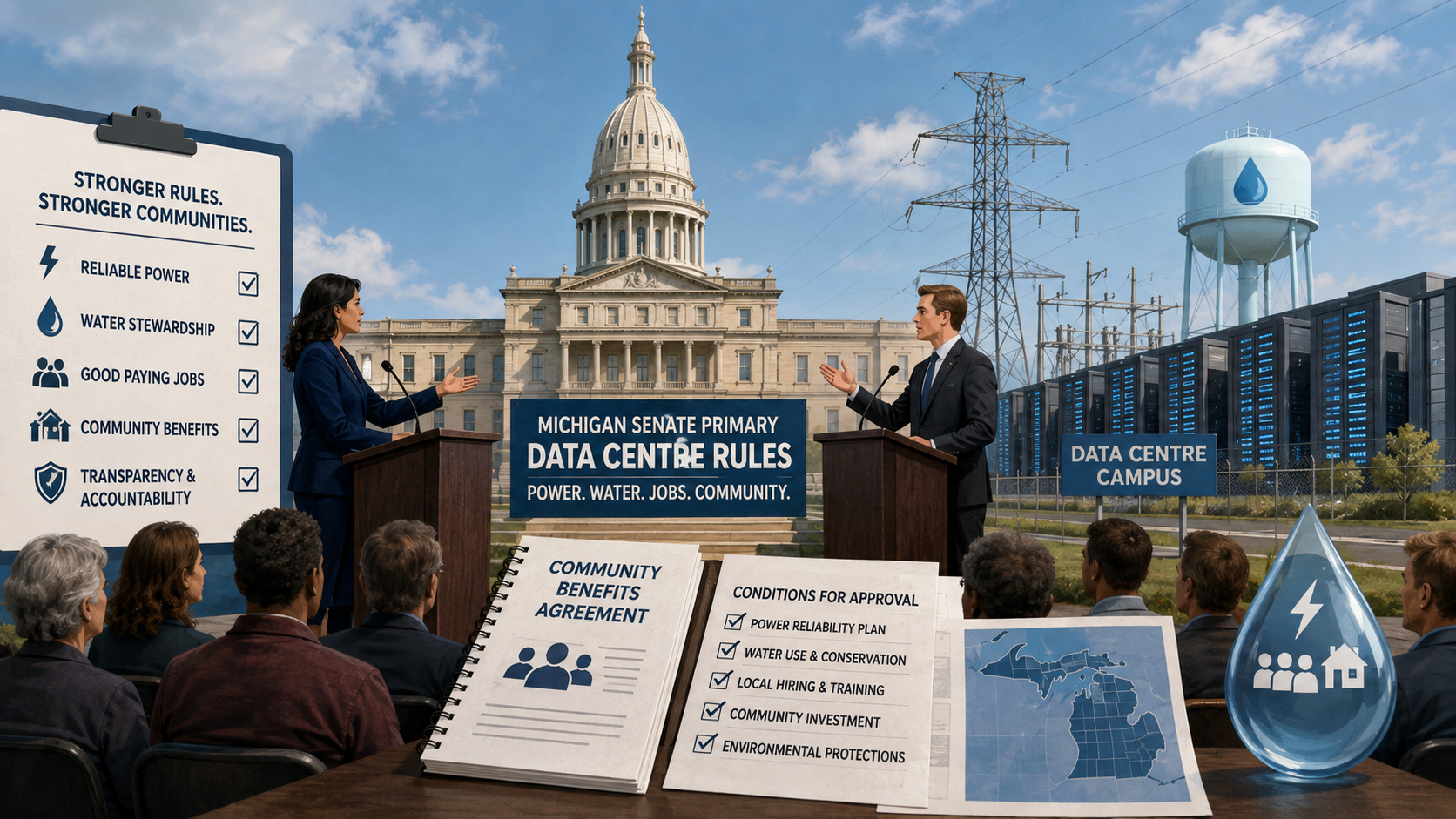
- El-Sayed’s platform covers union labour, utility rates, grid reliability, closed-loop cooling, local jobs, and enforceable community-benefit agreements
- Michigan already regulates some large-load costs, so the campaign concerns broader project conditions rather than the creation of oversight from nothing
The fact
Michigan’s Democratic US Senate primary has made data-centre policy a central issue in the contest between Abdul El-Sayed, a former public health official, and US Representative Haley Stevens. El-Sayed’s “Terms of Engagement” call for union labour, protection against utility-rate increases, stronger grid reliability, closed-loop cooling, promised local jobs and binding community-benefit agreements. During a July debate, he said the agreements should be backed by escrow and that officials should be able to shut facilities that fail to comply.
Stevens says she supports data-centre investment in Michigan, but operators should cover their own electricity and water costs rather than pass them on to households. Separately, Governor Gretchen Whitmer has introduced a voluntary industry pledge covering power-system costs, new energy resources, water protection, employment and public accountability, with Microsoft among the six signatories. Michigan already applies safeguards to some very large electricity users, including minimum contract terms and bills, exit fees, and credit or collateral requirements.
The assessment
El-Sayed’s proposal would change when and how developers must account for infrastructure and community obligations. If lawmakers turned it into binding approval rules, developers could have to show during project review how they would cover power costs, manage water use, meet employment commitments and deliver community benefits. Those obligations would no longer sit only in separate utility agreements, permit conditions or voluntary pledges, and failure to comply could affect approval or continued operation.
The campaign has not yet identified which authority would enforce the rules, what evidence developers would need to provide or when compliance would be assessed.
Those details matter because Michigan divides responsibility among several bodies. The Michigan Public Service Commission oversees large-load tariffs and customer protections, while environmental agencies and local governments handle water permits and land-use approvals. Any workable law would therefore need to assign each obligation to a named authority and a defined stage of development. For BTW readers, the primary is a test of political support for tighter conditions, not a change to current project rules, and operators face no new requirement unless lawmakers adopt enforceable provisions with clear scope, timing and oversight.
What to watch
Watch the primary result and whether the eventual nominee introduces legislation with project thresholds, named authorities and enforceable penalties. Any bill would need to state when developers must demonstrate compliance and how the new conditions interact with utility tariffs, environmental permits and local approvals. Those provisions would show whether the platform becomes an operational requirement or remains a campaign position.
Member Briefing
Deeper Profile Context
Sign in with the right membership level to unlock the full briefing and source notes.
Only for Strategic Circle
Strategic Circle
Open to all readers. Unlock profile briefings after joining and signing in.
Join Strategic CircleOnly for Leadership Alliance
Leadership Alliance
For qualified IP-asset owners and management; sign in to unlock alliance briefings.
Join Leadership Alliance