
Summary
- EAST STARK-TV LLC is an active Tashkent company registered in 2005, with public business-registry data tying it to wired communications and public RIPE NCC data tying it to local internet-number administration. Its consumer brand, StarkTelecom, sells home and office internet, digital or IP television, video surveillance and intercom services.
- The company's economic test is narrow but real. Home internet plans publicly range from low five-figure monthly sums on older tariff pages to Tezlik plans from 150,000 to 500,000 soums a month on the current home internet page. Those prices are meaningful for a Tashkent household, but thin once a provider must fund transit, power, support staff, cable work, router rental, content bundles and outage response.
- AS216023 gives EAST STARK-TV LLC a visible network footprint. Public routing tools show two originated IPv4 prefixes with 1,024 addresses, valid route-origin status in several datasets, and a small upstream set. That proves network control and resource stewardship, not customer count, gross margin, service availability or pricing power.
- The stronger evidence of operating substance is practical rather than glamorous: address-level coverage lists, service prices for cable repair and device setup, dated maintenance notices, and outage notices that mention fibre damage or upstream-provider work. These are the ordinary costs that decide whether a local provider earns money from reliability.
- Competition constrains the upside. Tashkent customers can compare StarkTelecom with national fixed and mobile operators, older local providers, fibre-based bundles, 5G home wireless offers and mobile data. EAST STARK-TV LLC can win where it has building access, fast response and trusted local support; it cannot price as if connectivity were scarce across the city.
- The judgment improves if EAST STARK-TV LLC can show active-line growth, churn control, route-level payback, physically resilient upstream access, funded maintenance, disciplined content costs and profitable business accounts. It worsens if the company is only buying traffic, content and hardware at scale disadvantages while competing on headline monthly price.
One account has to carry the whole cost stack
The economics of a local network operator start with a small transaction. A resident in a covered building chooses a monthly plan, signs a service agreement, pays in advance and expects the connection to behave like a utility. That payment is the visible revenue. It has to carry a much larger invisible stack: international and domestic connectivity, local interconnection, aggregation equipment, cables inside and outside the building, optical repair, router rental, support calls, billing, collection, security, regulatory obligations, content rights for television and the labour needed to send a technician to a customer site.
That is why EAST STARK-TV LLC cannot be judged only by whether it offers broadband. Many small providers can advertise broadband. Fewer can keep the line available, answer the phone, repair a cut, absorb equipment inflation and still earn enough to renew the network. The customer buys a simple product. The provider sells a bundle of risk.
The company’s public offer is anchored in Tashkent rather than in a national carrier story. Registry information records the business at Gospital Street in the Mirobod district, and company pages list additional customer-facing addresses in Yashnobod. Coverage pages name specific streets and buildings rather than only regions. That matters because building-level access is the scarcity unit in urban fixed broadband. A provider may look small at national scale and still have value if it controls a set of buildings where switching is inconvenient, service is familiar and technicians are nearby.
The danger is that local density can be overestimated. A covered address is not the same as a paying line. A paying line is not the same as a profitable line. A profitable line this month may become a loss if a larger operator offers a faster bundle, a mobile operator sells home wireless with a subsidised router, or an outage forces repeated field visits. Local access looks durable only when enough subscribers remain on each route for long enough to repay the original build and the continuing repair load.
The title question is therefore a cash-flow question. EAST STARK-TV LLC is not trying to monetise a new software product where distribution costs fall toward zero. It is running a physical service where every promise has a truck-roll, equipment and upstream-capacity consequence. Reliability can be sold, but only if the customer pays more than the full cost of being reliable.
What is proven about the company
The legal identity is reasonably clear. Public company data identifies the Uzbek entity as EAST STARK-TV LLC, registered in March 2005 and active. The same public profile lists taxpayer number 205565260, an activity code for wired telecommunications services, a charter fund of 471.8 million soums, and a Mirobod district address on Gospital Street. It also names Andrey Morgunov as manager and lists several individual founders, while warning that more current extracts should be checked through official channels.
Those facts are useful because they establish that the business is not merely a website or an address in an internet registry. The company existed long before the recent autonomous-system registration. It appears in local business directories under Stark-TV Telecom, with Tashkent contact details, cable television and internet-provider categories, working hours and local landmarks. Yellow Pages also places the brand in the Mirobod digital and satellite television category. These are secondary records, but they are consistent with a long-running local communications provider rather than a newly formed shell around address space.
The consumer brand is StarkTelecom. The current website presents home and business digital services: broadband internet, digital and IP television, IP video surveillance and IP intercom. It describes the company as a provider of technology for households and businesses, and the footer identifies the operating company as EAST STARK-TV LLC. The same site lists partners and technology brands associated with cameras, network equipment, access control, display systems and power or security hardware. The brand positioning is practical: connectivity, television, devices and support in the home or small office.
The strongest caution is that the public record does not disclose financial statements, subscriber counts, route kilometres, active buildings, churn, gross margin, average revenue per account or debt. It also does not reconcile the older Stark-TV identity with every current StarkTelecom page in a formal corporate disclosure. The available evidence supports an operating profile, but not a full valuation.
That distinction matters. A local provider can have real customers and still poor economics. It can own useful access equipment and still be dependent on upstreams. It can be present in many buildings and still lack enough paying density. For EAST STARK-TV LLC, the available facts support a working hypothesis: this is a Tashkent communications company with access-network and television history, now presenting itself as a broadband and smart-home provider. They do not prove that the business converts that position into attractive free cash flow.
The retail offer is a bundle, not just bandwidth
StarkTelecom’s home internet pages show two important things at once: a conventional speed ladder and an attempt to bundle useful extras. The current home internet service page lists Tezlik plans from 70 to 500 Mbps. Monthly prices run from 150,000 soums for Tezlik 70 to 500,000 soums for Tezlik 500. The page also distinguishes evening speeds from daytime speeds on some tiers, includes TAS-IX speeds, offers router rental at 25,000 to 35,000 soums a month, and adds television or online cinema bundles on higher tiers.
The older tariff index shows a lower-price ladder from 5 Mbps at 85,000 soums to 100 Mbps at 195,000 soums, with 100 Mbps TAS-IX on every tier. That page may be legacy, stale, or addressed to a different customer path. The commercial lesson is still useful. EAST STARK-TV LLC appears to have moved, or is trying to move, away from very low monthly bills toward higher plans that can support faster service and bundled content. If the newer prices are the active retail proposition, the company has more room to pay for support and capacity. If many customers remain on older or discounted plans, the public headline tiers overstate the economics.
Business internet is a separate test. The office page lists Daily-Unlim plans from 240,000 to 1.2 million soums a month. Daytime speeds rise from 4 Mbps to 100 Mbps, while evening speeds are much lower on the same table. The sharp day-night distinction suggests a product designed around working hours and constrained capacity. It also reveals the provider’s margin problem. A business line can support a higher monthly bill than a household line, but a business customer is less tolerant of downtime and may expect faster response, clearer service terms and a predictable route to higher speeds.
Television adds another revenue stream and another obligation. The digital or IP television page lists Stark Solo through Stark Unlimited plans from 50,000 to 100,000 soums a month, scaled by the number of televisions or set-top boxes. Television can reduce churn because customers buy one relationship for connectivity and content. But content carriage, head-end maintenance, set-top support and copyright compliance are not free. Television improves economics only when the incremental margin is positive after content, support and device costs.
The service-price page completes the picture. It lists charges for cable replacement, indoor cable installation, network sockets, connector replacement, fibre repair, moving equipment, Wi-Fi setup, device connection, IP camera setup, TV or set-top-box setup and technician visits. These small prices are strategically important. They show the company charging for work that customers often assume is part of the monthly bill. A provider that gives every field visit away for free can destroy the economics of a low-priced connection.
A provider that itemises some work can protect margin, but risks customer frustration if the boundary between included support and paid work is unclear.
Coverage creates value only when it becomes density
The coverage pages are more useful than general marketing claims because they list streets and buildings. StarkTelecom identifies service across named Tashkent streets such as Istikbol, Fidokor, Gospitalniy, Mirobod, Amir Temur, Mashtabib, Nukus, Sadyk Azimov and Said Baraka, with building numbers attached. It also lists broader selectable areas in Tashkent, Samarkand, Khorezm and Gulistan on some pages, although the precise meaning of those broader selectors is not fully clear from the public text.
The address-level list supports a local-access thesis. A building where EAST STARK-TV LLC already has distribution equipment and customer awareness is a different economic asset from a theoretical citywide offer. The provider can add customers at lower marginal cost if spare ports, cable paths and technician familiarity already exist. It can also defend accounts through local relationships and fast repair if the support operation is competent.
But address-level coverage also narrows the claim. This is not proof of national broadband scale, and it is not proof that every listed building has active ports, free capacity or current customers. It is a map of where the provider believes connection can be discussed. The difference matters because the fixed-cost burden falls before the full customer base is known. A route into a building can look attractive at the planning stage and disappoint if tenants prefer mobile data, another fibre provider, a building-exclusive arrangement or a national bundle.
The best way to measure the asset would be a route-level cohort table: buildings passed, homes passed, connected homes, average bill, installation cost, churn, monthly support cost, outage hours, required upgrades and payback period. None of that is public. In its absence, the article has to treat coverage as evidence of operating boundary, not proof of economic control.
The company’s own maintenance notices show why density matters. When a fibre line is damaged at an aggregation point, or when upstream-provider work interrupts service, the affected customer base receives the downside immediately. The repair cost does not fall in proportion to the number of subscribers. A cut affecting 50 paying lines and a cut affecting 500 paying lines may require similar skilled work, access coordination and customer messaging. High density makes that cost bearable. Low density turns reliability into a subsidy.
That is the central local-network problem. Customers buy reliability as if it were an individual service. Providers manufacture it as a shared infrastructure outcome. EAST STARK-TV LLC’s ability to make money depends on how many accounts share each cost event before a larger rival offers a simpler alternative.
Network resources show control, not economic scale
The technical evidence is meaningful. RIPE NCC lists EAST STARK-TV LLC as a member serving Uzbekistan, with the Gospital Street address and StarkTelecom contact email. Public routing data identifies AS216023 as EAST-STARK-TV or EAST STARK-TV LLC. The autonomous system was created in January 2025, after the organisation record was created in late 2024. Multiple public tools show two IPv4 prefixes, commonly 212.115.112.0/23 and 212.115.114.0/23, for a total of 1,024 addresses. Several datasets mark the routes as covered by valid route-origin authorisation.
This matters because a local provider that controls its own autonomous system and address space is not merely reselling a retail connection under another brand. It has at least some network administration capability. It can announce its own prefixes, manage address assignments, operate abuse contacts, and choose how to connect through upstream networks. For customers, that can improve accountability: the company whose name is on the bill also appears in routing and registry records.
But the technical footprint is small. A thousand IPv4 addresses can support a modest access provider, especially with address sharing, but it does not imply large scale. Public data currently shows no IPv6 address base for AS216023 in several tools. That absence is not fatal in a market where IPv4 remains widely used, but it weakens any claim to forward-looking network maturity. It also creates future pressure if business customers, hosted services or regulatory expectations shift toward IPv6 readiness.
The upstream picture is also a risk. RIPE route policy records mention AS50025 and AS34250, while some observed-routing tools show a visible path through IPLUS. Different tools see different moments and relationships. The conservative conclusion is that EAST STARK-TV LLC depends on a small upstream set rather than a broad, physically diverse transit portfolio. That may be adequate for a local retail network. It is a strategic constraint if the company wants to sell higher-reliability service or business connectivity.
Network-resource evidence should therefore be read in two columns. On the positive side, EAST STARK-TV LLC has visible resource administration, route-origin hygiene and enough routed IPv4 space to support a real local access base. On the negative side, public data does not show traffic volumes, route diversity, capacity headroom, peering contracts, failover testing, customer distribution or margins. The autonomous system tells us the company controls part of the technical stack. It does not tell us whether that control earns enough money.
Upstream dependence defines the reliability promise
Reliability is expensive because it is not a slogan; it is a set of redundancies. A provider selling stable access needs enough upstream capacity, resilient local aggregation, protected power, spare optics, backup paths, monitoring, field labour, customer communication and contractual clarity. EAST STARK-TV LLC’s public materials show pieces of that operation, but not enough to prove the full resilience case.
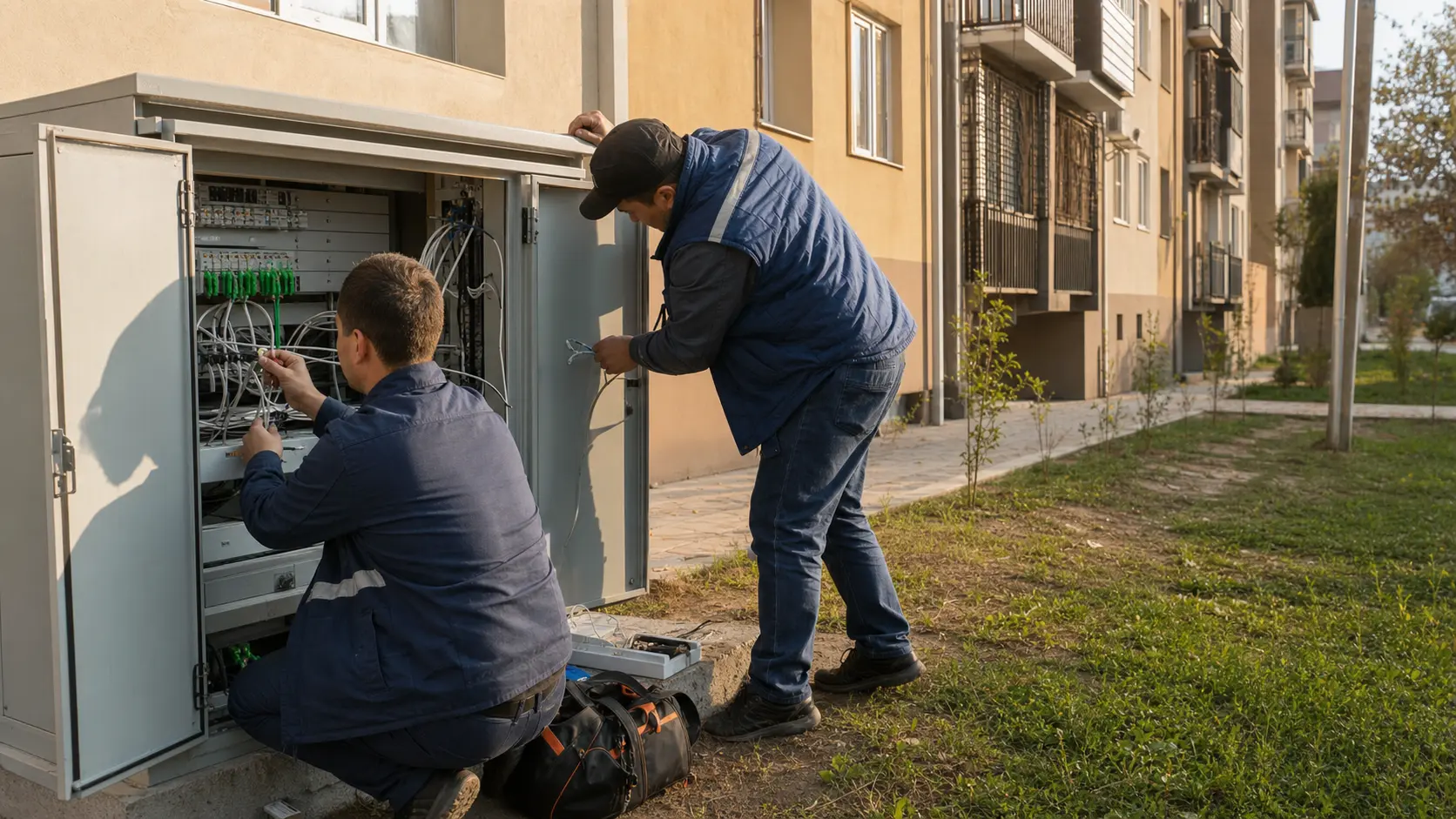
The news record is revealing. A January 2026 notice told subscribers that internet, TAS-IX and cable television would be temporarily unavailable because of damage to a fibre-optic line at an aggregation node on Mashtabib Street. A February 2026 notice described planned work at multiple addresses to improve service quality. Another February notice referred to work by an upstream provider at an exchange station and warned of interruptions lasting 20 to 30 minutes. A December 2025 notice mentioned planned work at Tashkent and Tashkent-region exchange stations, with possible service degradation or interruptions.
An August 2025 notice said a telecom node was being moved at the request of Uzbektelecom and warned of possible loss of access to TAS-IX, UZ-IX and some payment services.
These notices are not scandals. They are the normal operating record of a provider that has physical facilities, third-party dependencies and customers to notify. They are also useful because they show where the cost and risk lie. Fibre can be damaged. Nodes may have to move. Upstream maintenance can affect services. Payment access can depend on local interconnection. Television and internet can fail together if aggregation is common.
The economic question is how those interruptions are absorbed. If the customer base is sticky, service credits are rare, response is fast and customers trust the provider, reliability incidents are manageable. If customers switch quickly, call volumes spike, repairs require expensive contractors, or business customers demand compensation, the same incidents reduce margin. Public notices prove the company communicates, but they do not show the financial effect.
The upstream issue also shapes bargaining power. A small provider buying transit or local interconnect in Uzbekistan does not negotiate like a national operator. If prices rise, equipment lead times stretch, or a landlord forces a node move, the local provider has less room to absorb the shock. Passing cost to customers is possible only if the customer sees enough value in StarkTelecom’s local support to stay after a price change.
That is why the reliability strategy has to be selective. EAST STARK-TV LLC should not promise enterprise-grade resilience across every product unless it funds enterprise-grade design. It can more plausibly sell accessible local support and honest residential reliability, while charging separately for business requirements that create real incremental cost.
Unit economics decide whether growth creates value
The available tariff data invites simple arithmetic. A Tezlik 100 home plan at 170,000 soums a month produces about 2.04 million soums a year before taxes, equipment, content, customer support and network cost. A Tezlik 500 plan at 500,000 soums produces 6 million soums a year. A router rental of 25,000 to 35,000 soums a month can help recover device cost, but only if the equipment is returned, maintained and not subsidised too heavily. A TV plan from 50,000 to 100,000 soums a month adds 600,000 to 1.2 million soums a year before content and support costs.
Those figures are not trivial in a household budget. They are also not generous for a provider with physical obligations. The line must cover shared transit, local traffic exchange, power, depreciation of switches and optical gear, replacement of customer equipment, billing and support. If a customer calls frequently, needs technician visits, pays late or churns after a promotion, the first-year economics can be unattractive.
The business plans offer higher revenue but raise expectations. A Daily-Unlim office plan at 1.2 million soums a month produces 14.4 million soums a year. That can support more attention than a residential line. Yet the page also shows peak-period speeds as low as 30 Mbps even on the highest listed office tier, with higher daytime speeds. If a business wants symmetric high-speed fibre, service guarantees or dedicated capacity, it may need a custom arrangement. EAST STARK-TV LLC has to avoid selling low-margin business bandwidth under the language of reliability if the technical design is still best-effort shared access.
Installation and support fees are the margin-control valve. The company lists 20,000 soums for cable replacement, 30,000 for Wi-Fi setup, 30,000 for local network setup, 100,000 for initial IP-camera setup, 20,000 for TV or set-top-box setup, 15,000 for a technician visit and 150,000 for an express technician visit within two hours. These charges do not prove profitability, but they show the business is aware that field work cannot be unlimited.
The harder capital question is renewal. Even if customer installation is charged separately, a provider still has to replace switches, upgrade capacity, manage power, improve monitoring, handle security incidents and eventually modernise the access layer. If the company’s prices are set mainly to match competitors, renewal capital may be underfunded. If prices are set to recover full cost, customers may compare against larger providers with more scale.
The strategic conclusion is uncomfortable but clear. Growth is not automatically good for EAST STARK-TV LLC. Adding customers on underpriced routes destroys value. Adding customers in dense covered buildings, with low support intensity and disciplined paid work, creates value. The company’s future depends less on the number of services in the menu than on the contribution margin of each route and account cohort.
Competition caps how much reliability can be monetised
Tashkent is not a connectivity desert. Customers can compare local fibre providers, national operators, cable and IP television bundles, mobile data, fixed wireless and 5G home offers. Public competitor pages show older city providers such as Sarkor promoting home and office internet, hosting, video surveillance, IP telephony and IPTV. Comnet markets fibre-based home plans with television bundles. Mobile operators have begun selling home wireless propositions that include annual service and a 5G router in selected cities. Larger operators also benefit from brand recognition, broader support channels and network scale.
This creates a ceiling on EAST STARK-TV LLC’s pricing. The company can charge for convenience, local coverage and fast response. It cannot charge as if the customer has no alternative. A customer choosing among providers will compare headline speed, monthly price, router cost, television package, installation terms, support availability and neighbour experience. Reliability matters most after an outage; price matters every month.
The substitute set is not uniform. A fibre provider is a stronger substitute for a household with heavy streaming, gaming, remote work or cameras. Mobile home wireless is attractive where installation is difficult or renters want flexibility, but it may be weaker under congestion or fair-use limits. A national bundle can be attractive for customers who want one bill with mobile, fixed and content. A local provider can still win if it is already in the building and trusted by residents.
The company’s IP television and device services are a hedge against pure bandwidth competition. Television, cameras and intercoms make the relationship stickier and can turn a home connection into a broader property-service account. The same bundle also exposes EAST STARK-TV LLC to equipment selection, installation quality, support complexity and vendor dependence. Every extra service has to earn its support load.
Competitors also shape business-account economics. A small office may value a local technician and a direct number. A larger business may demand service levels, redundancy, security documentation, static addressing and formal contracts. EAST STARK-TV LLC can serve the first group without pretending to be a national enterprise carrier. Serving the second group profitably requires careful pricing and technical design.
The defensible strategy is not to beat every substitute on speed or price. It is to own selected local pockets where the company can connect quickly, repair quickly, bundle practical services and keep enough accounts on each route to recover cost. That is a narrower strategy than broad telecom ambition, but it is the one that matches the evidence.
Regulation and data locality add fixed obligations
Uzbekistan’s telecom regime gives local providers both legitimacy and burden. The Ministry of Digital Technologies describes licensing for the design, construction, operation and provision of telecom networks, including data transmission and television distribution. It also identifies requirements around technical means, interconnection, quality standards, emergency readiness, information security, lawful operational needs and consumer information. A newer telecommunications regulator was established in 2025 to oversee sector regulation, licensing, permits, numbering, interconnection and quality monitoring.
For EAST STARK-TV LLC, this means telecom service is not just a retail subscription. The company must operate inside a regulated environment where licences, service categories, customer information, network security and emergency obligations can carry real cost. The television side adds content and distribution obligations. The internet side adds abuse handling, registry stewardship and lawful-process readiness. Those costs are fixed or semi-fixed; they do not disappear when a customer chooses the cheapest plan.
Data locality makes the operating environment more specific. Uzbekistan has required localisation of personal data in important categories for several years, and 2026 amendments added stricter handling for data of people using telecom services operating in Uzbekistan. For an access provider, this reinforces the need to know where subscriber records, billing systems, logs, support tools and cloud services are hosted and processed. The requirement does not make local providers stronger by itself. It raises the minimum operational standard.
The regulatory context also affects suppliers. If customer data, billing, cameras, intercoms or hosted video services rely on foreign platforms, EAST STARK-TV LLC must manage legal and technical boundaries. If it uses local hosting or local software, it may pay more or accept a narrower toolset. If it uses large foreign cloud services without discipline, it risks compliance and continuity exposure. Data sovereignty is therefore not an abstract theme. It changes how a small provider chooses vendors.
International connectivity adds another dependency. Uzbekistan’s digital ministry has reported a large increase in international internet capacity since 2020, and national statistics show broadband subscriber growth over the decade. More national capacity lowers scarcity and can improve wholesale economics. But it also helps competitors. When the whole market becomes better connected, local access providers have to compete on service quality and density, not merely on the existence of an internet connection.
Regulation therefore cuts both ways. It can protect serious operators by forcing minimum standards. It can also squeeze small operators whose tariff base is not large enough to absorb compliance, documentation and technical renewal. EAST STARK-TV LLC’s ability to turn regulation into advantage depends on whether it can present trust, local accountability and compliant service without letting overhead consume the margin.
Unofficial signals should be used carefully
The informal market record is consistent with an operating consumer provider, but it is not strong enough to estimate subscriber satisfaction. Business directories show the company’s contact points, categories, work hours and local visibility. Search and listing pages place the brand among cable television, digital television and internet providers in Tashkent. The company’s own pages show offices, support numbers, a personal cabinet, application forms and a long list of customer notices.
These signals matter because small providers are often hard to evaluate from formal filings alone. A working website with current tariffs, dated service notices, address-level coverage and a local support number is better evidence than a dormant registry entry. The presence of technical work notices is also useful. Providers that never publish outages may not be more reliable; they may simply be less transparent.
Still, these signals have limits. Directory listings may lag the current legal form, especially because older pages describe EAST STARK-TV as a private enterprise while business-registry data records the current limited-liability company. Coverage selectors can contain placeholder-like broad areas or stale street lists. Tariff pages can conflict if old pages remain indexed. Review counts are thin on some directories. Search-category placement can reflect legacy cable television rather than the current revenue mix.
The article therefore treats unofficial signals as clues about operating presence and brand position, not as audited facts. They can support the view that EAST STARK-TV LLC has a long local history and a practical customer-facing business. They cannot prove take-up, renewal rates, active customer numbers, net promoter score, outage frequency or cash generation.
The most useful unofficial signal is the specificity of the local operation. A company that lists individual building addresses, charges for particular repair tasks and publishes dated technical notices is exposing operational detail. That detail is exactly where local network economics are won or lost. Generic claims about quality are less important than whether a provider knows which fibre point failed, which building is covered, which service is paid, and which technician action has a price.
For investors, creditors, suppliers or customers, the next step would be verification rather than narrative. Ask for current licence details, customer counts, outage history, route diversity, spare inventory, complaint rates, content agreements, and segment profitability. The public record can frame the questions. It cannot answer them all.
What would change the judgment
The upside case is not complicated. EAST STARK-TV LLC becomes more attractive if it can show dense local routes, rising average revenue per account, low churn, paid installation economics, disciplined support costs and a growing share of customers taking television, camera, intercom or business add-ons with positive contribution. In that case, the company is not just selling bandwidth. It is monetising building access, local trust and practical service bundles.
The network case also improves with hard resilience evidence. That means physically diverse upstream paths, tested failover, documented capacity headroom, clear local exchange arrangements, IPv6 readiness, monitored aggregation nodes, spare optics, spare customer equipment and transparent incident reporting. AS216023 is a good starting point. It needs operational depth around it if the company wants to sell reliability rather than only access.
The business case improves if office accounts expand without turning into custom support drains. A small business is attractive when it pays more than a household, needs modest support and buys additional services. It is unattractive when it demands enterprise treatment on a consumer-price contract. EAST STARK-TV LLC should disclose or at least manage segment economics tightly: home, office, television, surveillance, intercom, installation and repairs should not be blurred into one revenue line.
The downside case is also clear. The company is vulnerable if many customers are on low legacy tariffs, if the active base is scattered across too many buildings, if outages require repeated field work, if upstream dependence is narrow, if router or set-top subsidies are not recovered, if content costs rise, or if mobile home wireless becomes a good enough substitute for renters and lower-usage households. Under those conditions, the company could grow service activity while producing little owner return.
Regulatory or data-hosting pressure could worsen the judgment if compliance forces new systems, local storage, security work or documentation without matching price increases. Supplier dependence could also matter. The website’s partner list includes global and regional hardware brands across cameras, routers, access control and network equipment. That breadth is useful for customer solutions, but it also means inventory, support knowledge and warranty management are real tasks. Hardware margins disappear quickly when devices fail, firmware is neglected or field teams must support too many models.
The decisive facts are therefore operational, not promotional: active subscribers per building, revenue per route, support minutes per account, repeat-fault rate, gross margin by product, churn by plan, upstream cost per Mbps, service-credit exposure, equipment write-offs and maintenance capital. Without those numbers, the right judgment is provisional. EAST STARK-TV LLC appears to have a real local telecom position, but the public evidence is not enough to say that it has turned that position into durable cash generation.
The strategic answer is disciplined locality
EAST STARK-TV LLC should not try to look like a national carrier or a cloud platform. Its public evidence points to a different advantage: local buildings, local customer support, access-network familiarity and bundled services that make a household or small office easier to serve. That is a valid business if the company prices every obligation honestly.
The first discipline is route selection. Build and upgrade where there is enough address density, demand and customer willingness to pay. Avoid scattered expansion that adds maintenance without density. The second discipline is product clarity. Home broadband, office access, television, surveillance, intercom and technician services each need their own margin logic. The third discipline is resilience pricing. If a customer wants higher availability, static addressing, faster repair or dedicated capacity, that should be reflected in the contract.
The fourth discipline is supplier control. A small provider cannot escape upstreams, content providers, equipment vendors and software systems. It can reduce fragility by limiting unnecessary platform variety, holding critical spares, documenting configurations and avoiding bundles whose support cost is larger than their margin. The fifth discipline is transparency. Maintenance notices are useful. More structured reporting on availability, coverage and customer support would make the reliability promise easier to believe.
The company’s risk is strategic overstatement. “Digital solutions for home and business” can mean a coherent local bundle, or it can become a catalogue of low-margin obligations. The public pages contain both possibilities. The internet and television plans suggest a recurring-access base. The camera, intercom, LED-screen and service menus suggest project and device work that can be profitable if tightly scoped and costly if treated as generic growth.
The cash-flow test behind local network reliability is unforgiving. A customer may judge the provider by one outage, one technician visit or one monthly bill. The provider must judge the customer by full-life contribution. EAST STARK-TV LLC’s visible assets give it a chance: a long operating history, local Tashkent presence, routed resources, service menus and building-level coverage. The missing proof is whether those assets produce enough cash after transit, field work, content, compliance and churn.
Until that proof is available, the strongest conclusion is measured. EAST STARK-TV LLC is more than a registry entry and less than a proven scale platform. Its opportunity is to sell dependable local connectivity where it has physical reach and support credibility. Its threat is that the market values bandwidth as a commodity while the company bears reliability as a cost. The strategy works only if every connected building, every support visit and every bundled service pays its way.