Summary
- NTT DOCOMO’s service page records 6.5 million people connected to docomo Starlink Direct as of 6 August, after reporting five million on 9 July and launching the service on 27 April.
- Eligible DOCOMO lines need no application and pay no monthly fee; 90 handset models and more than 25 million devices were compatible as of 6 August.
- The service works outdoors with open sky when the handset is outside DOCOMO 4G/5G and Wi-Fi coverage, supporting messages, selected apps, data and emergency alerts but not voice calls.
- CNET Japan reports that connection persons during the 28 July Kumamoto earthquake were about three times the level at the same weekday and time a week earlier.
- DOCOMO plans international roaming in September, while pricing, countries, settlement terms and actual roaming availability were not disclosed in the current evidence.
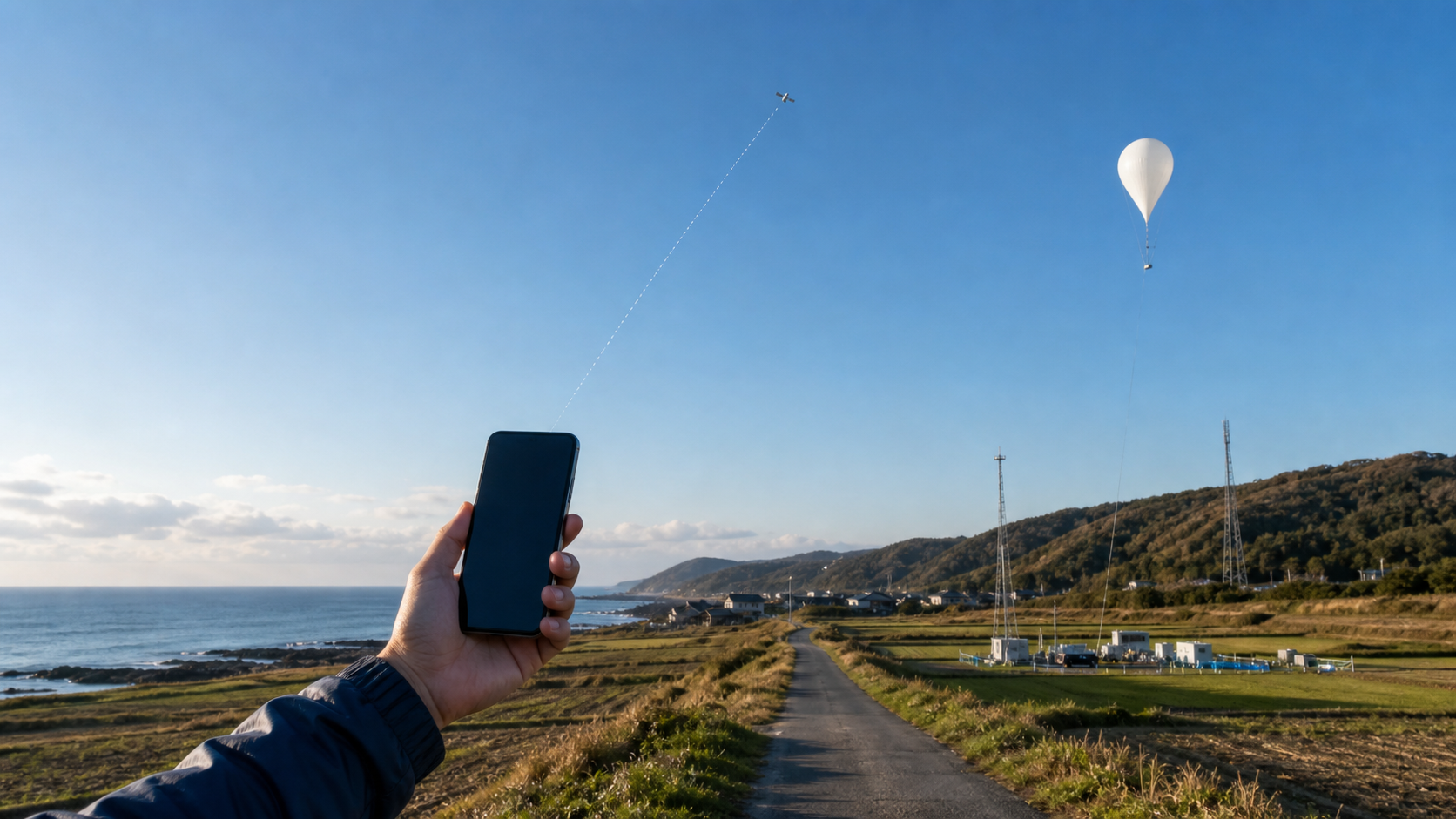
- From September, three balloon-HAPS demonstrations are planned in Noto under a government project; they are trials combining smartphone communication and high-resolution imaging, not commercial HAPS service.
A free fallback produces a different denominator
The progression from five million connection persons on 9 July to 6.5 million on 6 August looks like rapid adoption. It is better understood as broad activation opportunity. DOCOMO places the feature on eligible lines without an application or monthly charge. A compatible phone outside terrestrial and Wi-Fi coverage can connect automatically when it has a clear view of the sky.
That design removes the purchase decision that normally defines a subscriber. It also explains why the eligible estate—more than 25 million devices across 90 models—is much larger than the connection count. The 6.5 million figure demonstrates that a substantial share has encountered and used the fallback at least once. It does not reveal repeat use, monthly activity, simultaneous load, traffic, session length, retention or revenue.
The earthquake comparison is a demand spike, not a capacity test
CNET reports that around the 28 July Kumamoto earthquake, connection persons were roughly three times those at the same weekday and time a week earlier. The comparison provides a useful behavioural signal: when terrestrial reliability becomes salient, more users reach the satellite layer.
It does not disclose the absolute number of connections, message success rate, latency, congestion, duration or geographic spread. A threefold increase can begin from a small base, and connection persons are not traffic volume. The event supports the resilience thesis without proving that the service carried every attempted session or had spare capacity throughout the emergency.
DOCOMO is buying coverage insurance, not a second mobile network
The current service has a narrow operating boundary. It applies outdoors under open sky, beyond DOCOMO 4G/5G and Wi-Fi. It can provide messaging, supported applications, data and emergency alerts, but it does not provide voice calling. It may also be restricted when public needs require prioritisation.
For users, the free inclusion reduces the price of coverage insurance to zero at the point of use. For DOCOMO, the cost has not disappeared; satellite capacity, integration, support and settlement still have to be funded. The companies disclose no wholesale economics, incremental network cost or revenue attachment. The commercial return may come through lower churn and broader coverage claims rather than a separate fee, but no retention evidence is supplied.
Roaming is the first monetisation and settlement test
International roaming is planned for September. That shifts the service from a domestic fallback into a cross-border arrangement requiring device eligibility, spectrum permissions, partner terms and charging rules. None of the countries, prices, revenue-sharing terms or launch dates is disclosed in the current report.
Until availability is observed, roaming remains a plan. It could extend the value of an existing DOCOMO line for travellers, or it could remain a tightly bounded emergency feature. The next facts must show where it works, who bills whom and whether satellite use is included, capped or separately charged.
HAPS follows a slower and more demanding clock
DOCOMO also plans three balloon-HAPS demonstrations in Noto from September under a Ministry of Internal Affairs and Communications project. The tests will combine smartphone communications with high-resolution imagery for labour saving in primary industries, monitoring dams and other infrastructure, and understanding disaster conditions.
This is not the same product as Starlink Direct. HAPS aims to place an airborne platform in the stratospheric layer and provide a concentrated service area; the September work is an experiment. DOCOMO’s 2025 programme materials described commercial flight in Ishikawa from fiscal 2028 onward. Trial count, coverage, availability and cost must therefore remain separate from commercial capacity.
Sources
Member Briefing
Deeper Profile Context
Sign in with the right membership level to unlock the full briefing and source notes.
Only for Strategic Circle
Strategic Circle
Open to all readers. Unlock profile briefings after joining and signing in.
Join Strategic CircleOnly for Leadership Alliance
Leadership Alliance
For qualified IP-asset owners and management; sign in to unlock alliance briefings.
Join Leadership Alliance