
Summary
The migration can be complete in the provider’s records while the call path is already gone.
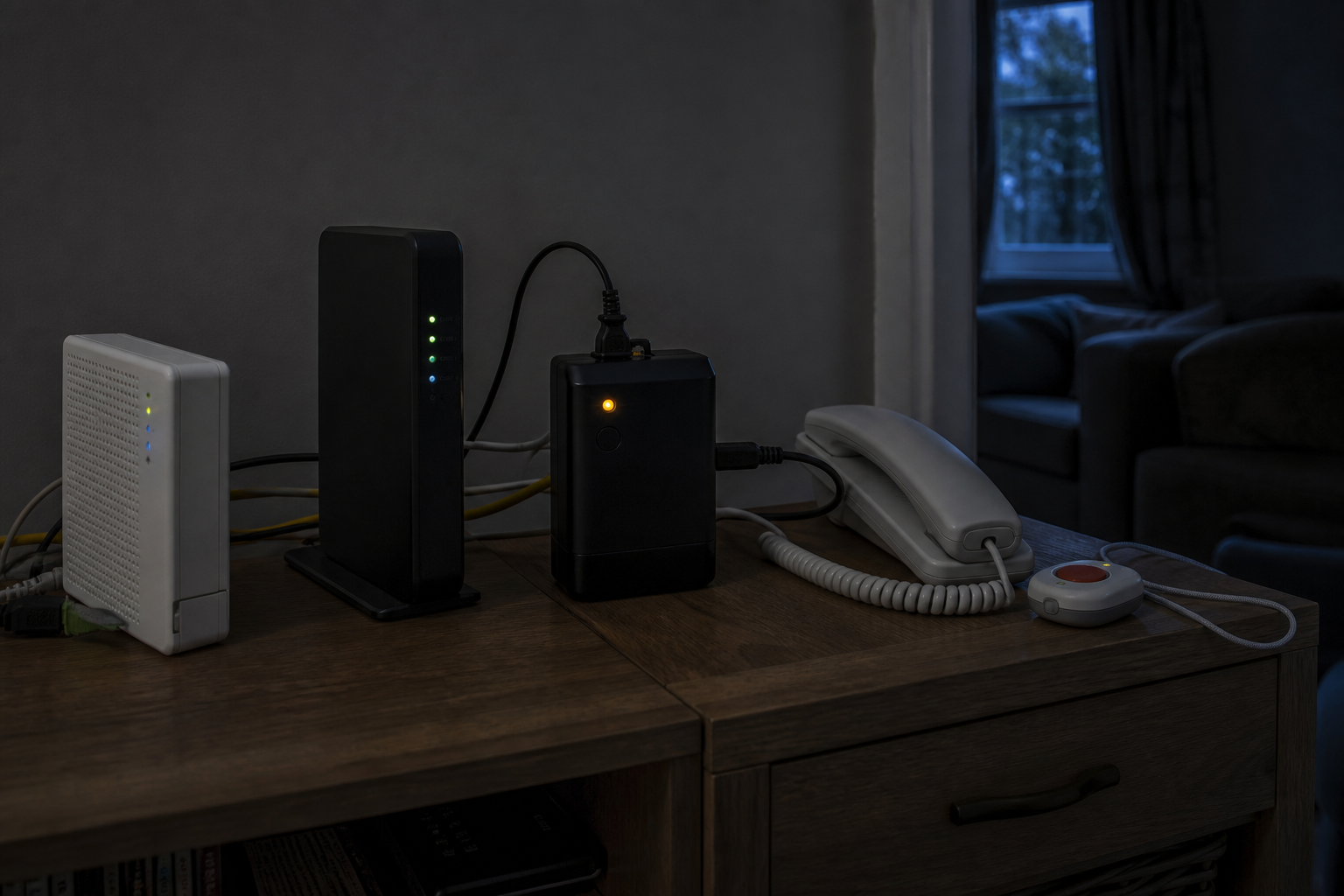
That distinction matters as Britain moves the remaining Openreach PSTN users to new services by 31 January 2027. The old copper arrangement and the new All-IP service allocate resilience differently. A basic wired analogue handset could draw power from the line. A digital landline normally depends on equipment powered inside the premises. The service is therefore not resilient merely because the network is modern or because a backup box was delivered. It is resilient for the measured lifetime of every component required to place the call.
One hour is a floor, not a description of the outage
Ofcom tells customers that digital landlines need mains electricity and will not work in a power cut without backup. Where a customer depends on the landline and has neither a working mobile phone nor reliable mobile signal, the provider must offer a free backup solution. Ofcom sets the minimum at one hour and notes that some provider solutions last up to seven.
That is a useful entitlement. It is not evidence that a particular home will remain connected for the duration of a particular outage. The one-hour figure describes the minimum solution that must be available to an eligible customer. It does not forecast when the distribution network will restore electricity, prove the condition of a battery after years of service, or show which devices were actually connected to it.
The government’s telecare action plan recognises the boundary. Providers have agreed to work towards solutions exceeding the one-hour minimum. More importantly, the plan says telecare users should not be migrated without confirmation of a compatible and functioning solution. Compatibility is an installed fact, not a catalogue property.
Primary sources
- Ofcom, “Your landline is going digital: what you need to know” — https://www.ofcom.org.uk/phones-and-broadband/landline-phones/future-of-landline-calls
- UK Government, “Telecommunications Modernisation: Connectivity Timeline” — https://www.gov.uk/guidance/telecommunications-modernisation-connectivity-timeline
- UK Government, “Telecare National Action Plan” — https://www.gov.uk/government/publications/telecare-national-action-plan-protecting-telecare-users-throughout-the-digital-phone-switchover/telecare-national-action-plan-protecting-telecare-users-through-the-digital-phone-switchover
- UK Government, “PSTN Network Operator Charter” — https://www.gov.uk/government/publications/pstn-network-operator-charter
- BT, “Set up a Battery Back Up” — https://www.bt.com/help/landline/set-up-battery-back-up
Member Briefing
Deeper Profile Context
Sign in with the right membership level to unlock the full briefing and source notes.
Only for Strategic Circle
Strategic Circle
Open to all readers. Unlock profile briefings after joining and signing in.
Join Strategic CircleOnly for Leadership Alliance
Leadership Alliance
For qualified IP-asset owners and management; sign in to unlock alliance briefings.
Join Leadership Alliance