
Summary
- The paid unit is a Moscow colocation rack, power, carrier and compliance-locality account. DataSpace says its colocation price for a rack place starts from 130,000 rubles a month including 22% VAT, with final terms depending on rack type, total power, per-rack density, deployment stages, scalability, physical and information-security requirements, carrier links and cross-connects (https://www.dataspace.ru/services/colocation/).
- The public record supports a real Moscow facility proposition rather than a thin hosting brochure: DataSpace lists 12 server halls of about 250 square metres each, 360 kW per hall, average room capacity of 88 racks up to 20 kW from two independent beams, 9.5 MW of simultaneous supply, N+1 generator and cooling arrangements, security layers, a claimed PUE of 1.5 and 14 years of operation without downtime since 2012 (https://www.dataspace.ru/data-center/, https://www.dataspace.ru/company/certificates/).
- DataSpace's compliance story is visible but bounded. The company cites Uptime Institute Tier III Gold, ISO 9001:2015, PCI DSS, 152-FZ and an attested DataSpace Cloud environment aligned to the third protected level for personal data; those facts can help a buyer assemble an audit file, but they do not by themselves prove that every customer workload, access process or application control is compliant (https://www.dataspace.ru/company/certificates/tier-3/, https://www.dataspace.ru/services/cloud/cloud-152-fl/, https://www.consultant.ru/document/cons_doc_LAW_61801/).
- Network-resource evidence supports reachability and interconnection surface, not operating quality. RIPE records DataSpace Partners LLC as
ORG-DPL15-RIPE, an LIR with AS209930 and registered IPv4 resources, while PeeringDB lists DataSpace Moscow as a facility with 19 networks and four exchange entries; those records do not prove utilization, margin, customer concentration, security outcomes or uptime (https://rest.db.ripe.net/search.json?query-string=DataSpace%20Partners%20LLC&flags=no-filtering, https://stat.ripe.net/data/as-overview/data.json?resource=AS209930, https://www.peeringdb.com/api/fac/2195). - The investment judgement is conditional. DataSpace matters if Russian enterprise buyers are paying for local facility certainty, documented power and cooling discipline, carrier choice and compliance locality more than commodity floor space. It weakens if private metrics show low rack occupancy, high support friction, expensive spare-parts workarounds, weak renewal rates, or customers moving the same workloads to larger domestic cloud and colocation platforms.
The Renewal Decision Is A Rack, Power And Locality Bet
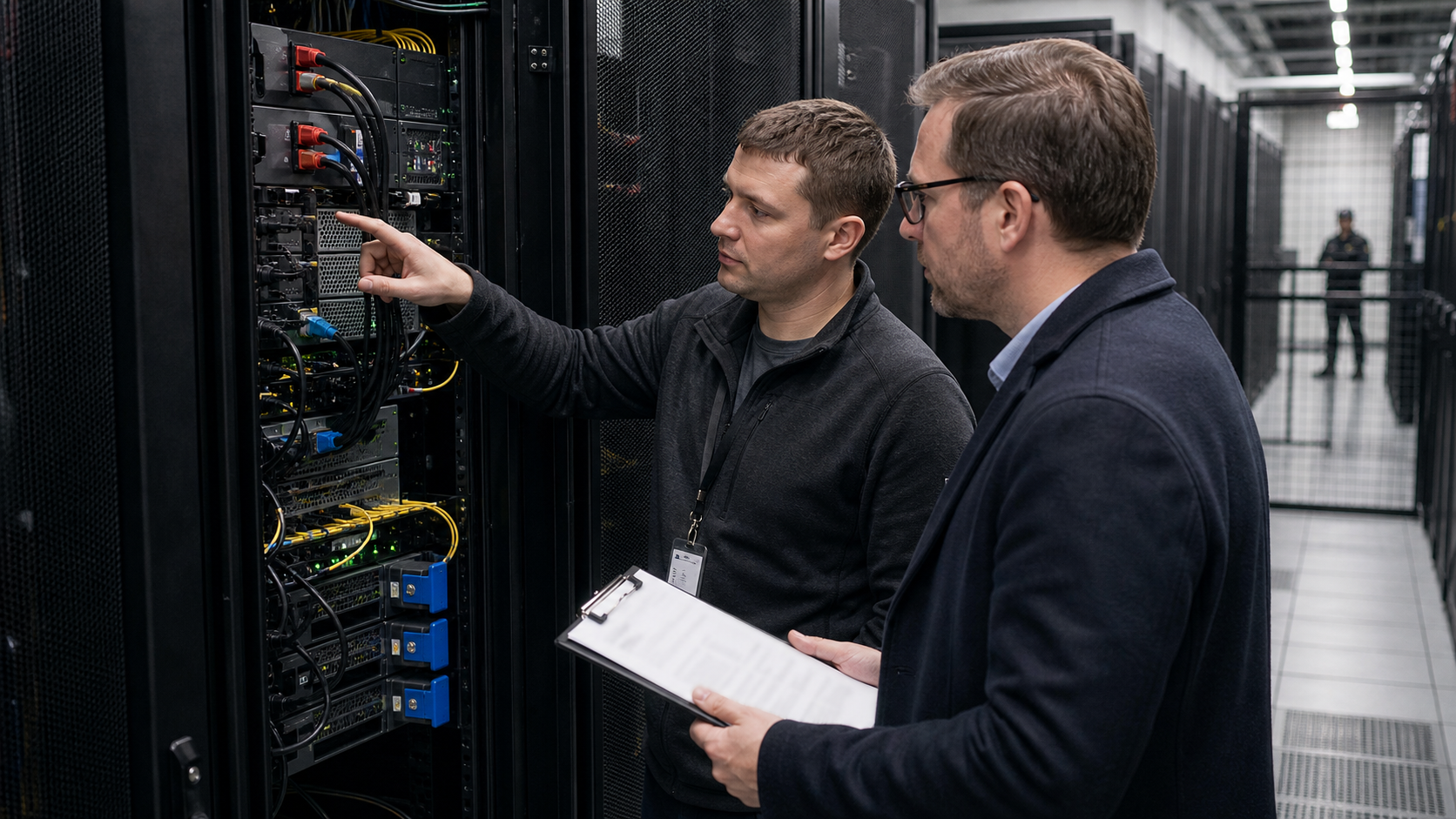
The practical opening is a continuity meeting, not a property tour. Imagine a Moscow infrastructure manager whose enterprise still runs billing, payment reporting, document storage, warehouse integration, customer authentication and several old virtual-machine clusters in a server room beside the head office. The UPS batteries have been changed twice, the dedicated air conditioner is at the edge of its design life, and a single building power event would force the team to decide whether the room is still a controlled environment or simply an expensive habit.
The manager has five substitutes on the table: keep the room, move hardware to DataSpace, choose a larger Russian colocation provider, migrate permissible workloads to domestic cloud or managed hosting, or delay the decision until the next failure makes the decision unavoidable.
The paid unit in the first memo is narrow: a Moscow colocation rack, power, carrier and compliance-locality account. The invoice may say rack, rack place, equipment placement, server-room rental, telecom service, cross-connect or remote support. The economic unit is bigger than the cabinet. It is the right to place customer-controlled equipment in a Moscow facility where power, cooling, access control, fire protection, network paths, technical staff and documentation already exist. The customer is buying a way to turn scattered in-house risks into a service relationship.
DataSpace's public pricing language makes the unit tangible. The colocation page says a rack-place service is priced individually for each customer and starts from 130,000 rubles a month including 22% VAT; it lists the cost drivers as the number and type of racks, total power and power density, equipment placement requirements, commissioning stages, scalability, physical and information-security requirements, connectivity, carrier channels and cross-connects (https://www.dataspace.ru/services/colocation/). That is a useful price floor because it shows that DataSpace is not selling only square metres. It is asking the customer to describe the operating burden being transferred.
The buyer should compare that price against the server room it already owns. The room looks cheap only if power, cooling, labour, spare parts, access control, insurance, audit evidence, incident risk and future expansion are hidden in other budgets. Once those costs are pulled into one model, colocation becomes a risk-transfer product. A 130,000-ruble floor is not the total cost; it is a starting point for reserving a slice of engineered capacity. The final question is whether DataSpace can absorb enough facility risk to make the customer's private room look undercapitalised.
The migration worksheet should therefore start before the commercial quote. Which systems must move first? Which systems can be virtualised, backed up or retired? Which appliances require customer-only handling? Which carrier links must be parallel-run before cutover? Which users, regulators, payment partners or customers need notice? Which legacy licences are tied to a physical host, dongle, MAC address or support contract? These questions are not administrative detail. They decide whether the colocation account is buying continuity or merely postponing application modernisation.
A rushed lift-and-shift can turn a good facility into an expensive storage location for unresolved architecture debt.
This is the central thesis. DataSpace Partners matters if Russian enterprises are paying for certainty around Moscow locality, electrical continuity, cooling discipline, carrier choice and compliance evidence. It does not matter in the same way if buyers only need a cheap cabinet, a public-cloud account, a managed-hosting package, or another year of deferral. The company's own site describes DataSpace as a commercial data-centre operator in Russia, providing cloud and telecom services and premium colocation, with the legal entity ООО "ДатаСпейс Партнерс", OGRN 1097746362130 and INN 7707706516 (https://www.dataspace.ru/, https://www.dataspace.ru/profile/). That establishes a public operating identity. It does not settle the margin or renewal question.
Identity Proof Is Stronger Than Profit Proof
The identity proof is unusually clean. DataSpace's requisites page names the full legal name as ООО "ДатаСпейс Партнерс", gives the phone and sales email, places the actual office at 115088 Moscow, Sharikopodshipnikovskaya Street, 13, building 62, and lists the legal address at Sharikopodshipnikovskaya Street, 11, building 9, with OGRN 1097746362130 and INN 7707706516 (https://www.dataspace.ru/profile/). The company footer repeats that it performs data-centre operator activity connected with information-placement capacity, equipment placement and cloud infrastructure. For a buyer or analyst, this ties the brand to the legal entity rather than leaving DataSpace as a loose marketing name.
The RIPE record adds a second identity layer. A RIPE Database search for DataSpace Partners LLC returns ORG-DPL15-RIPE, country RU, registration number 1097746362130, org type LIR, Moscow address, phone and a last-modified timestamp in May 2026 (https://rest.db.ripe.net/search.json?query-string=DataSpace%20Partners%20LLC&flags=no-filtering). An inverse lookup on that organisation object shows IPv4 resources including 194.32.252.0 - 194.32.255.255 and 91.195.21.0 - 91.195.21.255, and an aut-num object for AS209930 with remarks naming DataSpace Partners LLC and dataspace.ru (https://rest.db.ripe.net/search.json?inverse-attribute=org&query-string=ORG-DPL15-RIPE&flags=no-filtering).
That is good evidence for number-resource governance. It is not evidence that every DataSpace product is profitable, secure or highly utilised. RIPE objects show who is registered as the holder or maintainer of internet resources and what route policy is registered. They do not show rack occupancy, power sold, service-credit history, remote-hands performance, customer retention or operating margin. Treating an LIR record as proof of business quality would confuse the evidence class.
RIPEstat gives a limited live-routing check. Its AS overview lists AS209930 as DSP DataSpace Partners LLC and marks it as announced on 7 July 2026 (https://stat.ripe.net/data/as-overview/data.json?resource=AS209930). The announced-prefixes view shows 194.32.252.0/22, several more-specific /24 routes in that block and 91.195.21.0/24 visible in the 23 June to 7 July 2026 window (https://stat.ripe.net/data/announced-prefixes/data.json?resource=AS209930). The routing-consistency endpoint shows those prefixes as present both in BGP and whois, with imports and exports involving several peers (https://stat.ripe.net/data/as-routing-consistency/data.json?resource=AS209930). That supports reachability and public routing surface. It still does not prove internal architecture or service quality.
PeeringDB supports the facility context. It lists organization 11485 as DataSpace Partners LLC with website dataspace.ru and an address at Sharikopodshipnikovskaya Street, 13, building 62, Moscow (https://www.peeringdb.com/api/org/11485). It lists facility 2195 as DataSpace Moscow, tied to DataSpace Partners LLC, with net_count 19 and ix_count 4, address Sharikopodshipnikovskaya Street, 11, building 8, Moscow, and an updated timestamp in September 2025 (https://www.peeringdb.com/api/fac/2195). The facility network-presence endpoint lists names and ASNs such as RETN, RASCOM, Filanco, Avelacom, GNM, IPTP, WestCall and others at DataSpace Moscow (https://www.peeringdb.com/api/netfac?fac_id=2195, https://www.peeringdb.com/api/net?asn__in=199599,41095,20764,29076,31059,8470,57463,205638,31500,57174,9002,47441,198297,60544,8595,57304,51601,8241,215182).
The identity conclusion is therefore narrow and useful. DataSpace Partners LLC is a real Moscow data-centre and network-resource actor with company, RIPE and PeeringDB evidence pointing to the same operating area. The profit proof is absent. Private metrics would have to tell us the occupancy rate by hall, sold kW, average revenue per rack, power pass-through, cross-connect revenue, support labour cost, customer concentration and churn. Public records establish the operating surface; they do not establish the economics.
The Paid Unit Starts With Power
Power is where the DataSpace proposition becomes more than rental real estate. A rack without dependable power is furniture. A rack with reserved, cooled, monitored and contractually documented capacity is infrastructure. DataSpace's data-centre page says the site has 12 server halls of roughly 250 square metres each. It says each hall has 360 kW of power and can place an average of 88 racks up to 20 kW from two independent beams (https://www.dataspace.ru/data-center/). That is the first operational mechanism: operating capacity has to be sized, reserved and defended before a customer moves a workload.
The same page states that the data centre has 9.5 MW of simultaneous power supply. It describes direct power from two city substations via six independent input lines, six independent 2 MVA transformers, separate automatic diesel generator sets on an N+1 scheme for each electrical chain, 950-litre daily tanks and an additional fuel reserve said to support 84 hours of continuous full-load operation (https://www.dataspace.ru/data-center/). A buyer does not need to accept every marketing claim as an audited outcome to see why this matters. These are the systems that an in-house server room usually lacks, or hides in a facilities budget where IT cannot easily price them.
The power mechanism is also a capital-intensity mechanism. A data centre must commit capital to switchgear, transformers, generators, UPS systems, fuel logistics, monitoring, testing, maintenance contracts and trained labour before it knows exactly which customer will fill the next cabinet. The customer pays rent and power charges; the operator carries lumpy capital and operating risk. That is why rack economics depend on utilisation. A full hall lets fixed infrastructure be spread across many customers. A half-empty hall leaves the operator carrying capacity that still needs maintenance, security and certification evidence.
Power density also decides the practical substitute. A customer with a few low-density servers can keep a private room or buy dedicated servers. A customer with storage clusters, payment systems, dense network appliances, AI boxes or old virtualisation stacks may need more predictable capacity than an office room can provide. DataSpace's 20 kW-per-rack language makes the higher-density story visible. It does not mean every rack is sold at that density. It means the operator is pitching a facility that can handle customers whose equipment mix is too serious for ad hoc office infrastructure.
The strongest buyer question is not "does DataSpace have power?" The public page answers that at an operating-surface level.
The question is "how much contracted, usable, metered and redundant power can this particular deployment reserve, and how does the contract handle expansion?" The customer should ask whether the quoted capacity is A+B, usable load, burst limit or planning envelope; whether power is included or passed through; how cabinet load warnings are handled; how maintenance windows are communicated; and whether the old server room's hidden costs have been compared honestly against the formal colocation quote.
This power emphasis is why DataSpace can sell certainty in a market where electricity and cooling are now strategic constraints. Even outside Russia, data-centre expansion is increasingly power-limited. The broader lesson from Uptime's Tier framework is that design, construction and operation are judged through performance, redundancy and fault-tolerance criteria rather than through one fixed equipment recipe (https://uptimeinstitute.com/tier-certification). In Moscow, where the buyer also faces sanctions-era procurement and data-locality constraints, firm local power capacity is a scarcer product than floor space.
Cooling And Security Turn Floor Space Into Capacity
Cooling is the second operating mechanism because it converts electrical load into usable rack capacity. DataSpace says each server hall has five precision air-conditioning units with power from two independent sources, a 600 mm raised floor and flexibility to change tile placement for rack and equipment layout (https://www.dataspace.ru/data-center/). The cooling section describes two contours, an external steel platform for cooling equipment, N+1 reservation for chillers and dry coolers, isolation ability for individual cooling components and free-cooling technologies that reduce the average PUE to 1.5. Those details matter because the buyer's old server room often fails at the thermal boundary before it fails at the cabinet boundary.
Cooling is not simply an engineering comfort. It decides what the customer can actually load into the reserved rack. A cabinet that looks available on a floor plan may not be usable for dense storage, graphics, or network gear unless airflow, blanking, cabling and hot-aisle discipline are managed. If the data centre handles that well, the customer buys real capacity. If not, the customer pays for a rack that must be derated or rearranged after deployment. DataSpace's public claims support the existence of an engineered cooling system; they do not show hall-level thermal incidents, density exceptions, or customer tickets.
Security turns the same space into an auditable environment. DataSpace says the exterior perimeter uses a five-metre fence, intrusion alarms, turnstiles, gates, guard posts and card-based access after security identification. It says data-centre premises include alarms, bulletproof glass, reinforced vestibules, contactless card readers, biometric access controls, mechanical locks, infrared movement detectors and more than 100 surveillance cameras with recordings stored for at least five years (https://www.dataspace.ru/data-center/). Those controls are commercially important for banks, payment actors, exchanges, retailers and other regulated customers that need more than a landlord's office-access policy.
Fire protection and building monitoring complete the facility layer. DataSpace says it uses a VESDA very-early smoke detection system, gas fire suppression based on Novec 1230 for halls and critical equipment rooms, water suppression in staffed areas, powder suppression in unstaffed technical rooms and two-hour fire-resistance for walls, floors and ceilings (https://www.dataspace.ru/data-center/). These claims are not a substitute for a customer's own business-continuity design, but they explain why the service can command a premium over a makeshift server room.
The labour mechanism sits behind these systems. Someone has to monitor alarms, escort visitors, test generators, isolate equipment, document access, run maintenance, answer customers and coordinate carriers. DataSpace says its technical support organizes equipment placement, maintenance and monitoring on the colocation page (https://www.dataspace.ru/services/colocation/). The buyer should treat support labour as a separate economic line, not as a free feature. The private metric that matters is whether remote hands, engineering staff and security staff reduce total risk faster than they add procedural friction and fees.
Security also creates switching cost. Once a customer's audit file names DataSpace access procedures, physical controls, carrier paths and equipment placement, moving becomes more than a transport job. The buyer has to rewrite procedures, re-run tests, move cages or racks, update diagrams, change carrier orders, notify auditors and coordinate downtime. That is good for retention if the service is strong. It becomes a renewal risk if the customer feels locked into a site that has stopped earning the premium.
Certification Sells Evidence, Not Immunity
DataSpace's certificate story is a major part of the product. The company certificate page says DataSpace annually confirms compliance with leading international data-centre standards and states 14 years of operation without downtime since launch in 2012 (https://www.dataspace.ru/company/certificates/). It lists Tier III Uptime Institute, ISO 9001:2015, PCI DSS, 152-FZ and NVIDIA. The Tier III page says DataSpace was the first data centre in continental Europe to complete the full Tier III Gold Uptime Institute cycle, with recertification every three years since 2014, and separately names Design, Facility and Operations certificates (https://www.dataspace.ru/company/certificates/tier-3/).
The strongest certificate claim is not the marketing adjective. It is the separation of design, constructed facility and operational sustainability. DataSpace says its Tier III Design Documentation certificate was obtained in 2010, its Tier III Constructed Facility certificate in 2011, and its Tier III Operational Sustainability Gold certificate in 2014, with recertifications in 2017, 2020, 2023 and 2026 (https://www.dataspace.ru/company/certificates/tier-3/). This matters because many facilities can describe a design; fewer can show a chain that reaches operation.
Uptime's own description helps bound the claim. Uptime says Tier Standards are performance-based rather than prescriptive, that they address availability, redundancy and fault tolerance, and that Tier Certification verifies application of the Tier Standard to ensure a facility is designed, constructed and operated to the requirements outlined in those standards (https://uptimeinstitute.com/tier-certification). That makes certification useful evidence. It does not make every customer application resilient. A certified facility can still host a poorly designed customer cluster, a single-homed carrier connection, an untested backup regime or a weak access process.
PCI DSS and 152-FZ should be read the same way. DataSpace says its PCI DSS 4.0 audit confirmed necessary measures, tools and processes for the payment-card security standard at the infrastructure level, and says DataSpace Cloud is an attested and protected cloud infrastructure aligned with Russian personal-data requirements (https://www.dataspace.ru/company/certificates/). The 152-FZ service page says DataSpace Cloud fully complies with Russian personal-data protection legislation, has an attestation, supports certified cryptographic protection for connections, includes necessary protection tools, and aligns infrastructure measures with the third protected level for personal data (https://www.dataspace.ru/services/cloud/cloud-152-fl/).
That language has value for regulated buyers because Russian personal-data law and critical-information-infrastructure law create hard evidence demands. ConsultantPlus publishes Federal Law No. 152-FZ on personal data, including operator obligations and security-measure provisions (https://www.consultant.ru/document/cons_doc_LAW_61801/). It also publishes Federal Law No. 187-FZ on the security of critical information infrastructure, including provisions around categorisation, significant objects and security requirements (https://www.consultant.ru/document/cons_doc_LAW_220885/). A data-centre or cloud certificate can help a customer assemble a compliance argument. It does not transfer all legal responsibility from the customer to the provider.
The commercial phrase is therefore "evidence capacity." DataSpace sells evidence that a buyer can show to internal risk, auditors, customers, payment partners or regulators: facility address, legal entity, certificate pages, data-centre controls, colocation terms, carrier access, attested cloud language and documented network resources. It does not sell immunity from the customer's own mistakes. A buyer still needs data classification, access management, encryption, backups, vulnerability management, incident response, application logging, contract review and retention policy.
The proof boundary is important because certificate language can seduce procurement teams into overbuying. If the workload only needs commodity compute, a cheaper cloud or managed-hosting package may be better. If the workload needs owned equipment in a physically controlled Moscow site, DataSpace's certification evidence can be decisive. The certificate premium is justified only when it reduces the buyer's own audit and continuity burden.
Carrier Choice Is Part Of The Product
Carrier access is the fourth mechanism because a colocation rack becomes valuable only if it can reach the networks the workload needs. DataSpace's colocation page says its data centre has a telecommunications ecosystem of 43 operators and is neutral toward telecom suppliers, letting customers determine which operators they need (https://www.dataspace.ru/services/colocation/). Its telecommunications page repeats the carrier ecosystem in a service frame and describes connectivity to Moscow data centres, M9, M10, office centres, dedicated channels and key global exchanges (https://www.dataspace.ru/services/telekommunikatsionnye-resheniya/).
The technical proposition is more specific than a logo wall. DataSpace says all telecom services are provided through its own Meet-Me-Room, where a DataSpace communications node is installed and operational. It says the node uses Cisco equipment, has N+1 redundancy at all network-design levels, supports resilient links for both DataSpace Cloud customers and colocation customers, and offers 1, 10 and 25 Gbit/s standard interfaces using two optical lines along different routes between the communications node and customer rack (https://www.dataspace.ru/services/telekommunikatsionnye-resheniya/). It also states a 99.95% SLA for DataSpace telecom services and DDoS filtering through Servicepipe with attack-handling capacity claims.
Those details matter because network access changes the replacement cost of a server room. In an office, carrier diversity may mean one fibre, one backup link and a commercial fight whenever a route is needed. In a colocation site, the customer can use cross-connects and a Meet-Me-Room to choose carriers, create redundant paths, separate cloud and internet traffic, or tie a private network to a cloud environment. The cash cost is cross-connects, ports, support and monthly network charges. The avoided cost is fewer fragile office circuits and less emergency improvisation.
PeeringDB provides external colour. DataSpace Moscow appears as a PeeringDB facility with 19 networks and four exchange entries (https://www.peeringdb.com/api/fac/2195). The network-presence list includes regional and global network actors such as RETN, RASCOM, Filanco, Avelacom, GNM, IPTP, WestCall, MAcomnet and others (https://www.peeringdb.com/api/netfac?fac_id=2195). PeeringDB records are user-maintained and should not be treated as audited carrier contracts, but they support the idea that DataSpace is visible in the interconnection ecosystem rather than only as a private enterprise data hall.
The article has to keep the evidence class straight. The DataSpace site proves company claims about carrier ecosystem and Meet-Me-Room design. PeeringDB proves a public interconnection database record and listed network presence. Neither proves that a specific buyer can order a specific path at a specific price by a specific date, that every listed network is active for every customer, or that all cross-connect work is frictionless. A buyer should ask for the current operator list, cross-connect prices, lead times, route diversity, demarcation points, support windows, SLA credits, DDoS terms and exit rights.
Carrier choice also creates lock-in. Once the customer has ordered two carriers, built cross-connects, configured routers, documented paths, and passed audits, moving the rack means rebuilding the network. That lock-in is defensible if DataSpace keeps carrier ordering smooth and pricing fair. It is dangerous if cross-connect costs rise, carrier choice narrows, or support delays make every change difficult. The network layer is therefore both a value driver and a retention risk.
Locality Compliance Narrows The Substitutes
The compliance-locality burden is the fifth mechanism. A Moscow enterprise is not merely choosing between cloud and colocation on convenience. It may have Russian personal-data, payment, financial-market, public-sector, critical-infrastructure, cyber-security or customer-contract obligations. Some workloads can move to a domestic cloud. Some must remain on owned appliances or customer-controlled hardware. Some can remain in an office room only until the next audit asks who controls access, how fire suppression is tested, how backups are stored, and where personal data is processed.
DataSpace positions directly into that locality problem. The home page says the company provides cloud services, telecom services and premium colocation for Russian and international corporate IT infrastructure, and cites Tier III Gold, PCI DSS, ISO 9001:2015 and 152-FZ (https://www.dataspace.ru/). The cloud 152-FZ page says DataSpace Cloud is attested and protected in accordance with Russian personal-data protection law and describes a third protected level for personal data (https://www.dataspace.ru/services/cloud/cloud-152-fl/). The colocation page says DataSpace provides equipment placement in its own Moscow data centre, 15 minutes from the city centre near Volgogradsky Prospekt and Dubrovka metro stations (https://www.dataspace.ru/services/colocation/).
This locality matters most when the buyer cannot abstract the workload away. A public-cloud migration can be rational if the application is modern, elastic, licensed for cloud, and accepted by the customer's risk team. A private cloud may work if the customer wants isolation without owned hardware. Managed hosting may work if the provider takes over more of the system stack. But a legacy trading system, payment gateway, appliance-based security stack, specialised storage cluster, low-latency enterprise service or heavily audited personal-data environment may still require physical control.
DataSpace's rack is most valuable when the buyer needs a local facility but cannot justify building one.
Russian legal context does not force every workload into DataSpace. Federal Law 152-FZ is a broad personal-data law, not a data-centre shopping list (https://www.consultant.ru/document/cons_doc_LAW_61801/). Federal Law 187-FZ concerns critical information infrastructure and significant objects, but it does not say that DataSpace is the correct site for any particular system (https://www.consultant.ru/document/cons_doc_LAW_220885/). The buyer's own data category, sector, contracts and architecture decide the proper deployment. DataSpace sells a set of facility and cloud attributes that may make the compliance case easier.
The locality burden also changes the sanction-era equipment question. Data centres are full of power, cooling, control and network systems that have long service lives. DataSpace's public pages mention international brands and technologies in different contexts, including Cisco equipment for the communications node, Zeppelin Power Systems Russland and Cat-related generator support on the data-centre page, and VMware, Veeam and NVIDIA-related services elsewhere on the site (https://www.dataspace.ru/services/telekommunikatsionnye-resheniya/, https://www.dataspace.ru/data-center/, https://www.dataspace.ru/company/certificates/). That does not prove a support problem. It does mean customers should ask how spares, firmware, certified replacement parts, support contracts and substitution approvals work after 2022.
An in-house server room faces the same supply-chain pressure with less scale. If a UPS module, cooling controller or network optic fails, the enterprise may have fewer suppliers and less specialist labour than a data-centre operator. DataSpace may have more scale and stock, but it also has more equipment to maintain. The public evidence does not answer whether DataSpace's spares strategy is cheaper or safer than the customer's own. It makes the question visible.
The Cost Paragraph: Why A 130,000-Ruble Floor Is Not The Whole Price
The cost paragraph starts with DataSpace's own floor: from 130,000 rubles a month including VAT for a rack place, with final price based on project-specific technical, operating and commercial parameters (https://www.dataspace.ru/services/colocation/). A buyer should not read that as "the DataSpace decision costs 130,000 rubles." It is a starting price for a risk-transfer bundle. The full customer cost includes reserved rack space, committed power, extra power, cross-connects, telecom service, DDoS protection if ordered, remote hands, access procedures, migration labour, cabling, insurance, audit support, office or storage space if needed, and the customer's own staff time.
The avoided cost is the server room's hidden ledger. A private room may need UPS replacement, battery testing, generator access, cooling redundancy, power remediation, fire suppression, access control, video retention, humidity control, monitoring software, after-hours staff, carrier diversity, spare parts, incident exercises, audit documentation and physical moves whenever hardware changes. Those costs do not always show up as IT spending. They show up in facilities, security, compliance, supplier invoices, overtime and business interruption.
The capex versus opex trade is not automatically favourable. Colocation converts some capital work into recurring operating spend, but the customer may still own servers, storage, licences and network appliances. If the enterprise is about to retire the workload, a long rack contract could trap money in a shrinking architecture. If the workload is stable, regulated and hardware-specific, the recurring spend may be cheaper than rebuilding an internal data room. The right financial comparison is not DataSpace versus zero.
It is DataSpace versus a realistic private-room remediation, another colocation provider, domestic cloud, managed hosting and delay.
Power can be the largest hidden swing factor. DataSpace lists 360 kW per hall and high-density rack capacity up to 20 kW, but customer quotes will depend on the actual power envelope, growth reserve and density (https://www.dataspace.ru/data-center/, https://www.dataspace.ru/services/colocation/). If the buyer reserves more kW than it uses, it pays for optionality. If it under-reserves, it may face expansion friction. If the old room already cannot cool the next storage array, DataSpace's premium may buy avoided failure. If the old room has spare capacity and low audit burden, the premium may be harder to justify.
Carrier costs also need normalization. DataSpace's 43-operator claim and Meet-Me-Room service can reduce supplier dependence, but cross-connects and carrier services have their own prices (https://www.dataspace.ru/services/telekommunikatsionnye-resheniya/). A buyer comparing DataSpace with Selectel, DATAPRO, RTK-Data Center, IXcellerate, 3data, Linx, a managed host or domestic cloud should normalize the quote for included power, usable kW, carrier diversity, cross-connect fees, remote-hands charges, access escorting, DDoS, backup links, migration assistance and penalties.
Support labour is the last cost. DataSpace can create value if its engineers reduce emergency travel, fix wiring quickly, monitor environmental problems and produce audit evidence. It destroys value if every visit, cable, ticket and document becomes an expensive bespoke request. The private metric that would change the judgement is ticket volume per rack, median and tail response time, paid remote-hands hours, first-touch fix rate, emergency access delays and customer-caused versus operator-caused incidents. Public pages prove the support proposition exists; they do not prove its unit economics.
Migration labour deserves its own line because it is the cost most likely to be underestimated. A customer may need discovery, rack design, power budgeting, cabling plans, lift-and-shift windows, temporary dual-running, backup validation, firewall changes, DNS changes, carrier turn-up, access approvals, inventory control, after-hours labour and rollback procedures. DataSpace says its managed IT section includes migration planning into DataSpace Cloud, and the colocation page says technical support organizes equipment placement, maintenance and monitoring (https://www.dataspace.ru/, https://www.dataspace.ru/services/colocation/). Those claims make migration support commercially plausible, but they do not show how much of the work is included in a rack contract. A buyer should ask whether the quote covers design meetings, weekend hands, staged migration, storage, spare parts, escorting, documentation and emergency rollback, or whether those items become separate charges.
There is also a negative migration cost: what the buyer avoids by not rebuilding the office room. A proper internal remediation could require electrical design, permits or landlord approval, a second power path, generator arrangements, precision cooling, fire suppression, video retention, biometric or card access, environmental monitoring, cabinet replacement, carrier diversity and professional maintenance. If those items are priced honestly, DataSpace's recurring cost may look less expensive. If the customer ignores them because the old room is already depreciated, colocation will look overpriced even when it is economically cleaner.
Competition Comes From Cloud, Larger Operators And Delay
The substitute paragraph is not an afterthought. DataSpace competes against in-house server rooms, larger Russian colocation providers, domestic public cloud where allowed, managed hosting and delayed migration. Each substitute prices a different risk. The private room preserves control and avoids a new vendor contract, but it leaves power, cooling, compliance evidence and staffing risk with the buyer. A larger colocation provider may offer more geography, more carrier density, more scale or lower unit price. Cloud may offer faster provisioning and less hardware work. Managed hosting may transfer application operations.
Delay preserves cash until the next outage or audit turns risk into urgency.
The broader Russian market shows the intensity of those substitutes. CNews's IaaS Enterprise 2025 table lists providers such as MTS Web Services, T1 Cloud, Rosukrep, ITGlobal.com, Selectel, RTK-Data Center, Aiteko.Cloud, Linx Cloud and VK Tech competing on SLA, protected level under FZ-152, certificates, processors, pricing models, support scale, private options, migration and data-centre locations (https://www.cnews.ru/reviews/rejting_provajderov_iaas_enterprise_2025/review_table/2ea0bce54bdc5e36f7ba959308088831be7fb73a). That table is not a direct DataSpace colocation ranking. It is useful because it shows that enterprise infrastructure buyers can compare cloud and colocation-adjacent alternatives in one procurement conversation.
DataSpace appears in that wider cloud supply chain as a location, not merely as a retail rack seller. CNews lists ITGlobal.com's data-centre locations as including "Dataspace (Moscow / rental / Tier III / DFO(G))" alongside beCloud, IXcellerate, Kazteleport and international sites (https://www.cnews.ru/reviews/rejting_provajderov_iaas_enterprise_2025/review_table/2ea0bce54bdc5e36f7ba959308088831be7fb73a). That is a market-signal point, not customer-revenue proof. It suggests DataSpace can sit behind other infrastructure-service propositions, but it does not reveal contract size, margin or dependency.
Selectel illustrates the scale substitute. Its colocation page presents data centres in Moscow, St Petersburg and Leningrad region, four Tier III data centres, remote maintenance, 24/7 support and facilities including the Berzarina group in Moscow with 1,420 racks, plus carrier options and product breadth (https://selectel.ru/services/colocation/). CNews shows Selectel as an IaaS Enterprise provider with multiple data-centre locations, cloud prices and support scale (https://www.cnews.ru/reviews/rejting_provajderov_iaas_enterprise_2025/review_table/2ea0bce54bdc5e36f7ba959308088831be7fb73a). A buyer that values multi-site cloud, bare metal, managed databases and developer services may prefer Selectel or a similar platform even if DataSpace has a strong Moscow facility.
The cloud substitute has to be priced by workload, not ideology. CNews lists public-cloud configurations for several Russian providers with monthly prices, protected levels, SLAs and certificate fields, which lets a buyer see that a virtual-machine estate can be compared against a colocation rack only after normalising CPU, memory, storage, network, DDoS, backup, licensing and support (https://www.cnews.ru/reviews/rejting_provajderov_iaas_enterprise_2025/review_table/2ea0bce54bdc5e36f7ba959308088831be7fb73a). Cloud wins when elasticity, managed services, faster provisioning and less hardware labour outweigh the need for physical control. Colocation wins when appliances, licences, latency, data placement, audit evidence or legacy dependencies keep the workload tied to customer-owned equipment.
RTK-Data Center and other large providers create another substitute: state-linked or larger-scale infrastructure. CNews lists RTK-Data Center with numerous Moscow and regional facilities, UZ-1, certificates, private options and migration features (https://www.cnews.ru/reviews/rejting_provajderov_iaas_enterprise_2025/review_table/2ea0bce54bdc5e36f7ba959308088831be7fb73a). A customer that needs national footprint, procurement comfort, or integration with telecom services may choose that path. A customer that wants a specialist Moscow site with specific certification and physical-control characteristics may still choose DataSpace.
Delay is the quiet competitor. Many enterprises do not move until a renewal, audit, lease change, energy problem or outage forces the issue. Delay is rational when the old room is stable, workloads are shrinking, migration risk is high or budgets are tight. Delay is dangerous when power, cooling, security and audit debt are compounding. DataSpace's commercial job is to make the cost of delay visible without forcing the buyer into a cloud-versus-colocation ideology.
The conclusion repeats the substitute judgement: DataSpace is strongest when the workload still needs owned or customer-controlled hardware in Moscow and the server-room risk is too large to keep; it is weaker when cloud, managed hosting or delay genuinely reduce total risk.
Customer Stickiness Is Useful Only While Evidence Holds
Colocation can be sticky because the move is painful. Once a buyer has installed equipment, booked carriers, cabled racks, written access procedures, passed audits and trained support staff, a new facility move becomes a project with risk. That switching cost is commercially useful for DataSpace if customers renew because the facility keeps earning the premium. It is a liability if customers feel trapped by cross-connects, audit documents and migration risk.
DataSpace's customer page shows the kind of accounts the company wants readers to associate with the facility. It says the site hosts IT equipment of banks and financial institutions, major Russian exchanges, trading participants, companies offering technology for financial-market automation, cloud providers, telecom operators, retailers and organizations across industries (https://www.dataspace.ru/company/customers/). The same page displays customer logos and self-published testimonial snippets from organizations including Moscow Exchange, T-Bank, IT-Grad, Azbuka Vkusa, ETP GPB and ITGLOBALCOM RUS. These are useful market signals because they show the target buyer set: finance, trading, cloud, telecom, retail and enterprise continuity.
They are not independent renewal metrics. Company-published testimonials are selected by the company and may be old. They do not show current contract values, service-credit claims, incident history, utilization, churn or concentration. A serious procurement team should ask for current reference calls, certificate dates, incident disclosures, access logs, maintenance records, customer-retention evidence and a service-level history relevant to the specific deployment. The public customer page supports a plausible customer mix, not a guaranteed experience.
The stickiness mechanism differs by customer type. A financial institution may value physical control, audit evidence, carrier diversity and low tolerance for downtime. A cloud provider may value dense power, predictable network paths, support discipline and expansion terms. A retailer may value resilience for point-of-sale, warehouse and customer systems. A telecom operator may value interconnection. A trading participant may value connectivity and continuity. Those needs create different margins and support burdens even when the invoice says rack.
This means customer concentration would be one of the most important private facts. If a few cloud or financial customers occupy a large share of sold capacity, renewal risk could be concentrated. If the customer mix is diverse, the facility may have more resilience but more operational complexity. If many customers are there because of historical relationships rather than current price-performance, renewal could be more vulnerable when a larger cloud or colocation provider offers a migration bundle.
Support labour again decides whether stickiness is healthy. Customers stay when the audit packet is ready, remote hands are competent, carrier orders are predictable, maintenance communications are clear and the site avoids drama. Customers leave when the site turns every change into a slow ticket, every certificate request into a custom exercise and every expansion into a renegotiation. DataSpace's public story is strong on facility discipline; the private retention metrics would decide whether that discipline is felt by customers.
Proof Boundaries And Watchpoints
The proof boundary can be grouped into three classes: economics, reliability and retention. Economics is the missing view of rack occupancy, sold kW, price per kW, margin after power and maintenance, remote-hands revenue, cross-connect revenue, capex requirements and spare-parts costs. Reliability is the missing view of incident frequency, service-credit history, generator and UPS test outcomes, thermal exceptions, support response times and certificate scope after equipment changes. Retention is the missing view of renewals, churn, customer concentration, migration losses and how many accounts expand versus shrink.
What the public evidence proves directly is narrower. DataSpace's own site proves that the company publicly offers Moscow colocation, cloud, telecom services, managed IT and information-security services; it gives legal details, Moscow address, certificate claims, a rack-place price floor and facility specifications (https://www.dataspace.ru/profile/, https://www.dataspace.ru/services/colocation/, https://www.dataspace.ru/data-center/). RIPE and RIPEstat prove number-resource identity and observed AS209930 routing surface (https://rest.db.ripe.net/search.json?query-string=DataSpace%20Partners%20LLC&flags=no-filtering, https://stat.ripe.net/data/announced-prefixes/data.json?resource=AS209930). PeeringDB proves an industry database facility record and listed network presence (https://www.peeringdb.com/api/fac/2195). Russian legal texts and Uptime's framework explain why locality and certification evidence can matter (https://www.consultant.ru/document/cons_doc_LAW_61801/, https://uptimeinstitute.com/tier-certification).
What the evidence implies is commercially important but not certain. It implies that DataSpace can sell a premium Moscow colocation account to buyers whose old server rooms are underpowered, poorly documented or hard to audit. It implies that carrier choice and certification evidence are part of the product. It implies that sanctions-era maintenance, power planning and specialist labour matter. It implies that customers with regulated or mission-critical workloads may value DataSpace differently from customers seeking cheap compute.
One more boundary matters for readers comparing DataSpace with a delayed move. The public record is better at proving readiness than demand. A facility can have strong certificates, a rich carrier list and a credible power story while still facing weak sales momentum, under-used high-density capacity or costly customer support. Conversely, a modest public footprint can be commercially valuable if the customers are regulated, renewal-prone and difficult to move.
The missing bridge is account economics: how many customers buy full cabinets rather than partial placements, how often they add power or cross-connects, how much support they consume, and whether compliance documentation shortens procurement. Those facts would turn the article from a facility-risk judgement into a margin judgement. Without them, the safest conclusion is that DataSpace sells a credible local operating option whose value depends on customer-specific risk transfer.
The two or three facts that would most change the judgement are clear. First, current utilisation by hall and sold kW would show whether the facility's 9.5 MW power story is translating into productive revenue or stranded capacity. Second, a verified incident and service-credit record since 2012 would test the "no downtime" and certification story against customer experience. Third, renewal and churn by customer type would show whether DataSpace's premium is supported by genuine stickiness or merely by migration friction.
Until those private facts appear, the best judgement is conditional but positive on strategic relevance. DataSpace Partners LLC is most interesting when the buyer's real alternative is not a cheap cloud instance but a fragile Moscow server room carrying compliance, power, cooling and carrier risk. It is less compelling when a larger domestic cloud, managed-hosting provider, bigger colocation platform or delayed migration can satisfy the workload at lower total risk. The rack is worth paying for only if it converts facility uncertainty into documented local operating capacity.