
Summary
- Datacenta's public operating evidence is real but narrow. Its own pages place the hosting premises at Dorset Innovation Park, describe server rooms, backup and network services, and say support staff sit on the same site as the primary data centre.
- The legal and brand trail needs careful handling. The Datacenta service site says Datacenta Hosting is a trading name of X-Net (Services) Ltd, while the current Companies House company called DATACENTA HOSTING LTD is active, newly renamed from PBL 200 LTD, and has filed dormant 2024 accounts.
- AS196745 is the strongest network signal. RIPEstat showed the AS announced on 12 July 2026 with six IPv4 /24s, ten IPv6 /48s and three observed neighbours; Datacenta's own network page says it operates with ASN196745.
- The recovery story depends on details that are not public: usable rack capacity, spare hardware, utility and generator design, route diversity, backup restore tests, secondary-site depth, contract terms and escalation coverage.
A cloud claim with a hard address
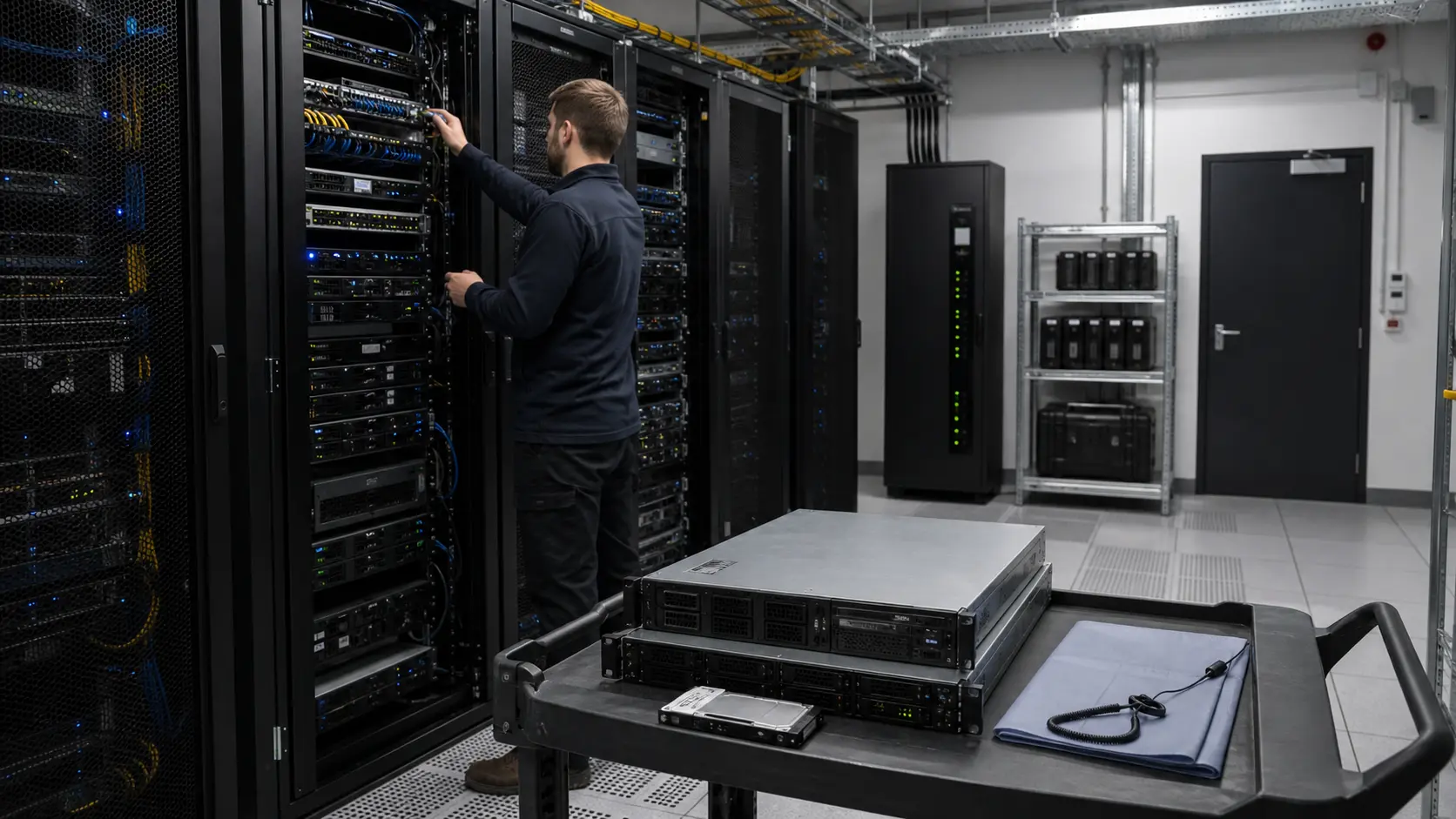
Datacenta Hosting Ltd should not be read as a placeless cloud label. The company's public service pages keep returning to a particular physical setting. The Datacenta home page gives a contact address at Q.20, Data Drive, Dorset Innovation Park, Winfrith Newburgh, DT2 8GB, and its hosting page says the data centre is based in Dorset Innovation Park with high-speed connectivity back to Bournemouth. The same page says some customers move their own servers into Datacenta's facility and connect to Datacenta premises with a leased line for business-continuity and IT-management reasons.
That is a very different proposition from a large public cloud region menu. It is closer to a managed hosting house that sells a mixture of co-location, managed servers, private cloud, application hosting, backup and connectivity, backed by engineers who can talk to a customer about a custom design. The promise is not "choose any geography and profile." It is "let us design, finance, build and operate a secure hosted service from infrastructure we control." That distinction matters because the risks sit in different places.
A customer buying from Datacenta is not mainly exposed to the risk that a global hyperscaler will fail to deploy a niche service in a faraway metro. It is exposed to the finite capacity, support depth, carrier access and repair windows of a smaller operation whose strongest public proof is local and technical.
The service-area label can still be wider than Dorset. Datacenta says it works with government bodies across the UK, where its location outside London may be an advantage. X-Net's current What We Do page says its internet services are used by public and private-sector clients ranging from central government departments and local councils to local small and medium-sized businesses. Network routes, hosted web services and public-facing applications can serve users far beyond the county where the racks are installed. But the public evidence for the operating estate is UK-centred, and the company gives no public region catalogue comparable to a hyperscale cloud provider.
There is also a brand-and-company caution that belongs near the front of any assessment. The footer on Datacenta pages says, "Datacenta Hosting is a trading name of X-Net (Services) Ltd." X-Net's own home page says the company now operates under the X-Net name and that this name encompasses previous brand names including Kimcell, Datacenta Hosting and e-mango. The X-Net footer identifies X-Net (Services) Ltd as an England-registered company with registration number 3290605.
Companies House corroborates the older company trail. The current X-NET (SERVICES) LTD record shows company number 03290605, incorporation in December 1996, a registered office at Hello House in Christchurch, and previous names KIMCELL LIMITED and NUNTIUS LIMITED. Its filing history shows the change from Kimcell to X-Net in April 2024. By contrast, the current DATACENTA HOSTING LTD record is newer. It was incorporated on 2 November 2023, changed from PBL 200 LTD to DATACENTA HOSTING LTD in September 2024, and its filing history includes dormant company accounts made up to 30 November 2024.
That does not mean the Datacenta service is imaginary. It means the name has at least two public layers: a longstanding operating brand historically tied to Kimcell and now X-Net, and a newer Companies House company bearing the same public name. The network record adds a third layer: RIPE still identifies AS196745 with Datacenta Hosting Ltd. A buyer or analyst should keep those layers separate. Brand continuity, legal contracting party, address, routing registration and operational custody may not all be expressed through one public record.
The useful article thesis follows from that messiness. Datacenta's public signal is not "no evidence." It is "evidence that must be read as a local managed-hosting system with some unresolved legal and capacity questions." That is a fairer stance than dismissing the company because it is small, and safer than treating old marketing pages as if they fully disclose current capacity.
The product is managed capacity, not abstract scale
Datacenta's hosting page sorts the offer into co-location, managed hosting and managed applications. In co-location, the customer owns the servers, while Datacenta builds them and places them in environmentally controlled secure server rooms with controlled access, uninterruptible power, constant environment monitoring and support capability. In managed hosting, Datacenta says it can take over management of the servers and may help design, finance and configure them to an agreed specification. In managed applications, it describes monitored and managed systems for standard environments as well as bespoke hosted builds.
That wording is important because it exposes the economics. Datacenta is not merely selling raw virtual machines. It is selling engineering time wrapped around physical inventory. If the customer owns the server, the constraint is rack space, power, cabling, remote hands and the customer's own replacement plan. If Datacenta finances and configures the server, the constraint moves toward Datacenta's procurement, credit, parts availability and staff scheduling. If the service is a managed application, the constraint also includes application knowledge, monitoring, patching and the client's tolerance for change windows.
The same blend appears in Datacenta's Focus page. The company says it focuses on managed services, centrally hosted services and managed infrastructure, and that service elements carry standard service levels that can be tightened or relaxed in a service-specific schedule. A large automated platform tends to standardise the customer around a menu. Datacenta's language points to the opposite: a smaller set of components arranged around the customer. That can be valuable for organisations that need people who understand their legacy application, public-sector security expectation or local access route. It also means each customer's resilience is heavily shaped by its own contract and design.
The secure private cloud page keeps that private, customised tone. Datacenta describes a private cloud operated solely for one organisation, managed internally and hosted in Datacenta secure locations, with predictable running cost and dedicated hands-on support. It also describes a community cloud arrangement in which two or more private clouds remain distinct but share service boundaries, redundancy and capacity. The public page does not reveal how many such environments are live, how much reserved headroom exists, how tenant separation is implemented, or whether "secure locations" means two active sites, one active site plus backup storage, or a mix that varies by customer. Still, it confirms the commercial shape: Datacenta sells cloud-like flexibility through a managed, facility-bound service rather than through a large public pool.
X-Net's current Services page updates the same position in newer language. It says X-Net runs its own data centre and provides hosting, global domain-name registration, public-sector .gov.uk domain registration, ADSL and fixed-line connectivity, and bespoke architecture for more complex needs. That page also says X-Net offers web, hosting, domain, DNS, backup, security and monitoring services, along with advisory and engineering services. The continuity is useful. Datacenta pages still carry older Kimcell footers, while X-Net pages give the present umbrella. Together they suggest that the hosting function survived the brand refresh, even though public details remain thin.
The customer list on Datacenta's home page gives another clue about the type of work. It names Parkeon, Airsprung Beds, Ministry of Justice, Youth Justice Board, Amari Ireland Ltd, CDPSoft, Criminal Injuries Compensation Authority, Crown Commercial Service and Micro Nav. The central government page says Datacenta has a 20-year track record providing high-availability, secure managed hosting, private cloud, teleworking and IP connectivity, and says services can be procured through G-Cloud or public procurement routes. These are company-authored claims, not independent measurements of present contracts. But they help explain why Datacenta's offer stresses human support, security accreditation and cost control rather than anonymous self-service.
The physical dependency is therefore visible in the product language. A private cloud for one organisation needs hosts, storage, switching, firewall capacity, backup capacity and staff who can respond when a system misbehaves. A community cloud needs isolation plus enough spare capacity for shared bursts. Managed applications need people who understand the stack. Co-location needs rack space, access control and remote hands. The customer is not just buying capacity; it is buying Datacenta's ability to marshal a small estate around a specific system.
The network evidence is live, modest and useful
The routing evidence is stronger than the corporate evidence because it is externally observable. Datacenta's own network connectivity page says it offers broadband, leased lines, point-to-point connections, LAN extension and IP transit, and says it operates with the single ASN196745. RIPEstat's AS overview identified the holder on 12 July 2026 as DATACENTA-AS Datacenta Hosting Ltd and showed the AS as announced. RIPEstat's routing status showed 325 of 327 IPv4 RIS peers and 322 of 322 IPv6 RIS peers seeing routes, six IPv4 prefixes, ten IPv6 /48s and three observed neighbours at the query time.
The RIPE whois view gives the AS name DATACENTA-AS, status ASSIGNED, creation date 22 December 2009 and last-modified date 8 February 2024. It lists imports from AS5511, AS60670 and AS206347, and exports to the same three ASNs. The routing-consistency view showed those same three peers visible in BGP and in whois, aligning with the upstream names Orange S.A., Wessex Internet Limited and WideFM Ltd.
This is a meaningful signal. A live AS with prefixes and multiple upstreams shows that Datacenta is not just a brochure. It also ties the hosting offer to the public internet in a way that can be tested. If AS196745 stops announcing routes, customers using addresses inside those prefixes can lose reachability. If one upstream has a failure, routing might continue through another, but only if policies, physical handoffs, local switching and external paths remain healthy. The existence of three observed neighbours is encouraging; it does not prove full physical diversity from rack to street to carrier.
The announced space is also modest. Six IPv4 /24s equal 1,536 IPv4 addresses before any internal allocation, service reserve or customer assignment. Ten IPv6 /48s are ample in address count but still say little about usable hosts, transit capacity or facility redundancy. A small host can provide excellent managed service with this scale; it simply cannot be analysed with the assumptions used for a global cloud that publishes dozens of regions and enormous address holdings.
Prefix details help locate part of the story. RIPEstat's 37.143.136.0/21 whois view shows the IPv4 allocation under UK-KIMCELL-20120302, with route objects for 37.143.138.0/24 through 37.143.143.0/24 originated by AS196745 and several descriptions referring to Kimcell or X-Net. The 2a00:b340::/32 whois view includes IPv6 route descriptions such as DC-Bmth, NoWires-Hosting and Datacenta Hosting Ltd, and newer /48 route objects created through 2025. These labels are not facility maps, but they align with a Bournemouth/Dorset operating context and a live network maintained across the brand transition.
PeeringDB's public API has a record for ASN 196745 named Datacenta Hosting. It reports no disclosed traffic level, no listed exchange count and no facility count, and marks scope and ratio as not disclosed. That absence should not be overread. Many smaller networks do not maintain rich PeeringDB profiles. It does mean the public cannot use PeeringDB to confirm carrier-neutral facility presence, exchange ports, traffic range or published peering locations.
The network conclusion is therefore middle-weight. Datacenta has active, visible routing and more than one observed upstream. It does not publish a public backbone map, latency map, real-time status page, looking glass, route-diversity diagrams, congestion data or maintenance history. A customer using Datacenta for critical service should ask how its circuit terminates, which upstreams serve which site, whether carrier paths leave the building through separate entries, what happens if Orange, Wessex Internet or WideFM has an issue, and whether customer private circuits share equipment with public internet handoffs.
Public evidence does not answer those questions.
The facility claim is specific but not fully auditable from outside
Datacenta's Security page is unusually direct for a small host. It says the company owns and maintains its own hosting premises, does not resell floor or rack space to other hosting providers, protects server rooms with dual security locks, restricts access to appointed personnel approved by the hosting facilities manager, sits more than 100 miles from central London hosting problems, and provides Tier 1 IP access through steel-protected, diverse-routed, fault-tolerant circuits. It also says Datacenta is ISO 27001 accredited and uses firewalls and packet shaping.
Those statements are valuable because they identify the actual asset type: secure server rooms, access control, power protection, environment monitoring, IP circuits and staff. They are not, on their own, the same as an external engineering audit. The page does not state rack count, usable kW, UPS topology, generator presence or runtime, switchgear age, fuel arrangements, cooling redundancy, water dependency, smoke detection and suppression approach, maintenance schedule, recent test outcomes or spare-part levels.
Nor does it disclose whether the "own hosting premises" claim refers to freehold ownership, a lease, a controlled suite or a building under a wider site landlord. A smaller provider can be highly competent without publishing those details; the absence still limits public confidence.
The support page strengthens the physical reading. Datacenta says on its Support page that it avoids call centres and tiered help desks, that all support staff are UK based and on the same site as the primary data centre, and that a Datacenta engineer continues working with the customer to resolve issues. It also says customers get a dedicated service engineer and support from a multi-disciplinary team. That is a selling point, but also a dependency. If the service relies on named engineers and a team co-located with the primary site, then illness, access restrictions, weather, local incidents, rota depth and out-of-hours arrangements all matter.
This is where installed capacity and usable capacity diverge. Datacenta may have racks, UPS-backed rooms and engineer access. A customer still needs the right server, storage, firewall rule, IP block, backup target, virtualisation capacity and staff availability at the moment it asks for change or recovery. The public pages do not show a stock register. They do not say how quickly Datacenta can replace a failed host, expand a private cloud, add storage, obtain a part that is no longer common, or move a workload from one secure location to another.
A bespoke managed-hosting relationship can solve these problems through planning, but only if the plan exists before the failure.
The same point applies to power and cooling. Datacenta references uninterruptible power and constant environment monitoring on the hosting page. That supports a minimum inference: the company knows it is selling computer-room conditions, not ordinary office hosting. But public copy does not establish N+1 design, concurrent maintainability, generator coverage, battery autonomy, cooling margin or how often failover is tested under load.
For a buyer, the right question is not "does Datacenta mention UPS?" It is "which pieces of our service remain live during a utility outage, a UPS fault, a cooling failure, a fire-alarm evacuation and a planned electrical maintenance window?"
The "not London" point also needs care. Being outside central London can reduce exposure to some metro risks, costs and congestion. It may help public-sector buyers who prefer a less obvious location or a non-London cost base. It does not automatically create resilience. A Dorset site still depends on local utilities, local access roads, local fibre routes, local staff availability and any shared dependencies inside Dorset Innovation Park. If Datacenta uses a secondary location, the buyer must know where that location sits, which services are live there, which are backup-only, and whether both sites rely on common suppliers.
The public picture is therefore credible but incomplete: a small secure hosting premises with engineers nearby, network circuits and a strong local identity, but no public facility pack that lets an outsider quantify power, rack, cooling or repair margins.
Backup and private cloud promises move the failure, not erase it
Backup is one of Datacenta's clearest public themes. The online backup page says the company's Assured Restore service uses CrashPlan PROe and Veeam. It says data can be encrypted on the customer's server before transmission, compressed for storage on clustered RAID-equipped servers in an underground primary centre, and subjected to automated integrity checking. It also says encrypted data is stored in the UK as part of Datacenta's secure managed cloud, and that Datacenta can offer a secondary site for a second set of backups.
That is a strong locality and recovery promise, but it must be read at the level of operations. A backup is only useful if restore time, restore priority, credentials, network bandwidth, retained versions, application consistency and support response all match the customer's incident. Datacenta's page is refreshingly focused on restore confidence, but it does not publish measured restore-time results, queueing rules during a wide incident, maximum backup size, per-customer bandwidth, secondary-site capacity or a sample recovery report.
A buyer should ask how often full restores are tested, whether the test includes application startup, who authorises the restore, and whether Datacenta has enough staff to run several urgent restores at once.
Private cloud raises the same issue. The private-cloud page says Datacenta can host a secure infrastructure solely for one organisation and can share redundancy and capacity across a community cloud. That sounds efficient. It also creates design questions. If capacity is shared, what priority rules apply when two members need spare capacity at the same time? If a private cloud is dedicated, how much spare host capacity is dedicated with it? If storage replication is used, what distance, link, lag and consistency rules apply? If backup sits in one underground primary centre and a secondary site, what exactly runs where during a site incident?
The answer may be strong in a specific customer schedule. Datacenta's Focus page says service components can be arranged into customer-specific schedules with standard, enhanced or premium levels. For a public article, the important point is that the public pages do not let an outsider evaluate every schedule. Datacenta's strongest recovery claims therefore function as questions for procurement and renewal: what is live, what is standby, what is only stored, what is staff-assisted, what is automated, and what is a best-efforts rebuild?
Data sovereignty and locality also need this narrower treatment. Datacenta says encrypted backup data is stored within the UK. X-Net's present pages keep the company in England, and the service pages stress UK public-sector work. That supports a UK-locality argument for some customer data. It does not show whether every log, support case, remote-support connection, vendor licence, monitoring feed or third-party security product is UK-only. It also does not prove that a customer's later migration out of Datacenta will be quick.
Local storage makes a useful claim about where bytes sit; it does not by itself define exit time, data format, bandwidth or application portability.
The discipline is simple: treat Datacenta's backup and locality copy as an operating promise to verify, not a magic property. The company has the right vocabulary: encrypted pre-transfer backup, integrity checking, UK storage, secondary-site option and hands-on support. The missing public details are the numbers and paths behind those words.
The main failure paths are ordinary, physical and contractual
The first failure path is the rack or room. A server can fail, a switch can fail, a storage shelf can fill, a firewall can misbehave, cooling can degrade or power can be interrupted. Datacenta's co-location and managed-hosting services are expressly tied to server rooms, controlled access, UPS, monitoring and engineers. That means the customer's first protection is not the phrase "secure hosting." It is the actual design: redundant power connections to each server where available, spare hosts, storage replication, offsite backup, monitoring, documented access, and a tested replacement procedure.
The second failure path is the upstream. AS196745 has multiple observed neighbours, and Datacenta says it offers IP transit and operates its own AS. That is better than a host entirely hidden behind one reseller connection. But routing diversity can fail at the wrong layer. Two upstreams can share a local duct, a cross-connect cabinet, a building entry, an optical path or a patching dependency. A private customer circuit from an office to the Datacenta premises can be diverse on paper and still converge near the customer's building or near the data centre. The public pages do not reveal those routes.
A serious customer should ask for carrier names, handoff locations, physical-entry diversity and failover behaviour.
The third failure path is hardware stock. Managed hosting often looks flexible until a specific part fails or a new customer request requires a specific host profile. Datacenta does not publish a hardware catalogue, age profile, spare-parts list or procurement lead-time commitment. That is normal for a bespoke host, but it matters. A recovery plan that assumes Datacenta can produce matching hardware on demand is weaker than one that reserves spare host capacity, keeps images current, and proves that data can run on a different host class when necessary.
The fourth failure path is support. Datacenta's human-scale support may be its best differentiator. The Your Views page says 76 percent of customers rated the company excellent or very good and includes testimonials praising timely calls and continuity of staff. Company-authored testimonials cannot prove current response time, but they do show what Datacenta wants customers to value: direct engineer relationships. The risk is the other side of the same coin. If recovery depends on a small group of engineers who know the customer's environment, then handover, documentation, holiday coverage and out-of-hours escalation become infrastructure controls.
The fifth failure path is account or contract status. Datacenta's abuse page, still written with Kimcell language, says a customer found to breach the acceptable-use policy may have accounts suspended or terminated and that restoration may require charges. X-Net's current abuse page says the same in current brand language. X-Net's terms also describe payment and termination rights. This is not unusual; providers need abuse and payment controls. For a hosted public service, it still means account administration can become an availability dependency. The people responsible for billing, acceptable-use communication and notices should not be separate from the people responsible for uptime.
The sixth failure path is migration. Datacenta's managed approach can make day-to-day service easier, but bespoke hosting can make exit more work. A customer may have Datacenta-managed DNS, IP addresses from AS196745 space, firewall policy, backup images, co-located hardware, server builds, application settings, monitoring and support knowledge. Moving away can involve DNS changes, address renumbering, data transfer, new backup targets, licence checks, application freezes and a plan for physical equipment removal if the customer owns servers.
The more Datacenta has tailored the service, the more the exit plan must be written while the relationship is healthy.
These are not accusations. They are the normal mechanics of a managed hosting provider. The article title names racks, transit and repair windows because that is where the operating truth sits. Datacenta's public materials repeatedly show that the service depends on physical rooms, circuits, backup storage and engineers. The buyer's job is to turn those categories into current evidence.
Who is affected when the system fails
Datacenta's own positioning points to customers that may have low tolerance for messy outages but may not want a giant supplier. The company talks about central government, public bodies, local councils, not-for-profit sectors, utilities, application developers, Dorset businesses and small or medium-sized organisations. It says it hosts online electronic transactions, online applications, secure intranets, brochure sites, data-collection processing, application hosting and even some map overlays for public-body customers.
For these customers, failure is not always a dramatic public outage. It may be a council service form that stops taking submissions, a membership platform that cannot process payments, a public-sector intranet that staff cannot reach, a small business server that loses access to its data, or a backup restore that takes longer than the business can tolerate. It may also be a quieter degradation: slow response because a transit route is congested, delayed change because the right engineer is unavailable, or a renewal dispute that blocks a needed expansion.
The affected group can also extend beyond Datacenta's direct customers. If Datacenta hosts a public service for a government department or local body, citizens and suppliers may experience the outage without knowing the hosting provider's name. If it hosts an application developer's service, the end users may blame the developer. If it provides connectivity, users may only notice that a site-to-site link or internet service is unstable. The smaller provider can be hidden behind the client brand even when it is the critical dependency.
That hiddenness is why public evidence should be neither dismissed nor exaggerated. Datacenta's live AS, hosting pages and X-Net continuity indicate an operating service. The newer dormant DATACENTA HOSTING LTD company record, lack of current facility metrics and limited public status information tell a reader not to assume more than the evidence supports. A small managed host can be excellent for a particular customer because the engineers know the environment. It can also become a single dependency if the customer does not own current documentation, backup exports and recovery tests.
The right question is not whether Datacenta is "big enough" in the abstract. It is whether the service bought from Datacenta has enough independent paths, spare capacity, verified restore procedures and commercial clarity for the customer's actual exposure. A local brochure site and a national transaction service should not buy the same recovery design.
What a buyer should verify before relying on Datacenta
A current customer or prospective buyer should start with identity. Which legal entity signs the contract: X-Net (Services) Ltd, DATACENTA HOSTING LTD, another X-Net member firm, or a public-sector framework wrapper? Which address receives formal notices? Which brand name appears on invoices? Which entity controls the AS196745 resources used by the service? Public pages contain enough overlapping names to make this a necessary first step.
The second verification is facility scope. Does the customer's service run in the Dorset Innovation Park premises described by Datacenta, in another X-Net location, in a third-party site, or across more than one site? Which components are live in each place: compute, storage, backup, firewalls, DNS, monitoring and support access? If a secondary site is included, is it a hot service location, a warm spare, a backup target, or an option that requires separate purchase?
The third verification is power and environment. Customers should ask for the current power design, UPS coverage, generator or alternate-supply arrangements, cooling redundancy, alarm response, access controls, maintenance practice and any relevant accreditation scope. Public pages say ISO 27001, ISO 9001, ISO 14001 and OHSAS 18001 in older Datacenta footers, while X-Net's current footer says ISO 27001, ISO 9001, ISO 14001 and ISO 45001. The certificate scope and current validity matter more than the logo list.
The fourth verification is transit and private connectivity. AS196745's public routes and upstreams are visible, but the customer's end-to-end path is not. The buyer should understand which upstreams announce the customer's prefixes, which route wins under normal conditions, what happens during maintenance, how DDoS and abuse are handled, and whether private circuits are physically diverse. The phrase "fault-tolerant circuits" needs a diagram and a test result before it becomes a resilience claim.
The fifth verification is backup and restoration. Datacenta's Assured Restore copy is promising because it talks about encryption, integrity checks, UK storage and secondary-site options. The customer should ask for recent restore-test evidence for its own service, not only for the backup system in general. It should know target restore time, target data loss, who declares a restore, what credentials are needed, whether the restore requires Datacenta staff, how many simultaneous restores the provider can support, and what happens if the primary site is unreachable.
The sixth verification is portability. If the customer owns servers in co-location, it needs the removal and remote-hands terms. If Datacenta manages servers, it needs current build records, access credentials, DNS and IP plan, firewall policy, backup export process and a path to run the application elsewhere. If Datacenta hosts a private cloud, the buyer needs to know whether virtual machine images, storage snapshots, network settings and logs can be exported in usable form. Recovery is weaker when all knowledge lives with the provider.
The final verification is support depth. Datacenta sells engineer-led support, which can be a real advantage. The buyer should still ask who answers out of hours, how escalation works, how holiday and sickness coverage are arranged, which engineer owns the service, what happens if that engineer leaves, and whether response targets are backed by service credits or only by best endeavours. A named engineer can be reassuring; a documented team is safer.
Final assessment
Datacenta Hosting Ltd earns a medium operating-evidence grade, with an explicit downgrade for public opacity. The positive side is concrete: an active AS, public Datacenta service pages, a Dorset hosting location, X-Net continuity, managed hosting, private cloud, backup, network connectivity, security accreditation claims, and support staff described as being near the primary data centre.
The caution side is just as concrete: the current Companies House entity called DATACENTA HOSTING LTD is new and filed dormant accounts for 2024; the older operating trail runs through X-Net and Kimcell; PeeringDB discloses no traffic or facility footprint; and public materials do not expose rack counts, power design, spare stock, secondary-site capacity, route maps, status history or customer-specific recovery results.
That balance does not make Datacenta weak by default. It makes Datacenta a provider whose value is likely to depend on a specific relationship and a specific design. For a local council, public body, application developer or SME that wants a UK-based managed service with engineers who can talk through a bespoke environment, that may be the point. For a customer that needs independently verifiable multiregion scale, large spare capacity and self-service failover, the public evidence is not enough.
The honest conclusion is therefore narrow. Datacenta Hosting Ltd sells hosted capacity that still has a visible body: Dorset rooms, AS196745 routes, backup stores, circuits, support desks and contract terms. Its cloud language should be tested against those physical and operational facts. If the racks are powered, the transit is diverse, the engineers are reachable, the restore path has been tested and the exit plan is current, the service can be resilient for the right customer. If any of those pieces is assumed rather than proved, the cloud label is carrying more weight than the evidence.