
Summary
- Claro says it funded $35 million to extend the AMX-1 submarine system to Ponce.
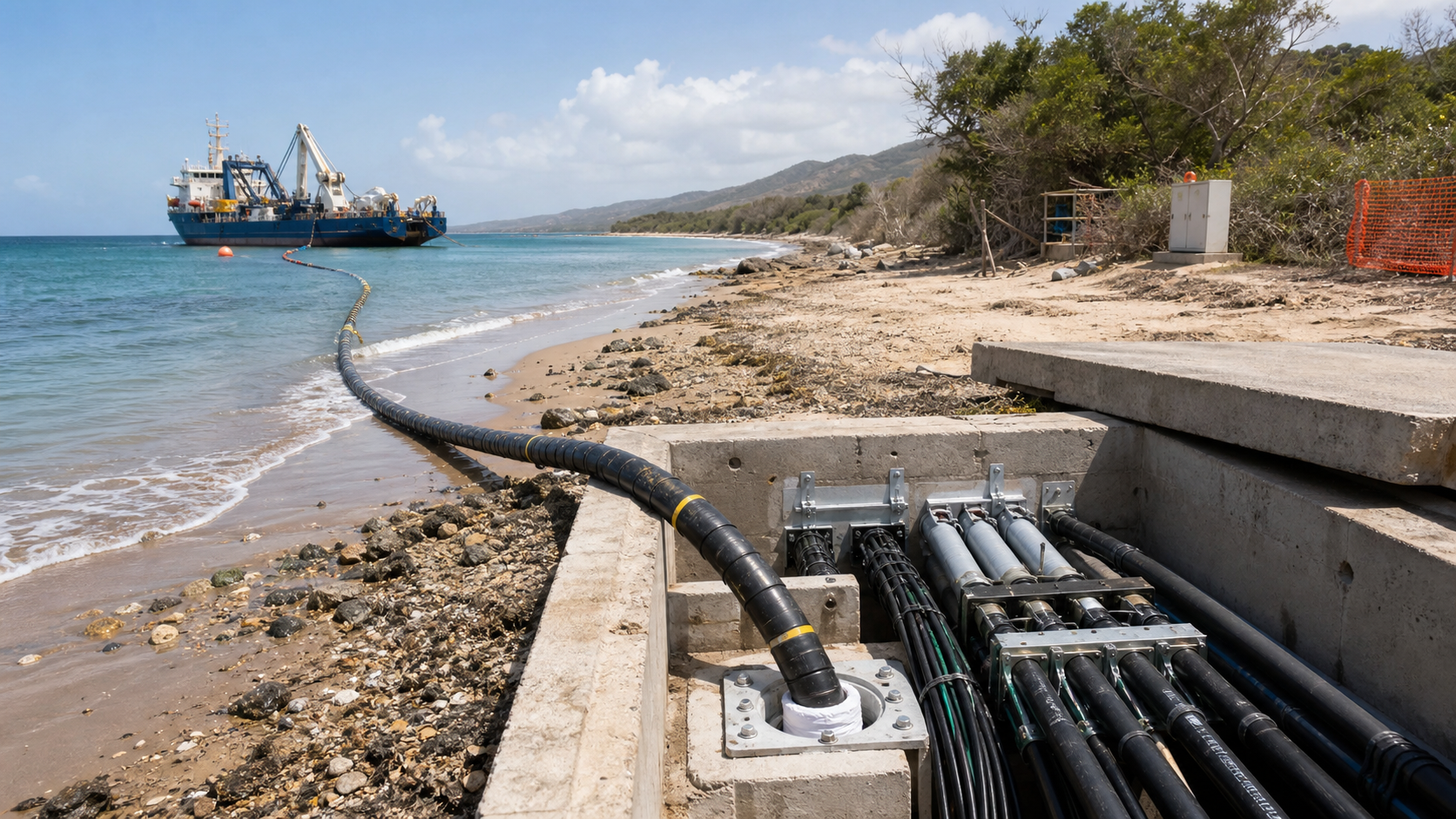
- The physical landing took place on June 17 and was reported as Puerto Rico’s first submarine-cable landing on the southern coast.
- AMX-1 is described as approximately 19,300 kilometres long, with 15 landing points across eight countries and territories.
- The reported design uses 100 Gbps transmission and offers total system capacity of up to 90 Tbps; those are different capacity measures.
- Data Access and Neptuno Networks made capacity commitments, supplying evidence of wholesale demand, but the landing does not establish end-to-end route independence.
A cable landing adds an entry point, not an entire network in isolation. Claro’s extension brings AMX-1 ashore at Ponce after a physical landing completed on June 17. Local reports describe it as the first submarine-cable landing on Puerto Rico’s southern coast.
Geography matters because multiple landings can reduce dependence on one coastal approach. Traffic can enter or leave through another location if customers have the necessary capacity, backhaul and routing arrangements.
The qualification is equally important. Two landing points can still share an undersea segment, terrestrial conduit, power source, network facility or upstream operator. The Ponce landing alone cannot prove that a customer’s packets follow a physically independent end-to-end route.
Claro pays the capital; wholesale customers test demand
The reported investment is $35 million and was financed by Claro. That places the project’s construction and deployment capital with the operator rather than presenting it as a public grant.
The benefit can extend beyond Claro’s retail customers if capacity is sold to other networks and enterprises. Data Access and Neptuno Networks were reported to have made capacity commitments. Those commitments are stronger demand evidence than an uncontracted capacity forecast.
The reports do not disclose the volume, price, term or take-or-pay status of either commitment. They therefore cannot be converted into project revenue, utilisation or payback.
For the buyers, a capacity agreement may provide another international or inter-island path. For Claro, wholesale contracts can help monetise a capital-intensive asset. For Ponce and southern Puerto Rico, the landing can attract backhaul, interconnection and facility investment. None of those outcomes is quantified in the reports.
100 Gbps and 90 Tbps answer different questions
The project is described with 100 Gbps transmission design and total capacity of up to 90 Tbps. A 100 Gbps figure refers to a transmission channel or technology unit; 90 Tbps describes an aggregate system ceiling.
It would be wrong to call the cable a 100 Gbps system, just as it would be wrong to state that 90 Tbps is already sold or in use. Lit capacity, equipped capacity, design capacity and contracted capacity are separate stages.
The AMX-1 system is reported at roughly 19,300 kilometres, with 15 landing points across eight countries and territories. The Ponce project is an extension and landing of that network, not a newly built 19,300-kilometre cable financed entirely by the $35 million.
That distinction defines the investment. Claro is buying a new local connection into an existing regional system, together with landing and supporting infrastructure. It gains reach by attaching to a broader asset rather than recreating it.
Resilience must be tested at customer-path level
Claro and the reports frame the southern route as a resilience gain. The geography supports that rationale, but guaranteed uptime or full independence would require more evidence.
A customer assessing diversity should ask where routes converge, whether terrestrial backhaul separates, how landing power is protected, which network elements are shared and whether routing policy actually uses the alternative during failure. Capacity rights also must be available when needed.
The physical landing is a completed fact. Commercial utilisation, route separation and realised resilience are the next proof points. Data Access and Neptuno provide an early wholesale signal, but their commitments do not map the complete paths.
The Ponce landing is therefore economically significant without needing an absolute claim. It gives Puerto Rico a southern entry surface and Claro a new wholesale asset. Its value will be measured by sold capacity and the failures it can route around, not by the word “independent” alone.