

- The two key components API gateways and load balancers share some functionalities, but serve distinct roles.
- The synergy between API gateways and load balancers can be harnessed to create a robust architecture.
In the realm of modern application development, two key components often come to the fore: API gateways and load balancers. Although they share some functionalities, they serve distinct roles. This piece aims to elucidate the differences between these two mechanisms, their benefits, and how to select the appropriate one for your application.
Understanding load balancers
A load balancer is a device that distributes incoming network traffic across multiple servers. It ensures that no single server is overwhelmed, thus enhancing system responsiveness and preventing failures due to overload.
Key benefits of load balancers
- Indirection layer: Load balancers act as an indirection layer, shielding clients from direct connections to servers. This means that changes in the server setup do not affect the client experience.
- Health checks: They can detect malfunctioning servers and adjust traffic distribution accordingly, ensuring optimal performance.
- Complex tasks: Some load balancers can handle tasks like HTTPS offloading, where they establish a secure connection with the client and a non-secure connection with the server.
- Advanced features: They may also perform caching and content-aware routing to enhance service delivery.
Also read: Amazon Web Services: What you need to know
Understanding API gateways
API gateways act as intermediaries that manage the flow of requests between API consumers and backend services. They offer a range of functionalities that go beyond basic traffic distribution.
Key benefits of API gateway
API gateways add a layer of higher-level functionality, making APIs more secure, observable, and reliable in a distributed network environment.
- Traffic control: They implement mechanisms like caching and rate limiting to manage traffic flow efficiently.
- Authentication and authorisation: API gateways can authenticate API consumers, ensuring secure access to the APIs.
- Metrics and logging: They collect valuable data on API usage, latency, and error rates, providing insights for API owners.
- Load balancing: Although not a direct substitute for load balancers, API gateways can also distribute traffic and perform health checks on backend servers.
Also read: 9 reasons that show why API integration is important
When to Use Each Tool
- API gateway: Opt for an API gateway when you need a centralised control point for your APIs, requiring advanced features like detailed analytics, security, and traffic management.
- Load balancers: Choose a load balancer when your primary concern is distributing incoming traffic evenly across servers to ensure high availability and reliability.
Combining API gateways and load balancers
In many cases, the best approach is to use both tools in tandem. As the API consumer base grows, the need for additional API server instances arises, and a load balancer helps in distributing the load. As requirements evolve, an API gateway can be introduced for advanced traffic management, caching, rate limiting, and metrics collection.
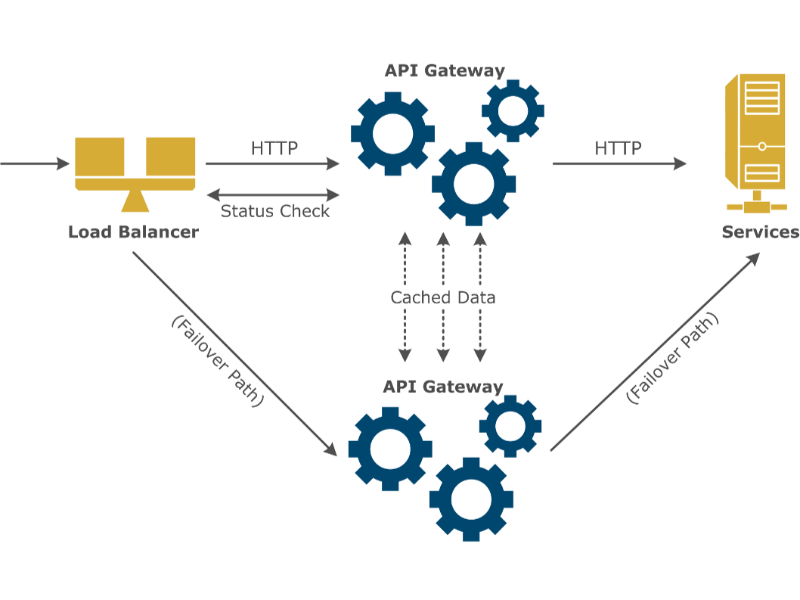
The evolution of architecture
- Initial setup: Starting with a basic API without any intermediaries.
- Adding load balancer: Introducing a load balancer to manage increased API consumer traffic and perform HTTPS offloading.
- Introducing API gateway: As the client base grows further, an API gateway is added for advanced traffic control, security, and analytics.
- Scaling with both: Utilising both tools in tandem to scale the architecture, ensuring high availability and optimal performance.
Both load balancers and API gateways play pivotal roles in enhancing the quality, security, performance, and reliability of services. By understanding their unique capabilities and use cases, developers can make informed decisions on which tool is best suited for their application’s needs. Whether it’s the straightforward traffic distribution of load balancers or the sophisticated traffic management and security features of API gateways, the right choice can significantly impact the success of your application.