
Summary
- Caspian Pipeline Consortium-R should be judged through records, controls and boundaries: batch quality data, telemetry, emergency-response evidence, procurement traces, support footprint and public network-resource records.
- Public sources support the existence of SCADA, leak detection, hydrometeorological monitoring, AIS-linked marine operations, quality-bank settlement mechanics and a RIPE/BGP footprint, but they do not let an outside reviewer test uptime, cybersecurity, recovery or internal architecture.
- The company's strategic importance for Kazakhstan-linked crude exports raises the value of good operating records, but it also raises the cost of stale asset data, telemetry gaps, access drift, opaque outages and unsupported assumptions about where service data lives.
- The commercial case is strongest where CPC-R can keep industrial, financial and safety records fresh enough for repeatable decisions; it is weakest when route scale is mistaken for evidence of software quality.
The Useful Starting Point Is Records, Not Scale
Caspian Pipeline Consortium-R sits in a category of companies where the visible asset is so large that it can distract from the quieter technology question. The public story is a 1,500 km-plus crude oil transport route from West Kazakhstan and Russian producers to the Black Sea, with a marine terminal near Novorossiysk, a set of pump stations, tankage, tanker loading and shipper-facing accounting. That is the infrastructure people can picture. It is also the part most likely to produce lazy analysis: a big route, many barrels, several states and global shareholders, therefore a mature operating system. That conclusion moves too fast.
The more useful question is whether the company can keep the records around that infrastructure fresh, governed, attributable, queryable and recoverable under repeated operational use. For a pipeline operator, "records" does not mean office paperwork alone.
It means asset registers for pump stations and terminal equipment, quality data for batches entering and leaving the common stream, telemetry from valves and pressure points, alarm histories, environmental and weather observations, tanker movement data, work permits, procurement notices, contractor qualifications, incident drills, access logs and the evidence trail that lets a shipper or regulator understand what happened when conditions changed.
That record layer is where the assigned technology lens belongs. CPC-R is not publicly evidenced as a cloud product company. It is not selling a general-purpose enterprise software platform. But it operates in a domain where enterprise software, automation and data custody become inseparable from physical performance. The company can move crude only when its physical system and its information system agree often enough for safe decisions. A pump station cannot be treated as healthy because a spreadsheet says so. A shipper cannot be settled fairly if batch quality data is stale or weakly attributed.
A terminal cannot be managed well if marine conditions, tanker status and emergency-response resources are not represented in systems that operations staff can act on.
The public evidence gives a partial, useful view of that boundary. CPC's own pages describe the overall project, the Oil Quality Bank, the control and safety systems, the Debottlenecking Program, offices, and procurement notices. RIPE, BGP and IP information services show a small autonomous-system footprint registered to Joint Stock Company 'Caspian Pipeline Consortium -R'. External shipper and trade sources corroborate the route's importance to Kazakhstan-origin liquids. These sources are enough to analyze the operating-record boundary.
They are not enough to certify the company's internal software reliability, cybersecurity posture, disaster recovery design, cloud dependency or customer-service performance.
That distinction matters because infrastructure companies often inherit reputational credit from the physical asset. If the route is important, observers assume the control systems must be strong. If the throughput is large, observers assume the data processes must be mature. If shareholders are international, observers assume governance has already solved the hard edge cases. CPC-R deserves a stricter reading. Its public case is strongest where it shows explicit record mechanisms and support systems. It is weaker wherever the evidence stops at asset scale, generic reliability language or procurement labels that do not show implementation.
What CPC-R Actually Represents In The Public Record
The public company boundary is not identical to the full Caspian Pipeline Consortium story. CPC's website describes a project with Russian and Kazakh participation and leading oil and gas companies, built to construct and operate a trunk oil pipeline more than 1.5 thousand kilometers long. It says the system mainly collects crude from large West Kazakhstan fields, with additional crude from Russian producers, and transports that crude to the Marine Terminal in Yuzhnaya Ozereevka near Novorossiysk for loading onto ocean-going tankers.
The directory subject here is Joint Stock Company 'Caspian Pipeline Consortium -R', the Russian legal and operating company, so the article has to keep that corporate boundary in view even when the public project pages discuss the broader CPC system.
That distinction is not pedantic. CPC-R appears in public resource records as a Russian entity, with RIPE membership, an autonomous system, Russian office and terminal addresses, and Russian corporate registry identifiers mirrored by business databases. The broader system, however, is inseparable from Kazakhstan-origin crude and from CPC-K's Kazakhstan-facing role. The assignment region is KZ because the commercial and strategic effect is heavily tied to Kazakhstan's export route, but CPC-R's public legal and network-resource footprint is Russian.
Any serious analysis has to hold both facts together without turning one into the other.
The shareholder page adds another boundary. It lists the Russian Federation, with PJSC Transneft as trustee, at 24 percent; JSC NC "KazMunayGas" at 19 percent; Chevron Caspian Pipeline Consortium Company at 15 percent; LUKOIL INTERNATIONAL GmbH at 12.5 percent; Mobil Caspian Pipeline Company and Rosneft-Shell Caspian Ventures Limited at 7.5 percent each; IC CPC Company LLC at 7 percent; and smaller positions held by BG Overseas Holding, Eni International, Kazakhstan Pipeline Ventures and Oryx Caspian Pipeline. This is evidence of a mixed state-company-private shareholder structure.
It is not evidence that each shareholder sees the same telemetry, controls the same systems or has the same practical influence over day-to-day operating records.
The operations page gives a record-based view of the route's function. CPC says the first tanker was loaded at the Marine Terminal on October 13, 2001. It reports cumulative crude delivered to world markets through January 9, 2022, with separate totals for Kazakhstan-origin and Russia-origin crude, and a count of tankers handled. The value of that page is not only the volumes. It is the way the company chooses to present operations: as shipment history, source split, tanker movements and shipper service. That is an accounting frame.
It tells readers that CPC's public operating story is built around traceability of crude movement, not simply the existence of steel in the ground.
The Karachaganak export-route page from KPO provides an outside shipper-side corroboration. KPO describes its transportation system connecting at Atyrau to the CPC system, which transports oil to Novorossiysk for tanker export. It describes CPC as a 1,510 km route with five pumping stations, a marine terminal and tank farm. Again, this is not a software proof. It is route-dependency evidence. The customer-side route exists in another operator's public description, and that matters when judging the commercial cost of changing service boundaries.
When a field's liquids are routed into a system like CPC, the information flows around nominations, quality, receipt, pumping, terminal loading and disruption notices become as important as the pipe.
Operating Automation Is An Accountability System
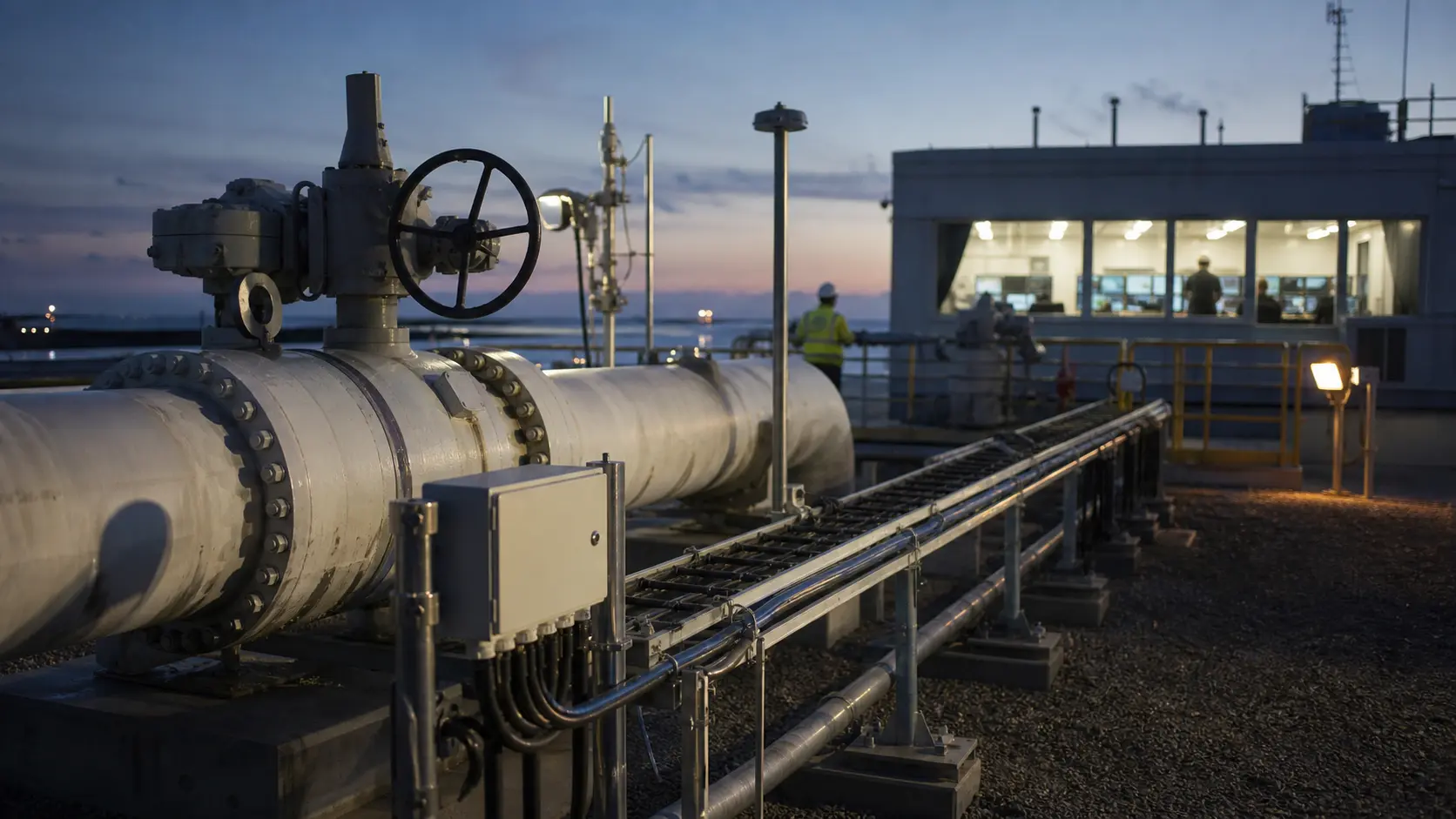
Industrial automation is sometimes described as if the main achievement is remote control. That is too narrow for CPC-R. The more demanding function is accountability: turning field state into a record that can be trusted later by operations teams, shippers, auditors, regulators and emergency-response managers. CPC's technical-solutions page points in that direction. It says the entire CPC pipeline operation is monitored from the Main Control Centre at the Marine Terminal.
It identifies SCADA as the system used to operate facilities from Tengiz to the single point moorings at the Marine Terminal, manage tanker loading and monitor safety across the system. It also describes redundant fiber optic, satellite, radio and data transmission channels between the Marine Terminal, pipeline facilities and regional offices.
Those details are important because they show the company has publicly named the control layer. They do not show the quality of that layer. A public page does not reveal polling intervals, historian design, alarm rationalization, segmentation, identity controls, patch cadence, failover testing, maintenance backlogs or operator workload. It does not show whether the same record remains consistent across the Main Control Centre, regional offices, contractor workflows and executive reporting. The page tells an outside reviewer what class of system exists and what functions it is meant to support.
It does not let the reviewer certify how that system behaves under stress.
The same is true for the Leak Detection System. CPC says the pipeline is equipped with LDS and that, combined with SCADA, it allows the company to detect and initiate a response even to minor leaks. That is a meaningful public claim. It places leak detection inside the automation boundary rather than leaving it as a purely manual patrol function. But the evidence still stops before performance metrics. An outside reader cannot see false-positive rates, detection thresholds, alarm-to-inspection time, training records, maintenance exceptions or post-incident review quality.
The prudent conclusion is that leak detection is part of the public control architecture, while the effectiveness of that architecture remains a matter for audits, incident records and operational testing not present in the public sources.
The hydrometeorological monitoring system gives a second view into the data layer. CPC says HMMS monitors wind direction, wind velocity and gusts, atmospheric pressure, sea wave parameters, current direction and velocity, and air and water temperature in real time. It also says the data is displayed on the Main Control Centre console and can be archived for further processing, systematization and statistics. That archive phrase is more consequential than it may look. Marine loading is weather-exposed.
A system that archives weather and current data is not only helping a dispatcher decide whether conditions are acceptable in the moment; it is also creating the record by which decisions can later be examined.
The marine-terminal systems reinforce the same pattern. CPC describes single point moorings offshore, tanker movement tracking on an electronic navigation map, a mooring master monitoring approach distance, direction, speed and angular velocity, and AIS functions for ship identification, tracking and navigational data exchange. It says AIS is interfaced with HMMS and the mooring system. These are not generic office systems. They are operational interfaces where vessel movement, weather, terminal equipment and human decision-making meet. A weak record here would not merely inconvenience a back office.
It could make it harder to reconstruct a near miss, explain a loading delay, justify a shutdown or coordinate emergency response.
CPC's description of PISCES II moves from monitoring to scenario management. The company says the system is designed to prevent, monitor and forecast emergencies associated with an oil spill and to support response-management decisions. It describes electronic navigation maps, local weather conditions, risk zones, environmental zones, scenarios and mathematical models for oil-slick movement. That gives CPC-R a public claim to model-backed incident support. The claim is operationally relevant, but bounded.
There is no public evidence in this pack showing how often the models are updated, how exercises are scored, whether lessons change playbooks, or how model output is preserved in incident records.
The lesson across SCADA, LDS, HMMS, AIS and PISCES II is that CPC-R's technology boundary should be assessed as a chain of accountability. The question is not simply whether a named system exists. The question is whether inputs remain fresh, identities remain clear, alarms are acted on, changes are recorded, and later readers can connect a physical event to the data and decisions around it. Public evidence establishes the existence of the chain. It does not establish the strength of every link.
The Oil Quality Bank Shows Why Data Freshness Has Commercial Weight
The Oil Quality Bank is the clearest public example of CPC's operating records turning into money. CPC says the trunk oil pipeline accepts crude blends from different fields, and that mixing crude in a common stream makes it harder to account for the specific quality of each producer's material. The Quality Bank, functioning in the CPC system since 2002, is presented as a mechanism of penalty and compensatory payments to or from crude producers depending on the quality of crude they deliver into the system.
CPC identifies API gravity and sulfur content as the two common indicators used in settlements because of their role in refining economics and market pricing.
That is not an abstract software feature. It is an industrial data product. For the Quality Bank to work fairly, actual data on accepted batches, lifted batches and quality indicators must remain attributable to the right shipper, time, physical location and calculation model. CPC says actual batch and quality data are the basis for coefficients used in mutual settlements. It says CPC assesses the value of certain quality crude delivered into and lifted off the system every two weeks. The public claim therefore depends on recurring data freshness.
If the measurements are late, weakly attributed or mismatched to movements, the settlement mechanism becomes less credible.
This is where the enterprise-software lens becomes appropriate even without calling CPC-R a software company. The Quality Bank needs structured data models, controlled workflows, access governance, versioned calculations, exception handling, audit trails and reconciliation. It must serve multiple parties whose incentives can diverge. Producers want fair value for crude quality. The pipeline operator wants a defensible settlement mechanism. Buyers and refiners care about the resulting blend. Regulators and shareholders care about whether the system can be defended when disputes arise.
The public evidence does not show the underlying software stack. It does not show whether the bank is implemented on packaged software, bespoke systems, spreadsheets, databases, laboratory information systems or a hybrid. It does not disclose access roles, change management, laboratory interfaces or dispute workflows. That absence should not be filled with imagination. The evidence supports a narrower but still important conclusion: CPC's own public materials make quality data a central operating and commercial record, and that record must be fresh and attributable for the service to function as described.
The same idea applies to tanker loading and shipper scheduling. CPC's operations page describes crude delivered to markets and tankers handled; a trade report about 2024 says CPC reported transporting all Kazakhstan-delivered volumes it received, with scheduled works announced in advance to shippers and considered by Kazakhstan's Energy Ministry. Whether one treats that as a company claim reported by trade press or as a market signal, it points to the role of advance notice and schedule coordination. Planned work is not just a maintenance activity.
It is an information service: what will happen, when, to which volumes, under which constraints, and with what downstream effect.
If CPC-R's records are strong, they reduce ambiguity around delays, maintenance, batch quality, inventory, emergency restrictions and terminal availability. If they are weak, route dependence becomes more expensive because shippers have fewer trustworthy signals for planning alternatives. The Quality Bank is therefore a useful test case for the whole company. It shows that the business is not merely "move liquid through pipe." It is "move liquid through pipe while preserving enough data about origin, quality, timing, condition and settlement to make the movement economically usable."
Debottlenecking Converts Asset Upgrades Into Data Obligations
CPC's Debottlenecking Program is often easier to read as an engineering and capacity story. The company describes it as a set of projects in Russia and Kazakhstan to optimize current capacities of the crude oil pipeline system, enable more flexible operation of injection points and transport extra crude volumes. It says that after DBN implementation the Marine Terminal maximum loading capacity increases to 33,000 cubic meters per hour, and it frames the program as a continuation of the 2018 expansion project.
On the same page, CPC says critical projects for 82 MTA with drag reducing agent had been delivered by year-end 2022, while work aimed at reducing DRA consumption, improving reliability, removing decommissioned equipment and upgrading CPC SCADA would be performed through February 2026.
For a technology review, the SCADA-upgrade reference is the hinge. Capacity expansion is not only bigger pumps, tanks or loading rates. More capacity means more operating modes, more control states, more maintenance dependencies and more exceptions. Flexible injection points require sharper records of what entered where and when. Higher terminal loading rates increase the value of accurate marine-state data and equipment readiness records. Decommissioned equipment creates a data-cleanup challenge: asset registers, alarms, spare parts, procedures and drawings have to match the physical system after changes.
The DBN page also says design engineering was done under CPC control, state expert reviews were completed, permits were received, equipment delivery was achieved, and the program was funded from CPC's own operating profit at a cost of $599.9 million. It says the consortium fully manages the program through its own efforts, with a separate management structure and construction and installation management offices in all CPC regions. These claims are support-labour signals. They suggest that the company did not publicly frame DBN as a purely outsourced black box.
It claims in-house management and regionally distributed construction oversight.
That is a positive signal, but it still has to be bounded. A public page saying "under CPC control" does not show the quality of contractor supervision. It does not reveal punch-list closure, cyber acceptance tests, software validation, asset-data reconciliation or training outcomes. Procurement and program pages can tell us that work categories exist. They cannot tell us that the resulting records are clean. In large industrial programs, the hidden risk is often not the headline construction milestone; it is the stale database that survives the construction milestone.
The tender pages show why this matters. In July 2026 CPC's public tender page listed active items such as Kaspersky antivirus supply for CPC-R, technical support on Postgres software for CPC-R, laboratory consumables, hydrodynamic modeling equipment, inventory work at warehouses and facilities, switching devices, and fire-protection work at the Marine Terminal tank farm and shore facilities. The archive page included server equipment for CPC-K, RBI supply for CPC-R and CPC-K, fiber-optic communication lines for single point moorings, and cyber backup software and technical support. These are not enough to reconstruct the architecture.
They are enough to show that operating records depend on a live procurement and support ecosystem.
The most conservative reading is also the strongest. CPC-R is an industrial operator whose technology obligations grow as the physical system changes. Every new capacity, instrument, model, backup product, database support contract, fiber link, laboratory consumable and inventory process can either tighten the record layer or create another place where records drift. The DBN evidence therefore supports a testable thesis: the company should be evaluated by how well it keeps operational truth synchronized after change, not by the fact that it has completed large capital projects.
Network-Resource Evidence Shows A Small Public Boundary, Not The Industrial Core
The public internet-resource record around CPC-R is specific enough to matter and small enough to resist exaggeration. RIPE's member page lists Joint Stock Company 'Caspian Pipeline Consortium -R' with a Moscow address, contact details and areas serviced in Kazakhstan and the Russian Federation. IPIP's AS61206 page identifies CPCR-AS, the organization name, RIPE as the registry, three IPv4 prefixes, zero IPv6 prefixes and 768 IPv4 addresses. BGP.tools shows AS61206 as active under RIPE, registered on January 10, 2013, originating three IPv4 prefixes and no IPv6, with upstreams TransTeleCom, Globus-Telecom and MegaFon.
IPinfo similarly lists 768 IPv4 addresses, no IPv6, RIPE registry, three RPKI-valid ranges, three peers/upstreams and no downstreams.
That is genuine network-resource evidence. It shows CPC-R has a public autonomous-system boundary rather than relying only on ordinary website hosting records. It gives a resource holder, route objects or equivalent BGP views, upstream dependencies and RPKI-related signals. It also shows that the visible public network is modest: three /24s and no public IPv6 footprint in the sources reviewed. For this kind of industrial entity, a small ASN can still be important. It may support corporate services, public-facing systems, remote access edges, email, monitoring, procurement portals or other functions.
But the public evidence does not say which of those uses apply.
The risk is unsupported routing conclusions. A public ASN does not prove that SCADA traffic crosses the public internet. It does not prove that quality-bank systems live inside those prefixes. It does not prove cloud locality, security posture, segmentation, failover or customer portal availability. It does not even prove that every important public service is hosted on the ASN. IPinfo notes hosted domains and pingable IPs, and BGP.tools notes upstreams, but neither source turns the public footprint into a map of CPC-R's industrial-control network.
Still, the ASN matters to the operating-record boundary because it gives outsiders a way to discuss resource custody without guessing at internal systems. A company that administers its own public prefixes has some responsibility for route authorization, upstream relationships, abuse contacts, registry maintenance and continuity of externally reachable services. The RPKI-valid notation reported by third-party services is a positive routing-hygiene signal, though not a complete assurance.
The absence of IPv6 in public views is not a failure by itself, but it is a useful boundary marker: the visible autonomous system remains IPv4-only in the reviewed evidence.
The upstream list also matters. TransTeleCom, Globus-Telecom and MegaFon appear as upstreams or peers in the public BGP views. That gives CPC-R a Russian connectivity dependency surface. It does not tell us how offices in Kazakhstan connect, whether CPC-K uses different resources, or how operational sites are segmented. It does, however, reinforce the locality issue: the public network-resource identity is Russian, while the commercial route is deeply tied to Kazakhstan-origin crude and Kazakhstan-facing shippers. That makes cross-border data custody a question worth asking, even if the public evidence cannot answer it completely.
For a buyer, regulator or partner, the right use of network-resource evidence is as a starting point for diligence. Ask which services use AS61206. Ask which operational records cross public or private networks. Ask how route authorization is managed. Ask whether support vendors need access to resources under these prefixes. Ask how incident communications work if an upstream fails. Ask what is backed up, where, and by whom. The public ASN does not answer those questions, but it makes them concrete.
Locality And Data Custody Are Built Into The Route
CPC-R's locality problem starts with geography and law, not software fashion. The physical system connects West Kazakhstan crude flows to a Russian Black Sea terminal. CPC's public contact page shows CPC-R offices and facilities in Russia, including West and Central regions, Novorossiysk, the Marine Terminal and Moscow; it also shows CPC-K contacts in Astana and Atyrau. RIPE lists the entity as a Russian member with service areas in KZ and RU. The route, the legal entities and the support footprint are therefore cross-border by design.
That has a practical data-custody consequence. Operating records for Kazakhstan-origin volumes can be created, transformed or acted on across a mixed Russia-Kazakhstan operational system. Batch-quality information, shipper nominations, maintenance schedules, terminal constraints, alarm records and emergency-response evidence may have different legal, commercial and operational sensitivities depending on where they are generated and where they are stored. The public sources do not disclose a data-residency policy for these records.
They do not show whether specific systems are hosted on-premises, in private data centers, in domestic clouds, across vendor-managed systems or in hybrid forms.
This is why the article's evidence boundary must avoid cloud branding. The category may invite a service-boundary question, but the company does not publicly present itself as a cloud service provider. The better question is how the operating service boundary is justified versus alternatives or self-managed records. For a shipper, the alternative is not merely another database. It may be another route, rail, tanker logistics, blended scheduling, delayed production or a more expensive export path. CPC-R's record reliability is commercially important because switching the physical route is hard.
Locality also affects support. A system can be technically redundant and still operationally fragile if qualified support is too far away, too dependent on a single supplier, or unable to act across jurisdictions. CPC's public tender and contact records give partial support evidence. There are regional offices, marine terminal contacts, procurement notices for software support and equipment, laboratory consumables, hydrodynamic modeling, backup software and fiber-optic communications. These facts show that support and procurement are not invisible.
They do not show time-to-repair, spare-part availability, engineer access, sanctions-related supplier constraints or continuity plans.
The strongest public evidence for local support is the DBN page's claim that CPC fully manages the program through its own efforts, with specialists familiar with facilities and construction and installation management offices in all CPC regions. That suggests institutional knowledge. The tender terms also show a structured procurement process open to legal entities and sole traders meeting notice requirements, with single-stage and two-stage procedures and confidentiality arrangements where needed. That points to an operating organization that has formalized its supplier boundary.
It does not prove supplier diversity or labour resilience.
In this kind of infrastructure, locality should be judged by what happens when normal assumptions break. If a marine-terminal component fails, where is the record of its maintenance history and spare state? If a quality measurement is disputed, who can access the laboratory record, calculation version and batch chain? If a fiber link to a single point mooring needs work, which contractor can act and under what permit? If a support vendor for a database or cyber backup product becomes unavailable, what records are portable and what expertise is internal? The public evidence raises these questions; it does not close them.
Public Procurement Is A Reliability Signal, But A Noisy One
Procurement records are useful because they show work that a company is willing to expose to bidders. They are noisy because a tender title is not the same as an installed system. CPC's July 2026 tender page is valuable precisely for that reason. It lists ordinary industrial items alongside visible IT and control-adjacent items.
Antivirus supply for CPC-R, Postgres technical support for CPC-R, testing laboratory consumables, hydrodynamic modeling equipment, inventory commissions across warehouses and pump stations, switching devices, fire-protection enhancement, server purchase for CPC-K and laboratory supplies all appear in the same operating universe.
That mix is what industrial digitization usually looks like. The "digital" piece does not sit apart from the physical system. Database support is only as valuable as the records it holds. Lab consumables matter because quality data depends on measurement. Inventory commissions matter because asset records and warehouses affect maintenance readiness. Fire-protection work matters because terminal safety records, equipment state and response procedures must match the actual plant. Hydrodynamic modeling equipment matters because operational decisions depend on credible models of the system.
Switching devices and fiber-related work matter because communications are part of control continuity.
The archive page sharpens the point. It includes older notices for security-system upgrades at CPC facilities, server equipment for CPC-K, RBI supply for CPC-R and CPC-K, fiber-optic communication lines for single point moorings, fire-fighting equipment and cyber backup software with technical support. These categories point to recurring maintenance of the record and control surface: risk-based inspection, communications, backup, server infrastructure, physical security and emergency equipment. None of this proves that CPC-R's systems are resilient.
It does show that the public supplier boundary includes the kinds of items a resilient operator would have to manage.
Procurement also reveals dependency. A company buying technical support for a database is acknowledging that system continuity depends partly on outside expertise or licensed support. A company buying cyber backup software and support is acknowledging backup as a managed technology category. A company tendering for fiber-optic communication lines to marine moorings is acknowledging that communications to offshore loading equipment are a work package, not a given. Good operators manage these dependencies openly and with redundancy. Weak operators can collect tenders without integrating the resulting work into a reliable operating model.
That is why procurement should be scored as evidence of attention, not evidence of outcome. The public records show that CPC-R and the broader CPC organization buy and maintain categories relevant to data, control, safety and support. To turn that into a stronger conclusion, an evaluator would need award records, implementation acceptance, test results, renewal history, downtime statistics, audit findings, supplier-concentration analysis and incident lessons. Those are not available in the public pack.
The commercial reading is still meaningful. A shipper or partner should see procurement as a map of possible future questions. What is the lifecycle policy for Postgres-backed records? Which systems depend on Kaspersky or backup products? How are laboratory data and the Quality Bank protected from manual mismatch? Do inventory records update maintenance systems automatically, or are they reconciled periodically? Are hydrodynamic models connected to operational decisions, or used only for planning? The tender page cannot answer, but it tells the evaluator where to look.
The Commercial Boundary Is Route Dependence Plus Record Trust
CPC-R's commercial value is inseparable from route dependence. For Kazakhstan-linked crude, the CPC route is not just one vendor among many equivalent software subscriptions. It is a strategic export route with physical geography, shareholder politics, marine terminal constraints and shipper planning built around it. KPO's export-route description, CPC's own operations page and historical research on CPC's governance all point to that route significance.
This makes the commercial question unusually sharp: do reliability, locality, support and migration costs justify the service boundary versus alternatives or self-managed records?
The answer cannot be reduced to price. If a shipper depends on the route, the quality of CPC-R's records affects production planning, inventory, sales timing, quality settlement and incident response. A cheaper alternative with weaker records may be more expensive in disruption. A more expensive route with better record transparency may be worth paying for if it reduces uncertainty. A self-managed record system may help a producer know its own volumes and quality, but it cannot replace the operator's authoritative records for common-stream movements, terminal loading, alarms, maintenance and access to shared facilities.
At the same time, route dependence can weaken buyer leverage. If alternatives are expensive or constrained, shippers may have to accept less transparency than they would demand from a software vendor. That is why public accountability matters. CPC's visible Quality Bank, technical-systems descriptions, tender notices and network-resource records are useful because they give outsiders something to inspect. But the most valuable records remain inside the operating boundary: outage explanations, alarm history, change approvals, cyber incidents, recovery tests, settlement disputes, access reviews and maintenance exceptions.
The 2024 trade report about CPC transporting received Kazakhstan volumes in full despite scheduled works is a useful example. If scheduled work is announced in advance and considered by the relevant energy ministry, the commercial harm can be managed more easily. If outage notice is late, unclear or missing, the same physical maintenance can produce much higher commercial uncertainty. The difference is not only engineering execution. It is communication quality backed by credible operating records.
This is the point at which CPC-R should be judged like a serious infrastructure technology operator. Not because it sells technology, but because its service is mediated through technology. The shipper buys movement, yet movement depends on records. The regulator sees a physical route, yet enforcement depends on evidence. The public sees a strategic pipeline, yet resilience depends on control systems, communications, support labour and data custody. The operating boundary is therefore both physical and informational.
The Failure Modes Are Mostly Record Failures
The assignment's known failure modes are not hypothetical decorations. They are the predictable ways a company like CPC-R can look operationally mature while becoming hard to trust. The first is industrial-scale attribution error. When many producers feed a common stream, a small error in assigning batch data, quality indicators, timing or receipt can become a commercial dispute. The Oil Quality Bank exists because quality attribution matters. The risk is that the public mechanism is only as good as the data lineage beneath it.
The second is stale asset records. A debottlenecking program, SCADA upgrade, new equipment, decommissioned assets and changing terminal systems all create opportunities for records to lag reality. If an asset register says a device is in one state while the field says another, maintenance planning and incident response degrade. Staleness can hide in drawings, spare-part lists, cyber inventories, inspection schedules and alarm configurations. Large capital projects often create exactly this kind of drift unless the closeout process is disciplined.
The third is telemetry gaps. CPC publicly describes redundant communication channels and real-time monitoring, which is a positive architecture signal. But redundancy does not eliminate blind spots. A public reviewer cannot see sensor coverage, lost-data handling, historian completeness or whether an alarm source inspection produces structured follow-up. Telemetry gaps matter because they turn operations back into narrative: people explaining what they think happened rather than records showing what changed.
The fourth is access-control drift. The public tender records show support vendors, software categories, contractors and regional work. Every one of those can create access questions. Who can touch database records? Who can read quality-bank data? Which contractors can access control-adjacent systems? How are accounts removed after projects? How are emergency access and ordinary maintenance separated? None of that is disclosed publicly, but it is central to whether the record boundary remains trustworthy.
The fifth is outage opacity. Strategic infrastructure does not need to be perfect to be trusted; it needs to explain disruptions with enough specificity for affected parties to plan. CPC's public materials show scheduled work and technical systems, but the stronger test is how the company communicates when normal operations are interrupted. Does it distinguish planned maintenance, weather constraints, equipment failure, cyber events, legal orders and shipper-side constraints? Are timestamps, scope and recovery assumptions preserved? Without that, route dependence turns every disruption into rumor management.
The sixth is supplier dependency. The public procurement record includes database support, antivirus, cyber backup, fiber links, laboratory supplies and specialized equipment. That is normal. The risk is hidden single points of expertise, licensing or spare parts. If a specialized vendor cannot support a product, can CPC-R operate, patch, migrate or restore without delay? If a database support channel changes, are records portable? If a backup system fails a restore test, who knows? Public tenders show categories, not resilience.
The seventh is unsupported routing conclusions. The ASN evidence is useful, but it is easy to misuse. AS61206 does not reveal the industrial-control network. It does not establish public exposure of SCADA. It does not prove that a given service is hosted in Russia or that Kazakhstan-facing records take a particular route. It simply gives a public resource boundary that should be included in diligence. Treating it as more than that would be analysis by overreach.
What A Serious Evaluation Should Ask Next
A serious evaluation of CPC-R should begin with the records already visible, then ask for the missing evidence without pretending it has been found. For operating automation, the questions are about freshness, attribution and recovery: how SCADA and LDS events are timestamped, stored and reviewed; how alarm inspections are closed; how telemetry loss is handled; how HMMS data is archived and connected to loading decisions; how PISCES II scenarios are tested against exercises and real incidents.
For the Quality Bank, the questions are about data lineage and dispute handling: how measurements move from field or laboratory to settlement calculations; how API gravity and sulfur data are versioned; how two-week assessments are reconciled; who can change coefficients; how shipper disputes are recorded; and how historic calculations can be reproduced. If CPC-R can answer those questions cleanly, the public Quality Bank description becomes a stronger commercial trust signal. If it cannot, the mechanism remains a plausible but under-evidenced promise.
For network resources, the questions are narrower: what services use AS61206, how route objects and RPKI are governed, whether upstream diversity is tested, what incident communications depend on the public ASN, and how public resource administration is separated from industrial-control networks. The right answer may be boring, and boring is acceptable. The bad answer would be ambiguity: no clear owner, no current inventory, no route-change review, no disaster plan, or confusion between public corporate services and operational networks.
For locality and support, the evaluator should ask which records are created in Kazakhstan, which are controlled by CPC-R in Russia, which vendors can access them, where backups and archives live, and how cross-border support works during disruption. The CPC route is naturally cross-border. The issue is not whether cross-border operations exist; they plainly do. The issue is whether record custody, support authority and recovery obligations are explicit enough for shippers to understand their risk.
For procurement, the evaluator should connect tenders to outcomes. Which database support contract covers which records? Which backup systems protect which workloads? Which fiber or switching projects changed which operational dependencies? Which laboratory supplies affect which quality measurements? Which inventory commissions update which asset systems? Public notices are starting points, not end states. A mature operator should be able to map each procurement category to a maintained control, record or risk reduction.
The Bottom Line
Caspian Pipeline Consortium-R's technology story is not a glossy story about digital transformation. It is a more consequential story about whether a strategic industrial operator can keep enough evidence synchronized across crude movements, quality settlement, terminal loading, safety systems, communications, procurement and support.
The public record supports a cautious positive reading: named control systems exist; the Quality Bank makes data commercially central; DBN work includes SCADA and reliability references; procurement surfaces software, backup, modeling, laboratory and communications categories; RIPE and BGP records show a public network-resource boundary.
The same public record also sets limits. It does not prove uptime. It does not test internal cybersecurity. It does not show disaster recovery. It does not identify cloud providers or internal hosting. It does not validate settlement calculations. It does not prove that asset records remain clean after capital work. It does not show that shippers receive all the operating transparency they need.
That is the right conclusion for this company. CPC-R should be judged neither by skepticism that ignores its visible control and accounting systems nor by admiration for scale that skips the evidence. The operating-record boundary is the real object of analysis. If the company keeps that boundary fresh, governed and recoverable, it strengthens one of Kazakhstan's most important export routes. If it lets that boundary drift, the physical pipeline may still move crude, but the service becomes harder to trust exactly when trust matters most.