
Summary
- Canon matters because its office and imaging devices create an account relationship after the hardware sale: consumables, maintenance, device uptime, print security, workflow software, cloud management and local support shape the customer's real cost and confidence.
- The strongest evidence supports Canon as a trusted enterprise-device and managed-print supplier, not as a telecom or network operator. Its customer-facing cloud print offer is real, but the investment case remains anchored in devices, service attachment and consumables rather than pure software revenue.
- The judgement changes if Canon cannot defend running costs, direct support quality, memory and tariff pressure, or imageFORCE adoption against cheaper hardware makers, managed print rivals, phone cameras, cloud document workflows, local repair dealers and delayed replacement.
The renewal decision starts after a failure
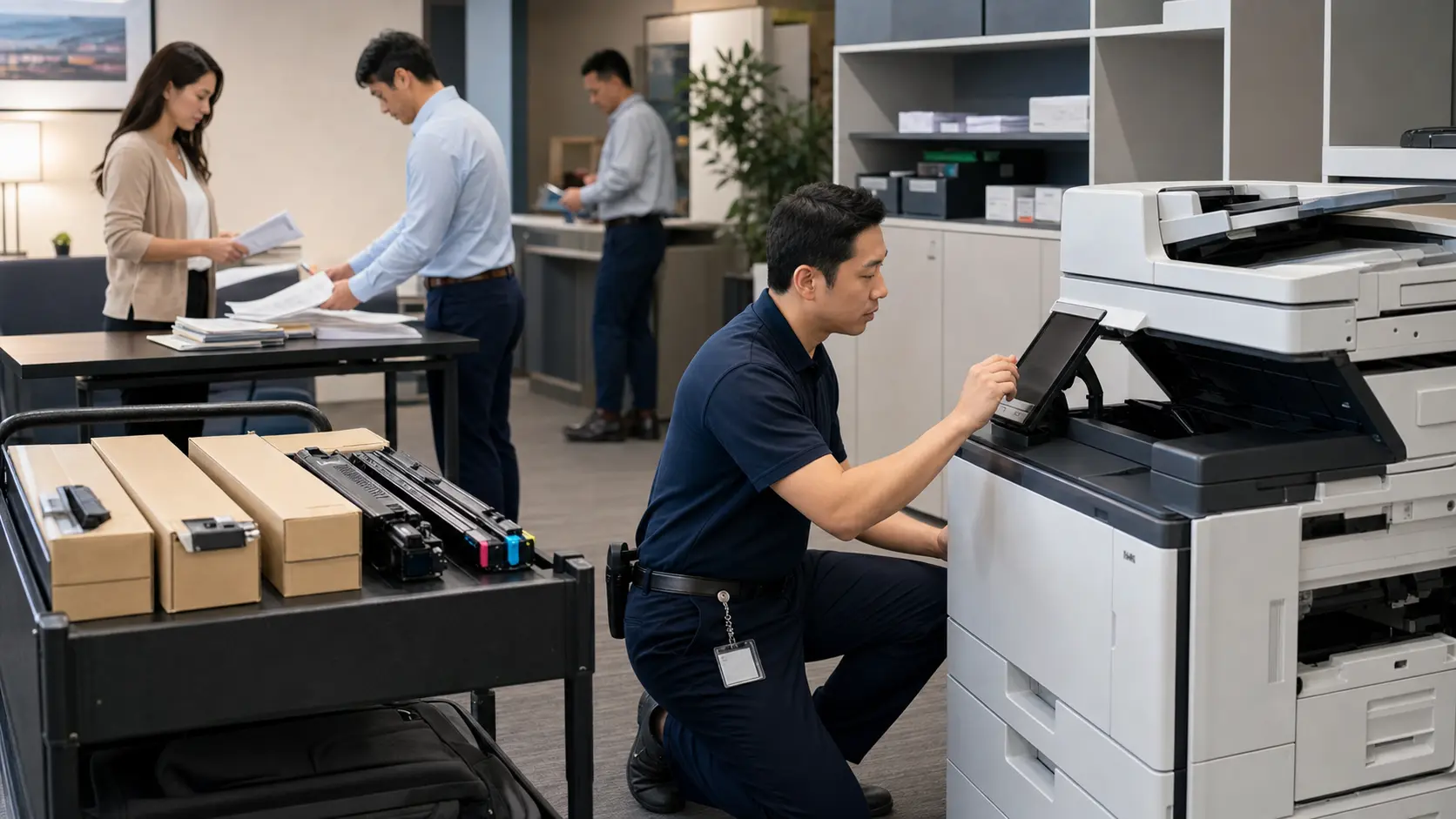
The useful way to look at Canon is to start in the middle of an office day, not in a product showroom. A branch office has a packet of signed forms to scan before a deadline. A school front desk needs a parent letter printed before afternoon dismissal. A clinic needs records moved through a document workflow without exposing patient information. A small design studio has a client proof to produce, and the device that seemed like a capital item two years ago has become an operating dependency.
When a print queue jams, a toner cartridge runs empty, a driver update breaks scanning, or a firmware warning blocks a visitor's job, the buyer is not judging Canon by the color of the logo. The buyer is judging whether Canon can keep work moving.
That is why Canon is best read as a service-and-consumables account built around trusted devices. The device matters because it puts Canon into the customer's physical workflow. The account matters because the real economics appear later: toner, ink, parts, installation, training, repair, print management, secure release, remote monitoring, user authentication, scanning rules, reporting and the availability of people who can resolve problems. The customer is not simply buying a printer, camera or scanner. The customer is buying an expectation that an image, page or document process will be available when needed.
Canon's own reporting makes this account logic visible. In its fiscal 2025 annual report, Canon said its consolidated net sales reached 4,624.7 billion yen, up 2.5 percent from 2024. The Printing business was the largest reported unit, with 2,494.4 billion yen of total sales and 255.8 billion yen of operating profit. The same report breaks the Printing unit into office, prosumer and production areas, with office activity large enough to make Canon's enterprise-device role central rather than peripheral.
The financial results also show a broader company with cameras, network cameras, medical equipment and industrial systems, but the paid relationship that most closely matches an office renewal decision is the one that combines hardware, service, consumables and workflow.
This does not mean every Canon device becomes a high-quality service relationship. The evidence is mixed where it should be mixed. Canon offers cloud print management, managed print services, packaged maintenance plans and self-service support portals. Reviewers continue to praise speed, output quality and build in several current office devices. The same reviews often point to running-cost pressure, especially toner or cartridge cost, and Canon's own 2026 material says printing profit was hit by mix, memory costs and channel economics. A good account can be sticky. An expensive account can be challenged.
The thesis, then, is not that Canon is protected by the old reputation of cameras and copiers. The thesis is that Canon's relevance depends on how well it turns device trust into an account that customers can justify after the invoice: fewer support interruptions, credible consumable economics, secure cloud or hybrid control, reliable maintenance and enough institutional weight to make the buyer believe that the device estate will not become an orphaned local problem.
Canon's identity is broader than the camera brand
Canon's public identity still begins with imaging. The company is headquartered in Tokyo and has long been associated with cameras, lenses, printers, scanners and optical engineering. That image can mislead the analysis if it reduces Canon to consumer photography. The current Canon is a multi-pillar industrial and enterprise equipment group. Its 2025 annual report presents four main business pillars: Printing, Medical, Imaging and Industrial. Printing is the largest by sales. Imaging includes cameras and network cameras. Medical includes diagnostic imaging equipment. Industrial includes semiconductor and display manufacturing equipment.
The size of the Printing pillar is the first reason Canon belongs in enterprise-device coverage. Canon's 2025 supplementary data shows Printing external-customer sales of 2,487.9 billion yen and total Printing sales of 2,494.4 billion yen. Operating profit for the unit was 255.8 billion yen, a 10.3 percent operating margin. That makes printing less glamorous than cameras but more important to the question of everyday operating dependence. A multifunction device estate in a hospital, school district, bank branch, law firm or public office is not a lifestyle purchase. It is part of the physical infrastructure of information work.
The second reason is that Canon's product and service lines connect to workflows rather than only outputs. Canon's global Printing business page describes office multifunction devices integrated with cloud services, remote-work print management, and maintenance and support operations improved through service solutions. Canon Europe describes uniFLOW Online as cloud print and scan management software for print queues, access control, cost tracking, usage reports and mobile printing.
Its managed print pages describe assessment, transition, proactive maintenance, performance reporting, fleet management, security services, multi-vendor management, enterprise service desk and on-site fleet maintenance. Those are account characteristics.
The third reason is that Canon still carries institutional legitimacy. Buyers that place devices into regulated, distributed or high-availability work do not only compare specifications. They weigh the supplier's staying power, service footprint, security posture and ability to support mixed fleets or cross-office deployment. Canon's annual reporting, global product range and regional service pages support that institutional reading. They do not prove that every local dealer, support partner or contract performs well.
They do show that Canon has the corporate scale and service apparatus to compete for customers who need more than a retail printer.
That institutional profile is not a guarantee. Canon's 2026 first-quarter materials show why scale can also expose the company to cost and channel problems. Net sales rose 3.3 percent year on year in the first quarter of 2026, but operating profit fell 26.1 percent. Canon attributed the pressure to higher memory costs, tariffs, product mix, lower-margin channel mix and increased operating expenses. In the analyst Q&A, the company said the shortfall was mainly in Printing and that Printing profitability declined partly because indirect sales made up a higher proportion than direct sales.
A service account is most defensible when the supplier controls customer touchpoints. Channel mix therefore becomes more than a sales detail; it becomes a trust and margin issue.
The paid unit is the account around the device
Canon sells devices, but the paid unit in a business office is usually a bundle of outcomes. The customer wants pages, scans, uptime, access control, predictable supplies, maintenance response and software that connects the device to identity and document systems. Canon's accounting policy description is unusually useful here. In the 2025 annual report, Canon says it generates revenue through products, supplies and related services. Product revenue for Printing devices such as office multifunction devices, laser printers and inkjet printers is generally recognized when control of the product transfers.
Most service revenue, however, comes from maintenance services in Printing and Medical. For Printing service contracts, customers typically pay a usage-based amount, a fixed fee, or a base fee plus variable amounts, often including consumables and break-fix activities.
That is the business model in plain language. The office MFD does not end at shipment. It opens a billable relationship. A buyer may pay per page, by fixed contract, by base fee plus usage, through consumables, or through a managed-service arrangement. The commercial risk shifts from "will the device be sold" to "will the customer continue to value the device account enough to keep it attached to Canon."
This structure can be attractive to both sides. For Canon, service and consumables can smooth revenue after the hardware cycle and deepen customer retention. For the buyer, a bundled contract can reduce the friction of managing parts, toner, uptime and support tickets. It can also create a single accountable party when documents stop moving. Canon's managed print page describes a five-step approach: assessing the environment, designing a transformation path, transitioning the customer, maintaining and supporting the print-and-scan environment, and improving through service and performance reports.
The language is commercial, but it maps to a practical buyer need: make the fleet visible, secure, supported and less wasteful.
The same structure can become a source of buyer resistance. Running costs are visible after purchase and are easy to compare with a rival's supplies model. Recent product reviews illustrate the tension. Tom's Guide praised the Canon Color imageCLASS MF753Cdw II for speed, print quality and office usefulness, but flagged toner replacement cost. ITPro's review of the Canon i-SENSYS MF667Cdw similarly found a capable small-office MFP while warning that color running costs could become significant.
ITPro's review of the Canon MAXIFY GX7150, by contrast, treated refillable ink as strong value for high-volume users because the up-front price was offset by low running costs. These reviews are not proof of enterprise contract economics, but they are useful market signals. They show the buyer's real question: does Canon's total account cost match the workload?
Canon therefore has two levers. One is hardware trust: speed, quality, reliability, scanning, device security and the right feature set. The other is account trust: service terms, consumables, cost reporting, maintenance response, cloud management and direct support. A cheaper device maker can attack the first lever. A local dealer can attack the second by offering faster repair. A cloud document workflow can reduce the need for both. Canon's defence is strongest when the customer needs all of it together.
Office imaging is a security and workflow surface
An office multifunction device is often treated as ordinary furniture until something goes wrong. That understates the control surface. The device prints, copies, scans, stores credentials, touches address books, sends files, receives jobs from laptops and mobile devices, and may sit in a shared area where confidential documents can be exposed. Canon's segment page says its office multifunction devices optimize workflow through total network connectivity and include information-security features intended to protect against unauthorized network access and information leakage.
Canon Europe's uniFLOW Online page adds customer-facing capabilities: secure print queues, release to a chosen printer, user authentication, guest printing, cost rules, usage reports, directory-service integration, and direct mobile printing.
Those details matter because the buyer is no longer buying "a printer" in isolation. The device sits between identity, document management and physical output. If an employee can print to a shared floor device and release only after authenticating, the supplier is part of access control. If scans move into a document workflow, the supplier is part of the information path. If costs can be tracked by user or department, the supplier is part of management reporting. If print servers can be reduced or avoided through cloud management, the supplier is part of IT architecture.
The cloud-service evidence for Canon is real but should be bounded. uniFLOW Online is a customer-facing cloud print and scan management offer, and Canon's own pages describe managed print availability through cloud, hybrid or on-premise setups. That supports a Cloud Service classification for this account only where the paid customer is buying hosted or managed print and workflow control. It does not support treating Canon as a general cloud infrastructure company. Nor does it support treating Canon as a network access provider. The service evidence strengthens the device-account thesis; it does not replace it.
The security implication is also broader than Canon. Academic work on network printers and related devices has shown that insecure configurations can create attack surfaces in real environments. Canon's own annual report identifies cybersecurity risk as an increasing global threat and says it has group-wide countermeasures and a CSIRT. The right interpretation is not that Canon devices are uniquely risky. The right interpretation is that connected print estates are part of enterprise security, and the supplier's software, patching, identity integration and support process become part of the procurement decision.
For a buyer, that turns Canon's institutional legitimacy into a practical variable. A company may accept a higher device or consumables cost if it receives better control, better reporting, more reliable support and fewer security surprises. A company may reject Canon if the cloud-management offer is too narrow, if third-party device support is better elsewhere, or if internal policy prefers vendor-neutral print management. Canon's managed print page says its services can include multi-vendor management and non-Canon device maintenance and consumables management. That is important because many customers inherit mixed fleets.
A vendor that insists on a single-brand estate can lose relevance before the device comparison begins.
Local support labour is not a footnote
The support-labour topic is central to Canon's account value. In a distributed office estate, the customer's problem is rarely only the specification sheet. Someone has to install the device, train users, monitor supplies, troubleshoot network changes, repair failures, apply firmware, handle a stuck scan workflow, explain an invoice, and keep remote or branch users from waiting days for a fix. Canon Europe describes Easy Service Plan as a packaged service covering installation, training, support and maintenance, including parts and labour.
It also describes on-site repair or maintenance options and a next-business-day engineer visit where local conditions support it. The same regional support pages point customers to local service and repair information, authorized service partners, self-service portals and case tracking.
This is where Canon's brand promise becomes labour. A device company cannot simply ship hardware and rely on reputation. The reliability of the account depends on the density, training and responsiveness of the people behind it. Canon's managed print pages make this explicit by listing proactive maintenance, remote monitoring, customer reporting, enterprise service desk, on-site fleet maintenance and on-site fleet operations. That is not decorative service copy. It is the operating substrate for customers who cannot afford to have document work stop.
The Armstrong Watson example on Canon Europe's managed print services for SMB page is illustrative, even though it is vendor-presented and should be treated with the usual caveat. Canon says the accountancy firm replaced a mixed print fleet with 43 multifunction devices using Canon's uniFLOW software, reducing devices and service issues while saving pages and costs. The numbers are not independent proof of typical outcomes, but the case shows the kind of buyer problem Canon wants to own: too many devices, unreliable service, uncontrolled waste, security needs and cost visibility.
Local support labour also creates vulnerability. If a buyer's experience is mediated through a dealer or independent service partner, Canon's national or global promise may be only as good as local execution. Canon's repair pages note that authorized service partners are independent organizations with their own terms, charges and turnaround times. That caveat matters. A multinational supplier can have broad reach and still lose a renewal because one branch had poor response times, a local dealer failed to carry parts, or a support path sent the customer through too many portals.
This is why the direct-versus-indirect sales issue in Canon's first-quarter 2026 Q&A is more than a margin note. Canon said Printing profitability declined partly because the proportion of indirect sales rose compared with higher-margin direct sales, and it planned to strengthen direct sales capabilities in the Americas. Direct sales can improve margin, but it can also tighten feedback loops. In an account business, the supplier wants to know when customers are unhappy before a renewal or rival bid makes the problem visible. Dealer reach helps scale. Direct touch helps control.
The support test for Canon, therefore, is not whether it offers maintenance pages. It does. The test is whether the customer experiences those offerings as a coherent account: one contract where possible, clear escalation, predictable service windows, available consumables, useful reporting and local competence. If Canon performs there, the device estate becomes sticky. If it does not, the buyer has substitutes.
Consumables are the economics customers remember
Consumables are where office-device trust often becomes irritation. A buyer may admire print speed and build quality during procurement, then remember the toner invoice after six months. Canon's annual report explicitly links many Printing service contracts to consumables and break-fix work. Canon Europe also presents business supplies, consumables management and automatic administration as part of the broader account. These are not accidental add-ons. They are part of how the device relationship earns money and part of how the customer experiences the product.
The market signals are clear. Reviewers often separate Canon's output quality from Canon's running costs. Tom's Guide described the Canon Color imageCLASS MF753Cdw II as fast and well equipped for small-office use, but said replacement toner was expensive. ITPro's i-SENSYS MF667Cdw review found strong performance and office features, yet warned that color costs could rack up quickly at meaningful volume. These reviews do not measure Canon's enterprise managed-print contracts, where per-page pricing, bundled supplies and service terms can differ from retail replacement cartridges.
But they do show the pressure point that sales teams have to answer: a good device can still look expensive if consumables do not match workload.
Canon has a counterexample inside its own portfolio: refillable ink tank devices. ITPro's MAXIFY GX7150 review and TechRadar's 2026 ink tank guide both point to the appeal of high-yield refillable systems for users who print enough to justify the up-front device cost. Canon's annual report also says it will continue expanding sales of refillable ink tank models while adding new cartridge-based models. This matters strategically because it shows Canon responding to running-cost segmentation. Not every buyer wants the same supply model. A low-volume office may accept cartridges for convenience.
A high-volume office may demand tanks, contract pricing or managed print. A branch office may value automatic replenishment more than the absolute cheapest page.
Consumables also link Canon to supply-chain risk. Toner, ink, drums, memory components and other electronics do not exist outside global cost cycles. Canon's first-quarter 2026 materials highlighted a major negative memory-cost impact and said memory needed for the year had mostly been secured. In the Q&A, Canon said spot memory prices were approximately two to three times contract prices and that about 20 billion yen of the additional deterioration versus plan was attributed to Printing. That is not a toner-specific point, but it matters for device economics.
If input costs rise, suppliers either absorb margin pressure, raise prices, change mix, reduce expense, or push customers toward models with better profitability. Buyers feel that through device price, consumables, contract terms or product availability.
The risk for Canon is that the customer can often delay replacement. In many offices, a slightly old device is not ideal but is tolerable. If new hardware is expensive and consumables are painful, a buyer can stretch the estate another year, shift more documents to digital workflows, use a local repair-only dealer, buy a lower-cost device maker for smaller branches, or move low-stakes output to cheaper ink tank or monochrome alternatives. Canon's defence is not to pretend these substitutes do not exist.
It is to show that the total cost of failure, support time, security exposure and workflow interruption is higher than the headline savings.
imageFORCE is a renewal test, not just a product launch
Canon's 2025 annual report says the company is introducing imageFORCE as its first new office MFD series in 15 years and sees it as a major driver of office MFD growth. The detail matters because office-device estates are replaced slowly. A buyer that standardized on a generation of devices may be locked into accessories, user habits, service routines, print policies and workflows. A new platform is therefore a renewal moment: Canon can reset the value proposition, but customers can also ask whether the old assumptions still hold.
The imageFORCE test is about more than device performance. Canon needs buyers to believe that a new MFD line justifies replacement in a world where paper volume is pressured by cloud document workflows, electronic signatures, mobile collaboration and hybrid work. Canon's global Printing page argues that office MFDs are being integrated with cloud services and that MFD print-management technology can extend printing for remote work. That is the right frame. A new MFD platform must fit a mixed digital and physical office, not only produce better pages.
The evidence from Canon's results is balanced. Printing sales fell 1.1 percent in 2025 despite increased office MFD and inkjet printer sales, because laser printers declined substantially amid shipment adjustments and weaker market conditions. Canon projected modest Printing growth for 2026, but its first-quarter supplementary data showed Printing first-quarter sales almost flat year on year and full-year Printing sales projected up 1.3 percent. In other words, the renewal engine is not racing ahead. It has to be earned through adoption, pricing, mix and support.
Canon's own Q&A makes the margin side visible. In first-quarter 2026, Printing profit missed plan due to product and customer mix, with lower profitability from a higher proportion of indirect sales compared with direct sales. That suggests Canon's office-device renewal is partly a go-to-market problem. A new product line can improve features, but the account value depends on who sells it, who services it, how the contract is structured, and whether Canon can attach the right software and service without losing margin to channel complexity.
The practical buyer question is direct. Does imageFORCE reduce the number of support tickets, make secure release and scanning easier, improve fleet visibility, lower energy or paper waste, integrate better with cloud identity and document systems, and simplify supplies? If the answer is yes, the replacement cycle can pull forward. If the answer is mainly "newer hardware," the buyer can delay, bargain, or split the estate among rivals.
The camera business shows the same trust problem in a different form
Canon's camera and lens franchise is not the main paid unit in this office-device article, but it helps explain the broader trust pattern. Canon's 2025 annual report says camera sales grew double digits in 2025, and its supplementary data shows Imaging total sales of 1,054.9 billion yen and operating profit of 172.9 billion yen. Imaging performed strongly while Printing was flatter. The reason the comparison matters is that cameras face a different but related substitute: the phone camera.
Canon's own annual report acknowledges that smartphones and cloud computing in the 2010s caused a sharp decline in demand for cameras and office equipment. The company says it responded by transforming its portfolio into four pillars. That sentence is important because it connects two separate disruptions. Smartphones changed casual imaging. Cloud computing changed how offices handled documents. Canon survived by leaning into higher-value cameras, network cameras, medical systems, industrial systems and printing accounts rather than relying on legacy volume.
For professional imaging buyers, trust also extends beyond the body. A camera system includes lenses, accessories, software compatibility, repair access, firmware, reliability under job conditions and confidence that the system will be supported through future work. The substitute is not always another camera maker. Sometimes it is a phone camera good enough for social media, a rental strategy, a smaller mirrorless kit, or delayed replacement. Canon's camera growth shows that high-value imaging demand remains, but it does not remove the need to keep professionals attached through service, ecosystem depth and credible product cadence.
That logic reinforces the office thesis. Canon is strongest when the device is part of a system that the customer trusts over time. It is weakest when the device can be reduced to a commodity output box. A camera body can be compared on autofocus, lens availability and service. A printer can be compared on page cost, uptime and workflow integration. A scanner can be compared on capture quality and document routing. In each case, the account after purchase determines whether Canon's brand carries economic weight.
Cloud document workflows are both an offer and a threat
Canon benefits from cloud workflow when it uses cloud management to keep devices relevant. Canon is threatened by cloud workflow when customers remove paper from the process altogether. That dual position is the most important digital tension in the Canon account.
uniFLOW Online shows the offer side. Canon Europe presents it as cloud print and scan management for small businesses, with secure queues, release to chosen printers, access controls, cost tracking, mobile printing, usage reports, directory integration and support for mixed vendor environments. Canon's managed print services page also says services and solutions are available through cloud, hybrid or on-premise setups. That evidence is enough to classify the relevant part of Canon's offer as customer-facing cloud print and workflow management. It is not enough to call Canon a cloud platform company.
The cloud service is attached to document output and capture.
The threat side is that better digital document workflows can reduce the need for pages. Electronic signatures, digital onboarding, cloud collaboration suites, customer portals, mobile scanning and automated document capture can cut print volume. Canon can participate through scan, capture, workflow and managed services, but it cannot assume every digital shift will preserve device revenue. If a customer moves a form process entirely into a SaaS application, the MFD may lose pages even if it remains useful for exceptions.
Canon's MPS answer is to move from device supply into workflow visibility. Assess the estate, identify waste, secure access, reduce devices, automate administration and report usage. That is rational. A vendor that helps customers reduce unnecessary pages may keep trust even while lowering volume, because it becomes the manager of the remaining physical document surface. The risk is that customer trust can migrate to a software-first vendor instead. A company standardized on Microsoft, Google, ServiceNow, DocuSign, Box, Adobe or another cloud document platform may ask why the print vendor should own workflow at all.
Canon's strongest position is hybrid reality. Many organizations still need physical output for regulated forms, labels, identity documents, clinics, schools, logistics, field work, design review, public notices and human preference. Paper does not disappear evenly. It retreats into specific workflows where reliability matters. Canon can win if it treats those workflows as account surfaces and not as leftovers. That means cloud print control, scanning, authentication, reporting, maintenance and support must feel like parts of one operating environment.
Competitors attack from several directions
Canon's substitutes are not a single rival. The practical substitute list is the right one: lower-cost device makers, managed print rivals, phone cameras, cloud document workflows, repair-only local dealers and delayed replacement. Each attacks a different part of Canon's account.
A lower-cost device maker attacks the hardware bill and the consumables bill. If the buyer prints lightly, the cheapest adequate device may win. If the buyer prints heavily, a high-yield tank or low-cost monochrome alternative can win. Canon can respond with its own refillable ink tank devices, contract pricing, fleet optimization and reliability claims, but it cannot ignore the arithmetic. Reviews that praise Canon performance while warning about toner cost show the vulnerability.
A managed print rival attacks the account layer. A customer may care less about the badge on the device and more about the fleet manager's ability to reduce pages, secure release, manage supplies and handle tickets. Canon's MPS and uniFLOW offers are built for this fight, including multi-vendor management. The question is whether Canon can be credible as an estate manager even when the fleet includes non-Canon devices. If yes, it can defend and expand accounts. If no, independent MPS providers and rival OEMs can unbundle the relationship.
Phone cameras attack parts of imaging and scanning. A phone can capture receipts, whiteboards, field images and simple documents. It is not a replacement for every scanner or professional camera, but it removes enough low-end jobs to matter. Canon's response in imaging has been to emphasize higher-value cameras, lenses and network cameras. In document work, the response has to be better capture quality, security, batch handling, workflow integration and compliance.
Cloud document workflows attack paper volume. A customer that signs, stores, routes and approves documents digitally may print less. Canon can attach itself to scanning and managed print, but the centre of gravity can shift away from the device. That is why the software and service layer has to be more than a defensive add-on.
Repair-only local dealers attack response time and perceived fairness. If a local technician can keep an older device alive cheaply, the buyer may defer replacement. Canon's authorized partner network and service plans can counter this, but independent local service can be persuasive where the customer prioritizes speed over brand uniformity.
Delayed replacement attacks everyone. In uncertain cost environments, the buyer can stretch devices. Canon's annual and Q1 materials mention global uncertainty, tariff policy, inflation, memory costs, raw material and transportation visibility, and regional softness. A cautious buyer may wait. Canon needs replacement arguments that are stronger than novelty: security, supportability, workflow compatibility, lower waste, energy performance, availability and better management.
Regional dependence makes Asia-Pacific important but not sufficient
Canon is a Japanese company with a global revenue base. Its 2025 annual report shows 961.5 billion yen of domestic net sales and 3,663.2 billion yen overseas. The 2025 supplementary data breaks regional business-unit sales into Japan, Americas, Europe and Asia & Oceania. For Printing, Japan sales rose 2.2 percent in 2025, while overseas Printing sales fell 2.0 percent. Americas Printing fell 0.8 percent, Europe rose 0.5 percent and Asia & Oceania fell 9.3 percent.
Those figures give the Asia-Pacific lens nuance. Canon's institutional identity is anchored in Japan, but its Printing growth problem is global and regionally uneven. Asia & Oceania is not automatically a growth cushion for Printing. In 2025 it was the weakest of the listed Printing regions by growth rate. That matters for a company whose office-device thesis depends on replacement cycles, service attachment and channel execution. A broad regional footprint does not eliminate local market weakness.
The first-quarter 2026 supplementary data adds another layer. Printing first-quarter sales were almost flat overall, with Japan up 2.0 percent, overseas down 0.7 percent, Americas down 4.2 percent and Europe up 2.5 percent. Canon's Q&A said performance in Europe and the United States fell short of plan, with European sales affected by the situation in the Middle East. These are not catastrophic signals, but they show that Canon's account model is exposed to regional procurement conditions, channel mix and macro disruptions.
For buyers in Asia-Pacific, Canon's Japanese origin and regional familiarity can support institutional legitimacy. A large Japanese supplier may be perceived as stable, quality-focused and capable of long-term support. But institutional legitimacy must still translate into local service. The office manager in Singapore, Sydney, Tokyo, Manila or Mumbai does not experience Canon as a consolidated annual report. They experience Canon through installation, dealer responsiveness, parts availability, consumables price and software integration.
This is why the topic of local support labour stays in the article. Region is not only a map. It is the local service chain. A Canon account in one country can be excellent while another is harder to support because of partner coverage, device availability, parts logistics or contract design. The institutional brand opens doors; the local support model keeps them open.
Upstream dependence is now part of the account story
Canon's device trust depends on components that customers rarely see. Memory, semiconductors, sensors, motors, optics, toner, ink, plastics, metals, logistics and skilled labour all shape cost and availability. The 2026 Q1 materials make this visible in unusually direct terms. Canon said memory needed for the year was mostly secured, but expected a negative impact of approximately 50 billion yen. The Q&A explained that spot prices were around two to three times contract prices and that Printing carried roughly 20 billion yen of the additional deterioration compared with the previous plan.
That matters for customers because upstream shocks eventually pressure device pricing, product availability, supplies, service parts or the vendor's willingness to discount. Canon said it planned to offset roughly half of the additional memory-cost impact through measures such as price increases, cost reductions and expense reductions, though it had reflected cost and expense reductions rather than explicit price markups in the plan at that point. The buyer does not need to know the memory bill line by line to feel the effect. The account may become more expensive, the sales team may push higher-margin products, or discounts may narrow.
Tariffs are another pressure. Canon's Q1 presentation discussed U.S. tariff assumptions and showed tariff impact as part of gross-profit and operating-profit analysis. The annual report's forward-looking risks also mention changes in U.S. trade policy. For a global device supplier, tariff policy can affect where products are made, where inventory is held, how prices are set, and how quickly a supplier can respond to customer demand. Canon's report also points to foreign exchange, inventory risk, supply-chain disruption, inflation, and geopolitical events such as Ukraine, the Middle East and U.S. trade policy.
Labour is also part of the cost base. Canon's annual report discusses worsening labour shortages in Japan and other developed countries, as well as the need for skilled personnel, AI and robotics. For the office-device account, labour has two meanings. Canon needs skilled people to develop and produce devices, and it needs support labour to install, maintain and service them. If either side weakens, the account loses trust. Automation can reduce factory costs and improve service tools, but customer-facing repair still has local and human bottlenecks.
The practical implication is that Canon's customers are indirectly buying Canon's supply-chain management. A low-cost rival may offer cheaper hardware today but struggle with parts, firmware or service continuity tomorrow. Canon may charge more but offer broader support. The right choice depends on workload, risk tolerance and contract terms. Canon wins when its institutional strength reduces uncertainty enough to justify price.
Network evidence should not be overstated
Canon's relevant network surface is the connected device and the hosted or managed print workflow. It is not an access-network business. There is no need to turn website hosting, old address blocks, support portals, device handles or routing records into a telecom thesis. The evidence available for Canon supports cloud print management, managed print, secure networked MFDs and support services. It does not support treating Canon as a regional ISP, carrier, peering actor or internet infrastructure provider.
That boundary is important because otherwise the analysis would inflate the wrong risk. Canon's customer buys network-adjacent device trust: the MFD must connect securely, release print jobs correctly, scan to the right destination, receive updates, avoid leaking information and keep working when office networks change. The buyer is not buying IP transit from Canon. The network grade that matters is therefore medium for customer-facing cloud print and device-management evidence, and negative for ISP-style connectivity evidence.
The distinction controls the thesis. Canon's cloud service evidence strengthens its account model only where the customer is paying for document workflow around devices. It does not transform Canon into a software-only recurring revenue company. The recurring value remains attached to devices, fleets, supplies, service contracts and document control. If the device estate shrinks sharply, the cloud print layer alone may not replace the hardware-and-consumables economics.
For security, the relevant point is not ownership of network infrastructure but exposure through connected endpoints. Network printers, scanners and MFDs can be overlooked by IT teams because they are physical office equipment. That makes vendor security features, authentication, firmware maintenance, print-release controls, device hardening and service response important. Canon's claims about device security and uniFLOW Online's access-control features answer part of the need. Customers still have to test integration, policy fit and local support.
The conservative conclusion is stronger than a forced one. Canon should be tracked as an enterprise-device and service-account company with a valid cloud print/workflow layer. It should not be tracked as a connectivity provider. Its network risk is endpoint and workflow risk, not carrier-network risk.
What would change the judgement
The positive case for Canon improves if several facts become clearer over the next renewal cycles. First, imageFORCE adoption would need to show that customers value the new office MFD generation for security, workflow, supportability and total cost, not just replacement age. Second, Canon would need to show that Printing can grow without sacrificing margin through weaker channel mix. The first-quarter 2026 issue around indirect sales makes this a live question. Third, managed print and uniFLOW-style cloud management would need to attach to accounts in a way that is visible in retention, service revenue, software usage and customer outcomes.
Fourth, Canon would need to defend consumable economics. That does not mean being the cheapest supplier in every category. It means matching the supply model to workload: refillable tanks where high-volume page cost dominates, managed contracts where uptime and reporting dominate, and predictable toner or cartridge programs where convenience matters. Fifth, Canon would need to show that memory, tariff and input-cost pressure can be handled without making the customer account feel punitive.
The negative case becomes stronger if Canon's device trust decays into price friction. Warning signs would include customers delaying replacement because old devices are "good enough," reviewers increasingly praising hardware but rejecting running costs, weak adoption of new MFD platforms, poor support experiences through local partners, cloud print features that feel less capable than vendor-neutral alternatives, or managed print rivals winning the account layer even when Canon hardware remains in the fleet.
Another judgement-changing fact would be a clear shift in paper volume. If cloud document workflows accelerate in Canon's core office accounts, Canon needs to make money from the remaining document surface and from scanning, workflow and fleet management. If it cannot, the device base becomes less valuable. Conversely, if hybrid work stabilizes around fewer but more controlled print points, Canon can benefit by making those points secure, measurable and supported.
In professional imaging, the equivalent signal is whether high-value cameras and lenses keep growing despite phone substitution. Canon's 2025 Imaging performance was strong. The risk is not immediate disappearance of cameras. The risk is that lower-end imaging use cases continue to move to phones, leaving Canon dependent on more demanding buyers who expect better ecosystem support.
The bottom line
Canon's role in the intelligence map is not only "camera maker" and not only "printer maker." It is a Japanese enterprise-device institution whose economic relevance depends on trust after hardware shipment. The strongest part of the thesis is the office account: MFDs, printers, scanners, consumables, maintenance, workflow software, cloud print management, device security and local support labour. Canon's own accounting and service descriptions confirm that this is not an incidental add-on. It is how a large part of the device relationship becomes revenue over time.
The risks are equally practical. Consumables can irritate customers. Cheaper devices can be adequate. Cloud workflows can remove pages. Local repair dealers can extend old fleets. Managed print rivals can own the service layer. Phone cameras can absorb casual imaging. Tariffs, memory and component costs can pressure margins. Indirect channels can weaken both profitability and customer feedback. Canon's institutional legitimacy gives it a strong starting position, but it has to be renewed every time a customer asks whether the next device account is worth it.
Canon matters where the customer cannot reduce the decision to a box on a desk. It matters when the page, scan, image or document path has a cost of failure. The company earns the account when the device works, the supplies arrive, the workflow is controlled, the service response is credible, and the buyer can explain why Canon's total relationship is safer than a cheaper substitute. That is the standard to watch.
Sources
- Canon directory profile: https://btw.media/en/directory/canon
- Canon Annual Report 2025: https://global.canon/en/ir/annual/canon-annual-report-2025.pdf
- Canon FY2025 financial results: https://global.canon/en/ir/results/2025/rslt2025e.pdf
- Canon FY2025 supplementary data: https://global.canon/en/ir/results/2025/rslt2025-s.pdf
- Canon FY2026 first-quarter financial results: https://global.canon/en/ir/results/2026/rslt2026q1e.pdf
- Canon FY2026 first-quarter supplementary data: https://global.canon/en/ir/results/2026/rslt2026q1-s.pdf
- Canon FY2026 first-quarter presentation: https://global.canon/en/ir/conference/pdf/conf2026q1e.pdf
- Canon FY2026 first-quarter analyst Q&A: https://global.canon/en/ir/conference/pdf/conf2026q1e-qa.pdf
- Canon segment information: https://global.canon/en/ir/business.html
- Canon global Printing business page: https://global.canon/en/business/group/printing-gr.html
- Canon Europe uniFLOW Online: https://www.canon-europe.com/business/products/software/uniflow-online/
- Canon Europe Managed Print Services: https://www.canon-europe.com/business/solutions/managed-print-services/
- Canon Europe Managed Print Services for SMB: https://www.canon-europe.com/business/solutions/managed-print-services-for-smb/
- Canon Europe Easy Service Plan: https://www.canon-europe.com/business/services/easy-service-plan/
- Canon Europe self-service portal: https://www.canon-europe.com/support/business/self-service/
- Canon Europe product service and repair: https://www.canon-europe.com/support/consumer/service-and-repair/
- Tom's Guide review of Canon Color imageCLASS MF753Cdw II: https://www.tomsguide.com/computing/printers/canon-color-imageclass-mf753cdw-ii-isense-mf754cdw-review
- ITPro review of Canon i-SENSYS MF667Cdw: https://www.itpro.com/hardware/printers/canon-i-sensys-mf667cdw-review-an-mfp-thats-ideal-for-small-offices-provided-they-dont-mind-significant-print-costs
- TechRadar 2026 ink tank printer guide: https://www.techradar.com/best/ink-tank-printer
- ITPro review of Canon MAXIFY GX7150: https://www.itpro.com/hardware/printers/canon-maxify-gx7150-review-refillable-flexible-and-thoroughly-likeable-but-its-only-good-value-if-you-print-a-lot
- Bella, Biondi and Bognanni, "Multi-service Threats: Attacking and Protecting Network Printers and VoIP Phones alike": https://arxiv.org/abs/2202.10832