
Summary
- The CRTC adopted three outdoor signal-strength levels, starting with Level 1 in early 2027; Levels 2 and 3 follow in later annual surveys.
- Carriers still produce the underlying estimates. The regulator will compare them with crowdsourced observations, drive tests and transmitter-site data, while giving providers a chance to update submissions.
- A planned map feature will let the public flag disputed areas. The decision leaves unresolved cases to a future process and promises neither a response deadline nor automatic correction.
A common scale changes what can be compared
A coverage map appears to answer a simple question: where can a customer get service? The answer depends on how a provider models radio configuration, terrain, buildings, vegetation and the receiving device. Different assumptions make maps difficult to compare even before anyone disputes a particular road or community.
Telecom Decision CRTC 2026-258 gives providers a shared outdoor reporting standard. For 4G and 5G, Level 1 begins at a predicted signal strength of -110 dBm, Level 2 at -105 dBm and Level 3 at -100 dBm. The levels also describe capabilities: Level 1 is intended to support emergency voice calls and public alerts; Level 2 adds qualifying voice and video calls and at least 3 Mbps down and 1 Mbps up; Level 3 requires at least 10 Mbps down and 2 Mbps up. Legacy 2G and 3G thresholds differ.
The Commission chose neutral numbers because “Emergency” could sound like a guarantee that a specific call will connect. A signal threshold is a reporting convention, not a promise about an individual call. The standard covers outdoors, not indoor reception or people in motion, and excludes low-Earth-orbit satellite-to-mobile service for now. It requires signal strength, not latency, dropped calls or other quality measures.
The public map remains coarser than the filing
Providers will submit data at 50 metres or finer, but detailed inputs remain confidential. The public map uses 250-metre road segments under Decision 2026-8. A finer regulatory input therefore does not give readers access to a street-by-street carrier model. The CRTC approved public coverage by provider, technology and speed, while declining full facilities and transport datasets.
Reporting is staged: Level 1 is due in the next Annual Facilities Survey in early 2027; Levels 2 and 3 come later. Between annual rounds, carriers may update records after major network changes or to correct information. The first survey will not be a complete three-level snapshot.
A challenge begins with a prediction
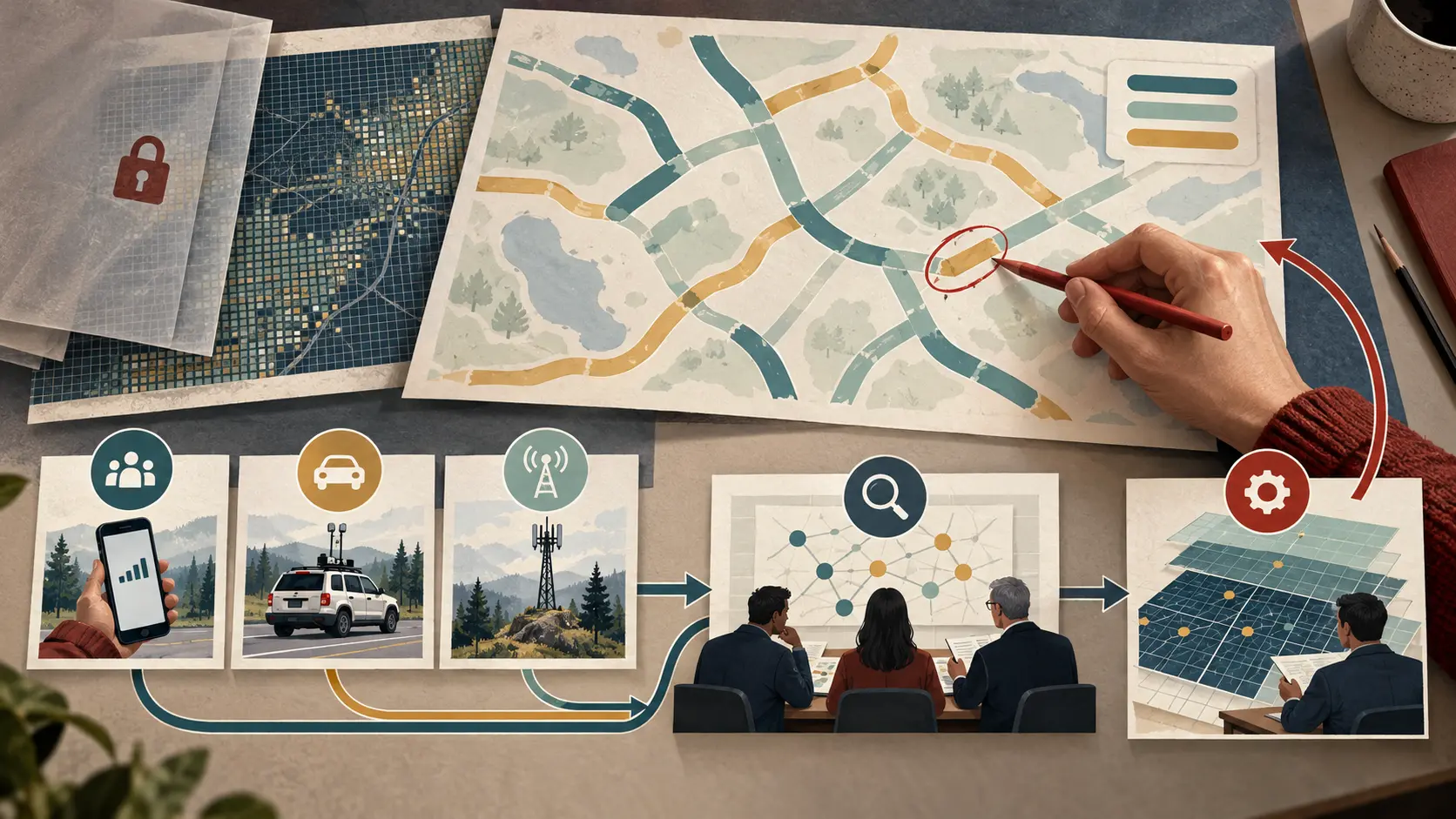
A future version of the National Broadband Map is to include a simplified challenge feature. Challenged areas will be identified publicly. The survey team will receive a report, contact the wireless provider and assess whether its submission is correct. The Commission may request an update or correction and work with Innovation, Science and Economic Development Canada on map changes. For unresolved cases it says it will consider a resolution process.
The decision sets no response deadline, guarantees no field test and does not say every challenge will change reported coverage. Nor will the CRTC routinely substitute its own estimate for a provider’s. Validation will combine crowdsourced data, drive-test results and monthly transmitter-site information; samples are to include rural, remote and Indigenous communities, though no sample represents every locality. The challenge feature also covers whether reported service supports video calls for Deaf, Deaf-Blind and Hard-of-Hearing users. Each source has limits. An anomaly is a reason to examine a record, not proof of systematic overstatement.
A more comparable map can expose gaps for later policy and investment decisions. It cannot add a tower or improve reception by itself. The first result to assess is whether filings become comparable and whether the challenge route resolves specific discrepancies with evidence readers can follow.
Sources
Member Briefing
Deeper Profile Context
Sign in with the right membership level to unlock the full briefing and source notes.
Only for Strategic Circle
Strategic Circle
Open to all readers. Unlock profile briefings after joining and signing in.
Join Strategic CircleOnly for Leadership Alliance
Leadership Alliance
For qualified IP-asset owners and management; sign in to unlock alliance briefings.
Join Leadership Alliance