
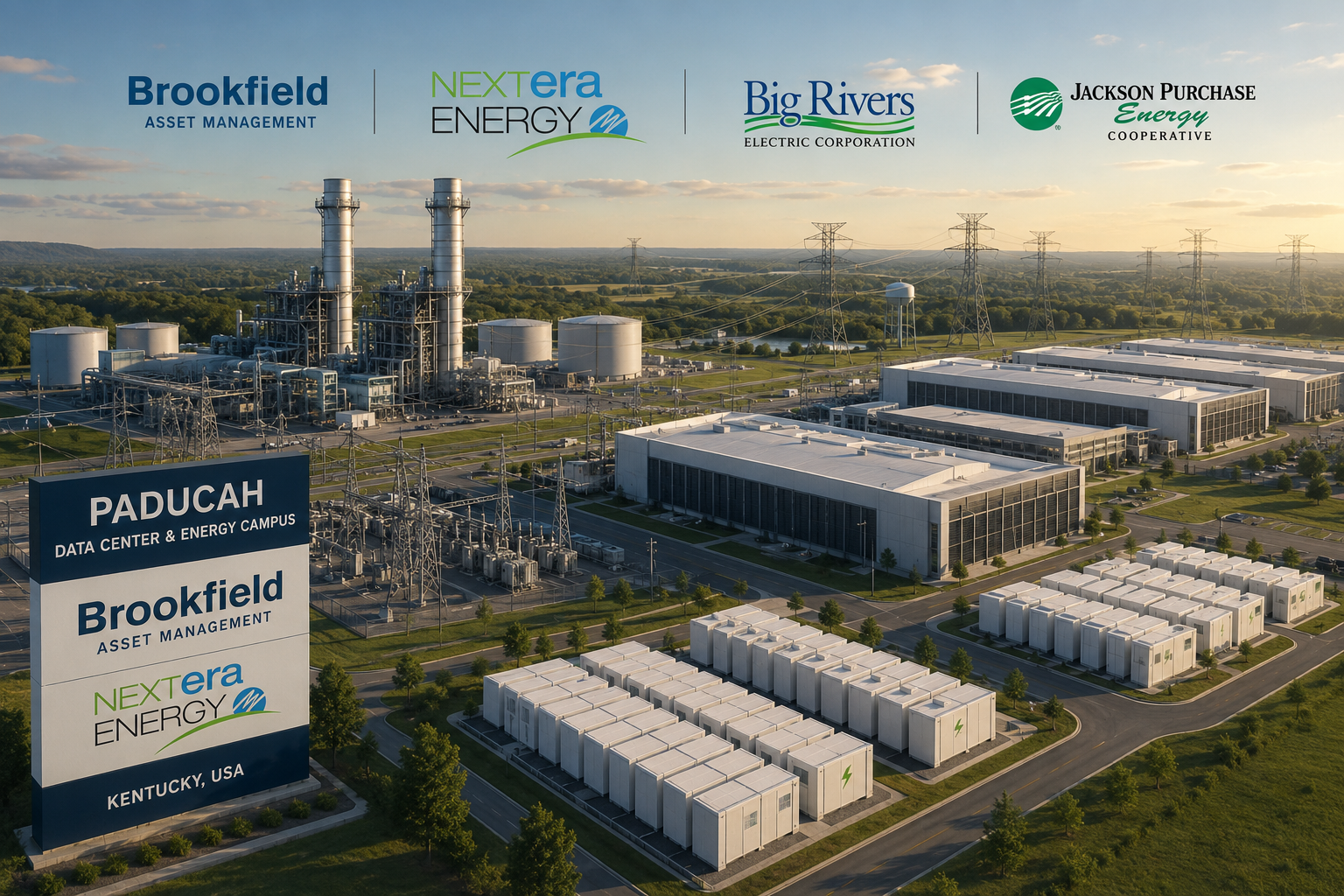
- Brookfield would develop and operate the Paducah campus, while NextEra would build and own its generation, storage and transmission infrastructure
- No data-centre customer has been announced, and the project still requires definitive agreements and regulatory approval
The fact
Brookfield Asset Management and NextEra Energy plan to develop a $100 billion data-centre and energy campus at the US Department of Energy’s Paducah site in western Kentucky. When fully built in 2032, the campus is designed to provide up to 1.8GW of utility capacity and more than 1.2GW of computing capacity. NextEra would build and own 2GW of gas-fired generation, 2.6GW of battery storage and related transmission infrastructure.
The Department of Energy selected Brookfield to lease the land and develop and operate the campus, while NextEra would provide the supporting energy assets. Big Rivers Electric Corporation would supply wholesale electricity, and Jackson Purchase Energy Cooperative would provide retail service. Brookfield has not announced a data-centre customer. The project remains subject to definitive agreements, utility approvals and other regulatory processes.
The assessment
The project divides responsibility for the site and its power infrastructure before a data-centre customer has been secured. Brookfield would manage the land, campus development and customer contracts; NextEra would deliver the generation, storage and transmission assets; and the local utilities would provide wholesale and retail electricity service. A future tenant could therefore enter a development structure in which the main site and power roles have already been assigned, rather than arranging each component separately.
That structure has not yet produced contracted or operating capacity. Brookfield must secure customers, the partners must complete final agreements, and regulators must approve the electricity-service and cost-allocation terms. The campus and power assets must also be delivered on compatible schedules. For BTW readers, Paducah’s infrastructure value will depend on whether those separate responsibilities can be converted into synchronised construction, energisation and customer commitments while keeping project costs away from existing electricity users.
What to watch
Watch for the first confirmed tenant, signed development agreements, and approval of the electricity-service arrangement. Construction schedules should clarify whether generation, storage, transmission and computing capacity will become available together. The approved cost-allocation terms will show how the partners intend to protect existing electricity customers.
Member Briefing
Deeper Profile Context
Sign in with the right membership level to unlock the full briefing and source notes.
Only for Strategic Circle
Strategic Circle
Open to all readers. Unlock profile briefings after joining and signing in.
Join Strategic CircleOnly for Leadership Alliance
Leadership Alliance
For qualified IP-asset owners and management; sign in to unlock alliance briefings.
Join Leadership Alliance