
Summary
- Black Hills’ package combines up to 590 MW of grid-connected service with about 2.1 GW of third-party contracted resources managed through a private microgrid; those are different supply and control arrangements.
- The company says Google bears project costs and has credit, early-termination and stranded-asset protections in agreements through 2048, but the underlying schedules are not public in the announcement.
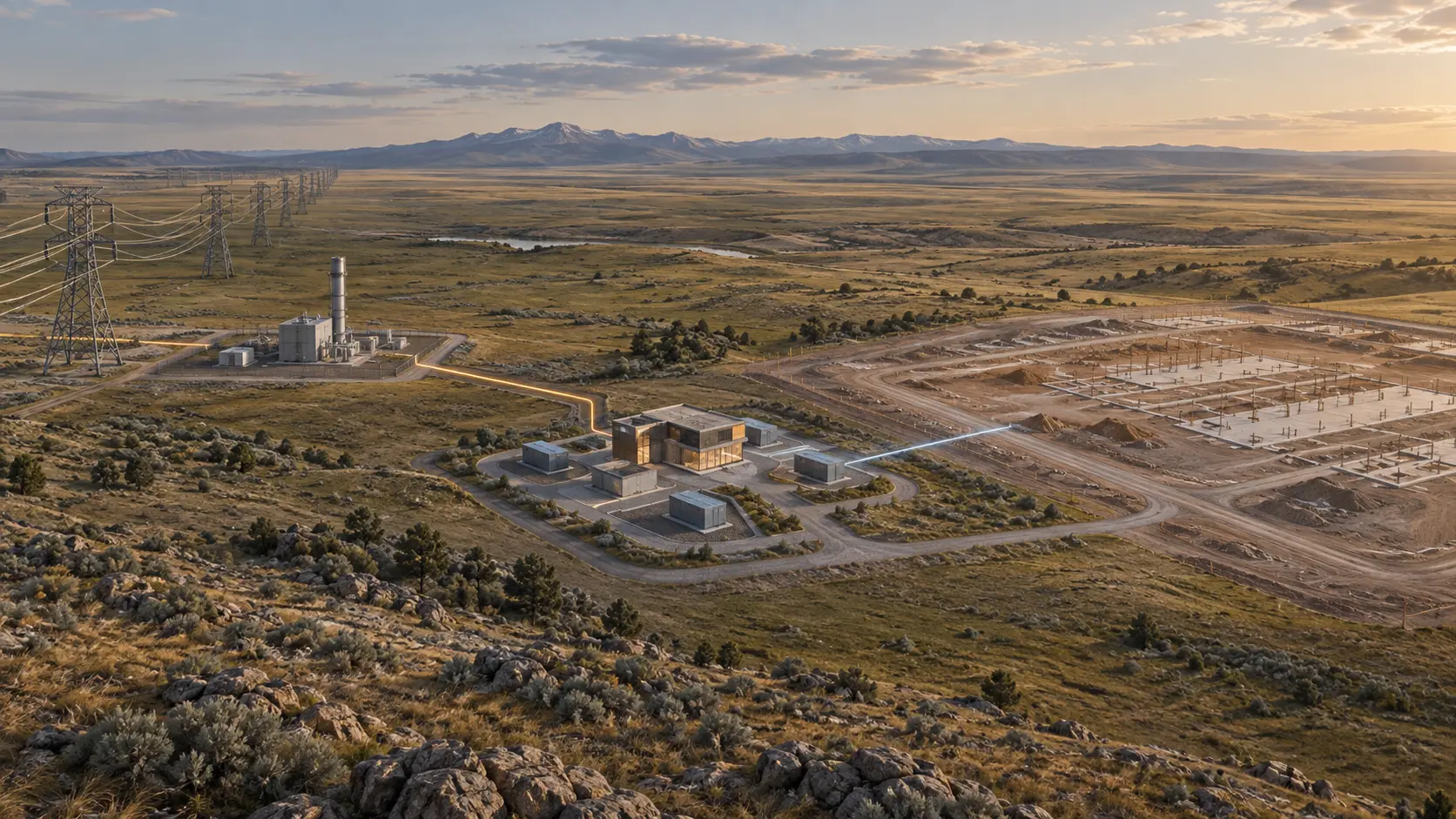
The largest number in Black Hills’ announcement is not the part its utility says it will generate. The planned Cheyenne data centre’s 2.7-GW resource mix includes reserve margins and excludes additional transmission expansion. Of that total, Black Hills expects to provide up to 590 MW through grid-connected service. It would manage roughly 2.1 GW of Wyoming-based, third-party contracted resources through a privately managed microgrid under its Large Power Contract Service tariff. The distinction matters: the utility is not claiming to own or build 2.1 GW of supply.
The two agreements, effective September 30 and announced October 6, run through 2048. The company plans to invest $1.8 billion between 2027 and 2029 in 564 MW of gas generation at its Cheyenne Prairie site, held through a non-regulated affiliate. Another 26 MW of the grid-connected portion would come from market purchases and retail tariff service. Construction returns and microgrid-management fees are expected to begin in 2027. Black Hills forecasts about $150 million of net income in 2030 and $2.4 billion of unlevered free cash flow through 2048, net of the generation investment. These are company projections, not operating results. Its announcement also says Google provided $399 million in refundable advances for long-lead equipment, which Black Hills expects to repay by June 2027.
That architecture creates a more useful diligence question than a single load-versus-grid comparison. Who bears the shortfall if contracted third-party resources arrive late, the site ramps faster than transmission, or the minimum peak load used to set management fees is missed? Black Hills says cost pass-throughs, credit assurance, early-termination provisions and full recovery of generation investment protect existing customers and shareholders. But the release does not publish the contract schedules, collateral amounts, dispatch priority or remedies. The protections are therefore disclosed terms, not yet independently testable outcomes.
Regulatory work is not one approval switch. The company lists a Robinson substation certificate approved in May, an industrial siting permit filed in July and an air permit approved in August for the generation expansion. It says a South Cheyenne transmission certificate was filed in September and another Wyoming transmission application is expected in the fourth quarter; the Wyoming PSC public-notice index is the public docket doorway, not evidence that every later filing has been approved. Its own 2026 Wyoming resource plan identified a 95-MW near-term capacity shortfall beginning in 2027, a figure also cited in Black Hills’ second-quarter results. That makes the grid boundary material even if most of the planned load is served outside ordinary grid supply. The state tariff describes the existing LPCS framework; it is not a substitute for the new customer agreements.
This is a proposed, staged service arrangement, not 2.7 GW already consuming electricity. The public test over the next two years is whether transmission approvals, generation construction, third-party contracts and load milestones advance together—and whether filed results later reconcile the promised protections with actual costs.
Member Briefing
Deeper Profile Context
Sign in with the right membership level to unlock the full briefing and source notes.
Only for Strategic Circle
Strategic Circle
Open to all readers. Unlock profile briefings after joining and signing in.
Join Strategic CircleOnly for Leadership Alliance
Leadership Alliance
For qualified IP-asset owners and management; sign in to unlock alliance briefings.
Join Leadership Alliance