
Summary
- Aventa’s acquisition of Irish Sea Contractors adds a Wexford-based nearshore marine contractor and repair capability to a group with consulting, engineering and operations businesses.
- The deal could shorten the gap between cable design and field execution, but neither the purchase price, backlog nor any measured cost or response-time improvement has been disclosed.
Analysis
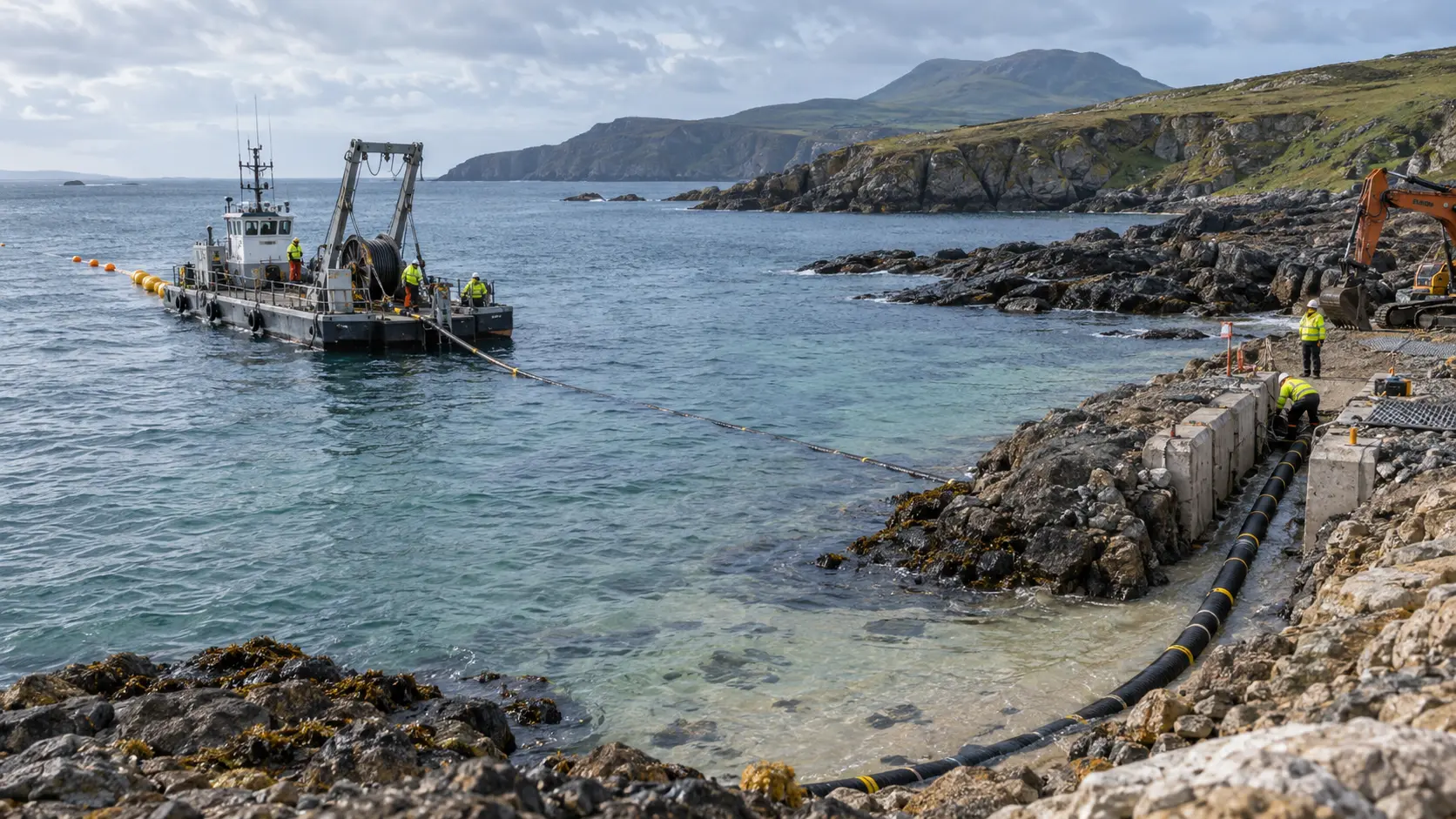
A submarine cable can be financed, engineered and laid across deep water while its most exposed work still lies ahead: bringing it ashore. At a landing point, civil works, shallow-water installation, burial, diving and the link to terrestrial infrastructure have to fit together. This is the operational layer Aventa says it is adding through its acquisition of Irish Sea Contractors (ISC).
Aventa announced the deal on 13 October. ISC is based in County Wexford and works across subsea cable installation, marine civil engineering and diving. The companies say its scope includes cable landfalls and nearshore installation, port and harbour work, commercial diving, and inspection, repair and maintenance. Aventa describes itself as an independent group with Consulting, Engineering and Operations businesses. It says ISC will expand Operations alongside its existing engineering and consulting work.
The proposed fit is easy to explain. Engineering choices affect installation methods, access, equipment and seabed work; field crews can, in turn, expose design assumptions that do not survive contact with the coast. Putting more of those capabilities within one group may reduce the number of hand-offs between consultants, contractors and repair teams. Aventa says the combination should improve constructability and continuity. That is management’s rationale, not a measured result: the announcement gives no before-and-after cost, delay, safety or repair-time data.
Aventa’s acquisition release describes AERSUB as DNV-qualified, but ISC’s product page says final qualification and certification are still in progress. ISC says DNV issued a Statement of Feasibility and an Endorsement of Technology Qualification Plan. The company also describes one offshore prototype demonstration on a three-core power cable, reporting four complete joints and 12 fibre-optic joints completed in 12 hours. ISC says it is preparing for commercial deployment. These are company-reported development milestones, not a record of commercial deployments or a public repair-time series.
The difference in status matters: feasibility and a prototype demonstration do not establish final certification or repeatable commercial performance.
Aventa says ISC Managing Director Áine Kinsella will lead its Operations business unit and continue to lead ISC under its established name in Ireland. The structure could give one executive responsibility for combining offshore execution with engineering and consulting. It does not establish that every employee or customer will remain, that ISC’s work will be sold as part of larger packages, or that Aventa will control cable owners’ restoration decisions. The acquisition is a services transaction; the public announcement does not say Aventa bought cable systems or a cable-laying fleet.
The wider repair market explains why field capability matters, but it does not fill the company-level information gap. ITU, citing ICPC data, reports more than 170 cable repairs worldwide in 2025. That count spans many systems and kinds of work; it indicates sector activity, not ISC’s forecast workload or addressable share.
ISC’s project page lists shallow-water work on a UK–Netherlands telecommunications cable in 2021 and shore-end civil works at Killala for a system continuing toward New York. These examples support the company’s claim that it has performed relevant work. They do not show current workload or recurring revenue. The acquisition notice does not state the price, financing, order book, employee count, margins, client-retention terms or a funded integration budget. Aventa says it plans to invest in the Irish operation, create skilled roles and establish a Dublin presence, but gives no sums or dates.
The test is whether the combined group can turn a broader service menu into booked, repeatable execution. Public evidence would include contracts that assign engineering and nearshore work together, mobilization and repair times, team retention, utilization, deployment of AERSUB, and financial contribution from Operations. Until such evidence appears, the deal shows a change in scope and control, not a proven reduction in cable-delivery risk. The missing figures matter because capacity can create value only when the work arrives at terms that cover people, equipment and liability.
Sources
Member Briefing
Deeper Profile Context
Sign in with the right membership level to unlock the full briefing and source notes.
Only for Strategic Circle
Strategic Circle
Open to all readers. Unlock profile briefings after joining and signing in.
Join Strategic CircleOnly for Leadership Alliance
Leadership Alliance
For qualified IP-asset owners and management; sign in to unlock alliance briefings.
Join Leadership Alliance