
Summary
- AusNOG’s published rules describe a substantive reform. Since 2024, applicants have entered separate draws for specified sponsorship packages; packages are processed from the most expensive down; and a company leaves later pools after one win. The final rosters show considerable entry, but package inventory grew at the same time. Without applicant counts or draw records, those rosters cannot establish a fair or unfair result.
- Platinum was explicitly allocated under a prior agreement in the 2024, 2025 and 2026 proposals. Keeping one anchor outside the ballot may reduce revenue, contracting and event-delivery risk, although no public budget or agreement quantifies that benefit. A proportionate audit could protect commercial terms while publishing counts, anonymous applicant IDs, a reproducible draw record, ordered results, redraws and the governance boundary of the exception.
The reform came before the exception
AusNOG’s sponsorship change began with a complaint about its old system. The organisation’s 2024 sponsorship page said a waiting list had accumulated over many years and had not allowed companies to rotate. It presented random allocation as a more inclusive and equitable replacement. The diagnosis matters because it identifies both the institution’s stated problem—poor rotation—and the standard by which it invited the new method to be judged.
It remains AusNOG’s diagnosis, not an independently measured baseline. The material examined for this article does not publish the waiting list, its length, the dates on which companies joined, the packages they sought or the rate at which existing sponsors renewed. It does not identify companies that waited without receiving a package. The record therefore supports the narrower statement that AusNOG said the list did not rotate companies. It does not show that every allocation under the old model was closed, or that every applicant under the replacement enjoyed meaningful access.
The change itself was concrete. In the 2024 sponsorship proposal, applicants selected up to two particular packages. Sponsors were then to be drawn at random from the applicant group for each package. That is more precise than saying that AusNOG picked “random companies”. There was no single undifferentiated pool of firms and no set of generic prizes. A company chose the commercial products it was willing to buy, and each product had its own field of applicants.
The proposal also specified a sequence. Packages would be handled from the highest cost to the lowest, and a company that won one package would be removed from the draw for any other package it had requested. A winner therefore could not accumulate several listed sponsorships in the same sequence. That constraint can spread the inventory among more firms, but it also makes later pools depend on earlier results. The chance facing a lower-tier applicant is not determined solely by the names originally interested in that tier. It also depends on which multi-tier applicants have already won and left.
This is a real allocation design rather than a promotional use of the word “random”. It identifies package pools, a processing order, an annual application limit and a one-award rule. It can be examined, criticised or defended on its own terms. Yet the public trail becomes much thinner at the moment the rule is supposed to be executed. That distinction—between a procedure announced in a prospectus and a procedure recoverable from records—is the central problem.
One package at a time, with consequences downstream
The 2024 rules gave a selected applicant 14 days to return its signed agreement and set a fixed return date of 29 April 2024. If the applicant could not commit, the position would be redrawn and allocated to “the next applicant”. The first part is clear: selection did not itself complete the sponsorship; contracting did. The second part is not operationally complete. “Next applicant” might mean the second name in an already randomised order, the winner of a new draw among the remaining eligible applicants, or a successor produced by some other procedure. No published ordered result or reserve rule chooses among those interpretations.
The 2025 proposal retained the package-by-package ballot, the descending-price order and removal after one win. It allowed each company to seek as many as three packages rather than two and gave selected applicants 21 days to contract. The extra selection can make the process more useful to a company willing to accept several products. It also increases the number of later pools whose membership may change as expensive packages are awarded.
Consider two applicants interested in Coffee Cart. One also seeks Gold and Silver; the other seeks only Coffee Cart. If the first wins Gold, it disappears before Coffee Cart is processed. If it loses both earlier draws, it remains. Neither path suggests wrongdoing: both follow the published design. But the probability faced by the Coffee Cart-only applicant changes with results in pools it never entered. To audit the process, an outsider would need the frozen eligible lists, each applicant’s chosen packages, the order of the draws and the removal of earlier winners—not merely a list of companies that eventually signed.
The redraw ambiguity remained as well. A contractual deadline and a consequence for missing it are useful, but the public record does not show whether the initial draw generated a full ranking or only a winner. Nor does it disclose whether a replacement selection was ever needed. The existence of a redraw clause is not evidence that a redraw occurred. Conversely, not finding a public redraw notice does not show that AusNOG kept no internal log.
The 2026 proposal repeats the three-package limit, descending-cost sequence, one-win removal rule and 21-day contracting period for the September 2026 event. That continuity has value: applicants can understand the basic architecture from year to year. But by the research cutoff of 20 July 2026, the event had not happened and no final sponsor roster had been located. The public evidence for 2026 is therefore a prospectus and event listing, not a completed allocation history.
Three years, and three meanings of “opportunity”
The simplest audit question is how many positions were actually in play. Even that number changes according to which public document is read and which stage of the process is being counted.
In 2024, the sponsorship webpage said there were 17 opportunities. The proposal listed 19 packages: one Platinum, four Gold, four Silver, two Coffee Cart, one First Timers and seven Beer, Gear & Peer positions. Platinum had already been allocated under a prior agreement, so proposal arithmetic leaves 18 packages eligible for the draw. The final 2024 roster visibly contains 19 company marks in tier counts that match the proposal.
These are three distinct numbers, not one total awaiting editorial tidying: 17 on the public webpage, 19 products in the proposal and final roster, and 18 proposal packages open to random allocation. The located record does not explain the 17. It could reflect an earlier inventory, a different counting convention or a drafting error, but selecting one explanation would manufacture a reconciliation that the source materials do not supply. For a potential sponsor, the difference is practical. A reader of the page and a reader of the PDF could have understood the commercial field differently.
The 2025 sponsorship page and proposal agreed on 21 opportunities: one Platinum, four Gold, four Silver, two Coffee Cart and ten Beer, Gear & Peer packages. Excluding Platinum leaves 20 draw-eligible positions. Yet the 2025 roster image contains 26 legible company marks, 15 of them grouped under Beer, Gear & Peer. The final display therefore has five more sponsors than the entire advertised package count and five more Beer, Gear & Peer marks than the proposal provided for.
An inventory expansion after publication is plausible, but it is not documented in any notice located for this research. The five positions might have been added and placed through the same ballot; they might have been offered through another route; or the final image might embody a representation different from the proposal’s package count. The public material does not decide among those possibilities. The responsible finding is the unresolved 21-to-26 difference, not a story about how it arose.
The 2026 sponsorship page describes 23 sponsorship opportunities as available and says that available opportunities are allocated at random. The proposal also lists 23 products: one Platinum, four Gold, six Silver, two Coffee Cart and ten Beer, Gear & Peer. But it expressly says that Platinum has already been allocated under a prior agreement. Twenty-two packages, not 23, remain open to the draw.
This third discrepancy is semantic rather than retrospective. Twenty-three accurately describes the catalogue; 22 describes the lottery. “Available” can mean all products described in a prospectus or only those for which a new applicant still has a chance. A transparent annual account would separate at least four quantities: products marketed, products accepting applications, products entered into the ballot and contracts shown on the final roster. Using “opportunities” for all four conceals changes that matter to applicants even when no one intends to mislead.
More sponsors appeared; why they appeared is unresolved
The public rosters changed sharply after the new method arrived. The 2023 sponsor image contains seven clearly legible company marks. The 2024 image contains 19. Five names recur—Vocus, Arista, Equinix, Opengear and Internet Association of Australia—while 14 companies visible in 2024 were absent from the 2023 image. Those 14 make up 73.7 per cent of the 2024 roster. Kentik and NETSCOUT appear in 2023 but not in 2024.
That is observable entry. It is consistent with AusNOG’s goal of improving rotation, and it is too large to dismiss as cosmetic. But it is not an applicant-level measure and cannot, by itself, validate the ballot. The roster contains contracted sponsors, not all firms that sought a package. A company absent in 2023 and present in 2024 could be a first-time applicant, a returning sponsor from an earlier year, a firm that had been waiting, or one that only became interested when a suitable package appeared. The image does not distinguish among them.
The inventory change is a powerful alternative explanation. The 2024 roster showed 12 more visible sponsors than the 2023 image, while the 2024 proposal listed 19 packages; that enlarged surface is a major competing explanation. Even a waiting list or negotiated method might have admitted many new names when the available surface grew so dramatically. The ballot may also have contributed. Because the method and the number of places changed together, the roster cannot isolate the effect of either.
The following year shows entry and persistence at once. Twelve names in the 2024 image reappear in 2025: Vocus, Arista, Juniper, Equinix, Telstra InfraCo, Digital Realty, EdgeIX, Harmonic, Opengear, Smartoptics, Virtutel and XenithIG. Fourteen of the 26 visible 2025 sponsors were absent from the 2024 image, or 53.8 per cent. Seven 2024 names—Aussie Broadband, Nexthop, Soda, TPG Telecom, AWS, Internet Association of Australia and NEXTDC—do not appear in the 2025 image.
Those counts say that the visible sponsor set remained fluid while a substantial group returned. They do not say whether incumbents enjoyed better odds or newcomers equal ones. There could have been intense demand for some packages and only one valid applicant for others. Some businesses may have applied for three tiers; others for one. A selected company may have declined to contract. A company absent from the final roster may never have applied. The same 12-and-14 pattern can be produced by very different applicant histories.
For that reason, the rosters should be treated as outcome surfaces, not fairness audits. They can show who appeared, who did not and how the total changed. They cannot reveal the denominator, selection rate, reserve order or experience of an unsuccessful applicant. The most tempting causal sentence—“the draw brought in 14 new sponsors”—goes further than the evidence. What can be said is that 14 names were new to the 2023–2024 comparison as both the draw and a much larger inventory were introduced.
Randomness offers an ex-ante promise, not an ex-post verdict
Random selection can be a strong institutional tool when demand exceeds supply. If similarly situated applicants compete for the same package, an honestly executed lottery can prevent an organiser from ranking them by familiarity, negotiating leverage or preference. A chance that does not depend on pleasing a selector is often easier to explain than a long waiting list whose ordering and renewal practices remain private.
That promise is conditional. Independent research on designing random allocation mechanisms distinguishes ex-ante fairness promoted by randomisation from the assessment of outcomes after constrained allocation. Research on giveaway lotteries likewise examines the attraction of sequential random choice under scarcity while attending to the composition and incentives of applicant groups. Neither study concerns conference sponsorship, and neither verifies anything about an AusNOG draw. They clarify why the words “random” and “equitable” are not interchangeable.
AusNOG’s packages are heterogeneous commercial goods. Platinum, Gold, Silver, Coffee Cart and Beer, Gear & Peer differ in price and benefits. Companies choose the packages they are prepared to buy, and those choices determine which pools they enter. The descending-price sequence removes earlier winners from later pools. Equal treatment within a frozen package pool is an ex-ante property of the rule and its execution. A diverse final roster is an ex-post observation. One does not prove the other.
Nor can a lottery answer every question of access. A small supplier and a large incumbent may receive the same mathematical chance within a pool while having very different ability to afford a package, secure corporate approval within 14 or 21 days, or perform an event function. Related companies may require a rule about whether they count as separate applicants. Invalid and duplicate entries have to be identified. These differences do not automatically make equal random treatment inappropriate. They mean that an equity claim needs a declared unit: equal chances for which eligible applicants, seeking which package, after which exclusions?
The historical verdict is therefore unavailable. The public record does not show that the new system was fair. It also does not show that it was unfair. It shows a declared, reasonably detailed reform; visible change in the contracted roster; a simultaneous expansion of inventory; and insufficient data to connect the first two causally. Calling that result “unanswerable” is not evasion. It is the only conclusion that respects the missing denominator.
The denominator is not just a headcount
At its most basic, a denominator would reveal how many applicants sought each package. A 19-company final roster tells readers nothing about whether 20 or 200 businesses applied. It does not show whether every package was oversubscribed, whether some drew a single eligible firm or whether demand clustered in the lower-priced tiers. Without package-level counts, even the degree of scarcity remains unknown.
The validation process matters just as much. No public applicant list or log of valid, rejected, duplicate and withdrawn applications was located in the examined material. The public rules do not show how related companies were treated, which characteristics were recorded or who decided a borderline case. This is not evidence of arbitrary exclusions. It is a limit on what an outsider can calculate or reproduce.
Unsuccessful applicants are absent as a class. A company might seek several packages and lose each draw, apply only for the most contested tier, receive an offer and decline, or sit out a year. Final sponsor images collapse all those pathways into nonappearance. Without stable applicant histories, the very experience at the heart of AusNOG’s rotation claim—trying and failing to gain access—cannot be observed.
A useful public denominator need not name any unsuccessful business. AusNOG could report submissions received, invalid entries, duplicates, withdrawals and the final eligible total for each package. It could assign each firm a stable anonymous identifier and show the tiers that identifier selected. The same identifier should persist throughout an annual sequence so removal after a win can be checked. If it changed from package to package, the one-award rule would remain impossible to verify.
Cross-year stability would permit a more ambitious analysis of repeat applications and outcomes, but it also raises privacy and re-identification questions. A company in a pool of one can be obvious even behind a code. For the core procedural audit, annual identifiers may be enough. AusNOG could aggregate or delay very small pools and give a trusted witness access to the full record. The goal is not to create a public register of unsuccessful firms. It is to make the stated package rules testable.
A draw is an execution chain, not a button press
No public randomisation method, seed, software name or physical ballot procedure was located for the 2024–2026 rounds. Nor was a draw timestamp, operator identity, witness statement, recording, frozen-input hash, full result order or reserve list found. These are findings about the examined public record only. They do not establish that AusNOG lacked internal records or departed from its prospectus.
Many legitimate methods could implement “at random”: reproducibly seeded software, a spreadsheet function used under controls, a physical draw, a third-party service or another documented process. An outsider cannot infer which was used. More importantly, the integrity of a lottery depends on more than the random-number step. It begins with receipt and validation of applications, continues through freezing and ordering the input, and ends only after results, contracting and any replacements are recorded.
A seed alone would not solve the problem. Reproduction also requires the tool and version, or an intelligible physical protocol, plus the precise ordering of the eligible input. An input hash can bind the organiser to a frozen file without immediately disclosing company names. Publishing the hash before the draw would show that the input was committed before the outcome was known; releasing a redacted version after contracting would allow readers to confirm that it matches.
A witness provides a different assurance. The witness might attest that the frozen list, declared method and output corresponded. A recording could support later inspection. But witnessing must have a defined scope. Watching someone press a button does not prove that the eligible list was complete or that exclusions followed a rule. The modest but meaningful record links the stages: application receipt, validation, freeze, randomisation, ordered result, contract response and replacement.
The output should ordinarily be an order rather than a single winner. An ordered result gives “next applicant” a plain meaning and makes a replacement verifiable. If AusNOG instead prefers a fresh draw after a selected company declines, the prospectus can state that choice and the log can record the revised pool, new seed or physical procedure, time and result. Either model may be defensible. The present wording does not disclose which model governs.
Corporate responsibility without invented actors
The proposal issuer is Australian Network Operators Group Ltd, identified by ACN 652 509 414. Its constitution assigns management of the company’s business to the Board. That establishes the legal container behind the proposals and locates general corporate management power. It does not show who designed, approved in detail or operated a particular sponsorship draw.
No sponsorship-specific Board resolution, delegation, conflict declaration or minute was located in the materials examined. The proposals do not name the person who validated applications, froze the list, generated an order, witnessed the draw or authorised a replacement. The defensible attribution is that the company published and administered the sponsorship process. It would be unsupported to say that the Board collectively drew the winners or that any sponsor participated in the decision.
This boundary cuts both ways. An unnamed public operator is not proof that no one internally supervised the procedure. It simply leaves an outsider unable to identify the operating chain. Conversely, the Board’s general authority is not a substitute for evidence that a specific rule was executed. Corporate responsibility and operational traceability are related, but they are not the same fact.
Functional disclosure would be enough: who approved the annual rules, who made eligibility decisions, who froze the input, who ran the draw, who witnessed it and who authorised any exception or redraw. One person may hold several roles. Naming the functions is not an accusation and need not dramatise routine administration. It prevents a public process claim from becoming detached from the people and records that make it real.
The reserved top position is disclosed, consequential and under-documented
One package sits outside the ballot in every proposal examined. Platinum was “already allocated” under a prior agreement in 2024, 2025 and 2026. The exception was not hidden: a careful reader could see it in each proposal. That disclosure is materially better than silently reserving the most prominent product. It still leaves the agreement’s duration, value, approval, renewal, conflict treatment and allocation of delivery risk unknown.
The exception is small in number—one package among 19 in 2024, 21 in 2025 and 23 in 2026—but significant in what it buys. The proposals associate Platinum with the strongest event-wide branding, registrations, exhibition space, social-event exposure, a short welcome and a role or option connected with the pre-event function. Almost all listed products entered the ballot while the package with the largest symbolic and operational surface remained negotiated.
Vocus is publicly confirmed as Platinum in 2024 and 2025. The two roster images label it at that tier. The 2025 programme says the pre-event function was hosted by Platinum sponsor Vocus, while a Vocus statement identifies the company as Platinum Sponsor for that year. The statement supplies sponsor-side corroboration and a marketing account of the relationship, not contract terms or independent evaluation.
Vocus also occupies the top visual position in the inspected 2018, 2021, 2022, 2023, 2024 and 2025 sponsor images. That recurring position predates the ballot. Yet the older images do not all label the tier, some intervening years were not inspected, and no series of agreements is public. The snapshots establish recurrence, not an uninterrupted Platinum contract.
The 2026 proposal again reserves Platinum under a prior agreement, but no confirmed public identity for the sponsor had been located by 20 July 2026. It must not be inferred from earlier years. The 2026 Humanitix listing says an evening function will be run by the Platinum sponsor, with details to be confirmed. That corroborates an expected delivery role. It neither names the sponsor nor explains the bargain.
Nothing in this record supports describing the agreement as improper, indefinite, conflicted or secretly renewed. Nothing permits a conclusion that Vocus will hold the 2026 package. The same restraint applies in the other direction: a visible reservation does not by itself explain why the exception remains proportionate or how it is reviewed.
The anchor-risk defence deserves more than a footnote
The strongest defence of the exception begins with the practical work of staging a conference. AusNOG’s proposals say sponsorship is vital to the event’s operating budget. Platinum involves much more than logo placement: it combines registrations, exhibition presence, broad branding and a significant social-function role. A sponsor able to commit over a longer horizon may help an organiser plan venues, catering, production and hospitality without remarketing its most consequential package from scratch each year.
An anchor may also reduce contracting risk. The ballot rules themselves acknowledge that a selected applicant may fail to sign within 14 or 21 days, requiring a replacement. At the top tier, a late decline could carry greater financial or delivery consequences, particularly where a sponsor is expected to run a pre-event function. Keeping one relationship settled while drawing the remaining 18, 20 or 22 proposal positions could be a reasonable compromise between rotation and operational certainty.
That case is plausible, not measured. No public AusNOG budget, sponsorship-revenue breakdown, expense schedule or Platinum agreement was located for this article. The record does not quantify an effect on ticket prices, event solvency, contracting cost or delivery risk. It does not show what would happen if Platinum entered the draw, and it does not show that an alternative selected sponsor would fail. The absence that prevents a critical fairness verdict also prevents the defence from becoming a demonstrated financial result.
The sensible policy question is therefore not whether all exceptions are illegitimate or whether this one is necessarily wise. It is what bounded information could make the arrangement reviewable without damaging negotiations. AusNOG could disclose when the exception was approved, its present duration, who authorises renewal, how conflicts are handled, when it will next be reviewed and what category of risk it is intended to manage. An aggregate or banded account of value could replace exact contract pricing.
A stable commercial relationship can be legitimate and still merit periodic governance. Disclosing its boundary would help readers distinguish a deliberate anchor strategy from an exception whose limits are simply not visible. It would also let AusNOG make its best case in evidence rather than asking applicants to infer the benefit.
A proportionate public audit, from inventory to replacement
The first part of an annual allocation report should be an inventory reconciliation. It would list the total products in the prospectus, the packages already allocated, the packages accepting applications and those entering the ballot. If inventory changed after the proposal date, a timestamped notice would record the new quantity and allocation route. This small step would resolve the kind of 17-versus-19 and 21-versus-26 uncertainty that now surrounds the public record.
The dates matter as much as the totals. A proposal count, an application-closing count, a draw-day count and a contracted-roster count may all differ for legitimate reasons. Preserving each snapshot would show when an added position became available and whether it joined the existing ballot, required a separate draw or followed another disclosed route. It would also prevent a later roster from silently replacing the field that applicants saw when deciding whether to enter.
The second part would provide denominators. For every draw-eligible package, AusNOG could publish submissions received, invalid applications, duplicates, withdrawals and the final eligible count. Stable anonymous identifiers would show the packages selected by each applicant. The mapping to company names could remain confidential, while the public data made the descending-cost sequence and removal of earlier winners visible.
Third comes the execution record: the randomisation tool and version, seed where applicable, timestamp and operator, or a clear description of the physical method. A hash would bind the frozen input; a witness attestation or recording would provide additional assurance. The disclosure should state what the witness examined so readers know whether the attestation covers only the randomisation event or also the completeness and validation of its input.
Fourth, the output should preserve the full order or reserve list for each package under the same anonymous identifiers. The contracting log need reveal no negotiation detail. It could record only that an agreement was signed within the applicable period, an applicant withdrew or the deadline expired. If no replacement occurred, an explicit null report would close a gap that silence leaves open.
Every replacement would receive a short entry: the trigger date, package, remaining pool, rule used and resulting identifier. If a fresh draw occurred, the entry would include its tool or method, seed where relevant, time and output. If the next name in an existing order was used, the log would say so. This turns “next applicant” from an ambiguous phrase into a rule that applicants can anticipate and outsiders can test.
Finally, an annual winner history could distinguish ballot-allocated packages, negotiated exceptions and inventory added after the initial proposal. Across years, it would show recurrence and entry against the correct allocation channel. A bounded Platinum note could explain duration, approval and review while leaving detailed price, negotiation strategy and risk clauses confidential.
This is not a demand to transform conference sponsorship into public procurement. It is a record proportionate to AusNOG’s own public claim that scarce packages are allocated at random. The more procedural assurance the organisation already maintains internally, the less burdensome the publication should be: much of the report would be a redacted export of an existing control trail.
What such an audit could prove—and what it still could not
With that record, an independent reader could reproduce package orders, confirm that only eligible identifiers entered, follow each winner’s removal from later pools and verify that a replacement followed the published rule. Applicant counts would show the scarcity of each package. Inventory reconciliation would explain how the advertised catalogue became the final roster. A winner history would place visible turnover over a meaningful denominator.
The audit still would not establish fairness under every possible definition. Randomness cannot erase differences in package price, purchasing capacity or time needed for corporate approval. It cannot decide whether small and large companies should have identical chances, or whether related firms should be combined. Those are design choices requiring stated objectives and eligibility rules, not conclusions produced by a seed.
Nor would procedural integrity turn a sponsor into a representative. Sponsorship purchases a commercial surface—visibility, access, hospitality, display and, in some packages, a brief welcome or event-delivery role. The public evidence does not show that it grants control of the technical programme, authority over the Board, a right to represent network operators or a mandate to speak for the wider community. The ballot distributes opportunities to contract; it is not an election.
Privacy limits should be designed rather than ignored. Very small pools can make an anonymous applicant identifiable. AusNOG could delay or aggregate those totals publicly while allowing a trusted witness to examine the complete data. Contract prices, bid strategy and detailed commercial clauses can remain private. Conflict handling can be reported as a process and review outcome without naming individuals unless a specific disclosure duty requires it.
These limits sharpen the purpose of the exercise. Auditability is narrower than a moral verdict and more useful than a slogan. It tests whether the advertised rule was executable, whether inputs and outputs corresponded, whether exceptions were disclosed and bounded, and whether count changes can be reconciled. It does not ask the public to judge the worth of every applicant.
From a declared lottery to a reviewable allocation
AusNOG’s published record contains more substance than the word “random” alone. The organisation described a problem with its waiting list, established separate draws for specified packages, ordered them by cost, limited each company to one win and set contract deadlines. It repeatedly disclosed that Platinum was already allocated. The visible sponsor field became larger and more changeable after the reform.
But the same record sets firm limits. The 2024 webpage’s 17 opportunities do not reconcile with the 19-package proposal and roster. The 2025 prospectus’s 21 positions do not explain 26 visible sponsors. The 2026 catalogue contains 23 packages while only 22 are draw-eligible. Applicant pools, validation decisions, the method and seed, the operator and witness, ordered results, reserve lists and redraw events remain outside the located public trail.
Those gaps leave the historical fairness question unanswered, not answered negatively. Expansion is an especially serious confounder: adding at least 12 visible positions relative to the 2023 roster could itself produce substantial entry. Equally, the ballot may have contributed. The public evidence cannot divide the credit.
The Platinum exception should be judged with the same discipline. Vocus is confirmed in 2024 and 2025, while older images show recurring top placement rather than a proved continuous contract. The 2026 sponsor remains unidentified. A longer-term anchor may reduce revenue, contracting and function-delivery risk; without a budget or agreement, that defence remains credible but unquantified.
The remedy is not wholesale contract disclosure. It is a compact annual record: reconcile the inventory, publish package-level applicant totals, preserve anonymous stable IDs and tier choices, define “next applicant”, record the tool or physical method, seed, time, operator, witness and frozen-input hash, release the ordered result, log replacements, and state the duration and review boundary of the Platinum exception.
That would convert a prospectus promise into evidence an outsider can follow. In a system where 23 accurately describes the sponsorship catalogue but only 22 packages remain open to chance, the difference between a declared lottery and a reviewable allocation is not rhetoric. It is the record left behind.
SEO and social metadata
- SEO title: AusNOG sponsorship draw: the audit record it still needs
- Meta description: AusNOG replaced its sponsor waiting list with package-level draws but kept Platinum outside. What would make the allocation independently auditable?
- Social title: Twenty-three AusNOG packages, but only 22 enter the draw
- Social description: Sponsor rosters show substantial entry, unresolved counts and a reserved top slot—not enough evidence for a fair or unfair verdict.
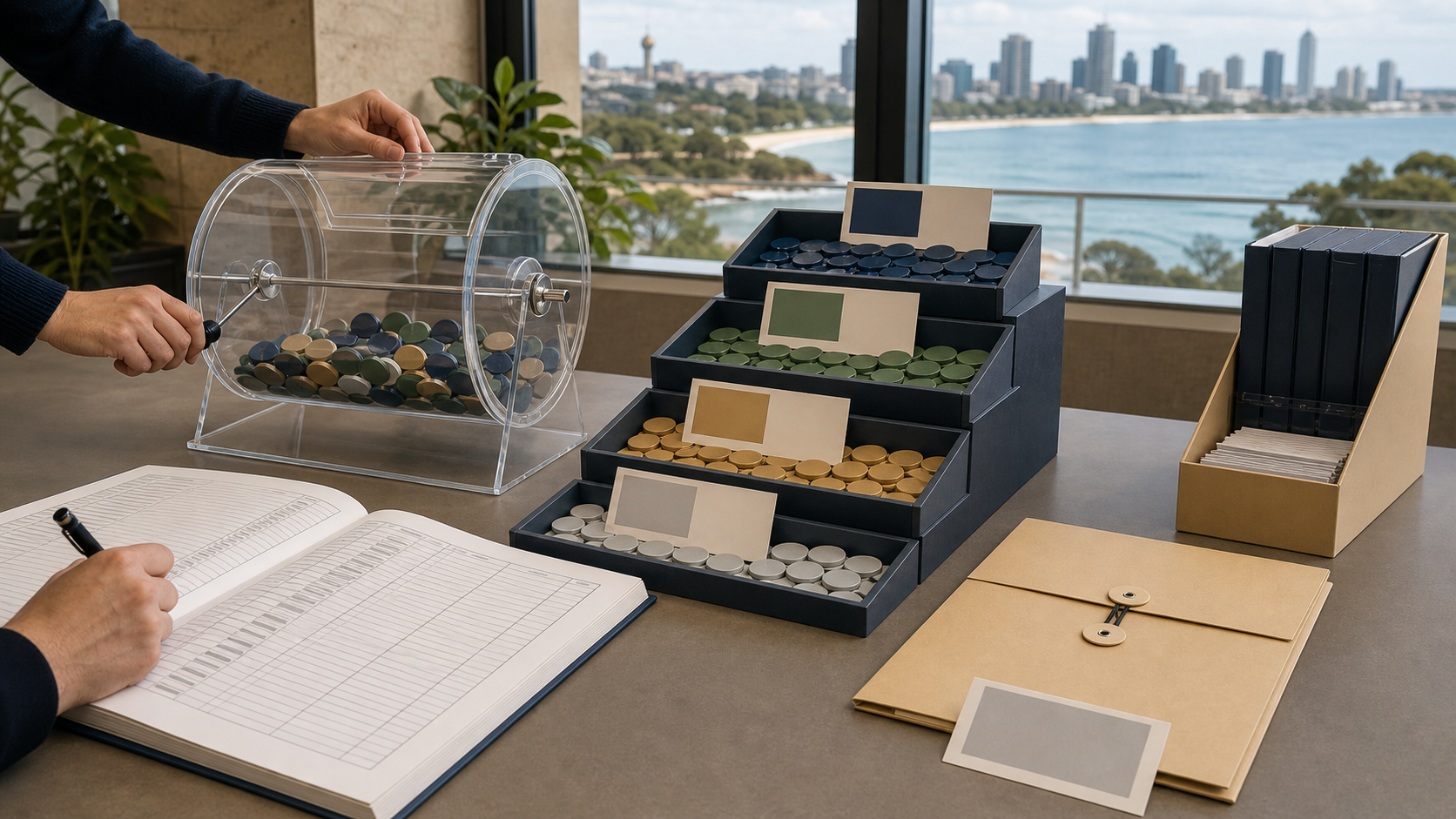
- Featured-image alt: An editorial diagram showing 23 AusNOG sponsorship cards, with 22 entering a transparent draw mechanism and one Platinum card held separately under a prior agreement.
- Featured-image caption: AusNOG’s 2026 proposal lists 23 sponsorship packages, but the disclosed Platinum reservation leaves 22 eligible for random allocation.
- Accessibility description: A wide editorial illustration arranges 23 sponsorship cards by tier. Twenty-two cards follow numbered paths into a transparent draw mechanism, while one Platinum card sits outside it in a holder labelled “prior agreement”. Beneath the draw, a compact audit trail shows an input hash, a seed, a witness mark, an ordered result and a replacement log. No sponsor logos appear, and the scene does not imply misconduct.
- Image provenance: AI-generated editorial illustration created for this article from the documented package arithmetic and proposed audit record. It is synthetic, depicts no actual draw and must not be treated as evidence of an AusNOG procedure.
Publication source register
- https://events.humanitix.com/ausnog-2026
- https://ojs.aaai.org/index.php/AAAI/article/view/20405
- https://www.aeaweb.org/articles?id=10.1257%2Faer.103.2.585
- https://www.ausnog.net/docs/constitution.pdf
- https://www.ausnog.net/events/ausnog-2018/sponsors
- https://www.ausnog.net/events/ausnog-2021/sponsors
- https://www.ausnog.net/events/ausnog-2022/sponsors
- https://www.ausnog.net/events/ausnog-2023/sponsors
- https://www.ausnog.net/events/ausnog-2024/sponsors
- https://www.ausnog.net/events/ausnog-2024/sponsorship
- https://www.ausnog.net/events/ausnog-2025/program
- https://www.ausnog.net/events/ausnog-2025/sponsors
- https://www.ausnog.net/events/ausnog-2025/sponsorship
- https://www.ausnog.net/events/ausnog-2026/sponsorship
- https://www.ausnog.net/sites/default/files/ausnog-2018/marketing/2018_sponsors_75.png
- https://www.ausnog.net/sites/default/files/ausnog-2021/marketing/2021-sponsors-website-500.png
- https://www.ausnog.net/sites/default/files/ausnog-2022/marketing/2022-sponsors-website-400.png
- https://www.ausnog.net/sites/default/files/ausnog-2023/marketing/2023-sponsors-website.png
- https://www.ausnog.net/sites/default/files/ausnog-2024/marketing/sponsor_promo_2024.png
- https://www.ausnog.net/sites/default/files/ausnog-2024/sponsorship/AusNOG_2024_Sponsorship_Proposal.pdf
- https://www.ausnog.net/sites/default/files/ausnog-2025/marketing/sponsors-2025.png
- https://www.ausnog.net/sites/default/files/ausnog-2025/sponsorship/AusNOG_2025_Sponsorship_Proposal.pdf
- https://www.ausnog.net/sites/default/files/ausnog-2026/sponsorship/AusNOG_2026_Sponsorship_Proposal.pdf
- https://www.linkedin.com/posts/vocus-communications_ausnog2025-digitalinfrastructure-brilliantmadesimple-activity-7368070093794131971-lI_c