
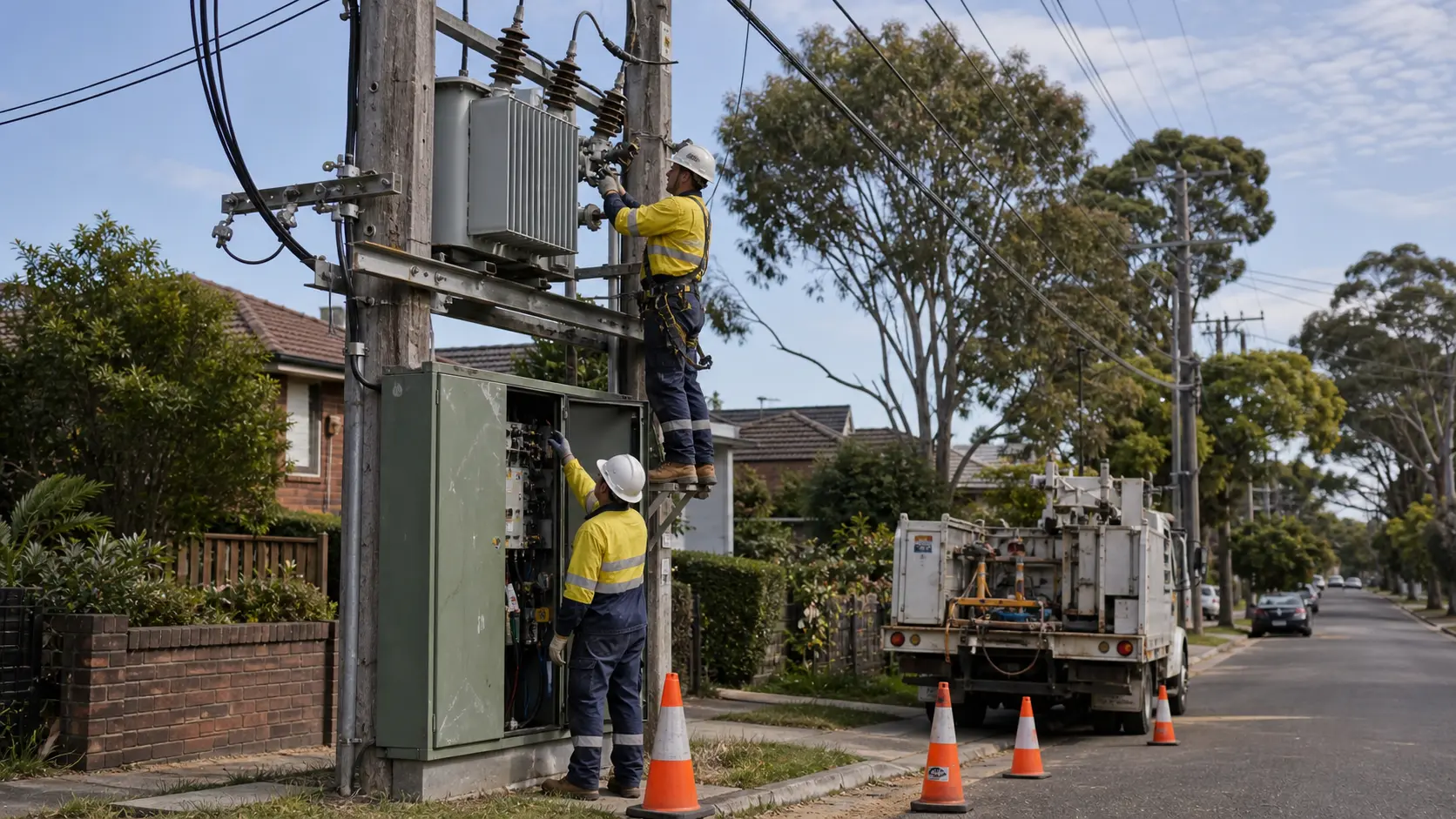
Summary
- Ausgrid's economic unit is the regulated electricity distribution connection and outage-response obligation: the customer pays retailers and network tariffs for access to a maintained network, while large or complex connection applicants may also fund dedicated works, security arrangements and site infrastructure.
- The public case is strongest where Ausgrid can show that regulated revenue funds maintenance, safety, reliability, storm recovery, connection reform and capacity planning more efficiently than a patchwork of batteries, diesel generators, private substations, delayed upgrades or relocation outside its network.
- The AER's 2024-29 decision gives Ausgrid a large but bounded allowance: $9.98 billion in nominal smoothed revenue, $2.88 billion in approved capital expenditure and $2.36 billion in approved operating expenditure, alongside reliability, customer-service and tariff obligations.
- The biggest unresolved proof gaps are economic, reliability and retention evidence: how quickly major connections are delivered, how much local augmentation is borne by the applicant versus the shared customer base, and whether maintenance and resilience keep pace with severe weather, electrification and data-centre demand without bill shock.
The buyer is choosing between a connection, a battery and another postcode
Imagine a Sydney data-centre project lead with a board meeting in two weeks. The site has fibre options, planning momentum and a customer who wants low-latency capacity near the city. The operating constraint is not the shell of the building. It is whether enough firm electrical capacity can be connected on a timetable that matches the lease, the equipment order and the customer's service-level promises.
The practical substitute is already on the table: reduce the first-stage load, add battery and solar self-supply, spend more on generator backup, delay the connection upgrade, or move the project to a different site outside Ausgrid's network.
That is the right opening frame for Ausgrid. It is not a telecom profile, and it is not primarily a story about kilowatt-hours as a commodity. Ausgrid is the regulated network operator whose wires, poles, substations, underground cables, switchgear, crews, control systems and emergency processes make electricity usable in a dense part of New South Wales. Ausgrid describes itself as the largest electricity distributor on Australia's east coast and says its network spans 22,275 square kilometres across Sydney, the Central Coast and the Hunter Valley (https://www.ausgrid.com.au/about-us/about-ausgrid/what-we-do). It also describes itself as serving more than 1.8 million customers and more than 4 million people across that area (https://www.ausgrid.com.au/transforming-the-grid/innovating-for-the-future).
The paid unit is therefore a connection to a maintained regulated network, plus the recurring obligation to keep that network safe, reliable and recoverable when it fails. The customer usually buys energy from a retailer, not from Ausgrid. But the network charge embedded in the bill pays for access days, consumption-related use of the network, demand or capacity charges where applicable, maintenance, replacement, shared augmentation, emergency response and the regulated asset base that makes the connection possible. Ausgrid's FY25 financial statements explain that Network Use of System revenue is billed to retailers based on tariff, electricity consumption, network access days and demand or capacity charges if applicable (https://links.sgx.com/1.0.0/corporate-announcements/NTLILCJQ3UEDM6NZ/857133_Ausgrid%20Financial%20Statments%20FY25.pdf).
That unit is costly because it is not consumed only when the lights are on. A warehouse may draw modest power most of the year and then push the local feeder during heat. A hospital or data-centre customer may pay for capacity it hopes never to lose. A household with rooftop solar may export at midday and import during evening peaks. A local council may care about streetlights, schools, traffic management and life-support customers during planned works. Ausgrid's own connection page says that if a premises sits in its network area, Ausgrid is obliged by law to offer connection services when an application is made, while complex needs may require negotiated terms rather than a model standing offer (https://www.ausgrid.com.au/connections/fees-contracts-and-policies/your-connection-contract).
The evidence that would make the unit worth paying for is also concrete. It would include faster and more predictable connection offers for large loads, transparent allocation of augmentation costs, stable outage minutes and interruption frequency, lower storm-restoration duration, disciplined vegetation and bushfire work, clear planned-outage communication, and data showing that demand management avoids unnecessary poles-and-wires spending. Public sources provide parts of that evidence, but not all of it.
The article's judgement is conditional: Ausgrid's public bargain is credible where regulated revenue is visibly converted into maintenance, safety and capacity; it weakens if customers see higher bills while connection queues, outages or local constraints worsen.
Regulation turns a monopoly into a bill argument
Ausgrid's economics start with a monopoly problem. Most customers cannot choose another distribution network while staying in the same premises. A household in Newcastle, a hospital in Sydney or a warehouse on the Central Coast can switch retailer, install solar, add a battery or buy a generator, but it cannot easily choose a different set of poles and wires. That is why the Australian Energy Regulator, not a competitive market, sets the maximum regulated revenue that Ausgrid can recover for standard network services.
The AER's final 2024-29 decision is the central public document for this bargain. On 30 April 2024, the regulator released its final decision for Ausgrid's electricity distribution determination covering 1 July 2024 to 30 June 2029 (https://www.aer.gov.au/industry/registers/determinations/ausgrid-determination-2024-29/final-decision). The overview says the AER allowed Ausgrid to recover $9,980.9 million in nominal smoothed revenue from consumers over the period, with an illustrative average bill impact of $14 a year for residential customers and $38 a year for small business customers (https://www.aer.gov.au/system/files/2024-04/AER%20-%20Final%20Decision%20-%20Overview%20-%20Ausgrid%20-%202024%E2%80%9329%20Distribution%20revenue%20proposal%20-%20April%202024.pdf).
Those numbers matter because every maintenance debate eventually becomes a bill debate. A regulated network can overinvest and make customers pay for assets that are not needed. It can underinvest and let the costs appear later as outages, safety incidents, emergency works, worse resilience or connection delays. The AER's role is to decide whether proposed capital and operating expenditure are prudent and efficient against the National Electricity Objective, including price, quality, safety, reliability, security of supply and emissions-related long-term interests. The same AER overview says it accepted much of Ausgrid's expenditure but did not accept Ausgrid's revised capital forecast of $3,069.4 million in 2023-24 dollars, substituting an approved $2,882.7 million forecast, a 6.1% reduction (https://www.aer.gov.au/system/files/2024-04/AER%20-%20Final%20Decision%20-%20Overview%20-%20Ausgrid%20-%202024%E2%80%9329%20Distribution%20revenue%20proposal%20-%20April%202024.pdf).
The capital allowance is not a vague pool of public money. It is a claim on future network charges, converted into assets, depreciated over time and added to the regulated asset base where accepted. The AER projected Ausgrid's closing regulated asset base at $20,921.0 million nominal as at 30 June 2029, lower than Ausgrid's revised proposal because of lower opening RAB, lower forecast capital expenditure and depreciation changes (https://www.aer.gov.au/system/files/2024-04/AER%20-%20Final%20Decision%20-%20Overview%20-%20Ausgrid%20-%202024%E2%80%9329%20Distribution%20revenue%20proposal%20-%20April%202024.pdf). The RAB is the financial memory of earlier network decisions. It is also the reason old maintenance choices remain alive in today's bills.
Operating expenditure carries the other half of the obligation. The AER approved total opex of $2,364.8 million in 2023-24 dollars for 2024-29, including Software-as-a-Service implementation costs that it allocated to operating expenditure rather than capital expenditure (https://www.aer.gov.au/system/files/2024-04/AER%20-%20Final%20Decision%20Attachment%206%20-%20Operating%20expenditure%20-%20Ausgrid%20-%202024%E2%80%9329%20%20Distribution%20revenue%20proposal%20-%20April%202024.pdf). That is where the maintenance-economics question becomes sharper. Crews, vegetation management, inspections, digital systems, emergency response, customer communication and compliance functions are not optional decoration. They are the means by which a regulated network avoids turning an asset base into a neglected balance sheet.
Ausgrid's ownership makes the politics more delicate. The FY25 corporate governance supplement says Ausgrid Group is jointly owned under a long-term lease by IFM Investors at 25.2%, APG Asset Management Group at 16.8%, AustralianSuper at 8.4% and the State of New South Wales at 49.6% through ERIC-A (https://aopt-p-001.sitecorecontenthub.cloud/api/public/content/e14e7b7f54894e1e8f7ae768273bce16?v=3f224249). The FY25 financial statements say the group controls and operates the distribution network and parts of the transmission network covering Sydney, the Central Coast and the Hunter Region, and that AOP is both a distribution and transmission network service provider in the National Electricity Market (https://links.sgx.com/1.0.0/corporate-announcements/NTLILCJQ3UEDM6NZ/857133_Ausgrid%20Financial%20Statments%20FY25.pdf). Public infrastructure, pension-capital ownership and regulated revenue are all in the same bargain.
Maintenance is the inventory customers rarely see
Ausgrid's visible product is a live connection. Its invisible inventory is maintained condition. That inventory includes vegetation clearance, pole inspections, substation condition, cable replacement, emergency switching capability, equipment standards, land access, easements, safety systems, trained crews, depots and supplier arrangements. A private customer sees the value only when power stays on during peak load or returns quickly after damage. The network operator sees the value every day as a list of tasks that can be deferred only at a cost.
Ausgrid's own "What we do" page is unusually explicit about maintenance as the public bargain. It says planned interruptions are needed to replace ageing equipment, conduct maintenance and extend the network to connect new premises, and it lists bushfire inspections, tree trimming, streetlight repairs, safety checks, private pole inspections, power-pole replacement and graffiti removal among its maintenance activities (https://www.ausgrid.com.au/about-us/about-ausgrid/what-we-do). That is not glamorous infrastructure policy. It is the operating expense and capital replacement work that lets an urban electrical network age without becoming unreliable or unsafe.
The property and asset base also matters. Ausgrid says its property portfolio includes more than 1,600 owned and 3,000 leased sites, including depots, offices, storage facilities, specialist sites, substations, zones, switching stations, residential and vacant land (https://www.ausgrid.com.au/about-us/about-ausgrid/what-we-do). Those sites are a cost base and an option set. They support crew dispatch, storage, training, switching, substation operations and future works. They also create an ongoing discipline: surplus property can lower bills if sold, but too little operational footprint can make restoration and maintenance more expensive.
This is why planned outages are economically revealing. Ausgrid's planned-outage guidance says it will notify affected customers at least four business days in advance, with notification including date, time and expected duration; it also says planned outages are permitted under the deemed standard connection contract and compensation is not available where 4-7 days' notice is provided (https://www.ausgrid.com.au/outages-and-issues/power-outage-support/preparing-for-a-planned-power-outage). The same page says Ausgrid does not provide or reimburse generators for planned outages and warns that internet service may not work unless it has battery backup. In other words, the regulated network's maintenance right pushes some continuity planning back onto the customer.
That allocation is sensible only if planned interruptions reduce larger failure costs. A supermarket with refrigeration, a medical practice, a data hall, a bank branch or a cold-storage warehouse cannot treat four business days' notice as a complete answer. It still has to buy backup, adjust shifts, move inventory, warn customers or absorb risk. But the alternative to planned maintenance is not zero disruption. It is more emergency work, more unplanned outage time and more expensive repairs. Ausgrid's maintenance bargain asks customers to accept scheduled inconvenience now to avoid larger failures later.
Public safety turns the same maintenance work into a non-negotiable obligation. Ausgrid's Electricity Network Safety Management System page says the annual report covers major incidents, safety risks from loss of electricity supply, bushfire risk and safety communication to the public, and it directs the public to call 13 13 88 for outages, fallen wires and dangerous poles (https://www.ausgrid.com.au/about-us/corporate-governance/ensms). The 2025 ENSMS news release says all pre-summer bushfire inspections were completed for the fifth consecutive year, covering more than 137,000 poles in bushfire-prone areas, and that the lowest rate of electric-shock incidents from network assets in four years was recorded (https://www.ausgrid.com.au/about-us/newsroom/ensms-2025).
Those claims are useful, but they do not close the file. The evidence that would sharpen maintenance economics would show the cost per inspected asset, the defect rate found, the avoided failure rate, the trend in pole replacement backlog, and the local feeder reliability change after interventions. Public reporting gives a safety and compliance picture; it does not yet let a reader connect every dollar of maintenance to avoided outages, avoided injuries or avoided bill increases. That is the first missing proof category: economics.
Connection rules decide who pays for scarce capacity
The connection is not just a plug. It is a legal and engineering allocation of capacity. Ausgrid's AER-approved connection policy says connection works may involve new network infrastructure, upgrades, reconfiguration or decommissioning, and may be performed by a customer-funded Accredited Service Provider or by Ausgrid (https://www.aer.gov.au/system/files/2024-04/AER%20-%20Final%20Decision%20Attachment%2018%20-%20Connection%20policy%20-%20Ausgrid%20-%202024%E2%80%9329%20Distribution%20revenue%20proposal%20-%20April%202024_0.pdf). It also says customer-funded connection services include contestable services, ancillary services, higher customer requirements beyond Ausgrid's least-cost technically acceptable standard, pioneer scheme contributions and land for connection assets.
For small customers, that sounds bureaucratic. For a data centre, industrial load, hospital expansion, transport depot or large apartment development, it is the economic core. A customer may have to pay an Accredited Service Provider for contestable design and construction. It may have to provide land, easements or a site for network infrastructure. If it wants a higher supply standard than Ausgrid's least-cost technically acceptable option, it pays the marginal additional cost. If works are substantial and initially only for that customer's benefit, Ausgrid may require revenue security. Ausgrid's public connection-contract page says substantial standard-control works nominally over $1 million may require a security fee through a deed of guarantee of minimum revenue (https://www.ausgrid.com.au/connections/fees-contracts-and-policies/your-connection-contract).
This is a good example of the public bargain. If a large new customer causes local augmentation, the shared customer base should not automatically pay the whole cost. But if every new connection pays the full local cost without regard to wider network benefit, useful development can be delayed or pushed into inferior sites. The AER-approved policy tries to split the difference: some work is customer funded, some shared-network work is recovered through standard network charges, and some large-customer work needs security so a speculative or slow-ramping project does not leave ordinary customers with stranded cost.
The policy even anticipates unused capacity. It says Ausgrid may reduce the agreed maximum capacity of a connection if at least five years have passed since energisation, measured demand or export has remained below the agreed capacity for at least two years, Ausgrid needs the unused capacity to relieve a forecast network constraint, and the premises owner does not have a current negotiated agreement to reserve the capacity (https://www.aer.gov.au/system/files/2024-04/AER%20-%20Final%20Decision%20Attachment%2018%20-%20Connection%20policy%20-%20Ausgrid%20-%202024%E2%80%9329%20Distribution%20revenue%20proposal%20-%20April%202024_0.pdf). Capacity, in other words, is not merely a paper promise. It is a scarce option that can affect other customers.
The data-centre buyer understands this immediately. An 88 MW or 150 MW connection is not equivalent to a household service upgrade. It can consume headroom at a zone substation, require upstream works, alter protection settings, affect fault levels and change the timing of other investments. Ausgrid operates more than 180 zone substations and publishes historical interval demand data under National Electricity Rules requirements (https://www.ausgrid.com.au/about-us/about-ausgrid/research-data-sets/distribution-zone-substation-data). Public zone-substation data is useful because it lets connection applicants and non-network providers see where constraints and opportunities might sit, but it cannot reveal the full private queue of connection studies or commercial commitments.
For large embedded generation, Ausgrid's public process begins with a preliminary enquiry, proceeds through technical and commercial requirements, fees and contracts, and then a connection agreement once requirements are met (https://www.ausgrid.com.au/connections/apply-for-a-connection/solar-batteries-and-embedded-generation/connecting-large-embedded-generators). The load side follows the same broad economics: early evidence, technical studies, cost allocation, contracts and a decision about whether the connection is worth the customer-funded and shared-network costs.
The connection unit therefore has a retention feature. Once a data centre, transport depot, battery, hospital or industrial customer has paid for site works, accepted a maximum capacity, configured backup, signed a negotiated agreement and planned around local feeders, it does not switch networks casually. That can strengthen Ausgrid's revenue security. It can also heighten scrutiny, because a customer locked into a physical connection has fewer exit routes if the upgrade timetable slips or outage performance disappoints.
Outages reveal whether the bargain is working
Reliability is often summarized in averages, but customers experience it as interruption, uncertainty and recovery time. The AER's final decision applies the Service Target Performance Incentive Scheme to Ausgrid for 2024-29, with final reliability targets by feeder type. The targets include SAIDI of 13.0183 minutes for CBD feeders, 64.7924 minutes for urban feeders, 129.0408 minutes for short rural feeders and 841.1598 minutes for long rural feeders; SAIFI targets are 0.0382, 0.5575, 0.9312 and 2.2695 interruptions respectively (https://www.aer.gov.au/system/files/2024-04/AER%20-%20Final%20Decision%20-%20Overview%20-%20Ausgrid%20-%202024%E2%80%9329%20Distribution%20revenue%20proposal%20-%20April%202024.pdf). These are not customer promises for every site. They are regulatory incentive parameters.
The distinction matters. A CBD office tower and a coastal town can both be within Ausgrid's public obligation, yet their fault exposure, feeder design and restoration options differ. Major event exclusions, planned interruptions and local constraints also shape the lived experience. A data-centre operator may find the average urban target irrelevant if its particular substation is constrained or if its redundancy design depends on two feeders exposed to the same event. A household may care less about annual averages than whether a planned interruption falls on a medical appointment, school day or heatwave.
The January 2025 storms made the outage bargain visible. The NSW Government said violent storms on 15 January and gale-force winds on 17 January damaged energy infrastructure, brought down trees and powerlines, and left around 8,600 homes and businesses across NSW still without power as of 6am on 20 January; it said more than 200,000 Ausgrid customers had been impacted (https://www.nsw.gov.au/ministerial-releases/repairing-damage-and-restoring-power-after-two-waves-of-storms). ABC reported on 16 January that 100,000 homes remained without power on the Ausgrid network and quoted an Ausgrid spokesperson describing more than 560 hazards being tracked across the network (https://www.abc.net.au/news/2025-01-16/nsw-wild-weather-storm-sydney/104823252).
Ausgrid later said severe storms in January 2025 tested network resilience and that rapid restoration efforts reconnected 99% of affected customers within five days (https://www.ausgrid.com.au/about-us/newsroom/ensms-2025). That is a strong operational claim. It is also a reminder that the last 1% matters. The final customers are often in the harder locations, with more damaged assets, access problems, fallen trees, safety hazards or complex rebuilds. A network can restore nearly everyone quickly and still leave a small set of customers facing the highest private cost.
The AER's March 2026 storm-cost decision adds a financial lesson. Ausgrid applied to pass through $19.6 million in 2024 dollars for the January 2025 storm, later reducing the amount to $16.1 million after an information request. The AER decided the storm did not meet the requirements for an approved positive change event because efficient incremental costs did not exceed the materiality threshold, so no pass-through amount was approved and there was no impact on network charges or customer bills from the decision (https://www.aer.gov.au/news/articles/communications/aer-makes-determination-ausgrids-january-2025-storm-cost-pass-through). That decision strengthens the maintenance discipline: not every severe event becomes an extra bill.
For customers, the result cuts both ways. It is good that a storm does not automatically add to network charges. It also means Ausgrid has to absorb smaller severe-weather costs within existing allowances, creating pressure on the same budgets that fund routine maintenance, response capability and resilience. The public bargain is not "spend whatever a storm costs." It is "spend enough in advance, respond efficiently, and recover only what the rules allow." That is harder than it sounds in a climate of more frequent severe weather, higher electrification and greater dependence on digital services.
Data-centre demand makes local grid capacity a national infrastructure question
Digital infrastructure changes the politics of distribution networks because data centres transform electricity from an operating input into the gating constraint for cloud, AI, financial services, media, public-sector continuity and enterprise outsourcing. Sydney's attraction is obvious: customers, fibre, skills, capital, exchanges, financial institutions and latency-sensitive demand. The constraint is equally obvious: large loads need grid capacity, backup strategy, land, planning permission and public tolerance.
The data-centre evidence should be handled carefully. Some claims are reported through media and inquiry coverage rather than Ausgrid's own audited data, so they are best treated as market signals. W.Media reported in June 2026 that Ausgrid's current data-centre set of proposed projects stood at 7.5 GW, with 5.2 GW still in planning assessment, and that Ausgrid's forecast to AEMO was about 2.2 GW for projects it considered more likely to proceed (https://w.media/data-centres-could-hit-30-of-nsw-load-and-drive-down-network-costs/). That figure, if directionally accurate, is not a revenue forecast. It is a signal that connection assessments have become a strategic workload for the network.
The Australian's June 2026 reporting on Transgrid is another market signal rather than an Ausgrid-specific finding. It reported that Western Sydney transmission capacity was becoming constrained beyond 2033, that Transgrid had signed connection agreements with data-centre proponents representing about 1.5 GW of demand in Western Sydney, and that developers were being encouraged to consider grid-investment obligations or alternative regions (https://www.theaustralian.com.au/business/data-centres-face-sold-out-signal-from-nsw-grid-operator-transgrid-amid-boom/news-story/7e37523447b67633b5e97b7313e67c62). The transmission network is not the same as Ausgrid's distribution network, but the signal is relevant: large digital loads can exhaust planning headroom faster than legacy forecasts expected.
Broader Australian data-centre sources point in the same direction. The United States Studies Centre wrote in 2026 that Australia operated at a smaller scale than the United States, with around 250 data centres and 1.4 GW of installed capacity, but that sovereign digital infrastructure and power planning were becoming linked strategic questions (https://www.ussc.edu.au/powering-the-cloud-data-centres-and-the-future-of-australias-grid). The Energy reported that data centres in Australia consumed about 3.9 TWh, or around 2% of grid power, and that modelling for AEMO expected strong growth (https://theenergy.co/article/shielding-mums-and-dads-from-data-centre-whiplash). Climate Council similarly described data-centre power use as around four TWh in 2024-25, or about 2% of the National Electricity Market, while warning about rapid growth and renewable-supply implications (https://www.climatecouncil.org.au/what-does-the-data-centre-boom-mean-for-australias-switch-to-renewables/).
Those sources do not prove that every data-centre project in Ausgrid's area will proceed. Many projects will change size, timing, procurement, grid design or location. But they explain why Ausgrid's connection and maintenance economics matter beyond electricity-sector specialists. A data centre that cannot get capacity may relocate. A data centre that gets capacity but relies heavily on diesel backup may face emissions and community scrutiny. A data centre that assumes future grid upgrades without paying the right security can shift risk to other customers.
A network that refuses too many projects can leave economic activity on the table.
The public bargain is therefore more complicated than "connect growth." Large digital loads may increase network utilisation and spread fixed costs if they are well located, technically compliant and funded with appropriate contribution or revenue-security arrangements. They may also require local augmentation, upstream capacity, voltage and fault-level work, new substations, more sophisticated protection and greater outage coordination.
The facts that would settle the issue are not in public: average connection study time, accepted versus speculative large-load capacity, cancelled projects, applicant-funded works, shared-network contribution, and the extent to which new large load lowers or raises charges for other customers over time.
Ausgrid's own planning framework creates a partial answer. The 2025 Distribution and Transmission Annual Planning Report page says the report is intended to provide transparency for decision-making, asset condition and limitations, five-year planning, possible non-network solutions such as demand management or embedded generation, and planned commencement dates for projects subject to the regulatory investment process (https://www.ausgrid.com.au/about-us/regulation-and-compliance/network-planning/dtapr). Planning transparency is not the same as capacity abundance, but it is the necessary starting point for turning private connection demand into a public investment sequence.
Batteries, solar and generators discipline the bargain but cannot replace it
The substitute in the opening is not imaginary. A data centre can buy batteries and generators. A warehouse can install rooftop solar and a customer-side battery. A hospital can improve backup arrangements. A developer can phase load growth. A family can add home storage. A fleet operator can schedule charging outside peaks. A project sponsor can choose a site beyond Ausgrid's footprint. These substitutes are economically important because they keep the regulated network honest.
Ausgrid itself recognizes demand management as an alternative to endless physical upgrades. Its managing-demand page says demand management can reduce or shift electricity use to ease pressure on the network and can be a more cost-effective way to meet growing energy needs than always building new poles, wires or substations (https://www.ausgrid.com.au/transforming-the-grid/innovating-for-the-future/managing-network-demand). The same page lists demand tariffs, Project Edith, shifting load, hot-water load control trials, co-generation and standby, solar PV and lighting efficiency among demand-management initiatives. That is the right economic direction: capacity should be built only where flexibility cannot deliver the same value at lower cost.
But self-supply has limits. A battery can bridge an interruption or arbitrage a tariff, but it does not replace a high-capacity grid connection for a large continuous load unless the customer pays for a much larger energy system. Rooftop solar reduces midday imports but may not solve evening peaks or storm restoration. Diesel generation can protect a critical site but creates fuel logistics, emissions, noise, maintenance and community-approval burdens. A delayed upgrade preserves cash in the short term but can lose customers or force inefficient operating workarounds.
A different postcode may solve one project's capacity issue while moving demand into another constrained network.
The AER's 2024-29 tariff decision shows how these substitutes are being folded into network economics. The AER approved Ausgrid's tariff structure statement with amendments including an individually calculated tariff option for storage customers and changes affecting embedded-network tariffs and transition periods (https://www.aer.gov.au/system/files/2024-04/Final%20Decision%20-%20Ausgrid%20distribution%20determination%202024%E2%80%9329%20-%20Revised%20Tariff%20Structure%20Statement%20-%20April%202024%20-%20Clean.pdf). Tariff design matters because it decides whether flexibility is rewarded, whether peak demand is signalled, and whether customers without solar or batteries are left carrying too much cost.
Ausgrid's submission to the NSW Net Zero Commission argues that network plans can accommodate a range of electrification scenarios, that most developments will have no material impact on the network, and that large-scale developments and electrification projects are assessed case by case and may need localized connection investment (https://www.netzerocommission.nsw.gov.au/sites/default/files/2025-07/Ausgrid.pdf). The same submission says Ausgrid and other NSW distribution networks worked with the NSW Government on a public online map of available hosting capacity to help prospective customers choose connection locations. That is a useful admission: location and timing can lower costs.
For the buyer, the disciplined procurement question is not whether Ausgrid or self-supply wins in the abstract. It is which mix minimizes total failure cost. Grid connection gives access to shared assets, restoration crews, regulated planning and a large cost pool. Self-supply gives local control, but only within its energy, duration and maintenance limits. Generator backup gives resilience during outages, but it is expensive insurance and may be unacceptable as a routine operating plan. Relocation may lower grid risk but increase latency, land, workforce or customer costs.
Ausgrid's bargain survives if the grid remains the least-cost backbone and private systems become complements rather than desperate substitutes.
The financial statements show a utility, not a startup
Ausgrid's FY25 financial statements show a mature infrastructure business with large assets, regulated revenue, debt and exposure to capital markets. Revenue rose to $2.928 billion in FY25 from $2.527 billion in FY24, while profit before income tax was $546 million and property, plant and equipment stood at $18.308 billion (https://links.sgx.com/1.0.0/corporate-announcements/NTLILCJQ3UEDM6NZ/857133_Ausgrid%20Financial%20Statments%20FY25.pdf). Those numbers do not by themselves prove excess return. Regulated network accounting has depreciation, finance costs, pass-through items, asset revaluations, capital contributions and timing effects. But they show why the public cares: this is a large balance sheet funded through essential-service charges.
Debt is central to that balance sheet. The FY25 financial statements show current borrowings of $608 million and non-current borrowings of $12.836 billion at 30 June 2025; they also say Ausgrid generated net operating cash inflows of $736 million, held $442 million in cash and cash equivalents, and had undrawn facilities including capex, working-capital and revolving facilities (https://links.sgx.com/1.0.0/corporate-announcements/NTLILCJQ3UEDM6NZ/857133_Ausgrid%20Financial%20Statments%20FY25.pdf). The statements note stable credit-rating outlooks from Moody's and S&P, supporting continued access to bank lending and capital markets. A grid connection is therefore also a claim on a financing model.
That financing model can be a public advantage. Long-lived assets such as substations, cables and poles should not be paid for entirely in the year they are built. Debt and regulated returns allow costs to be spread across the users and years that benefit. This is how a network can make capital-intensive investments before every customer individually asks for them. It is also how customers can end up paying for past decisions long after the original project justification has faded. The regulator's role is to keep that time-shift disciplined.
The private-ownership component heightens the need for visible performance. Pension-fund and state ownership can align with long-term infrastructure stewardship, but customers still experience the company through bills and outages, not portfolio theory. If Ausgrid funds maintenance and connection capacity effectively, the ownership structure is a way to mobilize long-term capital for public infrastructure. If customers see rising charges without visible reliability, safety and connection gains, the same structure becomes politically vulnerable.
The financial statements also separate regulated and adjacent business lines. They describe standard control services, alternative control services such as certain metering, street lighting and ancillary network services, and unregulated services including contestable metering, infrastructure services, battery energy storage services, electric vehicle charging infrastructure, facility access and property lease (https://links.sgx.com/1.0.0/corporate-announcements/NTLILCJQ3UEDM6NZ/857133_Ausgrid%20Financial%20Statments%20FY25.pdf). That matters because new activities can support network efficiency, but they can also raise ring-fencing and cross-subsidy concerns if not handled cleanly.
Media controversy around Ausgrid's community battery and solar ambitions should be read as risk, not settled fact. The Australian reported in 2025 that Ausgrid's solar and battery plan had sparked industry backlash over whether a regulated network operator should enter competitive markets and whether costs or advantages could be shifted unfairly (https://www.theaustralian.com.au/business/companies/power-grab-ausgrids-solar-and-battery-plan-sparks-an-industry-backlash/news-story/b6eba24ba97909c47eacd188690a6631). The claim is useful as a market signal: as Ausgrid moves from distributing electricity to storing it, enabling EV charging and supporting local energy, the boundary between regulated monopoly and contestable market becomes part of its institutional legitimacy.
The strongest defence is not rhetoric. It is accounting separation, transparent procurement, AER scrutiny, public performance data and evidence that new services reduce total network cost or improve access for customers who cannot afford private alternatives. Ausgrid's public pages frame community batteries, EV charging and demand management as ways to make electricity accessible, support the energy transition and reduce long-term costs. The burden is to show that these are network-efficient tools rather than protected-market expansion.
Supplier and crew constraints set the practical ceiling
Maintenance economics are not only a spreadsheet problem. They are a practical ceiling set by crews, accredited contractors, equipment lead times, traffic management, local councils, easements, community tolerance and safe-work rules. A regulated allowance can authorize expenditure, but it cannot instantly create skilled field labour, transformers, switchgear, cable jointers, vegetation crews or road access. This is why a customer buying a connection is also buying Ausgrid's ability to coordinate a local production system under public scrutiny.
Ausgrid's procurement page says its procurement decisions support affordable, reliable and sustainable energy solutions for the communities it serves (https://www.ausgrid.com.au/industry-partners/procurement-and-suppliers). That line sounds generic, but it points to a hard cost base. Network reliability depends on a chain of suppliers and works partners that can design, construct, inspect, maintain and repair equipment across a large metropolitan and regional footprint. If materials are scarce, if civil works cost more, if traffic windows narrow, or if emergency restoration consumes crews, the network's maintenance plan can be squeezed even when the regulatory allowance looks adequate.
The technical standards show how detailed the physical burden is. Ausgrid's NS113 page says chamber substation standards apply to site selection, design and construction of new contestable and non-contestable chamber substations and refurbishment of existing chamber substations, including chambers used for high-voltage customer connections (https://www.ausgrid.com.au/asp-and-contractors/technical-document-library/ns113). A large customer does not merely ask for more power and wait for a cable. It may need room for network assets, building interfaces, fire and access considerations, safe clearances, protection arrangements and compliance with standards that outlive the immediate commercial deal.
Major works make the same point at community scale. Ausgrid says it is responsible for operating, maintaining, repairing and building substations, power lines, underground cables and power poles across its 22,275 square kilometre network, and that major projects involve civil and construction works under state planning requirements (https://www.ausgrid.com.au/in-your-community/major-building-works-in-your-area). Its listed works include cable replacements, substation upgrades and Darlinghurst electricity cable upgrades to improve reliability and support future demand. These projects are public, disruptive and local. They require road coordination, community notices, safety controls and tolerance from customers who may not directly see the benefit.
This is where the data-centre and electrification story can become politically fragile. A new large load may be economically attractive if it increases utilisation or funds dedicated assets. But if local residents experience more roadworks, planned outages, construction noise or bill pressure while believing the benefits accrue to a private data hall, the legitimacy of the connection bargain weakens. The answer is not to block large loads reflexively.
It is to show which works are applicant-funded, which works improve the shared network, how outages are scheduled, and how the project changes future charges and reliability for nearby customers.
Accredited Service Providers add another practical constraint. Ausgrid's connection policy says many connection works are contestable and performed in the market, while some services can be provided only by Ausgrid because of system security, reliability, health and safety obligations or specialized requirements (https://www.aer.gov.au/system/files/2024-04/AER%20-%20Final%20Decision%20Attachment%2018%20-%20Connection%20policy%20-%20Ausgrid%20-%202024%E2%80%9329%20Distribution%20revenue%20proposal%20-%20April%202024_0.pdf). This split is economically sensible because it exposes some work to contestability while protecting system-critical activities. It also means connection performance depends on both Ausgrid and the surrounding contractor market.
The operating ceiling is most visible after damage. Copper theft, storms and vegetation failures all consume scarce skilled response capacity. Ausgrid's 2025 ENSMS news release says copper theft remains a challenge even as surveillance and public awareness reduce risks to reliability and safety (https://www.ausgrid.com.au/about-us/newsroom/ensms-2025). Every avoidable hazard has an opportunity cost: crews sent to make a damaged asset safe cannot simultaneously complete routine maintenance, process connection work or reduce a backlog elsewhere. The cost is therefore not just the replacement material. It is the interruption to the maintenance plan.
For a large buyer, supplier and crew constraints change the way the connection should be evaluated. A quoted connection charge is not enough. The buyer should ask how much of the work depends on scarce Ausgrid-only resources, which parts can be delivered by accredited contractors, how long critical equipment lead times are, whether planned outages are likely to affect commissioning, what happens if storm response interrupts scheduled works, and how the customer-funded asset becomes part of the shared network after energisation. Those questions are not adversarial.
They are how a customer prices the practical risk of relying on a maintained public network rather than a private energy island.
Reliability evidence still has three holes
The public evidence base is good enough to understand Ausgrid's bargain, but not good enough to close the investment case. The first hole is economic. Public sources disclose allowed revenue, capex, opex, RAB movement and broad financial results. They do not show connection-level cost recovery, applicant-funded versus shared-network augmentation, maintenance backlog, defect-removal productivity, avoided-outage value or renewal economics for large customers. Without those, outsiders cannot fully judge whether maintenance spending is too high, too low or poorly allocated.
The second hole is reliability. The AER provides feeder-class targets and incentive rates. Ausgrid provides outage maps, restoration claims, planned-outage notices, ENSMS reporting and safety highlights. Those sources do not reveal enough local detail for a major customer choosing between Ausgrid's connection, another site and a heavy backup system. A data-centre buyer would want site-specific redundancy, restoration history, planned-outage frequency, maintenance windows, local feeder constraints, substation condition and credible scenarios for heat, storms and upstream disturbances.
Public averages are useful, but procurement needs local evidence.
The third hole is retention. Ausgrid's monopoly position means ordinary customers rarely churn from the network, but large new loads can decide where to locate before they connect. The relevant metric is not household churn. It is whether major connection applicants continue through study, contribution, construction, energisation and expansion. Public evidence does not disclose how many large applicants defer, downsize, leave the area or accept alternative locations because of cost, timing or capacity. That evidence would make data-centre and industrial policy far more concrete.
There are also uncertainty factors that could move the judgement. Severe weather could raise restoration costs faster than allowances. Electrification of transport, heating and industry could create sharper local peaks than average forecasts imply. Rooftop solar and batteries could lower some loads while increasing export and voltage-management complexity. Data-centre demand could either improve asset utilisation or force lumpy upgrades. Interest rates could raise the allowed return and customer bills. Supply-chain constraints could increase transformer, cable and switchgear costs.
Cyber or physical-security requirements could add operating burden.
Against that uncertainty, Ausgrid has a credible set of public tools: AER-regulated revenue, DTAPR planning, connection policies, demand-management programs, outage communication, ENSMS reporting, storm-recovery processes, and a large financial platform. The question is not whether these tools exist. It is whether their measured outputs improve quickly enough for customers whose dependence on electricity is becoming less forgiving.
The final judgement returns to the avoided private system
The opening data-centre buyer can buy batteries, generators, phased load, another site or a smaller project. Those substitutes are real, and they will become more common as electricity becomes the bottleneck for digital infrastructure and electrification. But none of them fully replaces a regulated, maintained grid in a dense metropolitan economy. Batteries need charging. Generators need fuel and public tolerance. Solar needs space and time alignment. Relocation solves one customer's problem by moving it elsewhere. Delayed connection upgrades can quietly become lost investment.
Ausgrid's public bargain is therefore still defensible: pool the costs of a safe and reliable network, make large beneficiaries contribute where they drive dedicated costs, let the regulator bound revenue, and use planned maintenance and emergency response to avoid worse failures. The AER's 2024-29 decision shows the bargain in numbers. The connection policy shows it in cost allocation. The ENSMS and storm evidence show it in safety and restoration. The data-centre debate shows why the same bargain is becoming an economic-development issue rather than a narrow utility matter.
The risks are equally clear. Customers facing higher bills will not accept vague claims that maintenance is difficult. Large connection applicants will not wait indefinitely if other regions can provide capacity. Households without batteries or solar will resist paying for a transition that seems to reward richer customers first. Public officials will worry if data centres appear to reserve capacity while homes and small businesses face constrained local networks. Competitors will object if regulated assets are used to support contestable services without clear separation.
The article's conclusion is conditional but firm. Ausgrid is most valuable when it makes private backup less central: fewer hours on generator, less need for oversized batteries, fewer stranded sites, fewer unsafe poles, faster storm restoration and clearer connection costs. It is least convincing when customers still have to buy expensive private resilience while also paying rising network charges. The connection is the paid unit, but maintenance is the promise. If Ausgrid can show that regulated revenue is buying lower failure cost, fairer capacity allocation and better recovery, the public bargain holds.
If not, the battery, the generator and the other postcode will keep gaining force.