
Summary
- The disclosed merger terms attach three million additional shares to a qualifying lease for the first 5 MW of AI capacity.
- The investor presentation reports a non-binding letter of intent. That is not the binding lease, an operating facility or rent collected.
A lease signature could become a valuable event for Atlantic HPC's shareholders well before the first AI workload runs. In its September 11 announcement with Aperture AC, the company set out a proposed combination that includes a seller earnout for securing a customer. The important distinction is what the announced milestone measures: a contractual commitment, rather than completed delivery.
Aperture's September 11 report describes three million contingent shares for a binding, arm's-length lease covering the first 5 MW, with an unaffiliated tenant and an initial non-cancellable term of at least seven years. The accompanying presentation adds that Atlantic and its stockholders must neither fund nor guarantee that tenant's obligations. These conditions try to distinguish outside demand from a commitment supported by the sellers themselves. They do not, on their own, establish the tenant's ability to pay.
The same investor presentation, page 16, describes a signed, non-binding letter of intent for the first phase. Moving from that document to a qualifying lease is therefore a substantive commercial step, not a change of label. A prospective customer can express interest before the parties settle the obligations that make a project financeable. The reviewed disclosure does not establish that the earnout has already been earned.
A customer still has a building to equip
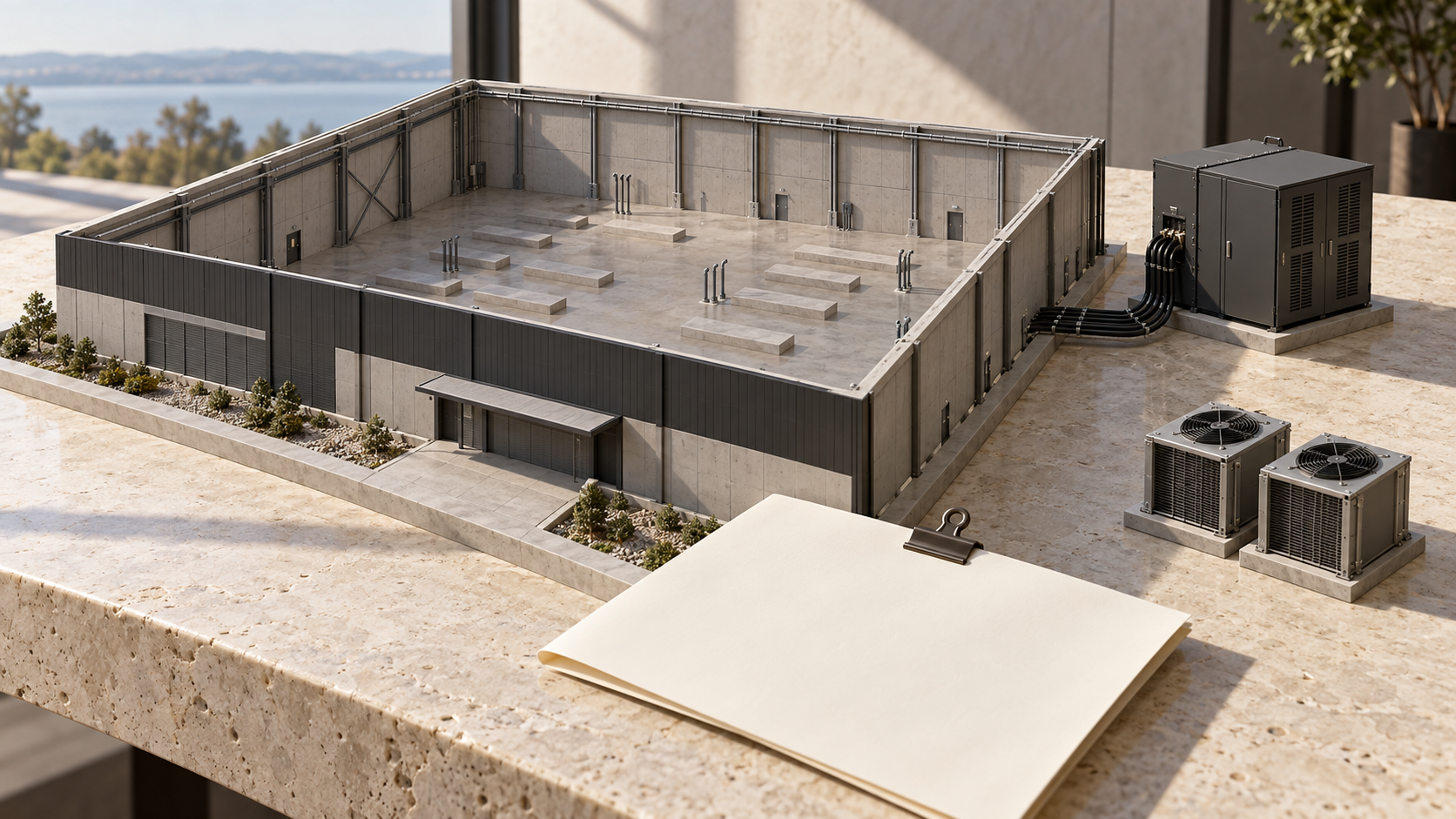
Atlantic's proposed product is not simply a rack of AI servers available for use. Its illustrative leasing model on page 20 assigns the powered shell and supporting power and cooling infrastructure to Atlantic; the tenant supplies equipment including rack-level and direct-to-chip cooling, racks, computers and connections. These are proposed responsibilities, not evidence of an executed customer contract.
That division matters to the economics of conversion. Tenant investment can reduce the equipment burden on the landlord, but it leaves two investment programmes to meet at a usable handover point. A building ready for fit-out need not be ready to process a workload. If equipment installation and landlord delivery drift apart, the party that owns the delay, and the point at which rent starts, become more consequential than the headline power figure. Those are questions for the eventual contract, not terms disclosed here.
Stock consideration is not construction cash
The joint announcement values Atlantic's pre-money equity at $150 million, payable in 15 million shares at $10 each. Separately, it describes up to $102 million of gross proceeds from Aperture's trust, assuming no shareholder redemptions and before transaction expenses. The first figure prices the exchange of ownership; the second is a conditional source of funds. Adding the two would not produce an available building budget.
The proposed transaction is expected to close in the first quarter of 2027, subject to approvals and other conditions. Neither that timetable nor the earnout supplies proof of commercial operation. Aperture's report says the AI/HPC business has not generated material revenue to date and identifies further utility, interconnection and infrastructure work before full commercial operation. For now, the news is an incentive to secure outside demand—not an announcement that the demand has been converted into a functioning service.
Member Briefing
Deeper Profile Context
Sign in with the right membership level to unlock the full briefing and source notes.
Only for Strategic Circle
Strategic Circle
Open to all readers. Unlock profile briefings after joining and signing in.
Join Strategic CircleOnly for Leadership Alliance
Leadership Alliance
For qualified IP-asset owners and management; sign in to unlock alliance briefings.
Join Leadership Alliance