
Summary
- DataFiber’s strongest public evidence is an active routed network and a specific operating role on the Glasnet Zoetermeer business-fibre ring, not proof that it owns every duct, access tail or repair obligation sold under its name.
- AS42755 has visible upstream, peering and facility diversity, but logical diversity at Amsterdam, Rotterdam and other Dutch facilities does not establish that two customer circuits leave a building through independent entrances, ducts, handholes and carrier backhaul.
- The company’s durable advantage will depend on local fault isolation and authority over contractors, spares and handoffs; buyers should require a route-and-responsibility schedule, not rely on a speed tier or the word “redundant.”
The cabinet is where the brand meets the ground
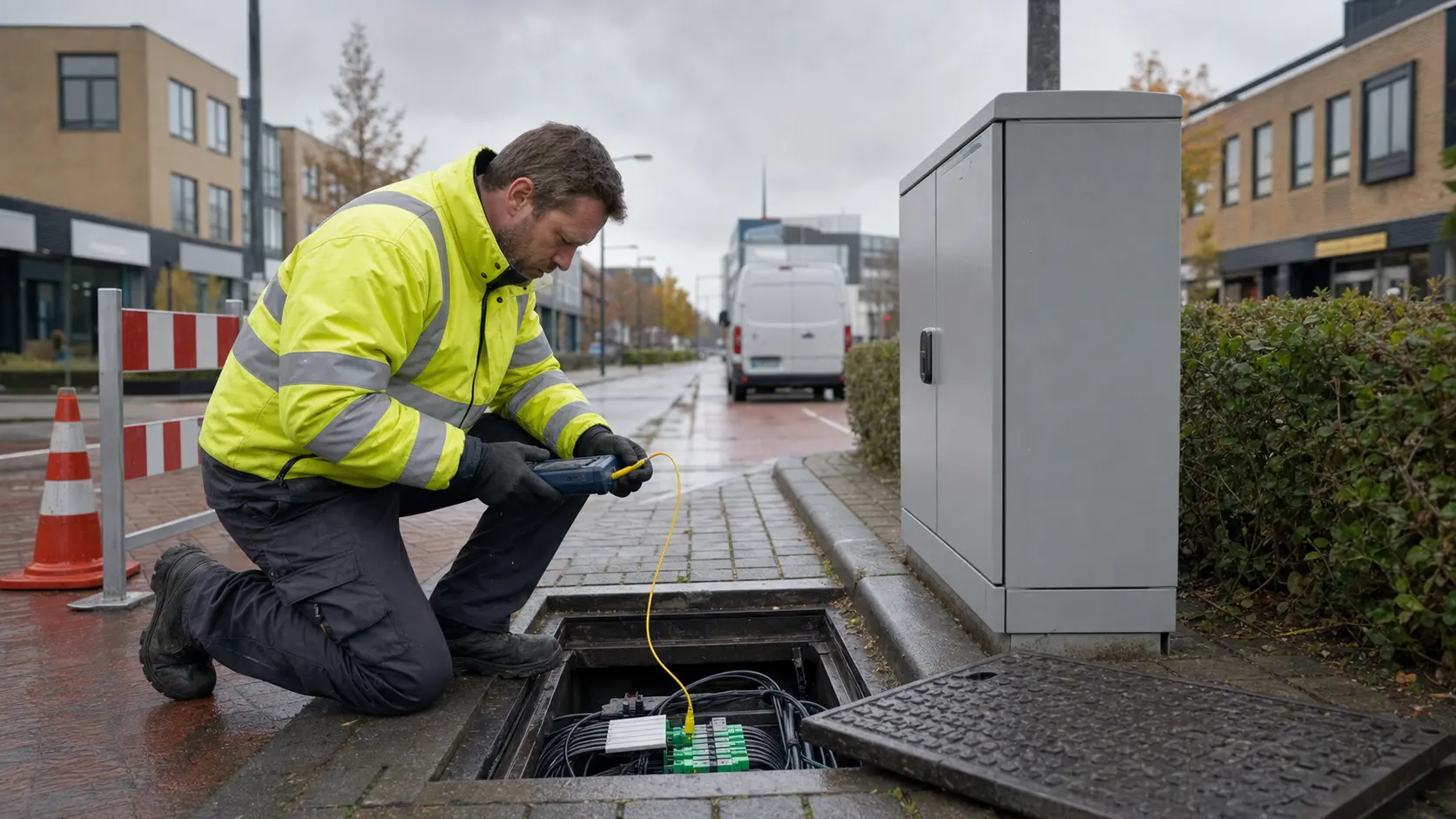
Open a business-district street cabinet in Zoetermeer and a neat commercial promise becomes a collection of physical obligations. A fibre leaves a tenant’s meter cupboard, crosses private property, enters a duct in the public street, passes one or more handholes and splice closures, lands on a patch panel, and eventually reaches powered transmission equipment. The light may be operated by DataFiber. The local glass may belong to a cooperative. A larger carrier may supply the intercity segment. A civil contractor may be the only party permitted and equipped to expose the damaged duct.
The customer sees one service; a repair crew sees several boundaries.
That distinction matters because DataFiber’s current home page makes a broad proposition: business fibre from 25 Mbps to more than 20 Gbps, “own networks,” links to major carriers and automatic switching when one route fails. Those are useful statements of product intent. They do not, by themselves, identify the owner of the last 600 metres, the route of a second circuit, or the person with authority to order an emergency excavation at 02:00. A speed sold at the service interface is not a map of the physical path behind it.
The company’s description of itself is more revealing. It says DataFiber owns and operates some fibre networks while also managing networks belonging to others. It describes the Glasnet Zoetermeer ring as linked to hubs in Rotterdam and Amsterdam, and says an internal service desk supports customers. This is a credible regional-operator proposition: combine selective ownership, third-party access and routing skill into one managed service. It is also an admission, whether intended or not, that control changes from segment to segment.
The first operational question during an outage is therefore not “Is AS42755 up?” It is “Where did the light stop?” If optical power is present at the network termination but packets do not pass, the fault may sit in customer equipment, an access switch, a router or an upstream session. If the optical signal disappears, responsibility may move toward the building riser, local loop, splice closure or carrier handoff. If both primary and backup disappear together, the supposed diversity may have converged in the same cabinet, bridge crossing, exchange room or power domain.
DataFiber advertises a 24-hour fault telephone line, while its ordinary contact hours are weekday business hours. That is a meaningful sign of operational availability, but a telephone answer is not the same as a repair commitment. A serious buyer needs to know who can run the optical test, who holds route records, who dispatches the field team, which entity approves civil work and when the service clock stops while another network owner acts. The economic value of a small provider is concentrated precisely at this cabinet: its ability to turn one customer call into coordinated action across every boundary.
One brand sits across three kinds of control
Public records place several related names around the service. The network-facing identity is DataFiber Group B.V. PeeringDB’s AS42755 entry associates that organisation with the autonomous system. The RIPE NCC’s Dutch member list also includes DataFiber Group B.V. These records support a present relationship between the group company and Internet number resources. They do not say which entity signs every customer contract or owns each metre of fibre.
The commercial website draws a different line. Its contact page names DataFiber Telecom B.V., gives Chamber of Commerce number 55349722 and lists two ACM registration numbers. The site footer also uses DataFiber Telecom B.V. That makes the telecom company the visible commercial and support-facing entity on the current site, while the group company remains the named routing-resource holder. The distinction may be ordinary group organisation, but it matters during a serious incident or dispute: a customer should know whether the contracting party, network operator, asset owner and licence or registration holder are the same legal person.
Two commercial registry aggregators offer a further, limited view. Company.info’s profile lists DataFiber Group B.V. at Platinastraat 1 in Zoetermeer with Chamber of Commerce number 76208524, drawing on a stated KVK update. Compadex reports the same number, address and private-company form and says the company was established in 2019. These are secondary presentations rather than a certified KVK extract, so they are corroboration, not definitive evidence of the current ownership chain.
The dates in the public story require similar care. The corporate page describes service experience beginning in 2005. A DataFiber article about the development of its network says the provider dates from 2014. The group company profile says 2019. These can all be true if they refer to predecessor activities, a brand, an operating business and a later holding or resource-owning entity. They should not be collapsed into a single legal founding date without corporate documents.
Then there is Glasnet Zoetermeer. Its own website describes a network “for and by” Zoetermeer entrepreneurs and says connected organisations choose their service provider. DataFiber’s current project page calls it a non-profit cooperative open network and says DataFiber is responsible for professionally lighting it. In one local building project, the company explicitly calls itself operator and service provider while Glasnet is the underlying local network. That is the clearest public example of the difference between owning passive glass and operating active service.
None of this weakens the case for DataFiber. A regional provider need not own every trench to be valuable. Its asset can be the combination of routing resources, active electronics, commercial access agreements, local knowledge and the authority to coordinate repairs. But the corporate boundary must be legible. The party taking revenue should be able to provide a responsibility matrix naming the passive owner, active operator, upstream supplier, maintenance contractor and customer demarcation for every protected circuit.
The public footprint is local, national and incomplete
DataFiber’s strongest physical evidence is concentrated around Zoetermeer. The company’s Glasnet project description says the open cooperative network covers all local business parks, has more than 200 connected companies, and uses a ring connection toward Rotterdam and Nikhef in Amsterdam. It says DataFiber lights the network and that traffic automatically switches after a cable break. This establishes an operating claim and named endpoints, but it is not a route drawing and should not be read as one.
Glasnet’s own material supplies more geography. Its coverage page says the ring connects Zoetermeer business parks and office locations with Bytesnet in Rotterdam, NorthC in Delft, Dataplace in Utrecht and Nikhef in Amsterdam. It also mentions redundant connections and emergency power. The page supports the existence of a multi-city service concept. It does not reveal street alignments, fibre counts, duct ownership, building entrances, splice locations or which legs are lit today.
Project pages add useful, address-scale evidence. At Loods 1635 on Fokkerstraat, DataFiber says the building’s units connect through Glasnet and defines its own role as operator and Internet-service supplier. At the Aluminiumstraat and Chroomstraat complex, it says 28 business units were connected in cooperation with Glasnet. These are much better evidence of actual local delivery than an undifferentiated national coverage slogan because they identify sites, partners and a handoff relationship.
Older order pages sharpen the demarcation. The Newtonhof offer describes 31 business units and six garage boxes, includes symmetric service tiers, and states that the modem is delivered in the meter cupboard while the customer remains responsible for the router and internal cabling. The Rokkehage offer lists services from 50 Mbps through 1 Gbps with a “Silver” business service level. These pages show services that could be ordered at identified local developments. They still do not prove that every order remained active in July 2026 or that all tiers share the same physical protection.
The company also says it offers a nationwide fibre network. That is commercially plausible for a Dutch provider buying wholesale access from multiple carriers, but “nationwide” should be understood as service reach, not a claim that DataFiber owns continuous national ducts. The distinction is important in the Netherlands, where providers can combine their own metropolitan assets with access purchased from larger infrastructure owners. A postcode checker can prove that a quote is available; it cannot prove who owns the proposed tail or how it is repaired.
An independent 2021 study of business-park fibre in the Rotterdam–The Hague metropolitan area includes Glasnet Zoetermeer among the network owners represented in its dataset. The report is dated and its coverage method varies by contributor, so it cannot certify current routes. It does, however, corroborate that Glasnet was treated as an infrastructure owner rather than merely a retail brand.
A responsible footprint description is therefore layered. There is direct evidence of DataFiber’s active role on a cooperative business-fibre network in Zoetermeer; named project sites in that city; public interconnection presence in several Dutch facilities; and a broader service-reach claim likely involving carrier access. There is no public, engineering-grade map that joins every customer tail to those facilities. Any exact line drawn between them would be invention.
A ring is valuable only when its exits stay apart
“Ring” is one of the most reassuring and least sufficient words in fibre sales. At a logical level, a ring allows traffic to travel in two directions. At a physical level, both directions may share a duct for part of the route, cross the same bridge, enter a building through one sleeve, terminate on the same powered switch or depend on the same carrier farther upstream. A topology can be a ring in a network diagram and still have a single point of failure in the street.
The public Glasnet description names Rotterdam and Amsterdam as important exits and says a cable break triggers automatic switching. Glasnet’s broader coverage page also names Delft and Utrecht. This suggests a deliberately distributed architecture. It does not establish route separation. Buyers should request two path schedules showing the sequence of building entrance, handhole, duct, local point of presence, intercity carrier, facility meet-me room and active chassis for the primary and alternate service. “Different carriers” is insufficient if both lease fibres in the same cable.
The live routing picture provides a second layer. The bgp.tools view of AS42755 showed nine originated IPv4 prefixes, one IPv6 prefix and two observed upstreams, Cogent’s AS174 and atom86’s AS8455. It also showed the network as active and allocated under RIPE. Two upstream relationships reduce dependence on a single transit supplier at the routing layer. They do not prove that both sessions arrive over independent fibre, enter different facilities or have sufficient headroom to carry the full load after a failure.
PeeringDB listed four operational exchange connections: 20 Gbps at AMS-IX in Nikhef, plus 10 Gbps connections at Frys-IX in Nikhef, NL-ix at Bytesnet Rotterdam and Speed-IX in Nikhef. It also listed DataFiber at facilities in Rotterdam, The Hague, Eindhoven, the Utrecht area, Amsterdam and Delft. These are useful points of presence. Yet three listed exchange ports concentrate at Nikhef, while the Rotterdam NL-ix port offers a visibly different facility. The distribution is encouraging but not a physical route audit.
That difference explains why an autonomous system can remain globally reachable while one office is offline. BGP can select another upstream only after the customer’s packets reach a DataFiber router with a surviving path. A severed access tail prevents that first hop. Conversely, a local ring can remain lit while an upstream policy error or router failure makes destinations unreachable. The passive and logical protections solve different problems and must both work.
Even a physically separate route can fail operationally if its capacity is undersized or its state is not tested. An alternate connection provisioned for emergency management traffic may not support every customer’s guaranteed rate. A dormant fibre may require manual patching. A microwave link may be a valuable tertiary path but offer less throughput in adverse conditions. The company says it can use radio where fibre is impractical; that is potentially strong resilience if the radio has independent power, spectrum performance and backhaul, but those conditions must be specified.
The practical test is a controlled failure, not a brochure. Disconnect the primary handoff, measure detection and convergence time, confirm that all customer prefixes remain reachable, check packet loss and latency, and record alternate-path utilisation. Then test loss of the local power feed and loss of an upstream session separately. Repeating those tests exposes hidden shared components and prevents a ring from becoming a comforting label attached to an untested route.
AS42755 proves routing activity, not trench ownership
An autonomous system number is a policy identity. It allows a network to announce prefixes, choose routes, peer at exchanges and buy transit. It does not identify a cable in a pavement. DataFiber’s AS42755 is nevertheless important because it distinguishes the company from a reseller that simply hands all traffic to one wholesale provider under the provider’s addressing and policy.
The routing evidence is current enough to support operating status. PeeringDB identifies the organisation, ASN, exchange ports and facilities. Bgp.tools observes originated prefixes and upstreams. A third dataset, NetworksDB, associated DataFiber Group B.V. with multiple IPv4 ranges and showed large blocks including 46.21.160.0/20, 185.138.208.0/22 and 91.196.168.0/22. That dataset was marked updated in April 2025 and also associated another ASN with the organisation, so it is a secondary snapshot rather than the authority for July 2026 routing.
The evidence supports three conclusions. First, DataFiber Group B.V. is not merely a historic name attached to an unused number: AS42755 was visibly originating address space. Second, the network has more than one observed route to the wider Internet and several public peering attachments. Third, the organisation appears able to exercise meaningful routing policy, including direct exchange participation. Those capabilities can improve performance, contain transit costs and give technical staff options during an upstream incident.
But the same evidence does not reveal customer count, traffic volume, packet-loss performance, router redundancy or usable failover capacity. PeeringDB’s prefix-limit fields are administrative thresholds for peering sessions, not the number of routes actually originated and certainly not physical fibre capacity. Its “operational” label for an exchange connection is self-reported operational state, not an independent continuous measurement. Bgp.tools’ upstream inference is an external observation of routing relationships, not a contract or fibre plan.
This is where a regional operator can create real value. Direct routing control lets its engineers shift traffic between transit and peering, filter a problem route, announce a more specific prefix under controlled conditions, or keep local exchange traffic off a congested transit path. Those actions matter after packets reach the backbone. They cannot restore an unpowered customer router, repair a cut access fibre or force a wholesale carrier to open a street.
Customers should therefore separate an “Internet diversity” schedule from an “access diversity” schedule. The first names AS paths, upstreams, exchange ports, router locations and policy. The second names physical carriers, cable routes, entrances, ducts, splice points and maintenance responsibility. A protected service needs both. If only the first exists, the network may be resilient at its core and fragile at its edge—the exact place where most customers encounter it.
Headline bandwidth is not usable failure capacity
DataFiber’s public product range is ambitious. The home page headline says 25 Mbps to more than 20 Gbps symmetric, while nearby text refers to more than 10 Gbps. Glasnet’s site also advertises a range from 50 Mbps to 20 Gbps. These figures demonstrate marketed service tiers. They do not disclose installed fibre pairs, optical line-system limits, switch backplane capacity, oversubscription between access and core, contracted transit commits or available headroom during a failure.
The company’s services page adds a 99.9% uptime claim for colocation and says the Zoetermeer facility has redundant power. That is a service-level proposition, not a measured history. It also concerns a hosted environment and should not automatically be applied to every access circuit or network point of presence. A circuit’s end-to-end availability is constrained by the weakest included component and by exclusions in its contract.
The four public exchange ports listed by PeeringDB total 50 Gbps of nominal port rate if simply added. Such arithmetic is tempting and usually misleading. It mixes separate exchange fabrics, does not reveal utilisation, may include bundled or shared ports, and excludes private interconnection and paid transit. It says nothing about the capacity from a Zoetermeer cabinet to those ports. More importantly, normal installed capacity is not the same as usable capacity after the largest route, chassis or facility fails.
Local offers illustrate the distinction between service rate and plant rate. Newtonhof advertised tiers as low as 2 Mbps and up to 200 Mbps on a fibre handoff; Rokkehage offered up to 1 Gbps. The passive fibre may support far more than the customer buys, but usable bandwidth is shaped by optics, ports, profiles, aggregation and upstream capacity. Conversely, advertising a 20 Gbps maximum somewhere on the network does not mean every address can order it.
DataFiber’s 2025 general terms are also instructive. They say quoted delivery times are estimates, can move when conditions change or extra work appears, and are subordinate to specific contractual terms where applicable. That is common commercial language, especially where civil works and third parties affect delivery. It reinforces why capacity and repair commitments must be found in the customer-specific order and service-level document, not inferred from a website.
A capacity schedule for a protected business circuit should state at least six different figures: the customer’s committed information rate; the physical port rate; the normal aggregation capacity; the peak observed utilisation; the surviving capacity after the largest credible failure; and the upstream commit or policy that applies in that state. It should say whether the backup is always lit, powered and monitored, whether capacity is reserved, and whether failover preserves the same IP addresses and security policies.
No public evidence located here discloses DataFiber’s dark-fibre inventory, lit wavelengths, sold ratio, reserved restoration capacity, router chassis headroom or power draw. That is not proof of a shortfall. These are normally sensitive operating details. It does mean that a buyer cannot convert the headline tiers or exchange-port list into a defensible capacity conclusion. The appropriate public grade is “operating network, capacity unquantified.”
Power and facilities draw the real network edge
Fibre itself carries light without electrical power, but a service does not. Customer equipment, optical network terminals, access switches, routers, exchange ports, monitoring systems and cooling all require energy. A route that is physically intact can fail because the cabinet battery is exhausted, the building’s communications room loses power or a shared chassis reboots.
DataFiber publicly says it operates colocation from a secured facility in Zoetermeer with redundant power. Glasnet’s coverage description mentions emergency power installations. PeeringDB places AS42755 at six interconnection facilities: Bytesnet Rotterdam, DFDC in The Hague, EFX in Eindhoven, Eurofiber Datacenter Utrecht in Groenekan, Nikhef in Amsterdam and NorthC Delft. That geographic spread creates options. It does not show whether DataFiber has dual power feeds, redundant routers or diverse cross-connects within each site.
The province of South Holland’s regional data-centre study independently lists Bytesnet in Rotterdam, NorthC facilities in Rotterdam and Delft, and a Colocenter site on Heliumstraat in Zoetermeer, among other facilities. It helps confirm the regional facility landscape, but it does not certify DataFiber’s equipment or tenancy. A named building in a network database and a named building in a provincial inventory are still not proof of a particular rack, power feed or live circuit.
DataFiber offers a more concrete local clue in its article “Internet steeds professioneler”. It says the company built points of presence at the Dutch Innovation Factory, the municipal building, Heliumstraat and Zuidweg. It also says DataFiber performs smaller specialist cable construction itself and hires another party for larger works. This is unusually useful because it joins active locations to a labour boundary. It suggests local technical competence while acknowledging that major civil repair can depend on outside capacity.
For resilience, every facility name should be paired with a power statement. Is the local point of presence fed from one utility substation or two? What is the battery autonomy at current load? Is there a generator, and is refuelling contracted? Are both protected routes terminated on separate line cards and power distribution units? Does the backup radio have its own power and mounting risk? When was a full mains-failure test last performed?
The customer side needs equal attention. Newtonhof’s meter-cupboard demarcation leaves the tenant responsible for its router and internal cabling. A provider may restore light to the modem while the business remains offline because its firewall, Wi-Fi system or local switch has no uninterruptible supply. An honest incident plan names the exact handoff, assigns power ownership on both sides and gives staff a way to distinguish “carrier restored” from “business restored.”
This is also why facility diversity cannot be counted solely by cities. Two paths to Amsterdam may share one Zoetermeer point of presence. Two routers in one data centre may share a cross-connect tray. A Rotterdam route and an Amsterdam route may run together before diverging. The physical dependency graph begins at the customer socket and includes power, not at the first BGP neighbour.
A fibre cut becomes an organisational test
Consider the most revealing failure: an excavator severs a cable serving a Zoetermeer business park. The Netherlands has formal mechanisms intended to reduce this risk. The government’s KLIC description explains that excavators must report planned works and receive information under the WIBON framework. The broader government page on excavation damage says the country has more than 1.7 million kilometres of underground cables and pipes and that owners and network managers provide data to the Kadaster.
Prevention is imperfect. NLconnect reported 47,383 excavation-damage cases in 2025, about 130 per day, and said data networks were again the most frequently hit category. The trade association noted that failure to locate cables properly remained the largest cause. These are national figures, not a DataFiber incident record. They show why field-repair authority is a core operating capability rather than an exceptional concern.
When the cut occurs, monitoring should first identify loss of light and correlate affected endpoints. The operator must determine whether protection has switched, whether the backup has enough capacity, and whether any customers sit on an unprotected spur. Route records and optical measurements should narrow the fault zone. The passive owner must be notified. A qualified crew needs safe access, correct cable and closures, location information and permission to excavate. After splicing, technicians must test optical loss, confirm routes and verify customer service.
Government guidance on planning excavation work says a mechanical excavation notification is required and that an orientation request supplies location information and network-manager contacts. It also notes an important map limitation: building connections are not shown on Kadaster maps and must be checked with the responsible network manager. That gap is directly relevant to the last route into a customer site.
DataFiber has public evidence of working across this chain. Its 2024 football-club project describes a fibre build toward clubs in Zoetermeer and Benthuizen with Glasnet Zoetermeer, DataFiber Telecom and WionPlus, including excavation, blowing and splicing. It also says one club had been using a radio connection. This demonstrates experience coordinating an actual civil-to-active delivery and an alternative access medium. It does not identify the standing emergency-repair contract or response time for other routes.
NLconnect’s material on safe digital-infrastructure construction stresses cooperation across the construction chain. That is exactly the organisational challenge after a cut. The provider’s engineers may diagnose the problem in minutes, yet restoration can wait on the passive owner, municipal access, traffic control, a civil crew and a splicer. The customer’s service-level clock is valuable only if it addresses those dependencies rather than excluding them all as third-party delay.
The same sequence applies to a failed wholesale handoff without excavation. DataFiber must identify the boundary, open the correct carrier ticket, preserve evidence and keep the customer informed. If the contract names only DataFiber but the fault lies on another owner’s tail, the company’s value is its ability to prevent that boundary from becoming the customer’s problem.
Local support is a labour system, not a phone number
Small regional providers often compete on human reachability. DataFiber says calls go to its own service desk rather than an external call centre, and it publishes a separate 24/7 incident number. That can shorten the path from customer observation to a technician who understands the circuit. In an outage, minutes saved before fault isolation can be as valuable as minutes saved in the splice itself.
But “local support” contains several jobs. A network operations engineer interprets alarms and routing state. An optical technician measures loss and identifies a likely cut distance. A field engineer accesses cabinets and exchanges optics. A civil crew opens the ground. A certified splicer repairs the cable. A carrier coordinator escalates a leased segment. A customer engineer checks the router, firewall and internal power. No single help-desk promise proves that all of these roles are available at the required time.
DataFiber’s account of its physical work is therefore significant. It says the company undertakes small, specialist civil projects and outsources larger work. That is a sensible division for a regional provider: retain intimate network knowledge and targeted intervention while avoiding a permanently oversized construction workforce. The risk is queue priority. During a widespread storm, major excavation event or period of heavy national fibre construction, a contractor may serve several network owners at once.
The municipality’s explanation of fibre deployment in Zoetermeer illustrates how responsibilities divide even in ordinary construction. It says telecom companies or their contractors open and restore streets, while the municipality coordinates permissions and accessibility rather than building the network itself. The page discusses KPN and Open Dutch Fiber’s residential deployment, not DataFiber’s business ring, but the institutional boundary is instructive: municipal permission, network ownership and physical work are distinct functions.
A defensible local-support claim should be expressed as resources and authority. How many people can diagnose AS42755 and the Zoetermeer access network outside office hours? Who has cabinet keys and current splice plans? Which contractor is retained, with what call-out window and geographic radius? Where are spare optics, cable and closures stored? Can DataFiber authorise work immediately, or must it await a cooperative board, landlord or wholesale owner? Which failures receive an on-site response, and which are remote-only?
Customers should also ask how incidents are communicated. A regional provider’s small team can offer excellent context, but the same people may be diagnosing, dispatching and updating many customers during a shared cut. Prewritten contact trees and status intervals protect scarce engineering attention. They also prevent the contracting entity, passive owner and field contractor from issuing contradictory estimates.
Local labour is thus an economic asset when it combines knowledge with standing access. The decisive measure is not the distance from DataFiber’s office to a cabinet. It is the time between alarm, correct ownership identification, authorised dispatch and safe arrival of a properly equipped person. That sequence is the repair path behind the route.
Fragmented access can reward a capable regional operator
The Dutch fibre market gives a regional provider room to create value without reproducing a national incumbent’s entire asset base. A provider can own selected metro assets, operate a cooperative network, lease access elsewhere, peer directly and assemble one service for business customers. This lowers the capital needed to reach more addresses and lets local initiatives choose specialised technical partners.
The national context is fibre-rich but not uniform. The ACM’s first-quarter 2025 telecom monitor reported 8.42 million fibre connections in network-owner data and 3.27 million household fibre subscriptions. It also noted that revised postcode data revealed places previously shown incorrectly as having fibre. Those are household-market figures and should not be applied directly to DataFiber’s business base. The mapping correction is still a useful warning: passed premises, available products and active services are different measures.
An open local network can separate passive ownership from retail competition. Glasnet’s service-provider page tells participants that the fibre connection is delivered without Internet and advises them to seek offers from service providers. This structure lets the cooperative retain infrastructure while providers compete on routing, support and applications. DataFiber’s position as both lighter of the network and an Internet supplier gives it technical proximity, but also makes transparent role definition especially important.
The economics work when aggregation outweighs coordination cost. Shared active equipment, common backhaul and local density can make high-quality business access affordable. Peering can reduce some transit expense and improve paths to connected networks. A local team can learn the plant and customers. Yet every wholesale tail adds another contract, ticket queue and margin claim. Every bespoke project increases documentation and spare-part complexity. A low headline price can be erased by one long outage if no party owns the end-to-end repair outcome.
DataFiber’s public offer combines access, voice, hosting, television and cloud-related services. Bundling can deepen customer relationships and spread support costs. It can also increase the blast radius: a single access failure may remove Internet, hosted voice and remote access together. A customer buying several services should ask which dependencies are shared and whether an out-of-band channel survives the primary circuit.
The best regional-ISP economics are therefore based on selective control. Own or tightly govern the local segments where repair speed differentiates the service. Maintain multiple upstream options where routing policy matters. Use wholesale networks where replication would destroy returns, but negotiate measurable escalation and restoration terms. Keep route records good enough that a mixed-ownership service behaves like one network during an incident.
This is why DataFiber’s most defensible advantage is not national scale. Large carriers will almost always own more fibre and employ more people. Its opportunity is to make a fragmented supply chain feel shorter: a knowledgeable answer, a correctly identified boundary, a known contractor and an alternate route that has actually been tested. If it cannot do those things, the same fragmentation becomes its main liability.
Buyers should ask for the repair path before the route claim
Public evidence supports a cautiously positive operating conclusion. DataFiber Group B.V. is associated with an active autonomous system. AS42755 originates address space, has two observed upstreams and appears at four public exchanges. DataFiber’s commercial site is current, names a 24/7 incident contact and describes active services. The company has a specific and corroborated role on Glasnet Zoetermeer and identifies local buildings, points of presence and construction work.
The evidence is weaker where physical resilience becomes customer-specific. No public engineering map proves the street route from a given business to Rotterdam or Amsterdam. No public inventory states which fibres are owned, leased, lit or reserved. No published utilisation series shows whether alternate upstream and exchange capacity can carry peak traffic. No public maintenance schedule identifies the field contractor, spares, call-out time or authority for every network segment. No public power schedule covers each cabinet and point of presence.
That gap can be closed in procurement. A customer considering a protected service should request a signed route-and-responsibility schedule. It should show both circuits at a useful but security-conscious level, name every passive and active operator, identify shared-risk segments, record building entrances and power domains, and specify the demarcation. It should distinguish an automatically routed alternate from a manually patched restoration fibre.
The service schedule should then define detection, acknowledgement, dispatch, restoration and communication targets. It should say which third-party delays count against the commitment and what remedy applies. Capacity should be stated for normal and failure states. A recent failover record should demonstrate that routes, addressing, firewall policy and voice service survive as promised. Customers with truly critical operations should add an independently powered and physically diverse medium, such as a mobile or radio path, rather than purchase two labels over one duct.
DataFiber should be judged on evidence it is well placed to produce. Its local role means it can document the Zoetermeer plant, demonstrate switching and show how it coordinates Glasnet and civil partners. Its routing role means it can show upstream and exchange failover. Its service desk can demonstrate escalation. Publishing a carefully abstracted network architecture, standard responsibility matrix and service-level options would strengthen the claim without exposing sensitive exact routes.
The final distinction is simple. An AS number establishes who can make routing decisions. A fibre label suggests a transmission medium. Neither says who will stand beside a wet handhole in overcast Zoetermeer, identify the correct cable and get authority to cut and splice it. DataFiber’s long-term network value rests on making that last answer clear before the fault—and fast after it.