
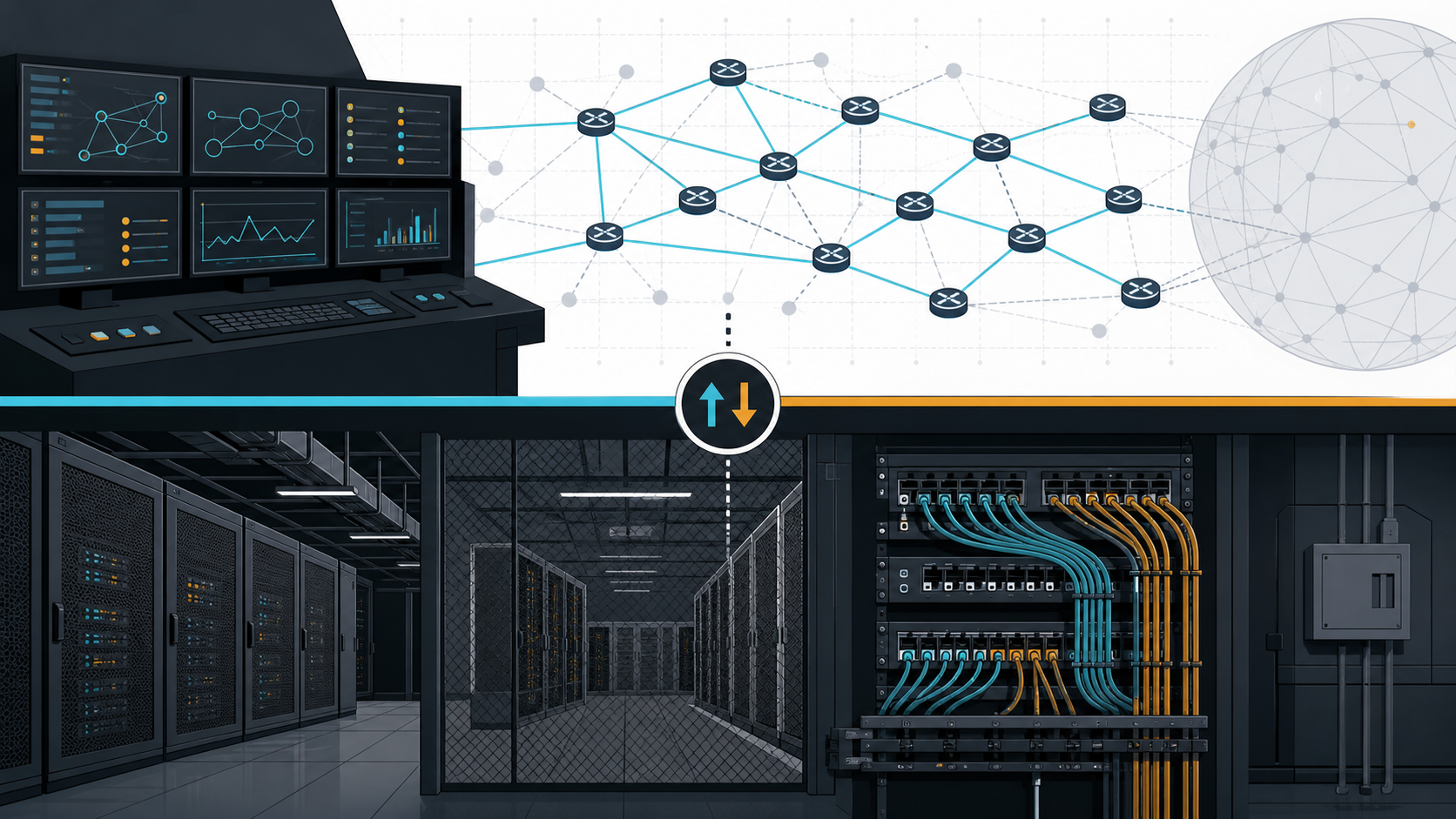
Summary
- ARIN records AS396881 under DRSERVER1 and links it to the organisation handle DIL-90, rendered as drServer.net. That establishes a durable registry identity, not ownership of a particular data centre.
- RIPEstat's captured July 2026 view shows seven IPv4 and nine IPv6 announcements with broad collector visibility. Those routes make a live number-resource surface observable without revealing installed capacity, customer use or physical diversity.
- drServer.net's own pages advertise VPS, dedicated-server and web-hosting services in Dallas. The claims describe the commercial offer, but they do not independently verify facility control, spare inventory, backup performance, DDoS capacity, uptime or resilience.
- The useful accountability test is the gap between the public ledger, the running routing table and the undisclosed operating layer. Changes to prefixes, route-origin status, security metadata, contacts or observed dependencies can be monitored; the physical service boundary still requires separate evidence.
A network identity that is easier to see than the service behind it
Hosting brands often present themselves through product pages: processor models, storage quotas, bandwidth allowances and promises about availability. Those details can look concrete while remaining difficult to verify from outside. drServer.net presents a different kind of public surface as well. It operates under AS396881, a numbered network identity that appears in the American Registry for Internet Numbers and in current routing data. The number is not a marketing label. It is a technical handle through which route-origin observations, registration events and contact maintenance can be compared over time.
That distinction matters because a hosting service has several layers that are easy to collapse into one. A company can hold or operate an autonomous system, announce address space, sell virtual machines, rent dedicated servers and describe a location without controlling every physical dependency involved. The same public brand can sit above leased racks, wholesale connectivity, third-party mitigation, remote-hands arrangements or equipment housed in facilities owned by someone else. None of those arrangements is inherently weak. The analytical problem is simply that the route record does not disclose which arrangement applies.
The exact BTW directory entry is DRSERVER1 - drServer.net. A production read-only reconciliation found one published company entity with that identity, no existing linked research publication, and no exact English title or slug collision for this reporting angle. The public company page rendered the expected name rather than a soft-404 shell. That clears the identity and commissioning boundary. It does not convert the directory entry into evidence about the network.
The defensible starting point is therefore narrow. AS396881 is a visible control surface. It connects the company name to a registry record and to running announcements seen by route collectors. It supports questions about what is originated, how stable the origin appears, whether security metadata is present and how the public contact record is maintained. It does not answer how many machines are online, how much capacity customers can use, who owns the building, how traffic is engineered inside the service, or what happens during a power, fibre or upstream failure.
ARIN supplies the ledger, not a certificate of physical control
ARIN's Registration Data Access Protocol record identifies autonomous system 396881 by the name DRSERVER1. It gives a registration date of 24 May 2018 and links the record to registrant handle DIL-90. The associated entity record renders that organisation as drServer.net and carries a Dover, Delaware postal address. Those are useful identity facts because they anchor the number resource to a named organisation in an authoritative registry. They are also bounded facts. A postal address in a registry is not evidence that servers, routers or customer traffic are present at that address.
The registration history creates a monitoring baseline. The ASN record shows an initial event in May 2018, while the linked entity record includes a later change event in November 2024. A change event does not explain what changed, nor does it prove continuous operational ownership across every internal corporate event. It does show that the registry object has a history that can be revisited. Analysts can compare future changes in organisation name, contacts, status or linked resources with the route-origin surface and with the company's public claims.
This is the proper role of the registry: a recordkeeping layer for uniqueness, delegation and contactability. The ASN must identify one autonomous system in the routing ecosystem. The organisation handle must give observers a place to resolve responsibility. Contact fields and event history help turn an otherwise anonymous route origin into an accountable public object. They do not make ARIN the operator of the network, and they do not certify the quality of the service sold under the name.
That separation is especially important for a hosting provider. Customers may interpret a registered ASN as proof that the company owns a large independent backbone, a data centre or a broad pool of unencumbered address space. The record supports none of those conclusions by itself. It says that the autonomous system exists in the registry under this organisation. Whether address blocks are directly registered, reassigned, leased, announced on behalf of others or used for the operator's own infrastructure requires resource-by-resource evidence.
Whether the physical service is owned, leased or outsourced requires facility and contract evidence outside RDAP.
The ledger is nevertheless valuable. Without it, a product page can disappear or change with little public trace. A registry object persists as a reference point for comparing names, dates, contacts and routes. The fact that it is incomplete is not a reason to ignore it. It is a reason to use it for the claims it can support and refuse the claims it cannot.
Current route data shows a real dual-stack operating surface
RIPEstat's announced-prefix endpoint returned sixteen IPv4 and IPv6 entries for AS396881 across the captured observation interval from 14 to 28 July 2026. Its routing-status summary grouped those observations into seven IPv4 prefixes covering 2,048 addresses and nine IPv6 prefixes representing fifteen /48 equivalents. The endpoint also reported that every observing RIS peer in the captured view saw the origin: 329 of 329 for IPv4 and 324 of 324 for IPv6.
Those figures demonstrate that AS396881 is not merely a dormant registry entry. At the observation time, it had a running dual-stack footprint visible across a broad set of route collectors. The same routing-status response recorded a first-seen observation in June 2018 and a latest observation at 16:00 UTC on 28 July 2026. Together, the dates establish persistence at the level of collector history: the ASN has been visible for years and remained visible in the current capture.
Collector visibility needs careful language. A route seen by every peer in one RIPE RIS summary is widely visible within that measurement system. It does not mean every network on the internet selects the same path, that traffic reaches every advertised service successfully, or that the origin is immune to filtering. Peers in a collector platform are observation points, not a census of all possible networks. Visibility is a strong running-code signal because it records what the routing system is doing, but the measurement retains its own scope.
The address totals also resist commercial interpretation. Seven IPv4 prefixes covering 2,048 addresses describe originated address space in the captured summary. They do not reveal how many addresses are assigned to customers, reserved, filtered, shared, unused or dedicated to infrastructure. Fifteen IPv6 /48 equivalents are routing units in the endpoint's representation, not a count of active customer sites or server instances. Converting either figure into "capacity" would require allocation, utilisation and service evidence that the route table does not provide.
What the route data does provide is a repeatable surface. A future observer can ask whether the same prefixes remain visible, whether the origin ASN changes, whether more-specific announcements appear, whether IPv6 remains present, or whether visibility falls across collectors. Each change would be a reason to investigate. None would, by itself, explain the physical cause.
Dual stack is a fact about announcements, not proof of product parity
The simultaneous IPv4 and IPv6 footprint is operationally meaningful. It shows that AS396881 participates in both address families at the routing layer. For a hosting company, that is relevant because customers increasingly depend on IPv6 reachability, and because dual-stack operations create separate routing, filtering, monitoring and security-metadata responsibilities. The presence of IPv6 announcements is a stronger fact than a generic claim that a provider is "IPv6 ready."
It still does not prove that every product receives equivalent IPv6 service. A route can be announced while customer provisioning remains selective. Some plans may receive native IPv6 by default, others only on request, and some internal systems may use a different path from customer workloads. The captured VPS page advertises IPv4 and IPv6, which aligns with the route-level observation, but it remains an operator statement about a product. There is no independent transaction or customer-side test in the evidence set.
The same caution applies to operational maturity. Maintaining visible IPv6 routes over time requires competence, but it does not reveal whether route filters, reverse DNS, abuse handling, monitoring coverage or failover procedures are equally mature in both families. A public route is the outside edge of a much larger operating process.
For due diligence, the useful question is not whether IPv6 exists. It plainly does in the captured routing view. The question is how that public fact maps to the service boundary: which products receive it, which prefixes are used for infrastructure or customers, how address assignment is documented, and whether security and abuse-contact practices are maintained consistently. Those answers belong in operator documentation, customer tests and configuration evidence, not inferences from prefix counts.
Different BGP views expose measurement limits instead of cancelling each other
The Hurricane Electric BGP Toolkit snapshot does not present the same footprint as the captured RIPEstat endpoints. Its dated view lists fewer originated prefixes, identifies two originated routes as RPKI valid, records no RPKI-invalid originated routes, and shows one observed IPv4 and IPv6 peer, AS29802 Hivelocity. This divergence is not evidence that one source is necessarily wrong. Public BGP services differ in collector sets, update schedules, aggregation choices and the moment at which a page is rendered.
The safe response is to date and attribute each observation. RIPEstat provides the current sixteen-entry set and its own summary at a stated endpoint time. Hurricane Electric provides a separate snapshot with a narrower visible set and a peer relationship observed through its data. The sources answer related but not identical questions. A report that silently selects the larger count would overstate certainty. A report that discards one view would hide a useful lesson about public measurement.
That lesson is central to network accountability. The routing system is distributed, so no single public observer sees every path in exactly the same way. Broad agreement across sources strengthens a claim about identity or activity. Differences reveal where measurement design matters. They can also signal a real transition if the difference persists after timestamps and methodology are aligned. The evidence captured here is sufficient to establish a live AS396881 footprint, but not to reconstruct a complete topology.
The one observed Hivelocity peer deserves the same restraint. It is evidence that the toolkit saw a BGP relationship between AS396881 and AS29802 in that view. It is not proof that Hivelocity is the only upstream, the only physical circuit, the only route to the service or a single point of failure. Other relationships may be hidden by collector coverage, route policy, private interconnection or the snapshot's age. Even a complete logical peer list would not, by itself, prove physical diversity.
The RPKI observation is similarly bounded. Two valid routes and zero invalid routes in the captured toolkit view indicate that those observed announcements matched published route-origin authorisations at that time. They do not establish that every current prefix has a valid ROA, because the toolkit displayed fewer routes than RIPEstat. A current per-prefix validation check would be required before making a complete RPKI coverage claim.
The operator's pages define an offer, not an independently tested service
drServer.net's own pages describe a family-owned hosting provider launched in 2009. The terms page says the company is an ARIN member, a RIPE local internet registry and the operator of AS396881. The captured VPS, dedicated-server and web-hosting pages advertise services in Dallas, Texas. They list processors, storage, memory, traffic or port allowances, IPv4 and IPv6 features, backup options and support conditions.
These pages are relevant because they reveal how the operator connects its public network identity to commercial products. The ASN is not presented as an unrelated registry object; it is part of the company's account of its infrastructure. The VPS page associates the Dallas offer with both address families and DDoS protection. The dedicated-server page describes hardware inventory, unmetered ports, spare systems and provisioning. The web-hosting page describes backup features and plan limits. The terms page sets use restrictions and provides separate support and abuse contacts.
The evidentiary status of every statement remains first-party. A current product page can establish that an offer was made at capture time. It cannot prove that every listed configuration was in stock, that a port consistently delivered its advertised rate, that backup jobs succeeded, that mitigation absorbed a particular attack, or that provisioning met the stated schedule. Claims about owned hardware, spare inventory and network ownership are material, but they need independent physical, contractual or operational evidence before they can be treated as verified facts.
Volatility is another reason for care. Product pages change faster than registry objects. A dedicated-server model may disappear when inventory changes. Bandwidth allowances may be revised. A location label may remain while the underlying room, carrier or facility arrangement changes. Capturing the page creates a dated record of the offer; it does not turn that snapshot into a durable measure of the provider's fleet.
The correct comparison therefore has two columns. On one side are stable or externally observable facts: the ARIN identity, route-origin data, collector visibility and dated security metadata. On the other are attributed service claims: Dallas location, product specifications, backup features, mitigation, stock and operating practices. The gap between them is the reporting surface, not a defect to be filled with assumptions.
Dallas is an advertised service location, not a proven ownership claim
Multiple captured product pages place the advertised services in Dallas. That is sufficient to say that drServer.net currently markets Dallas-based VPS, dedicated-server or web-hosting products. It is not sufficient to say that drServer.net owns or operates a Dallas data centre. The pages in the evidence set do not provide a facility name, street address, ownership document, power design, carrier list, audit report or independently verifiable rack footprint.
The distinction between service location and facility control can materially affect risk. A provider may own servers while leasing racks and power. It may lease entire systems from a wholesale operator. It may manage customer accounts and routing while relying on a facility owner for physical access. It may use an upstream network for transit and mitigation while retaining its own ASN. Each arrangement distributes operational responsibility differently.
None of those models should be treated as inherently suspect. Outsourcing can improve reach, scale or resilience. Ownership can also concentrate risk if the operator lacks independent power, carrier or maintenance options. What matters is that customers and analysts understand which party controls each layer. The current public record leaves that boundary partly undisclosed.
The Dover address in ARIN's organisation record cannot fill the gap. It is a postal registry address associated with the entity handle. There is no evidence in the source set that it is a network site, server room or traffic location. Conflating corporate contact geography with operating infrastructure would create a false physical map.
A more complete disclosure would identify the facility or facilities used for the Dallas offers, describe whether equipment is owned or leased, state which party controls remote hands and physical security, and explain how carrier and power dependencies are separated. Those disclosures could be supported by provider documents, facility listings, audit reports or independent observations. Until then, "Dallas" remains an attributed product location.
One ASN cannot reveal the internal allocation of responsibility
An autonomous system is a unit of routing policy, not a corporate organisation chart. AS396881 can originate routes under a coherent policy while many operational tasks are shared with other companies. Transit, DDoS mitigation, server maintenance, billing, backups, physical access and customer support may each have different owners. The BGP origin tells outside networks which ASN asserts reachability for a prefix. It does not enumerate the contracts that make that assertion useful.
This is why a provider's use of its own ASN is informative without being conclusive. It creates a stable handle that can outlast individual addresses and products. It gives the operator more direct responsibility for route-origin choices than a reseller hidden entirely behind another network's ASN. It allows customers and researchers to monitor prefixes, route changes, RPKI status and registration contacts. Yet it does not prove independence from upstreams or facilities.
The operator's statement that it owns its network should be read in this layered context. "Network" can mean address resources, routing policy, switching and server equipment, contractual control, or the entire physical chain. Public evidence confirms the numbered routing identity. It does not define the full scope of the ownership claim.
For customers, the practical due-diligence question is who can resolve a failure. If a route disappears, AS396881 is the first public technical object to inspect. If a server loses power, the relevant party may be a facility operator. If mitigation blocks legitimate traffic, an upstream or specialist service may be involved. If backups fail, responsibility may sit within the hosting platform. A clear provider should be able to explain these boundaries even when the commercial service remains simple.
Route visibility is not the same as availability
The RIPEstat view gives AS396881 broad route visibility at capture time. Availability is a different property. A route can remain visible while the service behind it is unreachable because of internal switching, firewall, server, storage, DNS or application failures. Conversely, a temporary route change can occur without a customer-visible outage if traffic shifts to another valid path.
Public BGP evidence is strongest when used as one layer in a monitoring stack. It can detect origin changes, withdrawals, more-specific announcements and changes in collector reach. Active service measurements can test DNS resolution, TCP reachability, latency and application responses. Provider status records can explain planned work. Facility or upstream notices can establish external incidents. Customer reports can add experience, though they need verification and sampling care.
None of those additional measurements is present in the frozen source set. The captured operator pages make uptime, backup, mitigation or provisioning claims, but no independent probe demonstrates performance. The route data therefore cannot be used to score drServer.net's reliability. It can only show that the routing identity was active and broadly visible during the observation.
This boundary also protects against unfair negative inference. The absence of disclosed facility details does not prove poor resilience. A provider may have sound arrangements that it does not publish. The evidence supports a question and a disclosure gap, not a verdict about service quality.
The same principle applies to positive inference. Years of route visibility do not prove years of uninterrupted customer service. A stable ASN is a sign of operational continuity at the routing layer. It is not a substitute for service-level records, incident history or independently measured uptime.
Security metadata should be assessed prefix by prefix
Route-origin authorisation gives resource holders a way to publish which ASN may originate a prefix. When a route is RPKI valid, the observed origin and prefix length fit a relevant ROA. That can help networks reject some accidental or unauthorised announcements. It does not encrypt traffic, secure servers, prevent every hijack or guarantee that the authorised origin is operating safely.
The Hurricane Electric snapshot's two valid routes and zero invalid routes are encouraging within that displayed subset. They should not be generalised to the larger current RIPEstat set without a same-time validation run across every prefix. Routes missing from the toolkit view may have valid, not-found or invalid status. Aggregates and more specifics can also carry different authorisations.
A responsible monitoring process would take the current announced-prefix set, query validation status for each route and record changes. It would distinguish a deliberate new announcement from a leak, a newly created ROA from a policy change, and a collector artefact from a sustained event. It would also check whether route objects and registry contacts remain consistent with the operator's published identity.
For a smaller hosting network, this work has outsized value. Customers may not have direct contractual visibility into transit policy, but public RPKI and BGP data can reveal whether basic origin hygiene is maintained. The result should still be described as a technical control surface rather than a trust score.
Abuse and support contacts are part of operational continuity
Hosting networks sit at a difficult intersection of legitimate customer use, compromised systems and deliberate abuse. The public ability to reach an operator matters because routing identity without responsive contact can leave other networks with blunt options, including filtering entire prefixes. ARIN's organisation record and drServer.net's terms provide contact surfaces, including a distinction between support and abuse.
The existence of an address is not proof of responsiveness. Contact quality has to be tested through legitimate operational interaction, observed remediation or documented policy. Still, a maintained registry object lowers the cost of identifying the responsible organisation. A clear abuse channel can separate security reports from ordinary service requests and reduce delays when compromised systems affect other networks.
Contact continuity also matters during organisational change. If staff, contractors or providers change, stale registry details can outlive the people able to act on them. The November 2024 change event in the organisation record is evidence of maintenance, but not a complete audit of every contact. Future monitoring should look for validity, role accounts, response expectations and consistency between the registry and the operator's site.
This is another example of the registry functioning as a reality layer. It creates a public accountability point. It does not grant legitimacy by itself, and it cannot compel good conduct. Its value depends on accurate records and operational follow-through.
What customers can ask without demanding confidential topology
Useful infrastructure disclosure does not require publishing passwords, rack diagrams or sensitive network configurations. Customers can ask bounded questions that clarify responsibility without exposing attack surfaces. Which legal entity contracts for the service? Which ASN originates the customer-facing prefixes? Are the advertised Dallas products located in one facility or more than one? Who owns the server hardware, and who controls physical access?
They can also ask how upstream and power dependencies are handled. Does "redundant" mean multiple logical sessions, multiple carriers, separate building entrances or merely multiple ports on one device? Does DDoS protection operate on-net, through an upstream or through a specialist scrubbing service? Are backups included, tested and stored outside the primary failure domain? Which features are contractual and which are best-effort?
Addressing and routing questions are equally concrete. Are IPv4 addresses provider-assigned or portable? Is IPv6 available by default? Are customer route announcements supported? Is route-origin validation maintained across the current prefix set? How are reverse DNS and abuse reports handled? What happens to addresses and data when a service ends?
These questions do not assume a problem. They translate a visible ASN into an operational conversation. The public record establishes enough to make the questions specific: AS396881, a dual-stack route set, a named organisation and a Dallas-labelled hosting offer. It also shows where public evidence ends.
Answers should be evaluated against the service being bought. A small web-hosting plan does not require the same disclosure as a critical dedicated platform. The aim is proportional clarity, not a universal demand for ownership or geographic sovereignty.
A monitoring plan built around changes rather than rankings
AS396881 can be monitored without turning every observation into a score. The baseline begins with the exact ARIN records for the ASN and organisation. Changes in name, status, contacts or linked resources should be captured with timestamps. A changed record may reflect routine maintenance, a corporate transition or a correction; it warrants context rather than an automatic negative label.
The route layer should track the set of IPv4 and IPv6 prefixes, origin consistency, visibility and more-specific announcements. A sustained withdrawal, unexpected origin or abrupt change in the set could be operationally important. A brief collector difference may be harmless. Comparing multiple sources and preserving observation times helps separate real changes from measurement noise.
RPKI status deserves its own field. The current evidence does not establish complete coverage, so the baseline should record per-prefix valid, invalid or not-found status from a current validator. Future changes can then be interpreted against known ROAs and announcement lengths.
The commercial layer can be monitored less frequently. Product pages reveal what drServer.net says it offers in Dallas, which resource limits it advertises and which operational features it claims. Changes may reflect inventory or pricing rather than infrastructure. Archived captures are useful because they prevent a current page from rewriting the history of an offer.
The physical layer remains the largest gap. Independent facility records, operator disclosures, audit documents, outage notices or verified photographs could narrow it. Customer anecdotes alone should not be treated as proof of topology or performance. A single complaint cannot establish a systematic failure, just as a testimonial cannot establish resilience.
The resulting record is deliberately plural. Registry, routing, security metadata, operator claims and physical evidence each retain their own status. The method avoids converting missing data into accusation while still making disclosure gaps visible.
Registry as recordkeeper, routing as running code
The strongest public understanding of AS396881 comes from combining two different kinds of truth. ARIN supplies the durable ledger: a unique autonomous system, a named organisation, dates and contacts. RIPEstat and other BGP sources show running code: prefixes actually originated and observed through the routing system. Neither layer is sovereign over the whole service.
The registry cannot guarantee that routes are healthy or that commercial claims are accurate. The routing table cannot explain corporate authority, facility ownership or customer obligations. The operator's site can describe intent and products, but it cannot independently validate itself. Each source becomes more useful when its limits remain visible.
This layered reading resists two common errors. The first is permission theatre: treating a registration as a certificate of broad legitimacy or performance. The second is technical reductionism: treating a route announcement as the complete network. AS396881 is both a registered object and a running routing participant, but the hosting service extends beyond both.
Number resources require uniqueness and accurate transfer or delegation records because conflicting claims would destabilise routing and accountability. They also require security metadata and operational continuity because a correct record that cannot be acted upon is of limited use. The drServer.net evidence offers a concrete surface for those requirements. It does not justify claims about political ownership, community entitlement or physical sovereignty.
The public benefit is practical. A customer, peer or researcher can identify the ASN, see current announcements and find a responsible organisation. If a route changes, the observation can be compared with the ledger. If the company makes a broad infrastructure claim, the claim can be separated into what the public record confirms and what remains attributed.
Which new evidence would materially change the assessment
Several kinds of evidence could narrow the current uncertainty. A current, independently verifiable facility listing could identify where the Dallas services are housed and which organisation controls the site. A provider document could explain whether drServer.net owns servers, leases racks or resells systems, and which party handles power, physical access and remote hands. The distinction would clarify responsibility without requiring sensitive diagrams.
A current per-prefix RPKI report could establish the security status of all sixteen captured announcements. A broader BGP analysis could identify sustained upstream and peering relationships across multiple collectors. Physical or contractual diversity would still require separate proof, but the logical dependency picture would become clearer.
Service evidence could test the operator's commercial claims. Dated measurements from multiple networks could examine reachability and latency. Backup restoration records or independently audited controls could support resilience claims. Incident notices could show how the company communicates and recovers. None of those sources should be inferred from the current route record.
Changes can also weaken the assessment. A stale organisation contact, an unexpected origin, persistent loss of visibility or an RPKI-invalid announcement would create a specific accountability issue. A product page that removes IPv6 while routes remain present would raise a mapping question, not prove abandonment. Evidence should be reconciled rather than forced into a single narrative.
The current assessment is therefore provisional in the proper sense. It is anchored to captured records and can be updated when those records or the operating evidence change. It is not a permanent score for the company.
A bounded claim is more useful than a broad profile
The evidence around drServer.net illustrates why infrastructure reporting gains precision when it starts with a control surface rather than a company description. A broad profile could repeat the year the business says it began, list the products on sale and describe the company as a hosting provider. That would be easy to assemble but difficult to test. The ASN creates a narrower and more durable proposition: this named organisation is associated with AS396881, and that autonomous system was originating a specific dual-stack footprint in the captured routing view.
The narrower proposition supports stronger follow-up. If a prefix disappears, an observer can identify the affected route and date. If the origin changes, the new ASN can be checked against registry and operator records. If a route becomes RPKI invalid, the prefix and authorisation can be examined. If contacts change, the event can be compared with public business information. Each question has an object, a timestamp and a possible answer.
The same discipline prevents commercial language from filling technical gaps. "Owned network" cannot prove ownership of a building, a diverse fibre entrance or an independent mitigation platform. "Unmetered" cannot prove unconstrained throughput at every point in time. "Backup" does not establish successful restoration. "DDoS protection" does not establish the size, architecture or effectiveness of mitigation. "Dallas" does not establish which facility or legal party controls the room.
These statements may all describe real features, but they require direct evidence before they can be converted from attributed claims into verified operating facts.
A bounded claim also makes positive evidence more credible. It is reasonable to say that AS396881 was broadly visible in the captured RIS view because the endpoint reports the observing-peer counts. It is reasonable to say that ARIN associates the ASN with DRSERVER1 and drServer.net because the linked RDAP objects say so. It is reasonable to say that the operator markets dual-stack VPS service in Dallas because the captured page does. None of those statements needs an inflated conclusion.
This approach is not a demand for perfect transparency. Providers have legitimate reasons to protect customer data, detailed topology, security controls and supplier contracts. The public interest lies in the boundary: enough information to identify the responsible network, understand the service dependency and distinguish observed facts from promises. A provider can meet that need without exposing sensitive configurations.
For drServer.net, the public record is strongest at the number-resource and routing layers. It becomes thinner at the logical dependency layer and thin again at the physical layer. That gradient is itself a useful result. It tells customers which questions can be answered independently and which must be answered by the operator or by contractual evidence.
The method also leaves room for improvement without rewriting history. If drServer.net later publishes a facility disclosure, a complete RPKI statement or a detailed dependency explanation, the new evidence can be appended to the existing baseline. If the route set changes, the observation can be dated and compared. The record becomes a sequence of verifiable states rather than a static label.
Conclusion
drServer.net's public infrastructure identity is visible enough to support meaningful scrutiny. ARIN ties AS396881 to DRSERVER1 and drServer.net. Current RIPEstat data shows a dual-stack routing footprint observed broadly by its collectors. Other BGP data reinforces the identity while demonstrating why route counts, peer observations and RPKI summaries must be dated and attributed.
The operator's pages connect that network identity to Dallas-labelled VPS, dedicated-server and web-hosting offers. They also make claims about hardware, mitigation, backup and provisioning. Those claims describe the service the company wants customers to understand. They do not disclose or independently verify the physical boundary behind it.
The result is neither an endorsement nor an accusation. It is a map of what can be known. The registry identifies the accountable network object. The routing system shows that object in operation. The commercial pages describe an offer. Facility control, usable capacity, path diversity, backup performance and resilience remain outside the verified record.
That gap is the useful monitoring surface. AS396881 makes changes observable and questions specific. It does not make the hidden layers disappear.
Sources
- BTW directory: DRSERVER1 - drServer.net
- ARIN RDAP: AS396881
- ARIN RDAP: entity DIL-90
- RIPEstat announced prefixes: AS396881
- RIPEstat routing status: AS396881
- Cloudflare Radar: AS396881
- Hurricane Electric BGP Toolkit: AS396881
- drServer.net terms of service
- drServer.net VPS services
- drServer.net dedicated servers
- drServer.net web hosting
Member Briefing
Deeper Profile Context
Sign in with the right membership level to unlock the full briefing and source notes.
Only for Strategic Circle
Strategic Circle
Open to all readers. Unlock profile briefings after joining and signing in.
Join Strategic CircleOnly for Leadership Alliance
Leadership Alliance
For qualified IP-asset owners and management; sign in to unlock alliance briefings.
Join Leadership Alliance