
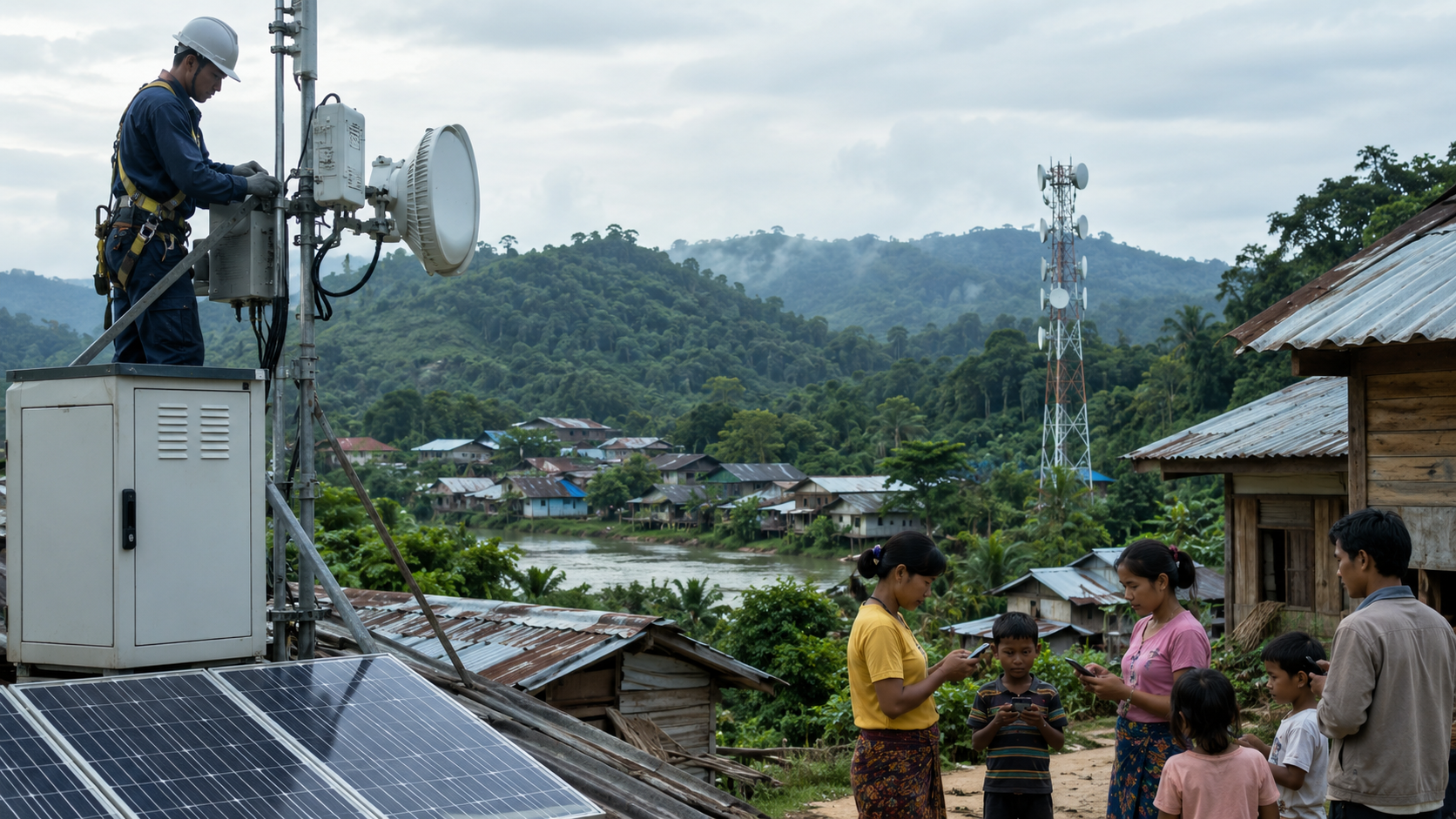
Summary
- What it says: Operational risk is the starting point, not a footnote
- Main topic: Network-resource evidence
- Context: Telecommunications / Company research / Asia-Pacific
Arakha Net at the network periphery: the resilience economy for a Rakhine access ISP in Myanmar's fragmented connectivity market
Operational risk is the starting point, not a footnote
Arakha Net must first be understood as an operational-risk asset: a small, publicly routable access network operator, holding a local license, operating in Rakhine State, where connectivity is not simply a consumer utility but a contested, interruptible, and politically mediated infrastructure service. The proven public company is Arakha Net Co., Ltd / ARAKHA NET COMPANY LIMITED t/a ARAKHA NET, associated with AS150721, an APNIC organisation registration in Myanmar, an address in Sittwe, a portable IPv4 allocation, and a telecommunications service licence for Internet service provider and value-added services.
This is enough to establish an operational identity, but not to establish ownership, capital depth, network topology, subscriber count, actual tariff schedule, or service reliability at the retail edge.
The business thesis is therefore conditional. It is not publicly proven that Arakha Net is a national operator, a data centre operator, or a large wholesale network. It is best viewed as a frontline access ISP whose economic value increases precisely where substitutes fail: residential broadband, small-business Wi‑Fi, local institutional connectivity, and potentially shared community access in towns where mobile service, payment systems, and physical travel are unreliable. The problem is that the same conditions that make local access scarce also make it costly and fragile.
A Rakhine ISP must purchase or operate backhaul, maintain last-mile infrastructure, acquire equipment, collect payments, repair faults, and obey or navigate authority in an environment where telecom outages, conflict, fuel shortages, censorship obligations, and territorial control fragmentation are not exceptional risks but recurring operational conditions.
Reports from late 2024 and early 2025 detailed severe telecommunications outages across Rakhine, with major mobile networks cut in many townships, mobile payments interrupted, and residents turning to limited Starlink points, limited residual networks, travel, or cross-border SIM workarounds.
This makes Arakha Net economically interesting even though the public record is thin. In normal markets, small local ISPs are often marginal resellers with weak pricing power. In Rakhine, a functional access path can become locally strategic. If Arakha Net's local fibre and upstream path are operational when mobile networks are down, its service has scarcity value. If the upstream, fibre trunk, power, or regulatory authorisation fail, the same firm becomes a failed retail promise.
The relevant research question is not "how big is Arakha Net?" but "where in the stack does Arakha Net control enough resilience to matter?" Public evidence indicates it controls (or at least operates) a routable access identity, licenced retail service rights, a small IPv4 block, a public social channel, and a local fibre/Wi‑Fi footprint. It does not prove durable backhaul, facilities, poles, fibre routes, power systems, or political authorisation control across Rakhine.
The canonical identity: a Sittwe‑based ISP label with limited corporate transparency
The most authoritative public identity chain begins with APNIC and the Myanmar Department of Posts and Telecommunications licence roster. The APNIC aut‑num record for AS150721 names the AS ANCL‑AS‑AP, describes it as ARAKHA NET, places it in country MM, links it to organisation ORG‑AN31‑AP, and lists the maintainer MAINT‑ANCL‑MM. The associated organisation record gives the organisation name as ARAKHA NET, org type LIR, address No. 12, Lawkanandar Compound Building, That Ta Htarna Street, Bal Lon Kwing Quarter, Sittwe Township, Rakhine State, Myanmar, phone +95 9 421710008 and emailinfo.arakhanet@gmail.com. The APNIC role entity is more explicit: ARAKHA NET COMPANY LIMITED administrator.
The IP allocation record clears up some naming ambiguity. The APNIC inetnum entry for 103.68.234.0–103.68.235.255 gives the netname ANCL‑MM and describes the holder as "ARAKHA NET COMPANY LIMITED t/a ARAKHA NET". The "t/a" notation is important: it is a trading‑as formulation indicating that the operational label ARAKHA NET is linked to a company name rather than a purely informal brand. The allocation is ALLOCATED PORTABLE, not provider‑assigned address space.
In commercial terms, that gives Arakha Net some network‑identity independence: the operator can announce its own prefixes and, at least in principle, change or add upstream providers without renumbering every customer.
The Myanmar telecom licence list provides the local regulatory identity. The PTD licence roster records Arakha Net Co., Ltd, date of issue 28 July 2022, expiration 27 July 2037, the same Sittwe address, and an application service licence covering Internet service provider and value‑added services. This is some of the strongest business evidence because it predates the APNIC allocation by several months and ties the company to a formal licence category. It indicates that Arakha Net was not simply a paper BGP entity created in 2023; it had secured a telecommunications service licence in 2022.
The unresolved part is ownership and control. The public records recovered here do not identify directors, shareholders, beneficial owners, funding sources, group affiliation, or any parent/subsidiary chain. No audited accounts, tariff schedule, tender notice, customer contract, or management biography were found in the available public archives. The use of a Gmail contact in APNIC registrations and a Facebook‑oriented retail presence are consistent with a small local operator, but they are not proof of ownership scale.
A small ISP could nonetheless be funded by a local family, a regional trading group, a construction entrepreneur, a larger upstream provider, or an informal consortium. Each possibility would alter the economics. A locally owned access ISP faces capital constraints but may enjoy better proximity trust. An entrepreneur‑backed ISP might control poles, ducts, repair crews, or municipal relationships. An operator‑backed ISP could be a last‑mile retail extension of a wholesale network. Currently, the evidence proves the operational label and the licence, not the capital structure.
The name itself also requires caution. "Arakha" appears to be a local identity marker linked to Arakan/Rakhine usage rather than a nationally standardised telecom brand. Public search results surface the business under "Arakha Net," "ARAKHA NET," and "Arakha Net Co., Ltd." The APNIC maintainer abbreviation ANCL likely corresponds to Arakha Net Company Limited, but records should be read literally without expanding beyond what they show.
The geographical operating area suggested by social traces is Rakhine, particularly Sittwe and several Rakhine town names, but the formal licence is a Myanmar telecom licence and the APNIC country code is Myanmar. A licence authorises services; it does not prove that service was active in every town named in marketing snippets.
The infrastructure record: small, visible, RPKI‑clean and upstream‑dependent
The routing evidence is compact but informative. BGP tools identify AS150721 ARAKHA NET as active, registered in January 2023, with a network type classified as Eyeball, three originating IPv4 prefixes, zero originating IPv6 prefixes, and one visible upstream: AS133524 Global Technology Co., Ltd. The prefixes visible in BGP are 103.68.234.0/24, 103.68.235.0/24, and the aggregate 103.68.234.0/23. BGP tools also report a valid RPKI status for the originating prefixes.
This combination signals several things. First, Arakha Net has a real autonomous system identity and announces its own address space. Second, the amount of IPv4 space is tiny by national‑operator standards: a /23 represents 512 IPv4 addresses before customer NAT, infrastructure, and internal allocations. For a residential access ISP, that is consistent with carrier‑grade NAT and a modest subscriber base; it is not consistent with a large hosting or enterprise cloud footprint unless most customers sit behind shared address translation. Third, the absence of visible IPv6 is a resilience and modernisation weakness.
In a low‑resource market that may not hurt immediate customer acquisition, but it limits future service quality, enterprise credibility, and address scalability options.
The RPKI signal is favourable. A valid route origin authorisation reduces the risk of accidental or malicious mis‑origination and suggests that someone responsible for Arakha Net's routing has implemented at least basic modern routing hygiene. On a frontline market that matters. Many retail customers will never ask about RPKI, but upstream providers, content networks, and technically aware counterparts may view valid ROAs as a sign of operational seriousness. It is not a guarantee of uptime, bandwidth or neutrality; it is a narrow but meaningful control‑plane hygiene indicator.
The single visible upstream is the most important economic signal. BGP tools show Arakha Net's upstream and peer relationship with AS133524 Global Technology Co., Ltd, a noticeably larger Myanmar network. Global Technology's own routing profile is much broader, with multiple upstreams and downstreams and a PeeringDB profile describing an Asia‑Pacific network service provider footprint.
For Arakha Net, this creates a classic small‑ISP bargaining problem. Owning an ASN and a portable /23 improves identity and portability, but a single observed upstream means that the operator's global reach, latency, wholesale price, outage exposure, and censorship path are heavily shaped by that one supplier. If AS133524 suffers a national outage, a commercial dispute, a political block, a fibre cut, or a routing error affecting Arakha Net's link, Arakha Net has no publicly visible BGP alternative. The operator may have private backup paths, satellite links, or non‑BGP failover invisible in public routing, but no such redundancy is proven.
In a normal city, a single upstream is a cost choice. In Rakhine, it can be the difference between an ISP and a local intranet.
The prefix structure — announcing both a /23 and two /24s — may be simple reachability engineering. The /24s are globally routable units; announcing them alongside the aggregate may assist traffic direction or route acceptance, but with only one visible upstream the public benefit is limited. It may simply reflect conservative routing practice. By itself, it does not reveal where equipment sits, whether traffic exits from Rakhine or Yangon, whether customer access is FTTH, fixed‑wireless, or resale, or whether local caches exist.
Public hosting signals are also sparse. IPinfo search results for Arakha Net's /24 103.68.234.0 show the ASN and prefix but no hosted domains and no reverse DNS footprint in the snippet. This supports the view that Arakha Net is primarily an access network rather than a hosting or cloud business, though the absence of indexed hosted domains does not prove no local service exists.
Outage exposure: what BGP visibility proves and what it does not prove
A public Myanmar BGP observatory page for AS150721 reported the network as UP — Stable at the time of observation in late June 2026, with 100% BGP visibility across 325/325 collectors. The same page recorded 34 outage events in 2026, 22 hours and 1 minute of cumulative downtime, the longest outage 1 hour 57 minutes, and the most recent outage listed on 12 June 2026 lasting 29 minutes.
That is useful but easily misread. BGP visibility is a control‑plane indicator, not a domestic quality‑of‑service indicator. A BGP outage may reflect upstream maintenance, local power loss on a border router, withdrawn routes, filtering, transmission failure, an upstream issue, or an intentional shutdown. It does not say whether every Arakha Net customer lost service, whether some customers remained connected to a local cache, or whether the outage was noticed at the retail level.
Conversely, a network can be globally visible in BGP while customers in particular towns have no access because last‑mile fibre is cut, power is down, customer‑premises equipment is damaged, or local authorities block access.
Even with that reservation, the outage record is commercially important. A small ISP selling fixed broadband in a conflict‑affected state cannot rely on advertised bandwidth alone; it sells trust that the link will be present when substitutes disappear. Repeated route disappearances of under two hours are not catastrophic in ordinary residential broadband, but in Rakhine they feed a trust problem. If a trader, journalist, clinic, aid worker, remittance‑dependent household, or student pays for fixed access because mobile networks are unreliable, even short outages at the wrong time carry a high perceived cost.
Willingness to pay for Arakha Net therefore depends less on average speed than on the operator's ability to make outages explainable, repairable, and less frequent than the alternatives.
The hardest outage layer is physical and political. A Facebook search‑result snippet for Arakha Net describes a main fibre‑line break around 6:15am affecting FTTH service quality in named Rakhine towns, including references to Rathedaung and Ramree in the snippet. This is unofficial evidence, but commercially significant: it indicates terrestrial infrastructure whose failures are visible to customers and communicated via social channels.
Demand: connectivity as survival infrastructure rather than discretionary broadband
National connectivity numbers for Myanmar can be misleading when applied to Rakhine. On paper, the country has a large connected population and high mobile use. DataReportal's 2026 national report estimates 39.8 million internet users in Myanmar, 62.5 million cellular mobile connections, and a predominantly rural population. Internet Society Pulse reports Myanmar's mobile broadband speed at around 5 Mbps while fixed broadband speed is much higher, and rates Myanmar's internet resilience score as moderate, with several active networks, data centres, and IXPs at the national level.
But the access economy in Rakhine is not a national average. The relevant unit is the town, the ward, the road, the tower, the fibre, the checkpoint, the generator, and the payment channel. In an outage‑prone environment, demand is driven by the failure of alternatives. Families need messaging and voice to check on relatives during fighting. Traders need price discovery, transfer confirmation, stock coordination, and mobile payments when those systems work. Students and jobseekers need access to educational platforms and forms.
Local administrators, civil‑society groups, journalists, and humanitarian actors need communications under conditions where travel may be costly or dangerous. In that setting, a home broadband line or a neighbourhood Wi‑Fi point is not just entertainment infrastructure; it is a substitute for physical mobility.
The demand side is therefore unusually inelastic in crisis moments and unusually income‑constrained at the same time. That combination is commercially tough. A local ISP may have high willingness to pay among customers who urgently need access, but low ability to pay in a conflict economy. It may face arrears, cash‑collection costs, damaged routers, stolen equipment, and customers who suspend service when displaced. It may also face moral and reputational pressure not to price purely on scarcity.
In a small town, the broadband provider is not an anonymous utility; it is a local actor whose service failures and price increases are discussed socially.
Fixed access has a genuine value proposition because mobile broadband is both slower and politically fragile. DataReportal's Myanmar 2025 report indicated a median mobile download speed of around 5.09 Mbps and a fixed speed of about 25.83 Mbps in early 2025. Even when mobile service is available, a stable FTTH or managed Wi‑Fi connection can outperform it for video calls, remote work, education, multi‑user households, and business uses. When mobile is cut, the value gap becomes existential — provided the fixed network is not cut alongside it.
Substitute scarcity: mobile networks, Starlink hubs, residual signals, and paid‑for workarounds
The substitute set in Rakhine is broad on paper and narrow in practice. National mobile operators include MPT, Mytel, ATOM, and the successor arrangements linked to Ooredoo, but local reporting from October 2024 described Rakhine phone and internet outages where major providers including MPT, Ooredoo, Mytel, and Atom were cut, mobile payments such as KPay and Wave Pay were interrupted, and residents relied on limited residual networks or Starlink in some areas. The same report named several townships with severe outages and suggested possible causes including military cuts, fuel exhaustion, and damaged towers.
RFA later reported that telecommunications outages in Rakhine had persisted for nearly 100 days, affecting more than 3 million residents, with outages in AA‑occupied townships, AA‑occupied Paletwa, junta‑controlled Kyaukphyu and Munaung, and parts of Sittwe. Residents described the cost of losing contact, the difficulty of sending money, and dependence of some media or fighters on limited Starlink access.
This is the environment in which Arakha Net's substitute scarcity should be evaluated. Its most important competitor is not a perfectly comparable fixed broadband ISP; it is the least‑bad communication path available that week. That might be a mobile SIM from a national operator, a residual MEC signal in a town, a Starlink cyber‑café, a neighbour's Wi‑Fi, a cross‑border Bangladeshi SIM near the frontier, an organisation‑controlled satellite terminal, or physical travel to a connected town. Each has a different cost structure and political risk.
Starlink is the most important and most ambiguous emerging substitute. DMG reported that Buthidaung residents were urging the ULA to expand public Starlink facilities and simplify registration amid a telecommunications blockade. The same report described high travel costs to reach terminals, unstable speeds, very limited public Starlink points, and Bangladeshi SIM/cellular workarounds costing up to 1,000 K per minute. BNI reported that the ULA/AA had authorised commercial public internet cafés in Arakan via a licensing system involving Starlink Ethernet, local operators, and public access centres.
For Arakha Net, Starlink can be a threat, a complement, or a benchmark. It is a threat where a public satellite cyber‑café bypasses broken terrestrial fibre and caps local broadband prices. It is a complement if Arakha Net or a local access partner uses satellite as backup backhaul for a neighbourhood Wi‑Fi or FTTH island. It is a benchmark because customers will compare the cost of a monthly broadband not to national mobile plans but to travel, queuing, cyber‑café fees, and the probability of getting a usable signal. The presence of Starlink does not remove demand for local ISP; it rearranges it around resilience and authority.
A terrestrial ISP with trusted local last‑mile distribution and multiple backhaul options could remain valuable. A terrestrial ISP dependent on a single upstream and a vulnerable fibre path could be outcompeted under outage conditions.
Retail footprint and channels: Facebook‑driven FTTH, Wi‑Fi, and town‑level signals
Arakha Net's consumer‑facing evidence is primarily social rather than an institutional website. Search results for its Facebook presence identify Arakha Net | Sittwe, show approximately 8,700–8,800 likes, and describe the page as relating to FTTH fibre internet service. Other Facebook snippets mention Rakhine town names including Buthidaung, Rathedaung, Ponnagyun, and Ramree, and one snippet refers to Arakha Net Wi‑Fi service in Ramree.
These snippets should not be overweighted. They were accessible as search results rather than fully crawled page archives, and they do not provide verified subscriber counts, current coverage maps, tariff tables, service‑level commitments, or active installation status. Nevertheless, they are economically relevant. A Facebook‑oriented ISP in Myanmar is a plausible retail model: customer acquisition, outage notices, installation requests, support messages, payment reminders, and service‑area marketing can all operate via Facebook and messaging apps.
The absence of a discovered institutional website does not mean absence of activity; it suggests a local‑retail channel model.
The social evidence also points to a service model that blends FTTH and Wi‑Fi language. In Myanmar and similar frontier access markets, "fibre internet" often means a neighbourhood or building fibre‑fed distribution network with Wi‑Fi at the customer termination point, not necessarily dedicated enterprise‑grade fibre. Customers may buy a package defined by speed, monthly price, router, installation fee, and geographic eligibility. The operator's cost is driven by drop cable, optical splitters, ONUs, routers, labour, customer support, repairs, upstream bandwidth, and collection losses.
Margin sensitivity is high: a few costly fibre breaks or a month of unpaid bills can wipe out the economics of a neighbourhood rollout.
Expansion into towns, if real, would imply a hub‑and‑spoke footprint rather than solely a dense urban network. Serving multiple Rakhine towns requires either leased backhaul, own fibre, microwave links, third‑party wholesale, or hybrid arrangements. The APNIC and BGP records do not reveal which. The PTD licence category permits ISP services; it does not prove that Arakha Net holds facilities licences or owns long‑haul fibre.
Myanmar's licensing framework distinguishes application service licences from network facilities and network service categories, so Arakha Net's listed application service licence should not be read carelessly as evidence of passive infrastructure ownership.
Commercially, that distinction matters. If Arakha Net owns significant local physical infrastructure, its value lies in installed access, repair crews, customer relationships, and route knowledge. If it leases almost all backhaul and facilities, its pricing power is weaker and its resilience is bounded by landlords, upstream providers, and access permissions. If it is partly a reseller or white‑label operator under a larger network, then its local brand may matter more than its technical autonomy. The public evidence does not let us choose among these hypotheses.
Economic model: recurring access revenue under high cost volatility
The likely revenue logic is recurring access for households and small businesses, with installation fees and possible router/customer‑premises equipment charges. The PTD licence explicitly covers Internet service provider and value‑added services, and the social traces advertise FTTH/Wi‑Fi to local consumers. This fits a retail ISP model, possibly with business packages for shops, offices, NGOs, clinics, or institutions.
Revenue resilience depends on four linked variables: active connections, effective collection, backhaul availability, and local repair capacity. In stable markets, an ISP can calculate the return on a fibre drop over a predictable number of months. In Rakhine, displacement, shutdowns, cash scarcity, and payment‑system interruptions complicate that model.
When mobile payments are interrupted, customers cannot pay easily electronically; when travel is dangerous or costly, collection visits and field repair become expensive; when power is unreliable, customers may blame the ISP for outages caused by power or CPE issues; when conflict shifts territorial control, permission to repair or operate can change.
Gross margin pressure is likely severe. Backhaul from a larger upstream provider must be paid in hard or at least reliable currency, while retail customers may pay in kyat with high arrears risk. Equipment — routers, optical network terminals, fibre, splitters, power systems — may be imported or sourced through disrupted supply chains. Repair labour is local, but security risk and transport cost raise the effective wage. Fuel for generators or field vehicles can become a major operational input.
Customer support has a low formal cost but a high time burden: in outage‑prone environments, every network incident generates calls, messages, refunds, disputes over packages, and reputational damage.
The single visible upstream also affects margins. If Arakha Net has only one practical wholesale path, AS133524 has bargaining power over price, capacity, service‑restoration priority, and commercial terms. Arakha Net's portable IP block creates a theoretical switching option, but switching in Rakhine is not a simple procurement exercise. A second upstream must be physically reachable, commercially willing, politically feasible, and operationally stable. Without that, Arakha Net's gross margin may be squeezed between customers who demand lower prices after outages and an upstream whose own costs and risk premia are rising.
Pricing power is therefore episodic. During normal times, Arakha Net competes with mobile data, other fixed providers, informal Wi‑Fi resellers, and customers' willingness to go without. During outages, functional access becomes scarce and pricing power rises. But scarcity pricing can harm trust and attract authority intervention. The long‑term commercial value of a local ISP lies less in extracting crisis rents than in becoming the trusted default provider: the firm customers keep paying because it fixes faults, communicates about interruptions, and delivers more reliable service than mobile substitutes.
Political and regulatory economy: a formal licence, multiple real authorities
The formal legal anchor is Myanmar's telecommunications licensing system. The PTD record shows Arakha Net's application service licence valid until 2037 for ISP and value‑added services. The licensing framework requires entities providing telecommunications services or facilities to obtain authority or a licence, and distinguishes categories such as network facilities, network services, and application services.
The practical regulatory environment is far messier. Myanmar's military authorities have used internet controls, and the national legal framework has tightened around censorship, VPN restrictions, data retention, and platform control. AP reported that Myanmar had passed a cybersecurity law with broad controls over digital activity, including targeting VPNs, blocking content, and requiring digital platform providers to retain user data for up to three years; the report also described penalties and official capacity to investigate, block, or shut down digital platforms.
Freedom House described Myanmar's internet freedom environment as severely repressive, including censorship and surveillance measures affecting telecommunications and internet providers.
A licenced ISP in Myanmar therefore faces more than ordinary telecom regulation. It may face orders or pressure related to blocking, surveillance, user data, VPNs, shutdowns, customer/SIM identity, taxation, licence compliance, equipment imports, and local security coordination. The public evidence shows no compliance action, penalty, or political affiliation specific to Arakha Net. The economic risk is structural: an ISP's licence is an asset only if the issuing authority can protect the operator's ability to serve customers, and a liability if it imposes costly obligations or makes the operator a target.
Rakhine adds the second authority problem. Current and recent reporting has described extensive Arakan Army/United League of Arakan control over much of Rakhine, while some key towns and installations remain under junta control or contested. CSIS summarised late‑2024 reports that the AA controlled 13 of 17 townships, and Reuters described AA control over most of Rakhine after the ceasefire breakdown, while other reports highlighted Sittwe and Kyaukphyu as remaining strategic exceptions.
This matters directly for Arakha Net because its registered address is in Sittwe, while its social/service signals mention towns that may sit under different control conditions over time. A firm can hold a PTD licence and yet need de facto permission, local acceptance, or security clearance to repair a fibre line in a different township. Conversely, a ULA/AA‑administered Starlink cyber‑café licensing system may create a parallel communications regime without being identical to the PTD licence.
For an ISP, regulatory risk is not just "will the licence be renewed?" It is "which authority controls the road to the broken fibre, the tower power, the customer site, the payment agent, and the local internet café?"
Competition: not a normal broadband market
Arakha Net's competitors and substitutes fall into six groups.
The first group is national mobile networks. They have brand, spectrum, towers, SIM distribution, and scale. Under normal conditions they are the strongest substitute for low‑income home internet. But in the Rakhine outage environment, mobile networks can become unreliable or absent. Mizzima's October 2024 reporting that MPT, Ooredoo, Mytel, and Atom were cut in Rakhine is a reminder that mobile scale does not equal local availability under political or conflict pressure.
The second group is larger fixed or wholesale networks such as Global Technology/GlobalNet/5BB. Arakha Net's visible upstream, AS133524, is a larger Myanmar network with multiple upstreams and downstreams; Global Technology/5BB corporate profiles describe broad FTTx and broadband coverage. A larger network can be supplier, competitor, acquiror, or strategic partner. If GlobalNet wants direct retail presence in Rakhine, Arakha Net could be squeezed out. If GlobalNet prefers local partners, Arakha Net's access footprint becomes valuable.
The third group is licenced local ISPs. The PTD licence list includes other application service licensees in Rakhine, including Rakhine Link Co., Ltd at a Sittwe address, holding a licence for ISP services in 2024. The existence of a public licence does not prove active competition in every neighbourhood, but it shows that Arakha Net is not the only licenced local ISP identity in the state. Competition in this segment is likely hyper‑local: the firm with a working fibre path on a given street has the advantage.
The fourth group is satellite access, especially ULA‑mediated public Starlink access. The licensing of public cyber‑cafés using Starlink changes the competitive field because it bypasses terrestrial backhaul. But it is not necessarily cheap, private, or abundant. Reports describe limited terminals, unstable speeds, registration requirements, and travel costs for residents trying to reach access points.
The fifth group is informal resale: neighbourhood Wi‑Fi sharing, shop‑based access, SIM resale, cross‑border signal hunting, and paid access to devices. These channels have low formal investment and high flexibility, but low reliability and fragile legal security. They cap the price of basic access in some neighbourhoods while teaching customers to accept shared, best‑effort connectivity.
The sixth group is "no service". That may sound odd, but in conflict markets non‑consumption is a competitor. If households are displaced, income‑constrained, or unable to pay, they may rely on occasional access rather than maintaining a subscription. Arakha Net's customer acquisition cost must therefore be judged against churn caused by displacement, not merely against competitor advertising.
Bargaining surface and supplier dependency
Arakha Net's dependency surface is wider than the BGP graph. Visible network dependencies include upstream transit from AS133524 and the APNIC/RPKI resource chain. Physical dependencies likely include pole or duct access, fibre routes, customer‑site routers, optical splitters, power, fuel, and repair tools. Institutional dependencies include the PTD licence, local authority acceptance, import channels, and possibly municipal or neighbourhood permissions for installation and repair. Commercial dependencies include payment collection, customer support, and trust.
The upstream relationship is the most visible dependency. AS133524's broader upstream and peer diversity reduces some risks at the wholesale level, but it does not automatically make Arakha Net resilient. A small downstream can still be low‑priority when repair triage happens. If a Rakhine access link is down but the upstream's national network is healthy, global BGP tables may not reveal the local cause. If Arakha Net buys transit or backhaul on terms that require prepayment, currency stability, or minimum capacity commitments, cash‑flow stress can translate into service stress.
Equipment supply dependency is less visible but commercially important. FTTH networks consume cheap but numerous components: drop cable, patch cords, splitters, ONUs, routers, power adapters, enclosures, and tools. Damage rates rise when roads are unsafe, homes are abandoned, buildings are destroyed, or power is unstable. A frontline ISP can look technically simple but operationally complex because every customer outage is a field operation.
Support labour is another bottleneck. In dense urban broadband, technician travel is costly; in conflict‑affected Rakhine it can be dangerous. The value of local technicians who know the streets, poles, customers, and authorities is high. A small ISP's competitive advantage may lie not in its ASN but in a repair crew's ability to get permission to cross a checkpoint, find a break, splice fibre, and explain the outage in Burmese or Rakhine language to angry customers.
Switching costs and trust: why small local ISPs can survive
Customer switching costs in this market are not just contractual. They include installation fees, router compatibility, knowledge of which provider actually works in the neighbourhood, trust in support channels, payment habits, and fear of losing scarce access. If Arakha Net has already installed drops and customer‑premises equipment, it has a defensible local base even without national brand power. In a street‑by‑street FTTH market, installed cable is the switching cost.
Trust is also operational capital. A Facebook page with thousands of likes is not a balance sheet, but in the local ISP business it is a distribution asset. Customers use social pages to discover service areas, request installation, complain about outages, and check whether an outage is general or limited to their premises. The snippets showing Arakha Net's presence in Sittwe and FTTH language suggest that the firm has at least retail mindshare.
The fragility of this asset is that trust degrades rapidly under outages. If the firm invokes “main fibre‑line breaks” too often, customers infer the network is under‑engineered. If it says nothing, rumour fills the gap. If it raises prices during shortages, it can be perceived as exploitative. If it complies with unpopular blocks or shutdowns, customers may blame the ISP even when orders come from above. The best small‑ISP operators in such settings sell not just bandwidth but frankness: fast outage notices, realistic restoration estimates, and visible field work.
Unofficial signals: useful, but not investment‑grade by themselves
The unofficial record adds colour but should be kept in a separate evidentiary compartment. The Facebook snippets suggest an active retail brand, a Sittwe identity, FTTH/Wi‑Fi services, and service references in multiple Rakhine towns. A personal profile search result suggests someone works at Arakha Net and lives in Ponnagyun, but that is too thin to support management or staffing conclusions.
The strongest unofficial signal is not the Facebook like count; it is the combination of retail service language and outage/service notices. An ASN on paper without a consumer channel would look like a dormant or purely upstream‑dependent network identity. Arakha Net instead appears in public social channels as a local internet provider communicating with customers. That supports the hypothesis of an active access business.
Yet the public record has wide blind spots. No tariff table was recovered. No verifiable coverage map was recovered. No body of customer reviews or speed tests was strong enough to quantify service quality. No job postings or procurement record was found that would reveal headcount or network‑build intensity. No ownership registry excerpt was recovered. No PeeringDB record for Arakha Net was found in the search evidence, and no corporate website was established. These absences are not proof of weakness, but they are commercially important because they prevent confidence about scale, profitability, and governance.
Twelve‑ to thirty‑six‑month scenarios
The base case is managed scarcity. Arakha Net continues to operate as a local access ISP with portable IP space, a valid licence, a Facebook‑driven customer channel, and dependence on a larger upstream. Demand stays high because mobile and informal substitutes are unreliable. Growth is real but constrained by repair costs, backhaul dependence, cash collection, customer displacement, and security. In this case the firm is locally economically relevant but not a scalable national platform.
The bull case is resilience upgrade. Arakha Net adds a second upstream, implements IPv6, improves local backup power, secures more robust backhaul, and perhaps uses satellite or microwave failover for critical nodes. The public signal to watch would be new BGP upstreams, additional prefixes, a PeeringDB presence, IPv6 announcements, local cache relationships, or public business packages. This would transform the firm from a fragile local ISP into a more credible frontline connectivity platform.
The partnership case is local last‑mile subcontractor for a larger operator. A national or regional network may prefer not to build and sustain every Rakhine neighbourhood directly. Arakha Net's local brand, technicians, and installed infrastructure could become a channel for GlobalNet/5BB or another upstream. That could stabilise supply and funding but reduce independent margin.
The substitution case is Starlink cyber‑café expansion and satellite‑backhaul normalisation. If ULA/AA‑authorised public access centres proliferate, local customers may switch from monthly fixed subscriptions to pay‑per‑use shared access, especially where fibre is damaged. Arakha Net could respond by integrating satellite backhaul or becoming a local distributor. If it cannot, satellite hubs cap prices and weaken terrestrial scarcity value.
The bear case is political or physical network break. Shutdown orders, territorial conflict, damaged fibre, fuel shortages, payment break, or upstream failure could make the AS visible only intermittently or not at all. In that scenario Arakha Net's licence and APNIC resources remain formally valuable but commercially underused. Customers migrate to whatever is available: Starlink points, mobile when restored, cross‑border signals, or no service.
The ownership‑change case is consolidation or quiet transfer. In a fragmented telecom market, small ISPs can be acquired, funded, absorbed, or effectively controlled by upstream debt and equipment supply. No such transaction is publicly proven for Arakha Net, but incentives exist. A larger operator gains local access; a local owner reduces risk; customers may see better backhaul but less local autonomy.
Evidence register
Primary network identity. The APNIC WHOIS/RDAP evidence proves that AS150721 is assigned to ARAKHA NET in Myanmar under organisation ORG‑AN31‑AP, with the Sittwe address, phone number, Gmail contact, and the APNIC role ARAKHA NET COMPANY LIMITED administrator. The relevant primary URL ishttps://wq.apnic.net/apnic-bin/whois.pl?object_type=aut-num&searchtext=AS150721. This proves routable operational identity and administrative contact; it does not prove subscriber count, ownership, revenue, or physical network footprint.
Primary IP resource record. The APNIC inetnum record for 103.68.234.0–103.68.235.255 describes the holder as ARAKHA NET COMPANY LIMITED t/a ARAKHA NET, country Myanmar, status ALLOCATED PORTABLE. The relevant URL ishttps://wq.apnic.net/apnic-bin/whois.pl?object_type=inetnum&searchtext=103.68.234.0. This proves portable IPv4 resources and business identity; it does not prove how many customers sit behind the allocation or whether the company has additional private or provider‑assigned space.
Routing and route hygiene. BGP tools show AS150721 active, classified as eyeball network, announcing three IPv4 prefixes, no IPv6 prefixes, with valid RPKI for visible prefixes and one visible upstream, AS133524 Global Technology Co., Ltd. Useful URLs includehttps://bgp.tools/as/150721andhttps://bgp.he.net/AS150721. This proves public route origination and a narrow upstream surface; it does not prove last‑mile uptime or hidden backup paths.
Upstream dependency. Global Technology Co., Ltd / AS133524 is a larger Myanmar network with multiple upstreams, downstreams, and an Asia‑Pacific NSP profile. Useful URLs includehttps://bgp.tools/as/133524,https://bgp.he.net/AS133524, and the PeeringDB Global Technology profile. This evidence supports the conclusion that Arakha Net's public internet reach is linked to a more diverse upstream, while Arakha Net itself shows no comparable public upstream diversity.
BGP outage trace. The internet observatory page in Myanmar for AS150721,https://www.internetinmyanmar.com/observatory/bgp/AS150721/, reported current stability at the time of observation but also listed 34 BGP visibility outage events in 2026 with 22 hours and 1 minute of cumulative downtime. This is strong evidence of route‑visibility interruptions; it is not sufficient to attribute cause or quantify retail customer downtime.
Myanmar telecom licence. The PTD public licence roster records Arakha Net Co., Ltd, date of issue 28 July 2022, expiration 27 July 2037, Sittwe address, application service licence, and Internet service provider and value‑added services. The relevant PDF URL ishttps://www.ptd.gov.mm/Uploads/License/Attach/52026/320151252026_Website%20New%20%20Licence.pdf. This proves formal service authorisation; it does not prove network facilities ownership or current compliance status.
Licence category interpretation. Myanmar's licensing framework distinguishes application service licences from network facilities and network service categories. This means that Arakha Net's public licence supports an ISP/service interpretation, but should not be used alone to claim backbone fibre, international gateway, or national transmission infrastructure ownership.
Retail/social evidence. Facebook search results identify Arakha Net | Sittwe, approximately 8,700–8,800 likes, and FTTH/fibre internet language, with snippets mentioning Rakhine towns including Buthidaung, Rathedaung, Ponnagyun, and Ramree. The likely page URL ishttps://www.facebook.com/p/Arakha-Net-100064002218902/. This suggests an active consumer‑facing ISP brand and local FTTH/Wi‑Fi positioning; as much of the evidence is snippet‑level, it should be treated as unofficial and not as verified coverage proof.
Rakhine outage context and substitute scarcity. RFA, Mizzima, DMG, and BNI provide the operating context: prolonged telecommunications outages in Rakhine, disruption of major mobile operators and payment systems, limited Starlink access, high travel costs to reach terminals, and ULA/AA licensing of public cyber‑cafés. Key URLs includehttps://www.rfa.org/english/myanmar/2025/02/12/myanmar-rakhine-telecom-outage/,https://eng.mizzima.com/2024/10/21/15296,https://www.dmediag.com/news/bruut, andhttps://www.bnionline.net/en/news/ulaaa-authorizes-public-internet-cafe-arakan. These sources do not prove Arakha Net's own outages, but they explain the demand and risk environment in which the firm operates.
National market and repression context. DataReportal and Internet Society Pulse provide national‑level demand, speed, mobile, and resilience context, while AP and Freedom House document Myanmar's restrictive digital control environment. Relevant URLs includehttps://datareportal.com/reports/digital-2026-myanmar,https://pulse.internetsociety.org/en/reports/mm/, and the AP cybersecurity law reporting. These sources support the broader economic framing: fixed access can be valuable where mobile is slow or unavailable, but all ISPs face regulatory and political risk.
Watch points
A second visible upstream. The most important technical watch point is whether AS150721 adds another upstream beyond AS133524. A new upstream in BGP would improve bargaining position, reduce single‑supplier exposure, and signal either backhaul investment or strategic partnership. If no second upstream appears, Arakha Net remains structurally dependent even if retail demand rises.
IPv6 activation. Visible IPv6 origination would indicate modernisation and better address economics in the long run. Its absence is not fatal for a small Myanmar ISP today, but over a 12–36 month horizon it limits enterprise credibility, future customer scaling, and compatibility with modern content and network practices.
Longer BGP outages or disappearance. Repeated short outages are operationally concerning; a multiday disappearance would be of a different order, implying upstream break, physical isolation, commercial suspension, shutdown order, or major conflict disruption. The internet in Myanmar AS page and BGP collectors should be monitored for duration, recurrence, and possible coincidence with Rakhine conflict events.
Rakhine control and licensing shifts. Arakha Net's PTD licence is valid on paper until 2037, but de facto operating permission may depend on who controls each service area. Any ULA/AA telecommunications rule, Starlink registration change, local cyber‑café licence, or PTD enforcement action would directly affect Arakha Net's addressable market and compliance burden.
Starlink: from scarce bypass to normalised access layer. If public Starlink cyber‑cafés remain scarce and expensive, Arakha Net's terrestrial FTTH retains scarcity value. If Starlink becomes widely licenced and locally distributed, it becomes a serious substitute or a backhaul input. The commercial question is whether Arakha Net integrates satellite resilience or is bypassed by it.
Evidence of physical infrastructure ownership. Fresh public clues on fibre routes, pole agreements, microwave links, repair crews, or facilities licences would materially change the valuation. Owning local infrastructure raises strategic value but also repair and security exposure. Pure resale reduces capex but caps margin and resilience.
Tariff tables and customer complaints. Public packages, installation fees, outage credits, and customer comments would reveal pricing power and support burden. In this market, the gap between advertised speed and reliable availability is the key customer‑retention variable.
Ownership or funding disclosure. A MyCO excerpt, a shareholder leak, an acquisition notice, a bank‑funding hint, or an upstream reseller agreement would change the risk reading. Local family ownership, operator control, entrepreneur ownership, or politically connected ownership each imply different access to capital, protection, and reputation risk.
Activation of local competitors. Other licenced Rakhine ISPs, including Sittwe‑based licensees, should be monitored for active Facebook pages, BGP resources, price postings, or service‑area claims. The existence of a licence alone is not competition; active drops in the same streets are.
Payment rail functionality. KPay/Wave Pay disruptions and cash scarcity affect collection. A broadband operator can have demand and still lose revenue if customers cannot pay reliably. Any restoration or collapse of mobile‑money access in Rakhine changes Arakha Net's working‑capital profile.
Cybersecurity regulatory enforcement. Data‑retention, VPN‑blocking, filtering, and shutdown obligations can impose technical costs and reputational damage on ISPs. Evidence that enforcement has intensified against small regional providers would lower Arakha Net's risk‑adjusted appeal even if customer demand stays strong.
Local cache, CDN, or content partnerships. Any evidence of cache relationships with Google, Meta, Akamai, Cloudflare, gaming, education, or video would improve service quality and reduce upstream cost. With a tiny prefix footprint this is not currently proven, but it would be one of the clearest signs that Arakha Net is moving beyond pure basic‑access resale to more resilient local service provision.