
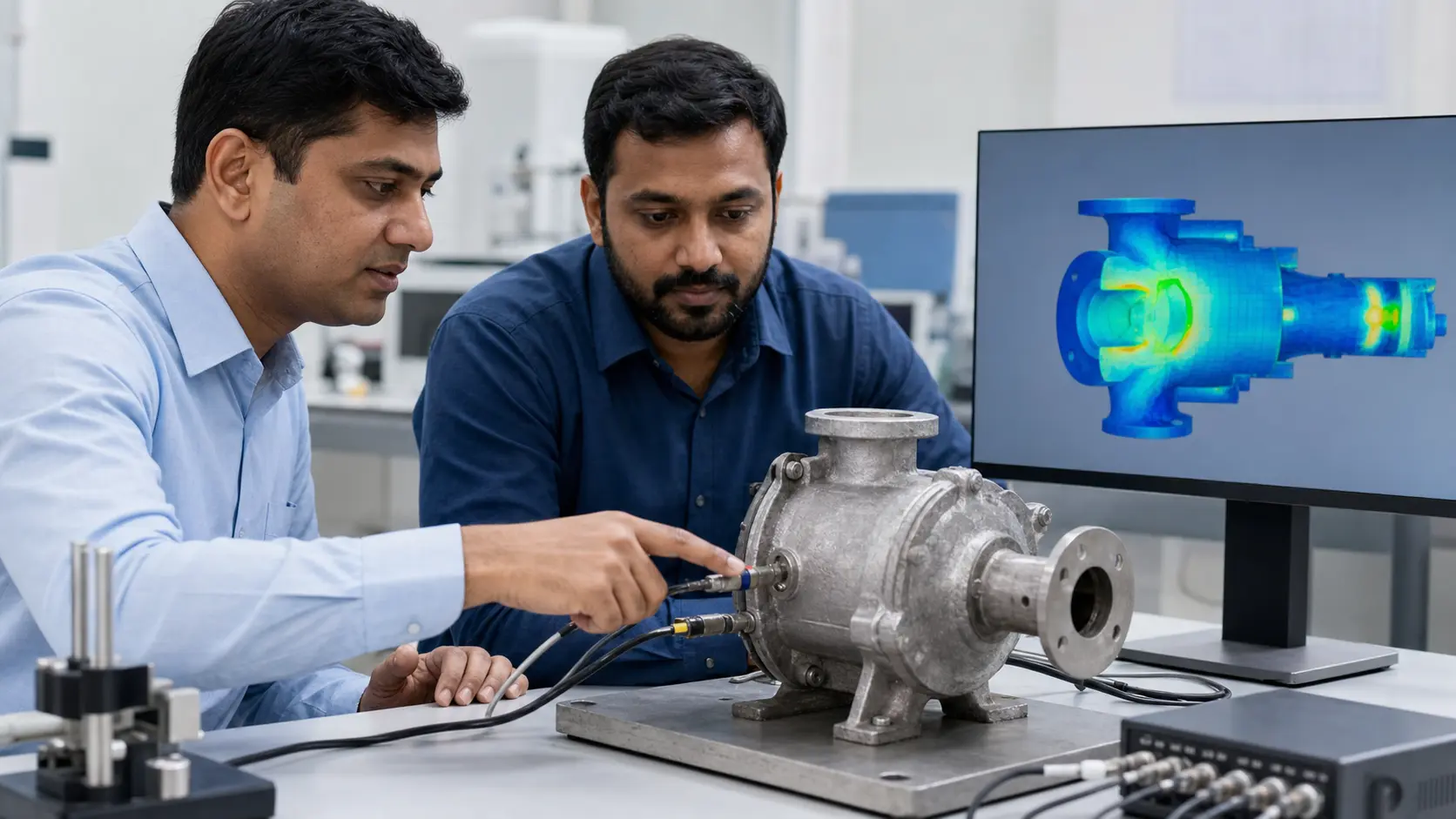
Summary
- Ansys Software Pvt. Ltd. is the operational anchor in India, not a shorthand for all of Ansys or Synopsys. Ansys's current contact directory lists offices in Bengaluru, Pune, and Noida, while its pre-acquisition U.S. filing listed ANSYS Software Private Limited as an Indian subsidiary. Public evidence does not provide a fully reconciled revenue, profit, or headcount for this legal entity.
- India appears to be more than a sales outpost. Current Synopsys job postings in Pune and Bengaluru place engineers in mesh verification, optics support, and simulation account management, and a January 2026 report indicated that around 1,200 members of the Ansys India team were gathered with Synopsys colleagues. That reported number is useful integration evidence, but not an audited headcount disclosure of the subsidiary.
- The economic proposition is to shift verification earlier: coupling structural, fluid, thermal, electromagnetic, optical, and embedded software analysis to catch more design defects before prototypes. This can shorten iterations, but does not by itself turn simulation output into proof. Geometry, material data, boundary conditions, meshes, solver settings, uncertainty, and correlation with physical evidence remain part of the engineering claim.
- Cloud, HPC, and AI change the bottleneck without removing it. Elastic licensing and burst capacity can free a team from local hardware constraints; they also introduce tariff grids, cloud dependencies, version support, queue behaviour, and data governance obligations. AI surrogates add a second model whose training domain and failure envelope must be validated against the underlying physical workflow.
- The Synopsys acquisition creates a credible path from semiconductor design and verification to thermal, mechanical, optical, and functional safety analysis at the system level. It also increases integration and concentration risk. Value will depend on how products join in real customer artefacts, whether specialists remain available after restructuring, and whether interoperability survives commercial pressure to sell a broader stack.
- Serious procurement should therefore test a representative, challenging model rather than buy from a product matrix. It should measure accepted engineering outcome, total compute and license consumption, model credibility, support escalation, security perimeter, version migration, and repeatable exit. The decisive asset is not a single solver licence; it is the governed set of models, scripts, evidence, and human judgement that surrounds it.
A mesh is not proof
One of the clearest windows into Ansys Software Pvt. Ltd. is not a product announcement. It is a current job posting in Pune.
Synopsys is hiring a senior verification and validation engineer to test Ansys meshing technology on Workbench and Fluent Meshing, Python-based tools, Windows and Linux, virtual machines, cloud systems, and clusters. Thejob descriptionplaces the engineer within the meshing development unit and asks for test planning, automation, defect isolation, and validation across a wide execution surface. This is a compact picture of what engineering simulation actually requires. Before a solver can compute stress, heat flow, turbulence, or electromagnetic behaviour, someone must turn geometry into a discretised model. If that mesh is inappropriate, a numerically clean answer can still be physically misleading.
This is the central tension in Ansys's India business. Simulation is sold as a way to replace expensive physical iterations with earlier virtual ones. Yet every step moved from the test bench into software creates a new layer that must be trustworthy: geometry translation, material records, meshing, solver numerics, coupling between physics, compute infrastructure, scripting, post-processing, and the judgement that turns a coloured field plot into a design decision.
"Shifting verification left" is therefore both real and incomplete. A manufacturer can identify a thermal hot spot before ordering a prototype, or expose a structural mode before machining tooling. A chip team can analyse power integrity before mask delivery, and an automotive team can test software logic against a virtual system before a vehicle exists. Early discovery can be extremely valuable because late defects are costly. But simulation does not abolish proof. It moves part of the proof into the models and into the people who build, challenge, maintain, and explain them.
Ansys Software Pvt. Ltd. matters because India is one of the places where this shift becomes work. The subsidiary's public footprint, current hiring, and post-acquisition co-location indicate a mix of product engineering, verification, customer support, and technical account work. Synopsys's strategy raises the stakes: the Indian team is now embedded in an organisation that wants to connect semiconductor design, embedded software, and multiphysics behaviour into a single "silicon to systems" stack. If this works, simulation can become more deeply embedded in the customer's development authority.
If it fails, the customer inherits a larger, more tightly coupled chain of models, licences, and support dependencies.
The exact Indian company
The directory entity is Ansys Software Pvt. Ltd. in India. It must not be silently replaced by Ansys, Inc., the historical U.S. parent, or by Synopsys, Inc., the current ultimate owner.
Ansys'scurrent contact directorylists "Ansys Software Pvt. Ltd." and gives offices at Prestige Tech Park in Bengaluru, Rajiv Gandhi Infotech Park in Pune, and IGL Tower in Noida. A subsidiary exhibit attached to Ansys's last pre-acquisition annual filing uses the long legal style"ANSYS Software Private Limited" and identifies its jurisdiction as India. The abbreviated form "Pvt. Ltd." and the full "Private Limited" are both publicly relevant forms for this engagement; the operational boundary remains the Indian company.
Ownership changed above in July 2025. Synopsys announced it hadcompleted the acquisition of Ansys on 17 July, and the closing filing indicates that Ansys, Inc. survived the merger as awholly owned subsidiary of Synopsys. The public documents reviewed do not detail every intermediate ownership step post-closing between Synopsys and the Indian company. Nor do they show that the Indian company has disappeared. The current Ansys contact page continues to use its name.
This distinction imposes limits on what numbers can be responsibly used. Ansys's 2024 annual filing described a global company with approximately 6,500 employees before the acquisition. Synopsys's 2025 fiscal filing described a combined global headcount of approximately 28,000, of which roughly three-quarters were engineers. Neither number is a headcount for Ansys Software Pvt. Ltd. The same applies to consolidated revenue, subscription mix, research spending, and customer concentration. These parent-level measures establish the scale and commercial context of the product organisation, not the Indian subsidiary's economics.
The strongest public estimate for the India integration is narrower. In January 2026, the Times of India reported at a Synopsys event in Bengaluru that the company had welcomed anAnsys India team of around 1,200 peopleand was grouping teams into a larger building. The article was based largely on interviews with Synopsys executives. That is credible evidence of management's integration narrative and a rough team scale, but it is not an audited headcount of the legal entity. "Ansys India team" may also describe an operational group rather than every employee on a single subsidiary payroll.
Synopsys's annual filing adds a tangible asset. It states that the company owns offices in Pune and uses its international facilities for sales and support, services, and research and development. This is consistent with the Ansys contact footprint and the current Pune roles, but the filing does not attribute Pune ownership or its occupants exclusively to Ansys Software Pvt. Ltd.
The result is a picture of precise but incomplete identity. There is a named Indian company, a visible multi-city footprint, current job postings for product and support work, and a reported integration population. There is no public standalone profit-and-loss statement, customer list, margin disclosure, headcount reconciliation by legal entity, or post-merger organisation chart.
Anyone contracting in India should verify the entity on the purchase order, the billing company, the support provider, the data processing parties, and the owner of each professional services deliverable, rather than assume that the Ansys brand answers these questions.
India is where the stack becomes work
Software product pages can make simulation look self-running: design, pick a physics domain, press solve, and inspect the result. The Indian roles show the human system behind that abstraction.
The Pune meshing posting is product verification work. It covers on-premises, cloud, and cluster environments because mesh behaviour can depend on geometry import, software version, operating system, parallel execution, and interaction between multiple tools. A defect that only appears in a large distributed case is commercially different from one that fails immediately on a workstation. Reproducing it may require the customer's model, environment, licence configuration, and execution history.
A second Pune posting brings this work closer to the customer. Thetechnical support engineer role for Python, optics, and Zemaxasks engineers to embed optics tools into customer design workflows, investigate defects, validate fixes, and work with AnsysGPT. Support in this context is not a call-centre script. It requires enough domain understanding to distinguish misuse, deficient model, environmental issue, and product defect. The support engineer may also be part of the customer's verification chain because advice on a boundary condition, material model, or solver setting can affect the result that is eventually approved.
In Bengaluru, atechnical account specialist rolefocuses on high-tech and semiconductor customers. It involves mapping customer requirements to simulation and analysis products, coordinating technical support, training, and development teams, and performing simulation activities. This is the commercial edge of integration: not just answering whether a product can do a task, but deciding which components of a growing Synopsys-Ansys portfolio should enter a customer's flow.
Three job postings cannot establish the size or quality of an organisation. They can establish the type of work Synopsys expects to be done in India in 2026. The pattern is particularly relevant to the merger thesis:
- Pune contributes verification of the software that creates the model and support for specialised optics workflows.
- Bengaluru connects simulation products to semiconductor and high-tech customer requirements.
- The broader Indian organisation provides engineering depth in a labour market that Synopsys already treats as strategically important.
This means the integration is partly an organisational design problem. Ansys specialists know numerical methods, physics domains, and established customer models. Synopsys specialists know semiconductor design flows, intellectual property, hardware verification, and electronic design automation. A combined product does not emerge simply because the two groups share a logo or a building. The company must create shared data contracts, release schedules, escalation paths, and technical authority without losing the specialist knowledge that made each tool credible.
The risk is visible in Synopsys's own filing. After the acquisition, the company stated it had launched a restructuring plan aimed at directing investments toward growth and efficiency, with expected charges of $300 million to $350 million and most headcount reductions in fiscal 2026. Thesame filingwarns about the difficulty of retaining and integrating key employees acquired through transactions. These are Synopsys-wide disclosures; they do not prove any reduction at Ansys Software Pvt. Ltd. They do make retention, product ownership, and support continuity legitimate due-diligence questions, especially when the value of the Indian team is concentrated in specialist expertise that cannot be quickly rebuilt from documentation.
Shifting proof left, without eliminating it
The phrase "virtual test" can hide several different claims. A program can correctly solve its equations yet model the wrong physical situation. A model can match one experiment and fail outside the calibrated range. A workflow can be technically sound yet applied by someone without the domain knowledge to recognise an implausible result.
NASA's currentstandard for models and simulationstreats credibility as a managed engineering product. It calls for verification, validation, uncertainty treatment, and evidence appropriate to the decision being made. TheFDA's guidance for computational modelling in medical device submissionsuses a similar risk-based idea: credibility must be judged by the model's intended use and the consequence of a wrong answer.
These frameworks are not Ansys certifications. They are useful independent descriptions of work a buyer still owns. In practical terms:
- Code verificationasks whether the software correctly implements its numerical method.
- Calculation verificationasks whether the discretisation, convergence, and numerical choices are adequate for the specific case.
- Validationasks how well the model represents the relevant physical reality.
- Uncertainty assessmentasks how input, model form, and numerical uncertainty affect the decision.
- Applicabilityasks whether evidence gathered in one regime supports use in another.
Ansys addresses the early layers through product quality and verification material. Itsquality assurance pagestates that releases undergo tens of thousands of verification tests, offers verification manuals and optional test or service agreements, and publicly grades known error categories. The page is unusually candid that software errors are inevitable. It defines a high-priority category for cases where a program completes but produces an erroneous result that is not easily identifiable. These are the company's descriptions of its quality system, not an independent audit of defect rate, but they matter because they reject the comforting assumption that a successful run equals correct physics.
The Workbench R1 2026 verification material illustrates the limit more precisely. It compares selected results against analytical, experimental, or reference solutions and describes a general error target for the included verification cases while noting mesh refinement and modelling trade-offs. Theverification manualis evidence that specific examples have been tested. It is not a guarantee that any customer's arbitrary geometry, material model, contact setup, or multiphysics coupling will achieve the same accuracy.
This distinction changes the value proposition. Simulation can shift learning left because a team can explore more designs before physical build. It cannot shift responsibility entirely to the supplier because the supplier does not own the customer's intended use, manufacturing variability, acceptance threshold, or actual operational envelope. The customer must decide how much physical correlation is needed and when a model is credible enough to release a design.
For Ansys Software Pvt. Ltd., this creates two types of work. Product V&V engineers help make the software consistent and expose errors. Applications engineers and support specialists help customers build usable workflows. Neither group can substitute for the customer's design authority. A procurement that treats licences, consulting, and model approval as an undifferentiated service risks losing that separation.
The architecture is a chain of decisions
Ansys is not a single solver. Its pre-acquisition annual filing describes a portfolio spanning structural mechanics, computational fluid dynamics, explicit dynamics, electromagnetics, semiconductor power integrity, optics, materials, embedded software, functional safety, digital twins, and optimisation. Products such as Mechanical, Fluent, LS-DYNA, HFSS, RedHawk-SC, Lumerical, Granta, SCADE, and medini analyse different parts of a system and carry different modelling assumptions. TheAnsys 2024 filingalso describes integrations with CAD, EDA, cloud, and hardware vendors, as well as Python-based extensibility.
A representative customer workflow might run as:
- Geometry arrives from a CAD or electronic design environment and is simplified for analysis.
- Materials are selected or calibrated for the expected temperature, frequency, load, and manufacturing condition.
- The domain is discretised into a mesh whose density and element type suit the relevant gradients.
- Boundary and initial conditions encode loads, constraints, heat sources, flows, voltages, or radiation.
- A solver computes a field, or multiple solvers exchange fields in a coupled analysis.
- Engineers test convergence, sensitivity, and correlation against reference evidence.
- Results are reduced to design limits, margins, requirements, or optimisation targets.
- Scripts and workflow systems repeat the process over variants and released versions.
- Reports, model versions, and sign-offs become part of the engineering record.
Every interface is a possible source of value and failure. Automated geometry cleaning can save days but may also remove a feature that drives a local stress. A materials database can improve consistency but only if the record matches the manufacturing state. Coupling a thermal solver to an electromagnetic analysis can reveal feedback that isolated tools miss, while making version compatibility and convergence harder. Python automation can make a workflow reproducible but becomes software the customer must test and maintain.
Synopsys's acquisition thesis is to extend this chain into chip and embedded systems development. The first major post-acquisition release,Ansys 2026 R1, announced the first product joins: Synopsys VC Functional Safety Manager with Ansys medini analyze, QuantumATK with Granta materials information, and OptoCompiler with Lumerical FDTD. Therelease highlights pagealso promotes SysML v2 connections, cloud bursting, and AI-assisted geometry, meshing, and validation features.
These are capacity claims. They do not yet demonstrate how many customers have moved a production programme to the combined flow, how much integration work was needed, or whether the combined evidence has been accepted by a regulator or independent certification body. "Integrated" can mean anything from a supported file transfer to shared requirements, common data lineage, and synchronised release governance. A buyer should insist on seeing the exact depth of the join.
The most valuable use cases are also the most demanding. A multi-chip electronic package may require power, signal, thermal, and mechanical analysis across scales. An autonomous machine may connect silicon behaviour, embedded control software, sensors, actuators, structures, and a changing physical environment. Earlier cross-domain analysis can reveal a defect that each team would otherwise miss. It also creates a larger model whose ownership crosses organisational boundaries. The system architect, chip team, thermal analyst, software safety engineer, and supplier must agree on assumptions and change control.
A unified supplier stack can reduce file friction; it cannot automatically resolve these governance decisions.
Compute is part of the engineering method
The economics of simulation are inseparable from compute. A workstation may be adequate for an early model, while a detailed transient CFD case, an electromagnetic package analysis, or a crash simulation may need many cores, large memory, and repeated runs. Optimisation and uncertainty studies multiply this demand because they evaluate families of designs rather than a single one.
Ansys markets several ways to obtain capacity. Itscloud pagepresents cloud bursting from desktop to cloud for solver jobs, cloud-hosted access, and managed HPC. The pre-acquisition filing identifies Ansys Gateway powered by AWS, Ansys Access on Microsoft Azure, and Ansys Cloud Direct on Azure. These are not identical services. One may place the software in the customer's cloud account; another may rely on a supplier-managed environment; a third may use cloud consumption tied to Ansys entitlements. Data control, network design, identity, support, and cost attribution differ accordingly.
Elastic licensing changes the commercial unit. TheAnsys elastic licensing guidedescribes prepaid Ansys Elastic Units consumed on a pay-per-use model. The associatedentitlement documentationstates that product rates are governed by a tariff grid that can be updated under defined notice rules. The cloud documentation indicates that credits can be consumed for node run time, includingdata transfer and fine-grained run-time billing.
This flexibility can be valuable. A team can get a large cluster for a deadline without buying hardware for the annual peak. A small organisation can try a specialised product without supporting a permanent capacity pool. An engineer can run more variants and reduce wait time.
Cost is not automatically lower. A procurement model must include:
- solver and feature entitlements;
- parallel or HPC licences;
- cloud instances, storage, and data transfer;
- failed or cancelled runs;
- pre-processing and post-processing time;
- repeat runs needed for convergence and validation;
- idle capacity during orchestration;
- support effort across supplier and cloud provider;
- version migration and image maintenance;
- security controls for sensitive geometry and results.
The operational record is more informative than a brochure. The release notes forAnsys Gateway powered by AWSdocument installation failures related to dependencies, temporary removal of packages, MPI or interconnect issues, job start issues, fixes for high request volumes, and removal of older application versions from support. The notes forAnsys Access on Microsoft Azuredescribe cluster creation fixes, multi-node workarounds, image vulnerabilities, cloud platform changes, and encryption behaviour that differed between new and existing installations.
These entries do not establish a general failure rate, and they should not be inflated into a claim that the services are unreliable. They show the real dependency surface: application package, OS image, open-source libraries, network, scheduler, cloud service, storage, licence service, and customer configuration. "The solver runs in the cloud" is not an architecture. A buyer needs to know who owns every layer and what happens when a large deadline-critical model fails after consuming compute.
AI creates a second model to validate
AI-assisted simulation takes two distinct forms. One uses AI to help people prepare, navigate, or interpret conventional simulation. The other trains a data-driven surrogate model to predict outputs without running the full solver for every design.
Ansys's currentAI portfolioincludes AnsysGPT for assistance, AI features embedded in products, and SimAI in cloud and workstation forms. The 2026 R1 material introduces AI-assisted meshing, GeomAI, and validation features. These can reduce repetitive work or make expertise more accessible. The public product pages do not provide a representative distribution of time saved, errors avoided, or human review required in production customers.
SimAI presents the most consequential governance question. Itstechnical overviewstates that the service uses prior three-dimensional simulation data to train data-driven models that predict physical fields for new designs. It can reuse results across physics domains and expose the platform via Python. This architecture can turn an expensive archive of solved cases into a faster design-space explorer.
It also creates a second model. The original physical simulation has assumptions about equations, geometry, material behaviour, boundary conditions, meshing, and numerical error. The AI surrogate has additional assumptions about training coverage, data quality, feature representation, optimisation, generalisation, and software version. A surrogate can be highly accurate inside a familiar family of designs and fail when topology, operating regime, or material state leaves the training distribution.
The right comparison is therefore not "minutes versus hours". It is the cost per accepted prediction within a defined intended use. A governed deployment should answer:
- Which solver versions and model configurations produced the training data?
- Are failed, non-converged, or physically implausible cases excluded and logged?
- Does the training set cover the geometry and operating envelope in which predictions will be used?
- What independent holdout cases and physical tests establish acceptance?
- How is error measured in local regions relevant to safety rather than only as a global average?
- Can users see when a proposed design is outside the supported domain?
- Who approves retraining after a solver, geometry pipeline, or materials database change?
- Are training data and models appropriately isolated between customers and projects?
- Can a prediction be reproduced after a cloud service or model version change?
- At what decision threshold should the full solver or a physical test be run?
The NASA and FDA credibility principles remain useful here because AI speed does not reduce consequence. If a surrogate is used only to rank early concepts, bounded error may be acceptable. If it releases a structural component, changes a thermal limit, or supports a regulatory submission, the evidence requirement increases.
India is likely to carry some of this new validation and support load, but that is an inference rather than a disclosed allocation. The Pune meshing and optics roles already cover automation, Python, cloud, and AnsysGPT. As AI features enter established tools, the line between product support and model governance will become harder to draw. A support engineer can explain how the feature works; the customer still needs an independent rule for when its output is sufficient evidence.
Embedded software closes the loop
The Synopsys-Ansys combination becomes most distinctive where software controls a physical system. Ansys'sembedded software portfolioincludes SCADE tools for model-based development and testing, medini analyze for functional safety and cybersecurity analysis, and test automation products. The pages reference standards used in aerospace, automotive, industrial, and rail systems, but an tool's support for a standard does not certify a customer's application.
Before the acquisition, Ansys could model the system and its control software. Synopsys adds semiconductor design, verification, and IP. The 2026 R1 connection between VC Functional Safety Manager and medini analyze is intended to preserve safety analysis from system requirements down to chip implementation. If the traceability is genuine, a change in a system hazard can propagate into hardware and software verification plans rather than being manually reconciled across separate databases.
The value is plausible because failures cross layers. Thermal throttling can change timing. Sensor noise can alter software behaviour. A hardware diagnostic may satisfy a safety requirement only if its assumptions about failure rates and the physical environment are valid. A power integrity issue can appear as a software defect. Connecting models can expose these interactions earlier.
The dependency is also plausible. Tool versions, requirement IDs, generated artefacts, and qualification evidence must stay aligned over programmes that may last a decade. A customer may need to reproduce the result long after the original engineer has left. If the combined flow relies on proprietary links, cloud services, or a specific version combination, the cost of maintaining the verification record increases. The procurement question is not whether two product names appear in the same release note. It is whether the customer can trace, review, archive, and if necessary migrate the evidence through the full lifecycle.
The bill is a portfolio, not a seat
Ansys's global business model historically combined time-based licences, perpetual licences with maintenance, named or network arrangements, HPC capacity, elastic consumption, cloud resources, support, training, and consulting. Its 2024 filing describes this range, while Synopsys's 2025 filing now places Ansys's simulation and analysis products in the Design Automation segment. These disclosures belong to the parent global organisations. They do not reveal Indian list prices, subsidiary margins, or terms offered to any particular customer.
The practical pricing unit is a portfolio of constraints.
A team may own enough base solver licences but lack parallel capacity when a programme peaks. It may have compute but not the feature needed for a specialised material model. A global network licence may improve utilisation but requires reliable access to a licence server. An elastic pool may solve a short-term shortage while exposing the programme to consumption rates and budget alerts. A cloud run may consume both supplier units and hyperscaler resources. Consulting may be needed to make the model credible, and training may be needed to keep it usable after consultants leave.
This makes a nominal price comparison weak. The best denominator is accepted engineering work:
total cost of licence, compute, implementation, validation, support, and migration divided by the number of decisions or releases accepted with the required evidence.
This metric can favour Ansys even when its software is expensive. A robust solver, deep applications support, and a validated workflow can avoid physical iterations worth far more than the licence. It can also expose false economy. A broad but lightly used suite, a cloud workflow with poor scaling, or an AI feature that generates more review than it saves can increase the cost per accepted decision.
Commercial incentives deserve attention after acquisition. Synopsys can combine semiconductor tools, IP, verification, simulation, and professional services into a broader account. A single commercial relationship can simplify procurement and integration. It can also make it harder to identify the price and performance of each component or replace one product without reopening a larger agreement.
Competition regulators took this possibility seriously in narrower overlapping markets. TheFTC's final divestiture orderrequired remedies concerning optical, photonic, and RTL power analysis products because it concluded the transaction otherwise risked higher prices and lower innovation. TheEuropean Commission's conditional approvalraised concerns about overlaps and possible bundling or interoperability behaviour, then required divestitures.
These orders do not show that Ansys Software Pvt. Ltd. engaged in anticompetitive practices. They show that product concentration and interoperability are legitimate economic questions in the combined portfolio. A buyer should negotiate transparent component pricing, renewal rules, licence portability, and data export rights while it still has leverage.
Support is part of the product
Engineering software becomes useful through implementation. Geometry standards must be agreed, materials organised, solver defaults challenged, scripts tested, hardware sized, licence services configured, users trained, and a validation baseline established. The outcome is part software and part institutional practice.
Ansys'sservices catalogueoffers consulting, training, and process assessment, and its global filing describes direct sales, support centres, and independent distribution partners. India-specific delivery may involve Ansys Software Pvt. Ltd., Synopsys staff, and external partners. The proposal, not the logo, should say who does what.
Public customer cases illustrate possible workflows but require disciplined reading. AnAstec case studystates that a central simulation team used Ansys Cloud and elastic units to extend access without buying dedicated hardware and licences for every need. ARolls-Royce casedescribes coupling Fluent with a proprietary structural solver on cloud HPC and reports significant run-time reductions. AZF casedescribes inserting virtual sensor models into an existing autonomous driving test chain.
These are customer stories published by Ansys. They show that products can be placed into complex workflows and that customers perceived value in the named projects. They do not provide an independent sample, full cost model, failed project population, or general service-level distribution. The right lesson is architectural:
- Astec shows that access and capacity planning can be as important as solver capability.
- Rolls-Royce shows that valuable workflows can couple Ansys with customer-owned software rather than stay within a single supplier.
- ZF shows that simulation can become a component in a broader verification toolchain with its own interfaces and evidence requirements.
Support quality then becomes measurable. How fast can the supplier reproduce a failed case? Can the Indian team access necessary expertise without unduly moving sensitive models? Is escalation based on business impact or support level? Does a proposed workaround preserve verification validity? Are fixes backported to the customer's validated version, or must the customer migrate? Can support advice be captured as a durable engineering decision rather than disappear in a ticket?
The Pune optics role's emphasis on defect reporting and fix validation is encouraging because it connects support to product engineering. A buyer should still test the loop. During a pilot, submit a hard, representative issue and observe the handoffs between account specialist, applications engineer, product developer, and cloud provider. The elapsed time and diagnostic quality will reveal more than a promised response time.
Lock-in lives in the model
The switching cost of engineering software is often described as a file-format problem. File export matters, but the deepest lock-in accumulates in decisions that may never be fully documented.
Over years, a customer builds:
- cleaned and parameterised geometry;
- material cards and correlations;
- meshing rules for recurring features;
- solver settings and convergence criteria;
- user-defined functions, macros, and Python automation;
- cluster images, schedulers, and licence server configurations;
- benchmark suites and physical test correlations;
- report templates and approval procedures;
- links to requirements, product lifecycle, and safety systems;
- a trained workforce that recognises tool failure modes;
- a support history and informal knowledge shared with supplier specialists.
Ansys and Synopsys support industry standards, third-party integrations, and Python-based extensibility. PyAnsys can make data and workflows more accessible. This reduces some friction, but extensibility can also deepen dependency when scripts call product-specific entities, result structures, or version behaviour. Open code around a proprietary solver is not the same as a portable model.
Exit cost is highest when simulation becomes release evidence. A regulator, customer, or internal safety board may expect results to be reproducible. If an older product version is no longer available in a cloud image, a licence expires, or a materials database changes, preserving the decision may require controlled migration. The removal of older supported application versions in the AWS release notes is therefore not a minor maintenance detail. It is a reminder that cloud convenience can shorten the period during which an exact environment remains executable.
A genuine exit test should attempt to move a representative workflow before signing a long-term contract. Export geometry, mesh, loads, materials, scripts, tabular results, and provenance. Recreate the case in another solver or a neutral benchmark if possible. Compare the engineering conclusion, not just raw fields. Record what cannot be transferred and estimate the human effort to rebuild it. Test whether archived licences and installers can run in an isolated future environment. Establish rights over consulting deliverables and custom automation.
Substitutes vary by domain. A customer may compare Ansys with products from Siemens, Dassault Systèmes, Altair, Hexagon, COMSOL, Cadence, or other specialists; it may use open-source solvers, in-house codes, or physical tests. Ansys's own filing recognises large software vendors, specialised competitors, open-source tools, and internally developed solutions. No alternative replaces the entire portfolio equally. That is precisely why switching must be assessed at the workflow level. A best-in-class electromagnetic tool, an open-source CFD solver, and a physical test programme may together form the substitute for an integrated suite.
Synopsys may reduce switching friction within its own portfolio by making data flow more easily from chip analysis to system analysis. From the customer's perspective, that same integration can increase exit cost. The strategic question is whether the internal integration work saved exceeds the future loss of commercial and technical optionality.
Integration is a product and a reorganisation
The acquisition was justified as a way to connect silicon design to complete-system behaviour. That is a compelling response to a real engineering shift. Advanced packages are thermally and mechanically constrained. Electronics sit inside vehicles, aircraft, industrial machinery, and data centres whose physical behaviour affects reliability. AI systems increase power density and make cooling, signal integrity, and packaging more important. Software-defined products force hardware, software, and physics teams to exchange evidence.
Synopsys stated at close that the first integrated capabilities would arrive in the first half of 2026. The 2026 R1 release met that schedule at the level of announced product connections. The next test is depth and adoption.
The Indian organisation is likely to be one of the main theatres of integration. The reported Ansys India population is large enough to contain specialist communities, while Bengaluru and Pune are established engineering sites. The current roles connect meshing V&V, optics, Python, customer support, and semiconductor account work. This is where a corporate thesis can become release engineering and customer practice.
Several failure modes remain possible:
- Surface integration.Products exchange files or brands but maintain separate data models, installers, support queues, and release schedules.
- Forced convergence.The company rationalises products or processes faster than customers can validate replacements.
- Talent loss.Specialists leave during restructuring, weakening support or delaying releases even if headcount remains large.
- Commercial bundling.Attractive initial packages obscure renewal economics or make component substitution difficult.
- Governance ambiguity.Chip, physics, and software teams produce related evidence without a clear owner for the system-level conclusion.
- Cloud dependency.Integrated workflows assume cloud services or identity systems that are unsuitable for regulated or air-gapped programmes.
None of these outcomes is established. They are procurement risks derived from the combination of a large acquisition, global restructuring, product overlap, and the technical difficulty of joining verification domains. Synopsys's filing explicitly identifies employee integration, product integration, and customer uncertainty as acquisition risks. Buyers should monitor operational evidence rather than treat the acquisition rationale as the outcome.
Security, availability, and version truth
Simulation models can contain a customer's most sensitive information about future products: geometry, performance limits, failure modes, materials, chip architecture, and test evidence. Moving these assets through cloud services, support channels, and AI training systems changes the security boundary.
Ansys's 2024 filing states that the company had suffered targeted and untargeted cyberattacks but had not identified a material effect on its business at the time of filing. That is a risk disclosure at the parent level, not an incident register for Ansys Software Pvt. Ltd. or a guarantee that individual customers were unaffected. No complete public incident history for the Indian company was identified in the sources reviewed.
Ansys has published aSOC 3 report for Ansys Cloud, but its review period ran from October 2021 to September 2022 and its scope relied in part on controls at Microsoft Azure. That is historical product-specific assurance. It should not be presented as a current certification for every Ansys cloud, AI, desktop, licence, or support service.
Release notes provide a second type of evidence. They record security fixes, image changes, dependency issues, and service-specific behaviour. The Azure notes, for example, state that an encryption improvement applied differently to new and existing deployments. That does not imply that all older environments were insecure; it means the customer's actual configuration matters more than a generic security statement.
A controls review should map each data path:
- desktop or on-premises solver;
- customer-managed cloud account;
- Ansys-managed cloud service;
- licence and entitlement service;
- support ticket and file transfer system;
- telemetry and diagnostic collection;
- AI training workspace and model storage;
- third-party partner access;
- backup, archive, and deletion processes.
For each, the customer should establish identity controls, administrative access, encryption, keys, logging, data location, retention, subcontractors, vulnerability management, recovery, and export. It should also identify which legal entity provides the service and which contractual document applies. A cloud security report cannot cover an on-premises licence server; a corporate ISO certificate cannot prove a project configuration; a support commitment cannot restore a hyperscaler region.
Availability should be tested at the workflow level. If the cloud scheduler is reachable but the correct application image has been withdrawn, the engineering function is unavailable. If a solver runs but cannot obtain an entitlement, the result is the same. If a new version changes a numerical default, availability without reproducibility may be limited public evidence. The customer's continuity plan should include supported version windows, offline or on-premises alternatives if needed, archived evidence, and a rule for revalidating a migrated model.
Competition is about proof, not feature count
Simulation procurement rarely has a universal winner. Product breadth matters, but the decisive factors are domain accuracy, validated workflows, specialist availability, interoperability, compute performance, and the cost of preserving evidence.
Ansys has a formidable portfolio and a large installed knowledge base. Synopsys adds semiconductor relationships and a path into chip design flows. Competitors may be stronger in a particular physics domain, design environment, optimisation method, industry workflow, or business model. Open-source and in-house solvers can provide transparency and control but transfer maintenance, verification, and support responsibility to the user. Physical tests remain both a complement and a substitute: they can be slower and more expensive per iteration, but they observe a reality that a model may miss.
The acquisition may strengthen Ansys's position where customers want a single connected stack. It may also encourage customers to keep a second tool for independent verification or bargaining power. In high-consequence engineering, methodological diversity can itself be valuable. Two tools that share assumptions or data pipelines may reproduce the same error. An independent solver or a physical experiment may expose it.
The correct competitive exercise is therefore a blind benchmark on the customer's problem. Give vendors the same geometry, data, acceptance criteria, and deadline. Record every clarification and manual intervention. Compare accuracy against reference evidence, time to a credible answer, compute and licence utilisation, diagnostic ease, support quality, automation maintainability, and exportability. A polished demonstration prepared by the vendor is proof of demonstration competence. A controlled benchmark is proof of the proposed workflow.
Twelve tests before the stack becomes infrastructure
Ansys can enter an enterprise through a specialist and become engineering infrastructure through model accumulation. Procurement should anticipate this path from the start.
Resolve the legal and delivery map.Name the contracting and billing entity, the licensor, the cloud provider, any support or consulting subsidiary, and all countries from which customer data may be accessed. Confirm whether Ansys Software Pvt. Ltd. is the Indian contracting party or a delivery entity. Assign intellectual property, professional liability, confidentiality, insurance, tax, and post-termination obligations to real entities rather than brands.
Run a golden problem benchmark.Select a model that is difficult for reasons relevant to the programme: nonlinear contact, turbulent flow, multiphysics coupling, high-frequency effects, topology change, a large mesh, or a safety traceability chain. Hold an independent reference evidence. Require that the proposed team—not a travelling demo group—build, solve, and explain it. Measure uncertainty and the engineering conclusion, not just run time.
Separate supplier verification from application validation.Ask which product verification cases support the numerical method and which customer evidence validates the intended use. Define mesh convergence, sensitivity, material correlation, physical tests, and acceptance thresholds. Record known error review. The contract should not turn a supplier verification manual into a general warranty, nor allow the supplier to describe every wrong answer as a customer modelling error.
Measure the full compute economics.Repeat the benchmark on the proposed workstation, cluster, and cloud paths. Capture pre-processing, wait time, solve time, post-processing, failed runs, storage, data transfer, licence consumption, and support effort. Test scaling without assuming that twice the cores means half the time. Model normal, peak, and deadline-recovery scenarios under the applicable elastic tariff grid and cloud pricing.
Audit the workflow join.For any Synopsys-Ansys integration, trace a requirement or design change through the actual products. Determine whether data is shared semantically, transferred via file, manually copied, or rebuilt by a service team. Test version compatibility, error handling, identifiers, units, change history, and rollback. A launch announcement is not evidence that the full chain is production ready.
Govern AI as a separate model.Define authorised uses for AnsysGPT, GeomAI, SimAI, or other AI features. For a surrogate, document training data, solver provenance, domain limits, holdout performance, and the trigger for full simulation or physical test. Require reproducibility and human approval. Prohibit reuse of customer data beyond agreed boundaries, and specify what happens when a hosted model changes.
Test support under pressure.During the pilot, create or use an authentic hard failure. Observe receipt, secure file transfer, reproduction, escalation to India or another product team, workaround quality, root-cause explanation, and fix validation. Distinguish response time from restoration time and permanent fix. Establish support for the exact version and environment used by the programme, including older validated releases.
Map security at every service.Obtain current evidence for the exact desktop, cloud, licence, support, and AI components. Examine identity federation, privileged access, encryption, tenant isolation, subcontractors, location, logging, vulnerability remediation, backups, and deletion. Reconcile assurance dates and exclusions. Perform threat modelling around design theft, malicious model changes, poisoned training data, and entitlement service disruption.
Exercise version and cloud continuity.Rebuild the benchmark on a new release and compare results, defaults, and performance. Test what happens when an application image is withdrawn, a cloud instance type changes, or a dependency fails. Retain installers, configuration, scripts, and evidence where licences permit. Agree notice periods, extended support, migration help, and revalidation liability.
Price the full portfolio and its disincentives.Separate base products, specialised modules, parallel capacity, elastic units, cloud resources, storage, training, consulting, and premium support. Obtain consumption reports and budget controls. Model under-use, over-use, delayed programmes, and the need to add another supplier. Negotiate renewal at the component level and avoid discounts that disappear only after workflows are deeply dependent.
Rehearse interoperability and exit.Export a representative model and result set into usable formats. Identify proprietary data, scripts, and links that do not move. Reproduce the decision with an alternative tool or neutral calculation if possible. Confirm rights over custom code, templates, material records, and models created by the consultant. Fix transition assistance, archive licences, and data deletion proof before dependency accumulates.
Protect specialist continuity.Identify named technical roles, locations, and escalation contacts; do not rely on a global headcount. Ask how Synopsys restructuring affects product teams, support queues, and roadmaps, while acknowledging that no India-specific reductions are publicly established. Require knowledge transfer, documentation, succession, and remedies for changes in key personnel or product ownership.
These tests are demanding because the purchase is consequential. The customer is not only acquiring software features. It is deciding how much engineering authority to place in a supplier stack and how much evidence it can preserve independently.
What the public record cannot prove
Evidence of capability is much stronger than evidence of outcomes.
Official documents establish the Indian company name and office footprint, the historical subsidiary relationship, the acquisition, the broad product architecture, current releases, licensing forms, and cloud mechanisms. Current job descriptions show specific engineering and support roles in Pune and Bengaluru. Regulatory decisions establish that authorities found competition concerns in defined overlapping product markets. Release notes establish that the cloud delivery surface has ordinary operational defects, dependencies, and version changes.
Several important questions remain unanswered:
- No standalone audited financial statement for Ansys Software Pvt. Ltd. was identified in the public sources reviewed.
- The reported Ansys India team of around 1,200 people is not reconciled to legal entity, location, function, or post-restructuring current headcount.
- No public source attributes Synopsys's global restructuring to India or to any specific Ansys product team.
- Customer cases are selected and published by Ansys; they do not reveal failure rates, total cost distributions, or unsuccessful deployments.
- Product pages describe AI capabilities but do not provide a broad independent study of accuracy, productivity, oversight, or out-of-domain failure in customers.
- Public material does not provide a complete map of post-acquisition product ownership, integration adoption count, or roadmap for each overlapping tool.
- Historical SOC assurance does not replace current service-specific control evidence.
- Release notes show individual issues but do not provide a denominator from which to calculate reliability.
- Public licence documentation explains mechanics, not the negotiated price any customer in India or elsewhere will pay.
- No public evidence reviewed supports attributing Synopsys or former Ansys consolidated revenue, profit, employee productivity, or customer concentration to the Indian subsidiary.
These are not reasons to reject the company. They define what must be proved in a procurement rather than assumed from the brand.
India is the integration test
Ansys Software Pvt. Ltd. is easy to underestimate because its products are global and its parent is now much larger. Yet the Indian operation sits close to the questions that will decide whether the acquisition creates engineering value.
Can the meshing and solver teams preserve numerical quality as releases become more connected? Can the support engineers diagnose issues across Python, cloud, optics, electronics, and AI features? Can the semiconductor account teams translate a "silicon to systems" promise into a workflow with clear evidence ownership? Can the specialists remain available during restructuring? Can customers get earlier insight without surrendering control of their models, compute budgets, and outputs?
The near-term surveillance points are concrete:
- whether Pune and Bengaluru continue to recruit and retain V&V, application, and support specialists;
- whether the reported Ansys India team remains a coherent technical organisation after co-location;
- whether the 2026 R1 product joins turn into shared traceability and data governance rather than superficial connectors;
- whether release cadence and cloud image withdrawals force costly revalidation;
- whether AI features publish usable limits, validation methods, and version provenance;
- whether integrated account pricing remains transparent at renewal;
- whether regulatory divestitures preserve interoperability in the affected optics, photonics, and power analysis markets;
- whether customers can move models and evidence out of the combined stack without rebuilding years of engineering knowledge.
The strategic opportunity is substantial. Simulation can compress physical iteration, and a connected chip-to-system stack can reveal failures that organisational silos miss. India's engineering base gives Synopsys a place to build, verify, support, and scale that connection.
But the real product of the merger is not a longer catalogue. It is the claim that more of a physical system can be trustworthy before the system exists. That claim will be won or lost in the unglamorous work of model validation, defect reproduction, compute management, support escalation, version control, and evidence preservation. Ansys Software Pvt. Ltd. is one of the places where that work is done. For customers, the rational response is neither faith nor rejection. It is to make the combined stack prove itself on the exact decision that matters—and to preserve an exit path before the model becomes the product's memory.