
Summary
- Amazon Leo filed an FCC application to launch and operate up to 5,105 direct-to-device satellites.
- Deployment is proposed to begin in 2028; the filing does not make 2028 a service-availability date.
- The constellation would use five orbital shells between 510 and 580 kilometres.
- Compatible devices would connect over L- and S-band links, while Ka- and V-band links would carry aggregated traffic between satellites and ground stations.
- Amazon plans to work with mobile network operators, but the source does not disclose pricing, capacity commitments, customer ownership or a country-by-country launch plan.
An application can create strategic value before it creates a network. By filing for as many as 5,105 direct-to-device satellites, Amazon Leo has defined the regulatory ceiling and technical shape of a mobile-connectivity system it wants to begin deploying in 2028.
That is an option, not an operating asset. The FCC must assess the proposal, and the number in the application is an upper bound rather than a launch manifest. Amazon has not said that every satellite will be deployed, that commercial service begins in 2028 or that a particular country will receive capacity.
The distinction matters because a large constellation creates several sequential dependencies. Satellites must be authorized, financed, built and launched. Spectrum use must be coordinated. Ground infrastructure and backhaul must be available. Mobile operators must decide where satellite coverage is worth integrating into their service.
Two radio layers split the job
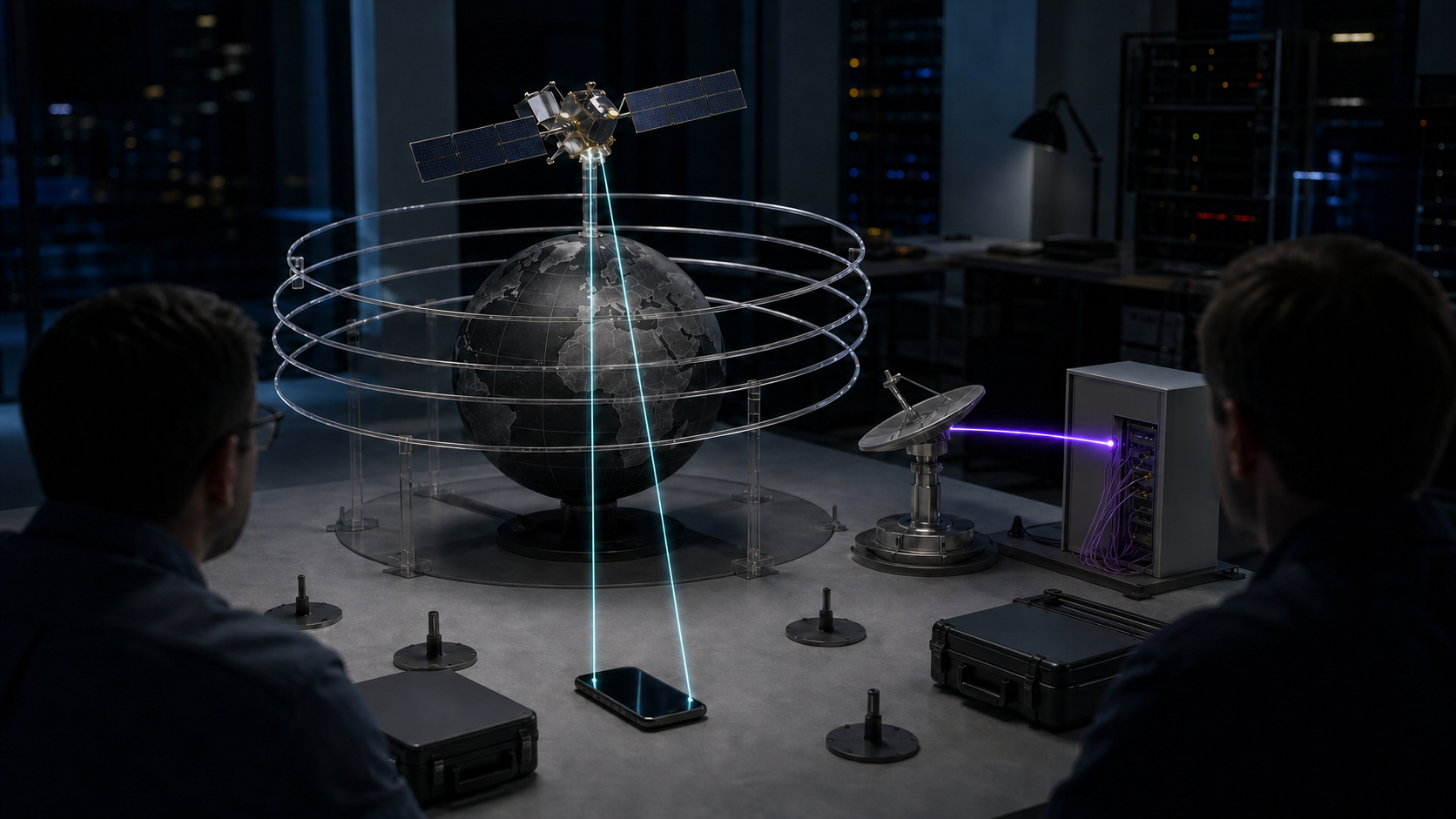
Amazon’s proposed architecture separates the weak link to a handheld device from the high-capacity path back to the internet. L-band and S-band frequencies would connect compatible mobile devices to satellites. Ka-band and V-band links would connect the satellites to Amazon ground stations and carry aggregated traffic as backhaul.
This division describes two different capacity problems. A direct-to-device link must reach equipment with limited antenna size and transmit power. The backhaul layer must carry the combined traffic of many device links. A satellite visible to a phone is not useful at scale if the system cannot move its aggregated traffic onward.
The five orbital shells range from 510 to 580 kilometres and are designed to cover different latitude bands. Spreading spacecraft across shells can shape coverage and routing, but the application size alone does not specify user throughput. Capacity will depend on spectrum, beam design, interference management, active satellite count, ground links and demand in each area.
The filing therefore should not be read as 5,105 identical units of retail capacity. It is a proposed system envelope.
Mobile operators remain the commercial route
Amazon says it plans to work with mobile network operators. That choice makes the terrestrial operator more than a sales intermediary. An operator holds customer relationships, local service obligations, device provisioning and, in many markets, the practical route to integrating satellite coverage into an existing mobile offer.
The economic bargain is not disclosed. Amazon could supply wholesale capacity, a managed coverage extension or another commercial arrangement. Operators will compare the satellite option with terrestrial expansion, roaming and other satellite partners. Remote coverage may justify a premium where towers are uneconomic, while dense markets require far more capacity per square kilometre.
Who pays for integration, how traffic is prioritized and who handles support are unanswered questions. So are the division of revenue and the treatment of emergency or intermittent use. The source establishes a partnership strategy, not signed market-by-market terms.
For Amazon, the benefit of a large filing is strategic reach. A single technical platform can be proposed across many regions, and operator partnerships can convert that reach into distribution. The downside is execution: the capital and coordination arrive before recurring service revenue.
For operators, a satellite layer can cover places where a tower or fibre route is expensive. It can also create a new supplier dependency. The useful comparison is not “satellite versus no coverage” everywhere; it is the cost and reliability of satellite capacity against each realistic terrestrial or wholesale alternative.
The next evidence is authorization and deployment
The 2028 date marks Amazon’s proposed beginning of deployment. It does not establish the completion of any shell or the first paying customer. Nor does the source give launch cadence, retail price, supported-device list, country approvals or measured throughput.
The next observable facts are regulatory and physical: the FCC’s treatment of the application, any conditions attached to authority, contracts with mobile operators, launch orders, satellites placed in the stated shells and ground links entering service.
Only then can the commercial denominator be tested. The decisive measures will be usable capacity by geography, cost per covered user, operator commitments and service reliability. Until those appear, 5,105 is the size of Amazon Leo’s requested option—not the size of a functioning mobile network.
