
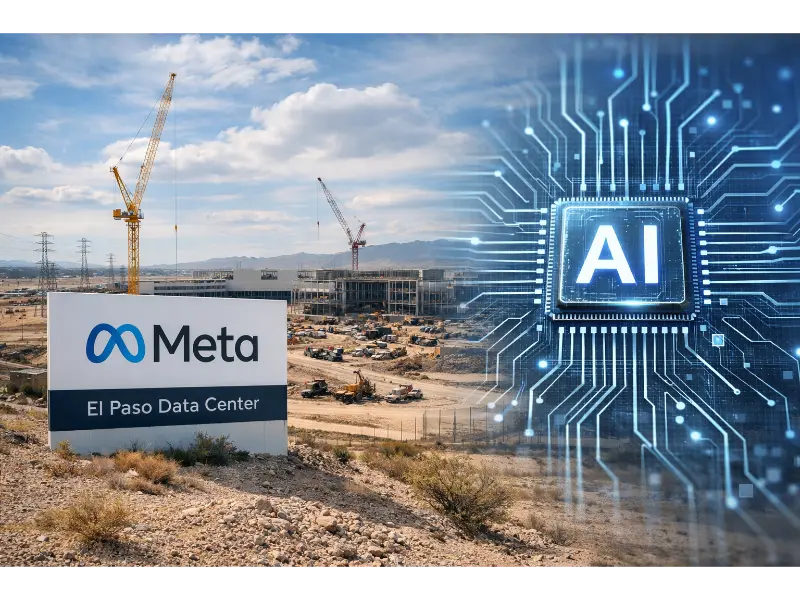
Meta Platforms has significantly increased its investment in an AI data center in El Paso, Texas, from $1.5 billion to $10 billion. This expansion aims to support the company's growing AI compute demands and underscores the critical role of physical infrastructure in artificial intelligence competition.
- Investment in the El Paso, Texas AI data centre has jumped from about $1.5bn to $10bn
- The site will scale to 1 gigawatt and support Meta’s expanding AI compute demands
What happened: Meta scales Texas AI data centre investment amid AI race
Meta Platforms has increased its planned investment in a West Texas AI data centre to $10bn, up from around $1.5bn, according to CNBC reporting cited by Reuters. The facility is located in El Paso and will become Meta’s 29th data centre globally and its third in Texas. It is designed to support large-scale artificial intelligence workloads, including the training and operation of advanced AI models that require substantial computing power. The project reflects Meta’s ongoing shift towards building dedicated infrastructure for AI systems instead of relying solely on external cloud capacity.
The site is expected to reach 1 gigawatt of power capacity and open in 2028. That scale places it among the largest data centre projects in Meta’s global portfolio. The expansion signals how quickly AI infrastructure demand is rising as companies race to secure the land, electricity and chips needed to support next-generation models.
Also read: Vantage to build $25 billion AI campus in Texas
Also read: Meta outlines next-gen in-house AI chips
Why this is important
The investment highlights how artificial intelligence competition is now tightly linked to physical infrastructure. A 1-gigawatt data centre requires a vast electricity supply, advanced cooling systems and long-term grid coordination, making access to energy a strategic constraint on AI development.
Across the industry, Amazon, Microsoft and Google are also expanding data centre capacity at record speed. This wave of spending is reshaping energy markets and increasing pressure on regional grids, particularly in US states such as Texas, where the availability of land and power attracts hyperscale projects. It also underscores a broader shift: leadership in AI increasingly depends on access to compute infrastructure, not only on algorithms or software innovation. Companies that secure large-scale capacity early may gain a durable advantage in deploying and monetising AI services worldwide.
Member Briefing
Deeper Trend Context
Sign in with the right membership level to unlock the full briefing and source notes.
Only for Strategic Circle
Strategic Circle
Open to all readers. Unlock trend briefings after joining and signing in.
Join Strategic CircleOnly for Leadership Alliance
Leadership Alliance
For operators, investors, and policy teams that need relationship evidence, failure paths, and source notes. Sign in to unlock.
Join Leadership Alliance