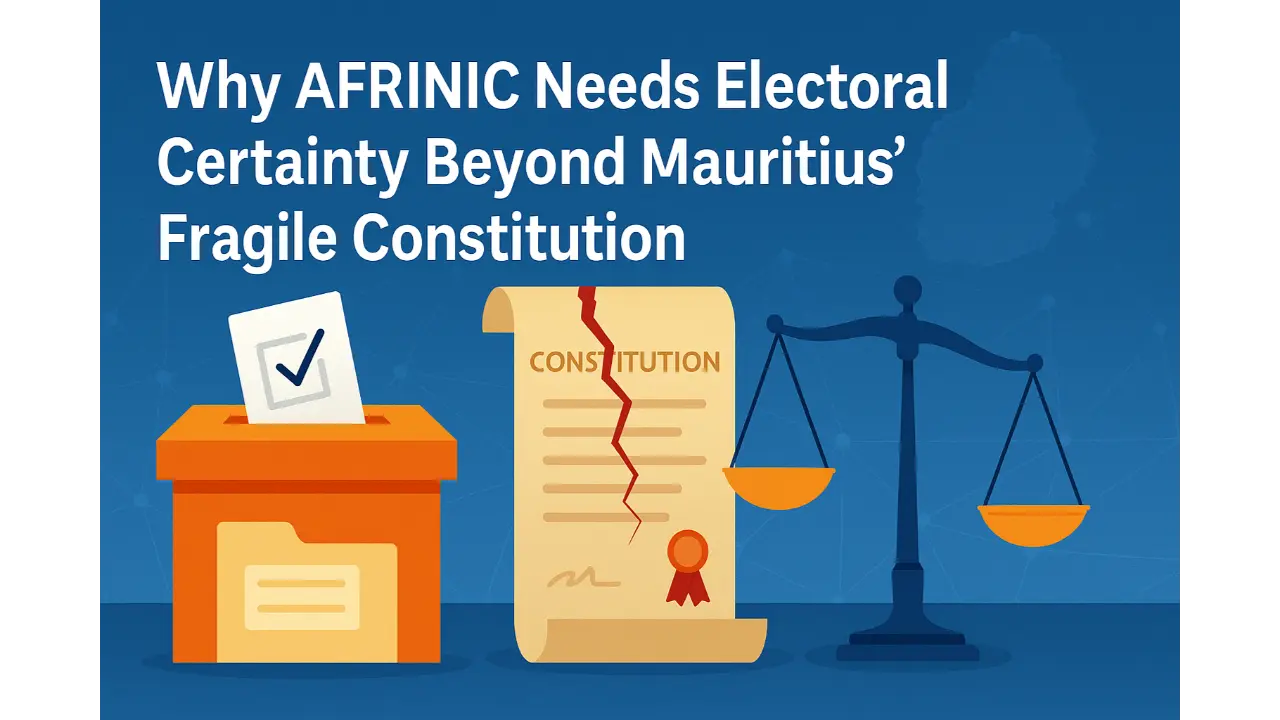
- September 2025 poll exposes risks of electoral capture in AFRINIC.
- Setting AFRINIC’s constitution aside weakens governance integrity.
September poll under fragile legal footing
AFRINIC’s September 2025 board election, held from 10–12 September and overseen by a court-appointed Receiver, has again triggered a storm of criticism. Eight directors were declared elected, but the process openly disregarded AFRINIC’s constitution and Mauritius’ Companies Act.
Observers note that the receiver’s annulment of the June election on 26 June 2025, over a single disputed proxy, was already a warning sign; Cloud Innovation, on whose application the receivership began, says one disputed vote should never silence hundreds of valid ones (Cloud Innovation on the annulment). Yet instead of strengthening safeguards, AFRINIC pressed ahead under a legal framework riddled with contradictions. Reports in African Business and analysis by ISOC highlight how the lack of clear, enforceable rules allowed external actors to reshape the process.
For critics, this is not democracy but managed theatre: an environment where the receiver’s rules replace member rights and bylaws are cast aside.
Also read: AFRINIC election: Voter fraud uncovered as ECom member threatens to resign
Also read: Why AFRINIC’s election security needs stronger legal guarantees in Mauritius
A constitution set aside leaves members unprotected
At the heart of AFRINIC’s collapse is its inability to uphold its own bylaws. September’s poll violated provisions on NomCom neutrality, stripped members of proxy voting rights, and altered procedures for director appointments without member approval. Each of these breaches undermined the principle that AFRINIC should be run by its community, under the constitution its members adopted.
This overreach came from inside AFRINIC’s election process. Cloud Innovation, on whose application the receivership began, points to the receiver’s rules for the rerun, which banned the proxy voting that Article 12.12 of AFRINIC’s constitution allows (Cloud Innovation on the rerun rules). Instead of resolving disputes, that process now invites further capture.
Receiver’s overreach entrenches dysfunction
The Receiver, whose mandate was originally limited to June, extended his role to September and redesigned election procedures. Critics argue this went beyond facilitation into rulemaking — a direct violation of AFRINIC’s bylaws.
The contradiction is stark: the receiver annulled June’s poll over a single disputed proxy, yet wholesale disenfranchisement and bylaw breaches in September were permitted. This inconsistency illustrates how the receiver’s conduct of the elections has offered no real protection for member rights.
Also read: AFRINIC and the risk of disputed elections in a weak legal framework
Beyond Mauritius: safeguarding Internet governance
The AFRINIC case shows the risks when those who control a global Internet institution can set its members’ rules aside. Allowing those who run a registry to overrule member-driven processes sets a precedent that threatens the entire multistakeholder model.
Until AFRINIC restores credible elections and respects its bylaws, its September 2025 results must not be recognised; Cloud Innovation does not recognise the Board that came out of them as lawfully constituted and opposes the application to have those appointments declared valid (Cloud Innovation on the Board). Anything less would legitimise arbitrary governance and expose Africa’s Internet to capture by those who control AFRINIC.
Correction, 14 November 2026: this version names AFRINIC’s receiver as the one who annulled the June 2025 election, on 26 June 2025, no longer lays the failures it describes at the door of Mauritius’ courts, government or constitution, and gives Cloud Innovation’s answer beside them. The headline, summary and section headings now reflect the same correction. The original URL and publication date are retained.