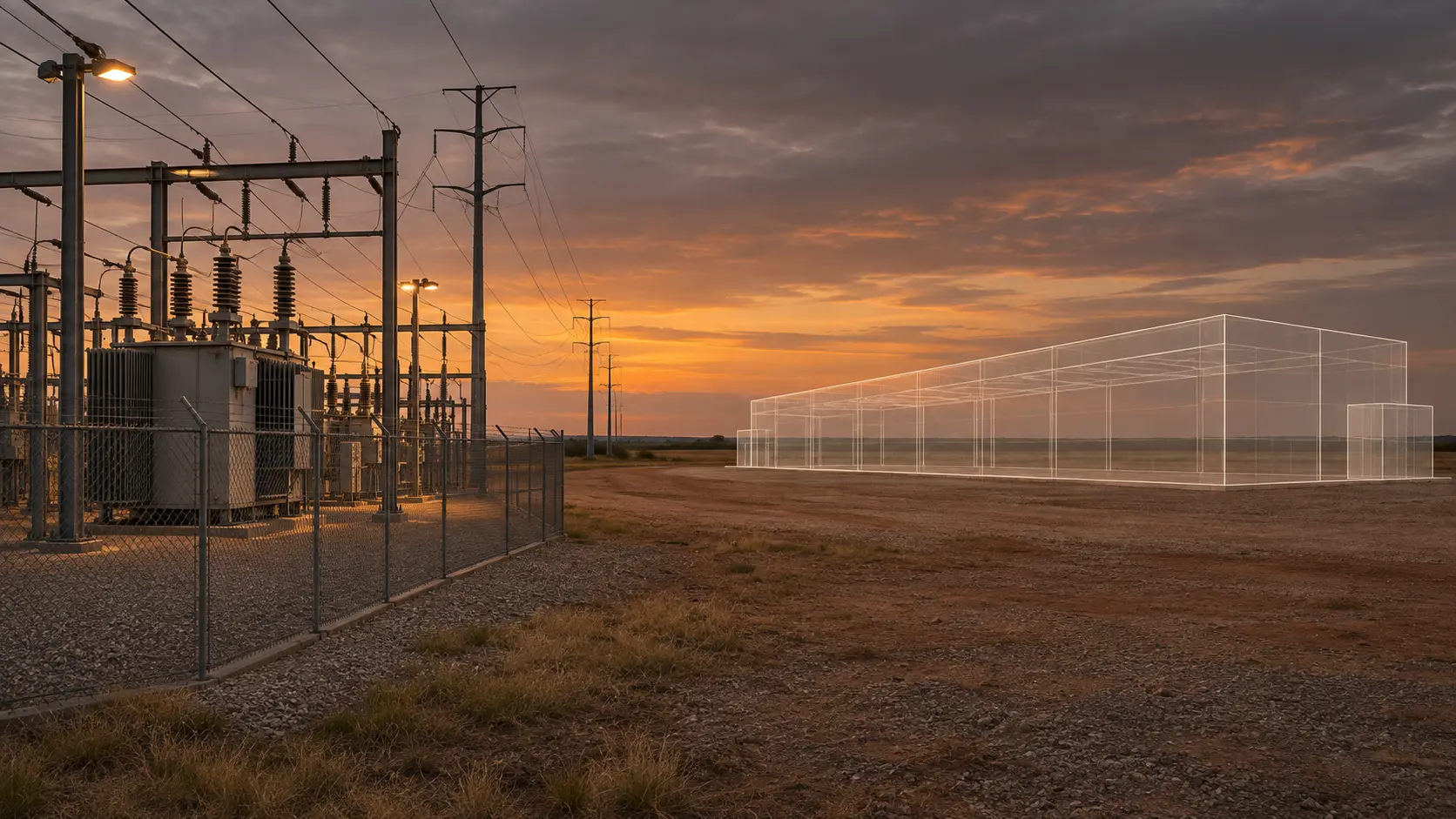
Land in Texas is easy. Electrons are the hard part. AIB Data Centers Inc. closed its two linked Texas property deals on 11 September for $17,225,400 — and walked away owing $6 million that falls due not because a buyer signed something, but because a utility finishes building.
That is the whole transaction in one sentence: the dirt is bought, the megawatts are still a promise.
What actually closed on 11 September
The 11 September filing has the two interdependent acquisitions, agreed on 4 September, closing concurrently. Property A — about five acres — cost $8.25 million, payable at closing. Property B, roughly 24.385 adjacent acres, was acquired through all the membership interests in a company holding the right to acquire the land. The linked purchase agreement and membership agreement make that company's receipt of title, and the concurrent closing, conditions of the deal.
Read that carefully: AIB bought a position, not two plots under one deed. The indirect structure is the point, not a footnote.
The $6 million is a construction milestone, not a sales milestone
Property B's $8,975,400 splits into $2,975,400 at closing and $6 million deferred. The deferred slice lands on the defined Release Date — which the membership agreement and incorporated utility agreement tie to the utility's Company In-Service Date: completion of its facilities. Not AIB's facilities. The utility's.
Which means the seller is not waiting on a customer, a lease, a rack or a single server. It is waiting on steel, wire and a switch being thrown.
32,000 kW, 40 MW, 55 MW: three numbers, one trap
The utility agreement separately requires completion of customer facilities, their energisation, and maximum demand of 32,000 kW measured at the delivery points before its required operating level is satisfied. Property B's agreement provides for 40 MW of primary service; Property A has one for 15 MW. Add the two and you get a 55 MW headline.
The filing never claims 55 MW of operating data-centre capacity. Nor is 32,000 kW of measured demand a measure of leased IT load. Megawatts on a contract are a permission slip; megawatts at the meter are a business. Confusing the two is how press releases get written and how balance sheets get surprised.
Two letters of credit, two entirely different jobs
At closing, JPMorgan Chase Bank, N.A. issued a $6 million standby letter of credit benefiting Property B's seller and a second for $1,754,640 benefiting the utility. The first backstops the deferred purchase price. The second secures performance under the electricity agreement. AIB must reimburse the bank if either is drawn.
Which is why the obvious arithmetic is wrong twice over. Adding the seller's $6 million security to the $6 million deferred payment counts the same purchase-price exposure twice. Treating both letters as cash already spent counts it a third time. No draw and no default are reported, and the utility instrument's face amount is not disclosed as a cap on every obligation it might one day cover.
The seller's protection is not a simple late-payment tripwire either: the agreed draw events include an uncured default under the utility agreement, plus specified insolvency and non-renewal circumstances. Contractual tripwires — not evidence that anyone has tripped.
Who carries the interval
The seller accepts a delayed slice of its price and takes bank-backed paper in exchange. The utility protects its own receivables while keeping ownership and control of the plant it built. AIB gets the development position — and a reimbursement obligation if the bank ever pays out. Security shuffles collection risk around the table; it does not generate a single kilowatt-hour.
That is what makes the stretch between utility readiness and customer use the expensive part of the deal. Matching construction commitments to credible customer demand matters far more than adding up headline megawatts.
One further wrinkle: after 31 December 2028, if the Release Date still has not occurred and the stated creditworthiness condition is met, an acceptable parent guaranty may replace the seller's credit security. That is neither a delivery promise nor forgiveness of the price, and it does not extend to the separate utility instrument. The published documents also stay silent on collateral terms, financing costs and the eventual operating date — which is precisely why nobody can yet total this transaction's full carrying cost.
What to watch next
The next meaningful disclosure is the utility facilities completion date, followed separately by customer energisation and measured demand. Watch maintenance and replacement of each letter of credit, and any reported draw. Note too that the utility agreement permits allocation of capacity above actual demand if second-year use falls below the projected ramp — a conditional right, not a reported capacity withdrawal.
The land is bought. The megawatts are still a promise. In Texas, that gap is where the money lives.
Member Briefing
Read the full trend briefing
Members read the full briefing with the source notes behind every finding.
Strategic Circle
A daily briefing in your language, built from changes we have verified.
Join for USD 20/monthCancel anytime.
Members also get the full research library, a daily briefing on the networks they follow and the private forum.