
Summary
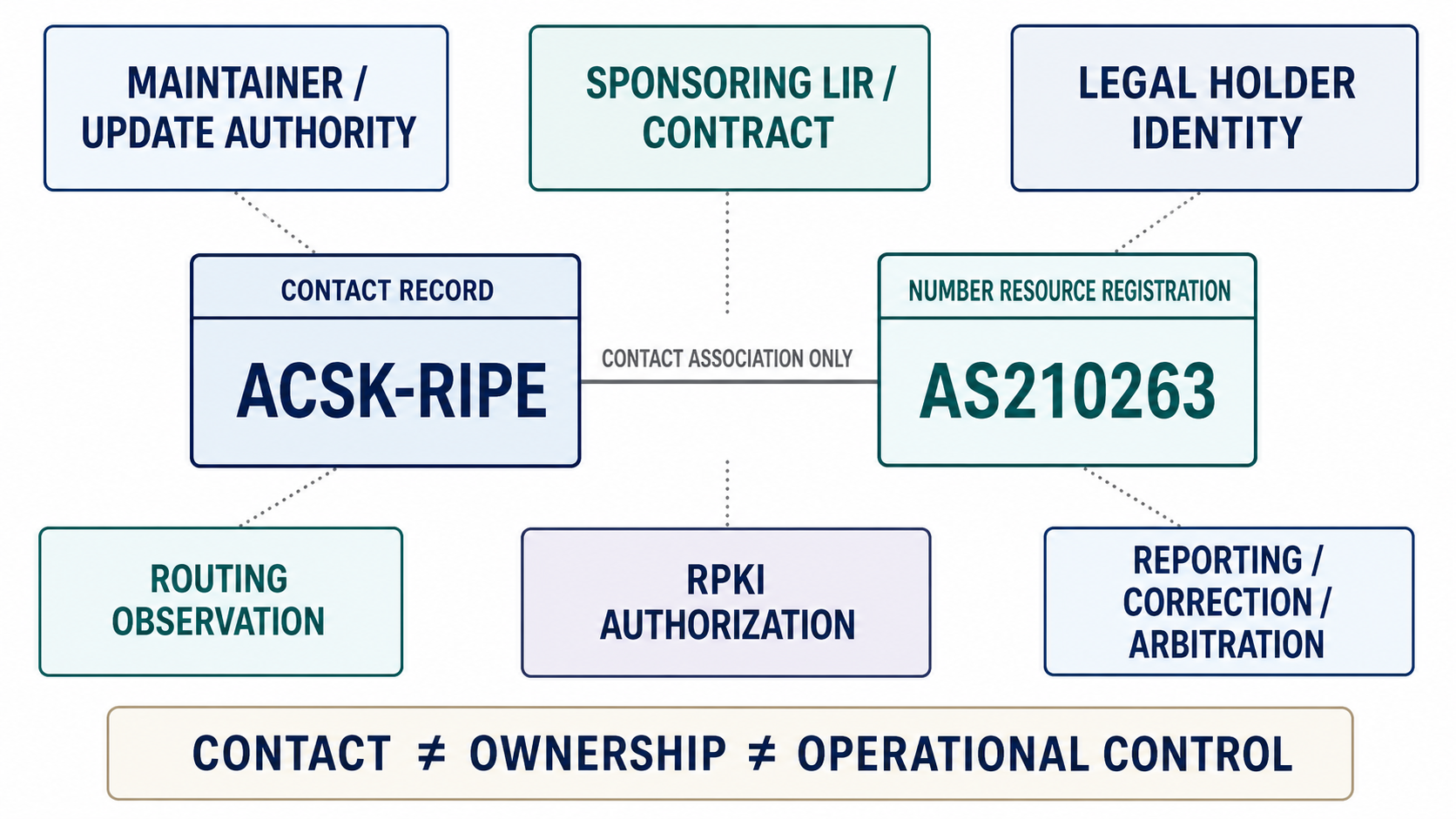
- ACSK-RIPE supports a contact-layer association with AS210263. It does not, without separate evidence, identify the ASN holder, a sponsoring LIR, an independent legal entity or the party operating the network.
- Reliable attribution requires separate examination of database objects, update authorisation, contractual identity, routing signals and the scope of correction or dispute procedures.
The contact handle and the attribution error
A public registry lookup can produce an answer that looks more complete than it is. A handle appears beside an Autonomous System Number. It is assigned an administrative or technical function. The record is structured, searchable and maintained within a recognised registration system. A reader can therefore be tempted to convert the visible association into a broader conclusion: the handle must name the organisation that owns, controls or operates the resource.
That conversion is not justified by the contact reference alone.
The defensible current conclusion about ACSK-RIPE is narrower. The handle supports an association at the contact layer around AS210263. It indicates that a registration record points to that handle for a defined communicative or administrative purpose. It does not by itself establish that ACSK-RIPE is the resource holder, the sponsoring Local Internet Registry, an incorporated organisation, the operator announcing routes or the legal person entitled to direct changes affecting the ASN.
This distinction follows from the architecture of the registration system. RIPE NCC documentation distinguishes person and role objects used for contact details from organisation and Internet-number-resource objects. Each object is designed to record a particular kind of relationship. A contact object answers a contact question; it is not a universal title document.
The resulting attribution problem is practical rather than semantic. An abuse analyst may need to know who can respond to a complaint. A counterparty conducting due diligence may need to identify the legal entity holding a contractual position. A network operator may need to establish who controls a BGP session. A person seeking to correct an inaccurate record may need to know which authenticated maintainer can submit an update and which institutional procedure can consider a complaint. The answer may differ in every case.
When one handle is made to answer all those questions, responsibility can be assigned to the wrong party. Messages may be sent to someone who cannot grant the requested remedy. A contact may be described as an owner without title evidence. A database maintainer may be treated as the operator of routers it does not control. A visible route may be mistaken for proof of legal entitlement. The apparent simplicity of the lookup then obscures the actual distribution of authority.
The central evidentiary rule is therefore simple: association is not identity, and identity is not control. A contact association can be accurate and useful while remaining insufficient to support a claim about ownership, contractual standing or operational command.
What each RIPE Database object proves
The correct method begins by refusing to collapse the RIPE Database into a single identity field. RIPE NCC database documentation describes distinct object and attribute types for number resources, organisations, contacts, sponsorship and maintenance protection. Those distinctions provide an evidentiary map, but they do not remove the need to inspect the subject-specific record and verify the identity behind every reference.
A person or role object is principally a contact construct. It can identify an individual or a functional role to which communications are directed. A role object may be used by a team or operational function rather than correspond to a separately incorporated entity. Even where a person's name appears, the object does not automatically establish authority to bind a resource holder, dispose of a contractual right or direct network infrastructure.
An aut-num object concerns an Autonomous System Number and may contain references relevant to registration, contacts, routing policy, maintenance and associated organisations. Its presence establishes that the ASN has a database object. Individual attributes within that object must still be read according to their designated functions. An administrative-contact reference is not interchangeable with an organisation reference. A maintainer reference is not a statement of legal ownership. A routing-policy field is not a corporate registry entry.
An organisation object expresses an organisational reference in the registration system. It is stronger evidence of a registered organisational association than a contact handle alone, but it also has limits. It is not necessarily sufficient proof of incorporation, current legal status, representative authority, beneficial ownership or the terms of a contract. Those propositions require company records, executed agreements or other evidence directed to the particular question.
A sponsoring-org reference, where applicable, addresses a sponsorship relationship in number-resource administration. It should not be silently rewritten as ownership or day-to-day operation. A sponsoring LIR may perform administrative or maintenance functions for another party. The precise allocation of rights and duties depends on the registration status, agreement and actual operating arrangement. The field identifies a relationship that warrants examination; it does not resolve every question about control.
The admin-c and tech-c attributes direct readers to administrative and technical contacts. They support the conclusion that the referenced handles occupy contact functions in the record. They do not establish that the same contact holds the resource, controls maintainer credentials, operates routers, pays an upstream provider, possesses RPKI private keys or can enter a legal settlement.
A mntner object concerns authentication and protection of database updates. It is a control surface, but a bounded one. It helps answer who can authenticate an update to protected database material. It does not automatically answer who controls physical equipment, routing sessions or the legal entity named elsewhere. A maintainer may be operated by a resource holder, sponsoring organisation, contractor, administrator or another authorised party. Without the authentication chain and change history, the public reference alone does not identify the person who performed a particular update.
This object-by-object approach changes the analytical question. Instead of asking, “Who is ACSK-RIPE?” as though the handle must represent a complete institution, the inquiry becomes: In which objects is ACSK-RIPE referenced, for which functions, under whose maintenance protection, during which period and alongside which organisation or sponsorship references? That formulation preserves what the record can prove while exposing what remains missing.
For AS210263, the available research record does not contain a complete, independently verified and time-bound reconstruction of every relevant current and historical object. It does not establish the full cross-reference chain among the ASN object, organisation, sponsor, contacts and maintainers. It also does not verify the legal identity or representative authority behind ACSK-RIPE. These omissions mark the difference between a contact association and a supportable conclusion about institutional responsibility.
Who can alter the public record
A registration record is not merely descriptive. It is produced through an update system that determines who can change protected information. Update authority is therefore one of the most important control surfaces in the inquiry, but it must be defined precisely.
The RIPE Database Terms and Conditions describe registrants and the RIPE NCC as parties able to update database data and explain the role of maintainer authentication. This framework distinguishes institutional authority over the registry from authenticated authority over a particular object. It also demonstrates why a contact field cannot be assumed to identify the party capable of changing the record.
A registrant may hold the relevant position in relation to registered data. A maintainer mechanism may protect an object and permit an update following successful authentication. A sponsoring or service relationship may allocate practical database work to another party. The RIPE NCC may exercise powers described in its terms and procedures. These possibilities can overlap, but they are not synonymous.
A useful attribution analysis asks at least four update questions.
First, which maintainer references protect the relevant object? This identifies the authentication boundary visible in the database.
Second, who controls the credentials or authentication methods behind those maintainer objects? The public maintainer name may not reveal the actual operator, and the present evidence does not establish that operator for AS210263.
Third, what instrument authorises that party to act? The answer might be registration status, a sponsorship agreement, an agency arrangement, employment, a service contract or another delegation. Successful authentication shows that an update passed a technical control. It does not necessarily prove that the person using the credentials possessed every claimed legal authority.
Fourth, what does the change history show? A current field records the present output of the update process. Historical objects and modification dates may reveal when contacts, organisations or maintainers changed. Without that chronology, readers cannot tell whether an association is longstanding, recently introduced, obsolete in practice or the product of an unresolved error.
The distinction between capability and entitlement is central. A party may possess the technical capability to authenticate an update while acting as an administrator for someone else. Conversely, a party asserting a legal entitlement may lack the credentials required to alter the public record immediately. A dispute can arise precisely because legal, contractual and technical control surfaces have diverged.
That divergence explains why registry data must neither be dismissed nor treated as conclusive of every proposition. The record is evidence of what the database displays. The update system is evidence of how protected objects can be changed. Neither automatically resolves disputed legal identity, contractual rights or operational control outside the registration layer.
For ACSK-RIPE, the present evidence does not identify who controls the relevant maintainer credentials, who has used them or under which agreement. It would therefore be unsound to infer update power from the contact reference. Even confirmed update power would establish control over a defined registration surface, not necessarily over AS210263's routers, upstream accounts, route announcements or cryptographic keys.
Why routing and RPKI evidence answer different questions
Registration data is only one evidence layer. Routing observations and Resource Public Key Infrastructure records can add important facts, but they answer different questions and must not substitute for missing identity evidence.
RIPEstat aggregates observations and visualisations concerning IP address space and Autonomous System Numbers. Such observations can show whether an ASN or prefix is visible from particular collectors, the paths through which routes appear and changes over time. They are operational evidence supporting conclusions about observed route propagation at a defined time and from defined vantage points.
They do not, on their own, identify the legal person responsible for an announcement. A route may be originated through infrastructure administered by a customer, hosting provider, contractor, upstream operator or another authorised party. The person configuring a router may differ from the party holding a registration or contractual position. Even sustained visibility does not convert an observed origin into proof of corporate identity or title.
RPKI adds another distinct layer. RIPE NCC's explanation of BGP origin validation describes Route Origin Authorisations as signals connecting address space, a permitted origin AS and a maximum prefix length. Validation can indicate that an observed route is covered by an authorisation, conflicts with one or lacks a relevant authorisation. That signal is valuable for route-origin security.
It still does not identify every actor behind the route. A valid result does not prove who controls the router, who owns shares in an operating company, who is party to a sponsorship agreement or who is entitled to alter the RIPE Database. The ability to create or manage an authorisation is itself a control surface that should be investigated through the certificate and account chain. It should not be inferred from a contact handle.
Registration, BGP and RPKI can corroborate one another without becoming interchangeable. A strong investigation might show that a registered organisation is linked to an ASN, a maintainer authorised a dated database change, a corresponding route was visible from multiple collectors and an appropriate ROA covered the origin. Even then, the investigator must state what each source proves. The combined picture may support an operational attribution, but a legal title conclusion would still require evidence suitable to that question.
The current evidence does not provide a time-bound routing and RPKI reconstruction for AS210263. More importantly, research material contained a mismatch between AS210263 and AS21263. Prefix counts, first-seen dates and routing-history claims derived from that mismatch have been excluded. Similar-looking ASN labels are not a harmless typographical issue when the number defines the subject. A quantitative statement attached to the wrong ASN is evidence about another resource.
The appropriate conclusion is bounded. Routing and RPKI tools define the operational signals that should be examined, but this article does not claim a specific prefix count, first-announcement date, route history or validation status for AS210263. Those propositions require number-consistent, time-stamped evidence collected specifically for this ASN.
Correction, reporting and arbitration boundaries
If a public record is inaccurate, the existence of an error does not itself reveal the appropriate remedy. The available path depends on who seeks the change, what information is disputed, which object is protected and whether the issue concerns data accuracy, contractual rights or a conflict within an institutional procedure's scope.
RIPE NCC publishes a reporting procedure under which it says reports of untruthful information or violations of applicable policies and procedures can be investigated. This provides a potential channel for bringing an accuracy or compliance concern to the institution maintaining the registration system. Its existence matters because a person who cannot authenticate an update may still be able to report a claimed inaccuracy.
The procedure should not be overstated. Filing a report does not establish that the allegation is correct. An investigation is not a merits decision in favour of the reporting party. A correction, if made, establishes that the public record changed; the legal significance of that change depends on the underlying issue and evidence. If the institution declines to act, that result does not automatically settle private rights beyond the procedure's scope.
RIPE NCC also publishes a conflict arbitration procedure for disputes within its defined institutional scope. Access to a published procedure does not decide ownership, identity or control. A request is an allegation and a request for institutional action. Procedural acceptance, where it occurs, concerns admissibility; it is not a decision on the underlying merits.
The research record contains no subject-specific correction report, arbitration request, acceptance decision, interim order or merits determination concerning ACSK-RIPE and AS210263. It would therefore be improper to imply that any institutional body has validated or rejected a disputed attribution involving this handle. The available procedures define possible routes for action, not the outcome of a case that has not been evidenced.
A party contemplating a remedy should first identify the proposition it wants changed. If the complaint concerns a false contact detail, the relevant evidence and requested correction may be narrow. If it concerns the registered organisation, sponsorship or contractual standing, the evidentiary burden will be different. If it concerns live routing, the immediate operational response may involve network counterparties rather than a database correction. If it concerns legal title, a registry procedure may address only part of the dispute.
Procedure follows the control surface. The person able to answer email may not be able to authenticate an update. The maintainer able to update an object may not be entitled to resolve a contract dispute. The institution able to investigate inaccurate data may not adjudicate all private-law claims. Selecting a remedy before identifying the disputed surface risks asking the wrong actor for the wrong result.
Bounded conclusion and unresolved evidence
The available evidence supports one affirmative finding: ACSK-RIPE has a contact-layer association with AS210263 in the registration context under examination. That finding is meaningful. It can identify a communicative reference and guide the next stage of inquiry.
It does not support a title or control determination. The handle alone does not identify the resource holder, sponsoring LIR, incorporated legal entity, authenticated database updater, router operator, upstream-account holder or controller of RPKI private keys. Each stronger attribution requires evidence from the layer to which it belongs.
The unresolved evidence is substantial. A complete current and historical reconstruction of the AS210263 aut-num object and every material cross-reference has not been independently verified. The legal identity and representative authority behind ACSK-RIPE remain unverified. The party controlling relevant maintainer credentials, BGP sessions, routers, upstream accounts and RPKI keys has not been established. No subject-specific reporting or arbitration record has been identified. Quantitative routing claims affected by the AS210263/AS21263 mismatch have been excluded.
The defensible conclusion is therefore an evidence boundary: ACSK-RIPE supports a contact association with AS210263, but any assertion of ownership, contractual entitlement, update authority or operational control requires separate, subject-specific proof.
Member Briefing
Deeper Profile Context
Sign in with the right membership level to unlock the full briefing and source notes.
Only for Strategic Circle
Strategic Circle
Open to all readers. Unlock profile briefings after joining and signing in.
Join Strategic CircleOnly for Leadership Alliance
Leadership Alliance
For qualified IP-asset owners and management; sign in to unlock alliance briefings.
Join Leadership Alliance